Your First Online Race: A Step-by-Step Guide

A Guide to Racing online with Gran Turismo 7
Going online to multiplayer in Gran Turismo 7 is one of the biggest attractions in the game. In single-player mode, the opponents are predictable. You can practice a track for hours, perfect your lines, and gradually build your pace. But the moment you enter an online race, everything changes. You’re now sharing the track with 15 other real human drivers who race like real people. They brake late, defend aggressively, make mistakes under pressure, and seize every opportunity to increase their position. The intensity, the unpredictability, and the satisfaction of a clean overtake or a hard-fought podium are simply impossible to replicate against the computer.
Two Things You Need Before Online Mode
Before you race online in Gran Turismo 7, you will need at least an active PlayStation Plus Essential subscription to access Sport Mode and Daily Races.
- Go to the PlayStation Store and the basic Essential subscription.
- Complete the Requirements by finishing Menu Book No. 9 in the GT Café (this unlocks Sport Mode). It’s quick and teaches you the basics.
Going Online
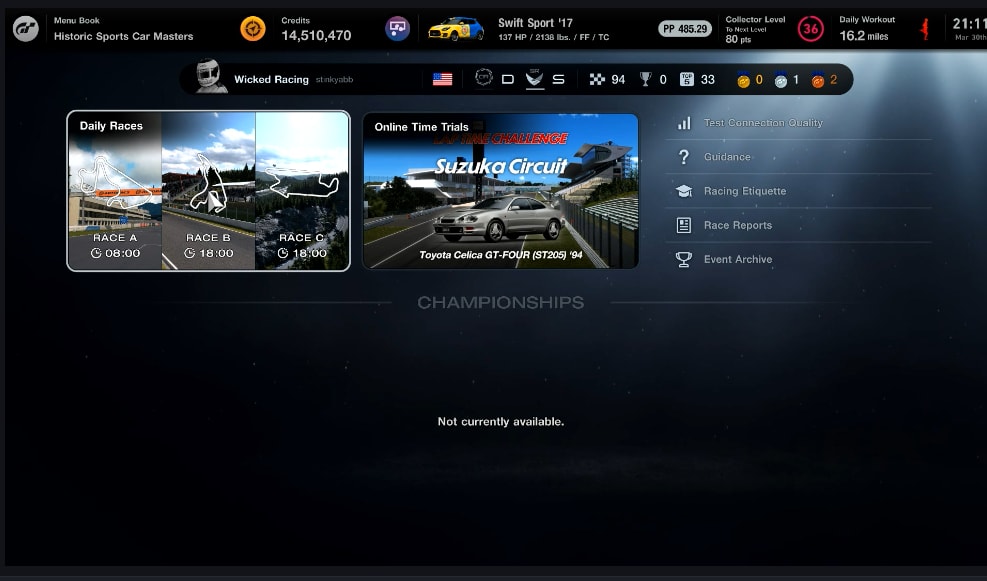
Now that you have an active subscription and unlocked Menu Book No. 9, head over to the GT7 main World Map, and navigate to Sport > Daily Races.
Step 1: Check This Week’s Race A Combination
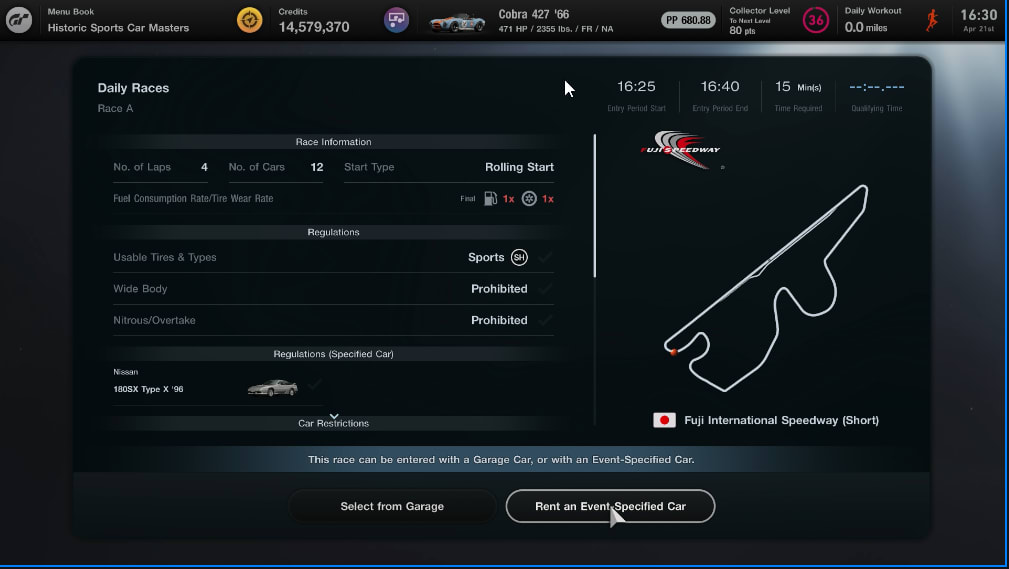
Read the Race A entry requirements: note the car class, the circuit, the number of laps, and the tire compound.
If you do not own the vehicle, a courtesy car is provided with the Rent an Event-Specified Car option.
Step 2: Complete Qualifying
Before entering any Daily Race, it’s recommended that you complete at least three qualifying laps on the race circuit. Your fastest clean lap sets your grid position. A higher grid position is always worth an extra ten minutes of qualifying work. Qualifying is optional, but if you don’t qualify, you will be placed at the rear of the grid.
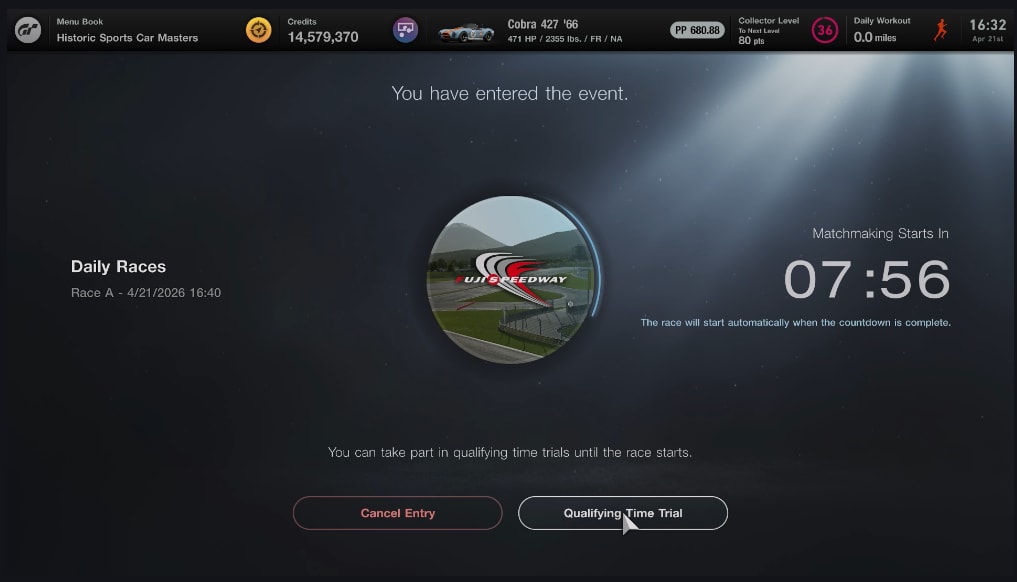
That being said, I do not qualify for my Daily races. I prefer to start at the rear of the grid and pace myself and move up through the field if it allows. I find that most problems in Daily Race A happen in the first couple of corners, and then the race sorts itself out.
Step 3: Wait for the Race to Begin. Races start at set times (usually every 20 minutes for Race A). The game will show a countdown. You’ll enter a lobby with up to 16 real players.
The opening corner of a Daily Race is the most dangerous moment in GT7 online, and where the majority of incidents happen. Drivers carry different levels of confidence, different braking points, and sometimes different intentions into Turn 1. Cold tires, cold brakes, and an overwhelming sense of confidence often sort out the field in the first corner.
The community’s unanimous advice: brake slightly earlier than your qualifying lap, leave more space than feels natural on the inside, and prioritise track position on exit over optimum line through the corner. A clean exit from Turn 1 in a reasonable position is a significantly better outcome than a damaged car or an SR penalty from a first-corner collision while fighting for one place.
Step 4: Review the Replay
Regardless of the results, when the race is over, take time to view the replay. GT7’s post-race replay is one of the most valuable learning tools in the game. Watch it from the outside (not the cockpit camera) for all incidents during the race. Understanding what the other driver was doing, what line they were on, and what you could have done differently builds the situational awareness that separates drivers who avoid incidents from those who repeatedly find themselves in them.
For all incidents, I assume that I am at fault and look for areas I can concentrate on to avoid contact in the future.
Tips for Beginners
Treat your first few Daily Race A sessions as learning time. Don’t worry about finishing last, the goal is to finish races cleanly and get comfortable with online racing.
- Start clean — Focus on getting through the first lap without incidents. The opening corners can be chaotic.
- Drive defensively at first. Learn the other drivers’ lines and braking points.
- Prioritize Sportsmanship Rating (SR) over position. Clean racing (no avoidable contact) is more important than winning when you’re new.
- Daily Race A often does not affect your Driver Rating (DR), so it’s a low-pressure way to gain experience.
- Use the in-race map and mirrors to stay aware of cars around you.
- Act like you own the car and are responsible for any repairs needed. When I started to drive like I owned the car, my online racing experience improved, and I started to have a lot more fun.
Understanding Driver Rating and Sportsmanship Rating
Gran Turismo 7’s Sport Mode operates around two parallel rating systems that work together to determine who you race against and what kind of racing you experience. Understanding what these ratings mean is the difference between a system that seems fair and one that feels inexplicable. These are your DR and SR rankings.
Driver Rating (DR)
Driver Rating measures your racing performance and determines the speed level of the drivers you are matched with. It runs from E at the bottom through D, C, B, A, and A+, with an invitation-only S class reserved for the very best players in the world (those competing at or near GT World Series level). All new players begin at DR E for a five-race probationary period before the full rating system activates. n n n n DR operates on a points exchange system: you gain points from every driver you finish ahead of in a race and lose points to every driver who finishes ahead of you. The amount gained or lost depends on the relative DR scores involved. For example, finishing ahead of a higher-rated driver earns more points than finishing ahead of a lower-rated one. The practical implication is straightforward: consistently finish in the top half of the field and your DR rises. Consistently finish in the bottom half and it falls. The system rewards racing skill directly, without shortcuts.
Sportsmanship Rating (SR)
Sportsmanship Rating is the more immediately impactful of the two ratings for a new online player, because it acts as a hard ceiling on your DR. Your DR rank can never exceed your SR rank. A DR B driver whose SR falls to C will find their DR progress blocked until SR recovers. A driver whose SR falls two full levels below their DR will have their DR reset automatically to match. In practice, this means that protecting your SR is the priority of every online session. Not winning, and not pace. n n The actions that cost SR are consistent and well-documented across the GT7 sim racing community and are as follows:
- Contact with other cars – This is the most significant SR cost, regardless of fault. The penalty system does not distinguish between the driver who caused the contact and the driver who received it; both can lose SR. This is the most frustrating aspect of the system for new players, and the community’s response is simple: give more space than you think you need, brake earlier than you think necessary in the opening laps, and treat avoiding contact as a higher priority than maintaining position. You can almost always have done something different to avoid contact.
- Going off-track – Leaving the track surface or exceeding track limits means all four wheels are beyond the white line. This will cause a loss of SR, even if no other driver is involved and no advantage is gained.
- Corner cutting – Cutting a corner and gaining an advantage by going inside the track limits is both a time penalty and an SR cost. GT7’s corner-cutting detection is automatic. The community consensus is that even if another driver pushes you off track, the correct response is to give the position back rather than cut back onto the circuit with the advantage retained.
- DNF (Did Not Finish) – Leaving a race before its conclusion is one of the steepest SR penalties in the game. If a race goes wrong early or if you are involved in a first-corner incident that leaves you at the back, the community’s strong advice is to complete the race regardless of position. Finishing last cleanly costs less SR than quitting.
GT7 awards a Clean Race Bonus for completing a race without penalties or contact. The bonus scales with race length and field size. Beyond the credits, a clean race with green SR sectors throughout provides the fastest SR gain available. A week of clean races will take a new player from SR B (the starting SR) to SR S more reliably than any other approach.
The Unofficial Rules of Online Racing
Gran Turismo 7’s penalty system handles most driving incidents automatically. But a large category of conduct falls outside what an algorithm can detect, the marginal moves, the defensive lines taken slightly too aggressively, the corner entry that was technically clean but forced a competitor wide. These are the situations where motorsport etiquette applies and where the sim racing community has developed consistent expectations over years of competitive play.
These rules apply to all sim racing games and real-life motorsports, too.
-
Leave a car’s width at all times – When racing side by side through a corner, leave at least one car’s width of space on the outside. Running a competitor off the track, even without contact, is considered unsporting behavior and will be noted in league race stewarding reviews. Real motorsport sanctions this behavior consistently. GT7’s online community expects the same.
-
The overtaking driver carries responsibility – If you attempt an overtake and make contact, the responsibility is yours, regardless of the other driver’s line. A clean overtake requires arriving at the corner with enough of your car alongside your competitor’s to have a legitimate claim to the apex. A lunge from half a car’s length with no commitment on the brakes is not a legitimate overtake; it is a collision waiting to happen.
-
Do not defend multiple times – In real motorsport, moving once to defend your line is legal. Moving twice, once to block, then returning to the racing line, is prohibited. GT7’s penalty system does not always detect this, but the community does. Repeated blocking moves are one of the fastest ways to develop a bad reputation.
-
Respect blue flags in split-class racing – If you are the backmarker, hold your line predictably and let the faster car find its own way past. Do not move to block, not intentionally, and not by making sudden line changes. The responsibility for a safe pass lies with the overtaking car; your responsibility is predictability.
-
Hold Your Brakes – When you are in an accident, spin, or have an off-track incident, hold your brakes. Make yourself predictable. If you are in the racing line, drive out of the area to assess damage when traffic has passed.
See You on the Grid
Learn these rules in Daily Race A, and they will help you in your sim racing journey. Violate them, and the collective online stewarding community will offer quick judgment to point out your mistakes.
