
My GPU Was Starving: How I Broke the I/O Wall for 3.7x Faster Training

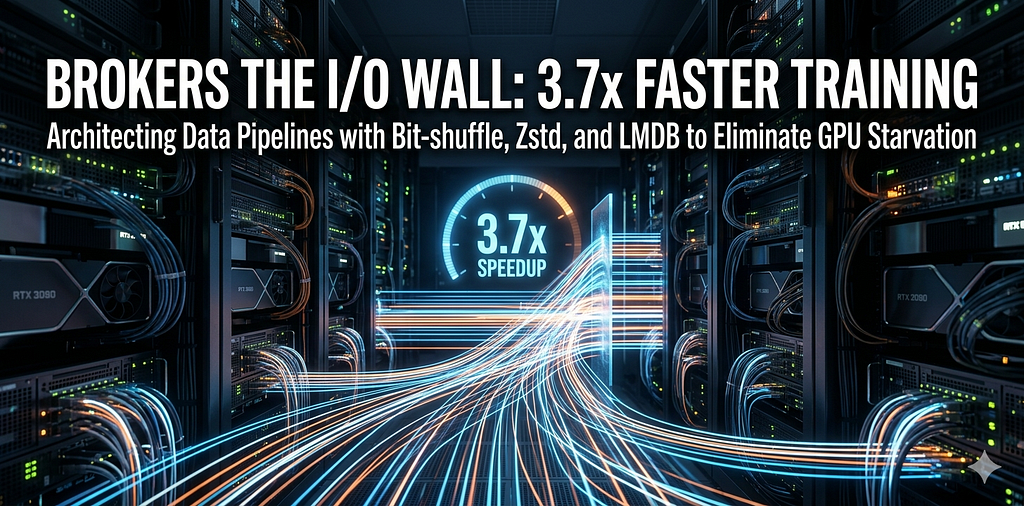
Re-architecting data pipelines with Bit-shuffle, Zstd, and LMDB to eliminate SSD bottlenecks in million-scale AI projects.
The Silent Killer of GPU Performance
In the pursuit of faster model convergence, we often obsess over TFLOPS and learning rates. However, during a recent million-scale training project, I encountered a bottleneck that no amount of model tuning could fix: The I/O Wall.
My diagnostic probes — custom-built to monitor the real-time bandwidth across the GPU, PCIe, DDR, and storage — revealed a sobering reality. While my RTX 3090 was capable of immense throughput, it was “starving.” The core issue wasn’t the raw sequential bandwidth, but the random read performance of the SSD. The default torch.save (Pickle-based) de-serialization of millions of small files was crushing the disk’s IOPS, causing GPU utilization to fluctuate wildly between 0% and 99%.
With no budget for hardware upgrades this year (goodbye, RTX 5090 and PCIe 5.0 SSDs), I had to pivot. If I couldn’t get a “bigger pipe” with higher IOPS, I had to make the data flow smarter.
The Strategy: Trading CPU Cycles for Virtual Bandwidth
My workstation’s Intel i9–14900KF features 24 cores that previously sat idle, paralyzed by I/O wait-states. The re-architecture philosophy centers on a strategic resource trade-off: leveraging surplus CPU cycles and intelligent indexing to bypass physical SSD throughput limitations. By shifting the bottleneck from hardware I/O to computational decompression, I effectively synthesized “Virtual Bandwidth” that exceeds the physical ceiling of the storage media [1].
1. Zero-Latency Metadata via LMDB
To bypass the overhead of querying millions of individual files, I utilized LMDB (Lightning Memory-Mapped Database). By leveraging mmap, LMDB maps its B+ Tree index directly into the virtual memory space [2]. This allows the kernel to resolve metadata queries within the Page Cache, eliminating the costly per-sample syscalls (inode resolution and directory traversal) that paralyze naive multi-file pipelines at scale.
2. The “Naked Bytes” Protocol (BF16)
I stripped the “Pickle Tax.” Instead of saving heavy Python objects, I converted tensors to Bfloat16 and stored them as raw bytes. By removing headers and metadata, I minimized the payload before it even hit the compression engine [3].
3. Bit-Shuffle + Zstandard: The Tensor Optimizer
Standard compression algorithms struggle with the high entropy of numerical data. To solve this, I integrated Blosc’s Bit-shuffle with Zstd.
- Bit-shuffle rearranges the bits of the tensors to group similar exponents together.
- Zstd then compresses this rearranged stream with surgical efficiency.
Here is the core implementation of the transparent compression layer:
import blosc
import torch
import numpy as np

def compress_tensor(tensor):
    """Cast to BF16 and apply Bit-Shuffle + Zstd"""
    raw_bytes = tensor.to(torch.bfloat16).view(torch.int16).numpy().copy().tobytes()
    return blosc.compress(raw_bytes, typesize=2, clevel=9,
                          shuffle=blosc.BITSHUFFLE, cname='zstd')

def decompress_tensor(compressed_data, target_shape):
    """High-speed reconstruction directly into Torch"""
    decompressed = blosc.decompress(compressed_data)
    restored_np = np.frombuffer(decompressed, dtype=np.int16).copy()
    return torch.from_numpy(restored_np).view(torch.bfloat16).reshape(target_shape)
The “Aha!” Moment: Benchmarking Results
By shifting the workload from “Disk Read” to “CPU Decompression,” I effectively increased the virtual bandwidth of my existing hardware. The training pipeline finally broke through the I/O wall.
1.Data Compression & Efficiency Metrics
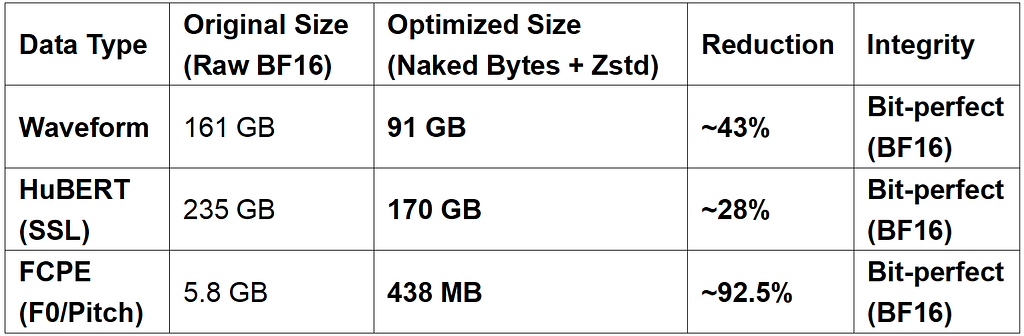
The 92.5% reduction in FCPE features was the turning point. Because pitch data is highly sequential and redundant, Bit-shuffle allowed Zstd to compress nearly 6GB of data into less than 450MB, effectively granting the SSD a 10x speed boost for these specific features.
2. Training Efficiency: Before vs. After
To validate the architecture, I focused on the FCPE-based Pitch Estimator distillation (3.5M+ samples, 1s each, at 24kHz). The transformation in training stability and speed was immediate:
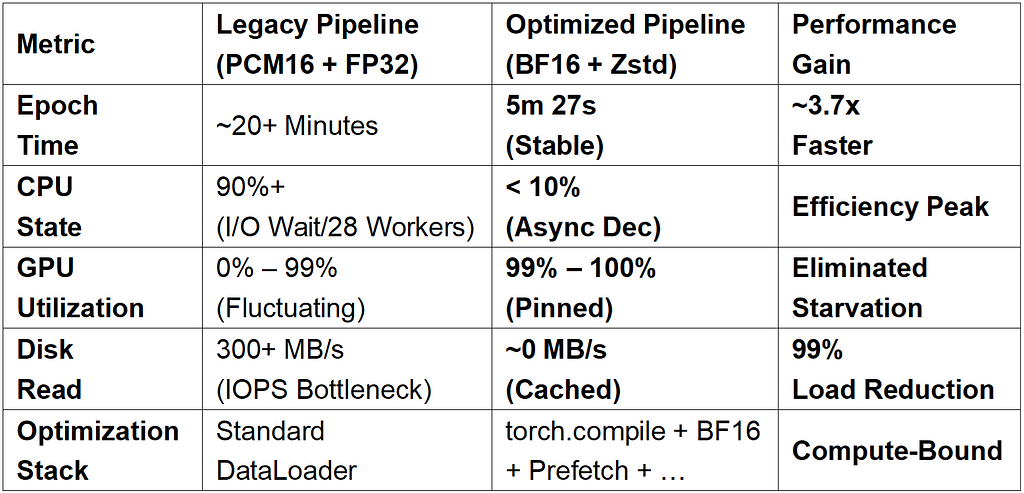
This 3.7x speedup isn’t just a byproduct of compression — it’s a systemic elimination of systemic friction.
· Breaking the Metadata Bottleneck: The legacy pipeline performed a glob scan and opened multiple files per sample, generating massive filesystem overhead. Even with high worker counts, the CPU was paralyzed by context switching and I/O wait.
· The Page Cache Illusion: For users of DRAM-less SSDs, the lack of physical cache leads to severe performance degradation during concurrent access. My monitoring revealed a critical behavior: while the first epoch incurred a physical I/O penalty — peaked at ~200+ MB/s due to cold cache — physical disk reads dropped to near zero from the second epoch onward. By shrinking the dataset footprint, the 128GB of RAM effortlessly absorbed the entire compressed payload into the Linux Page Cache. I effectively turned a budget SSD into a virtual RAM-disk natively.
· Kernel-Level Efficiency: I eliminated Python-level orchestration overhead by integrating torch.compile(mode=”reduce-overhead”). By streamlining the DataLoader (8 workers, prefetch_factor=2) and utilizing Pinned Memory with non-blocking transfers, the architecture achieved a near-perfect overlap between H2D (Host-to-Device) data movement and GPU kernel execution.
The CPU now focuses its power on Bit-shuffle decompression rather than fighting I/O queues. This ensures the RTX 3090 is pinned at a constant 347W power draw — maximum compute utilization has finally been achieved.
Conclusion: Architecture Over Brute Force
This journey proved that raw hardware isn’t always the answer. By re-architecting the pipeline — pinning metadata for zero-latency indexing, utilizing BF16 for precision-aware storage, and integrating Bit-shuffle + Zstd — I eliminated the bottlenecks that were crippling my workstation.
The result is a 3.7x training speedup, with GPU utilization pinned at a constant 99% even as the storage footprint shrank by 140GB. When the budget says “no,” let your architecture say “yes.”
References
· [1] F. Alted: “Why Modern CPUs Are Starving and What We Can Do About It,” Computing in Science & Engineering, 2010. (Blosc: https://blosc.org)
· [2] Symas Corp: “LMDB: Lightning Memory-Mapped Database.” [https://www.symas.com/lmdb]
· [3] K. Wang et al.: “BFloat16: The Secret to High Performance on Cloud TPUs,” Google AI Blog, 2019. [https://cloud.google.com/blog/products/ai-machine-learning/bfloat16-the-secret-to-high-performance-on-cloud-tpus]
Code & Data Attribution
· Code Baseline: Modified from the open-source implementation of train_pe.py in the FasterSVC repository.
· Datasets: VCTK Corpus (Edinburgh), AISHELL-3 (OpenSLR), and community-aggregated Game Voice Corpora via ModelScope. Disclaimer: Used strictly for non-commercial algorithmic research. Readers should independently verify compliance with relevant Terms of Service.
· FCPE Model: Pitch supervision during the distillation phase was provided by the FCPE (Fast Context-aware Pitch Estimator), accessed via the torchf @ cpe package.
My GPU Was Starving: How I Broke the I/O Wall for 3.7x Faster Training was originally published in Towards AI on Medium, where people are continuing the conversation by highlighting and responding to this story.
