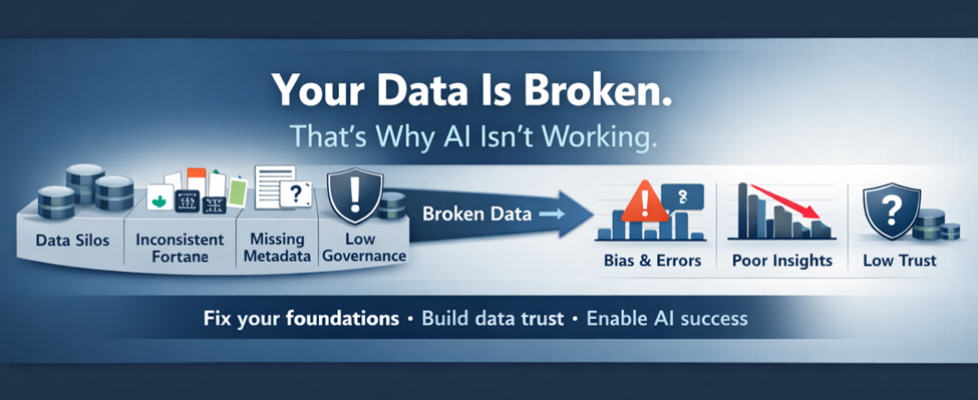
Your Data Is Broken. That’s Why AI Isn’t Working

How data silos, legacy monoliths, and technical debt quietly kill every AI initiative — and the architectural approach to fix it
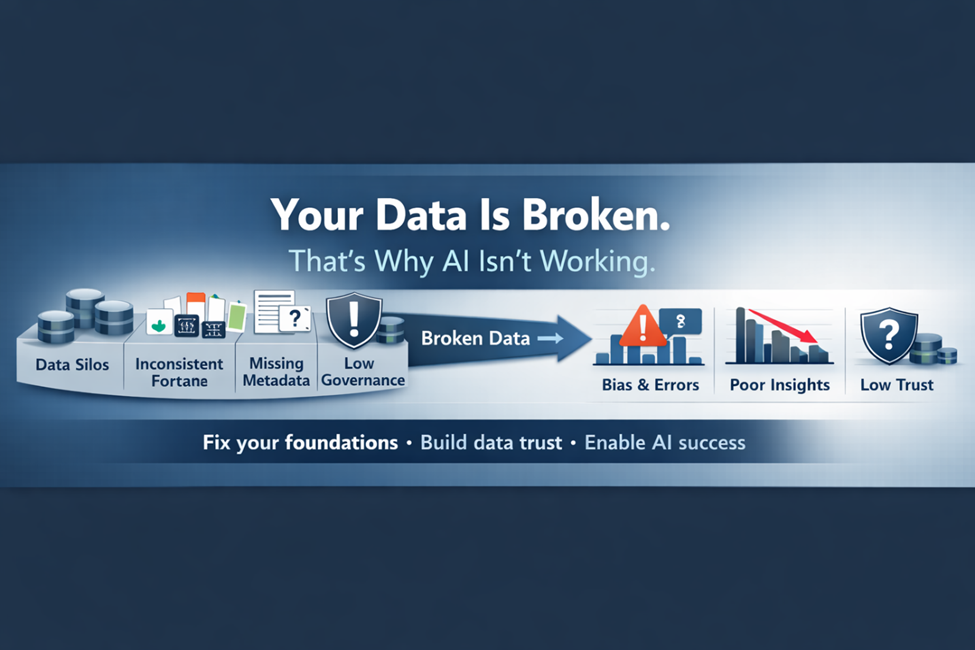
Every organisation wants to build AI. Most of them hit the same wall six weeks in — not because the technology does not work, but because the data underneath it is a mess.
Three systems. Three different definitions of a “customer.” Five years of transactional data locked inside an application nobody dares to touch. A data warehouse built for last year’s reporting, not tomorrow’s AI.
This is the problem nobody puts on the project plan. And it is the reason most AI projects stall.
From Silos to Systems: Fixing Data Foundations for AI Success
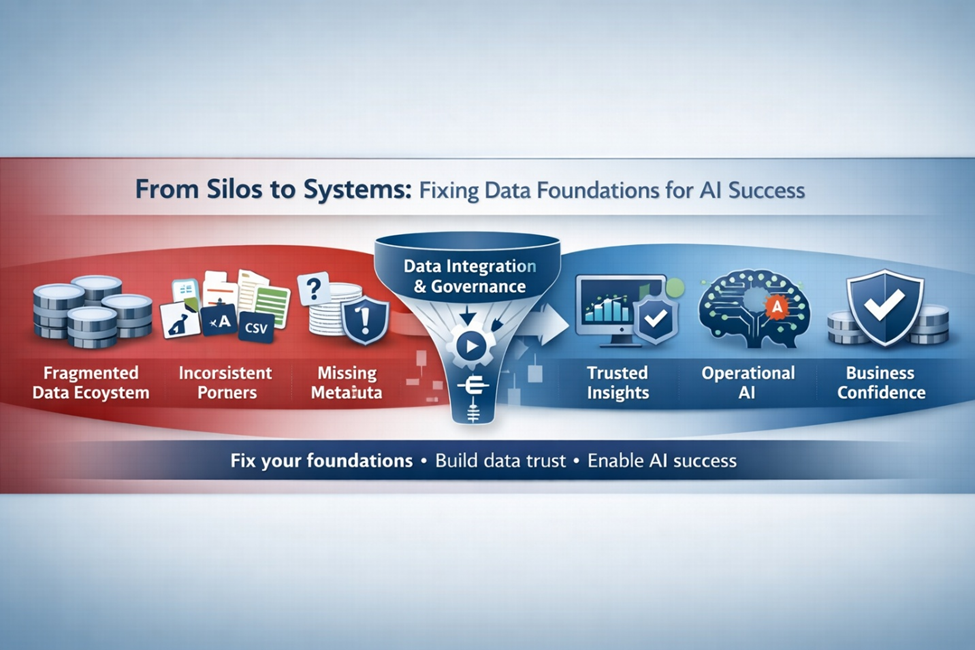
Artificial intelligence isn’t failing because the algorithms are weak — it’s failing because the data feeding those algorithms is broken, inconsistent, and untrustworthy. Every time an AI project stalls, it’s not the model that’s broken; it’s the foundation beneath it.
Enterprises are discovering the hard truth: AI acts as a stress test for your data strategy. It magnifies silos, exposes missing metadata, and amplifies governance gaps. What looks like “AI failure” is really a mirror reflecting the cracks already present in your data ecosystem.
Those cracks can be repaired. Moving from silos to systems — by unifying data flows, enforcing governance, and embedding trust — is the difference between AI that frustrates and AI that transforms.
The Problem — Why AI Isn’t Working: The Data Integrity Gap
The Hidden Foundation — Data Silos and Fragmentation
Data silos are what happen when every department builds its own system and nobody talks to anybody else. Your CRM knows the customer’s name. Your billing system knows what they bought. Your risk system knows their credit history. But none of these systems can see what the others know. Your AI needs all three to make a good decision — and it cannot access any of them in the same breath.
When AI tries to reason across these silos, it encounters contradictions, missing links, and duplicated truths. The result? Models that can’t see the full picture.
A retail AI predicting demand might rely on sales data but miss supply chain delays logged in another system. The model looks “smart” but acts blind.
Legacy monoliths
Legacy monoliths are large, old applications that do everything — billing, customer management, reporting, order processing — inside one giant codebase. They work. That is the problem. They work well enough that nobody wants to touch them, but they are too tightly coupled to extend or integrate with modern AI tools. Changing one thing breaks three others.
Missing Metadata — The Context Collapse
Metadata is the oxygen of AI reasoning. It tells the model where data came from, how it was collected, and what it means. Without lineage or definitions, AI can’t distinguish between a “refund” and a “discount,” or between “active” and “inactive” customers.
Inconsistent Formats
AI thrives on structure, but enterprises feed it chaos: CSVs, PDFs, APIs, legacy databases, and spreadsheets with creative column names. Without harmonization, even simple joins become brittle. Schema mismatches lead to silent errors, and model training pipelines collapse under inconsistent data types.
A customer’s “ID” might be numeric in one system and alphanumeric in another. AI sees two different entities — and your personalization engine fails.
Low Governance — The Trust Deficit
Governance isn’t bureaucracy; it’s the backbone of trust. Without clear ownership, validation rules, and audit trails, data becomes a liability. AI built on ungoverned data inherits every flaw — bias, drift, and opacity. Stakeholders lose confidence, and adoption stalls.
A credit scoring model trained on outdated demographic data may unintentionally discriminate. The issue isn’t the algorithm — it’s the governance gap.
Technical debt
Technical debt is the accumulated cost of shortcuts taken years ago. A quick fix here, a hardcoded value there, a database schema that made sense in 2012 but nobody fully understands today. Every piece of technical debt is a wall between where you are and where AI can take you.
Together, these create a situation where AI integration feels impossible — not because the AI is hard, but because the foundation it needs to stand on does not exist yet.
Why This Kills AI Specifically
Traditional software can limp along with messy data. You query one system, return a result, show it on a screen. AI is fundamentally different.
An AI model making a credit decision needs clean, consistent, complete data from multiple sources — simultaneously. If your customer ID in the CRM does not match your customer ID in the billing system — a more common problem than most people admit — The model is already learning from broken data. Garbage in, garbage out. But now the garbage is making automated decisions at scale.
The second problem is speed. AI systems need data in near-real time. A fraud detection model that analyses transactions from yesterday is useless. But most legacy systems were built for batch processing — they export data once a day, overnight. That is fine for a monthly report. It is fatal for an AI system that needs to act on what just happened.
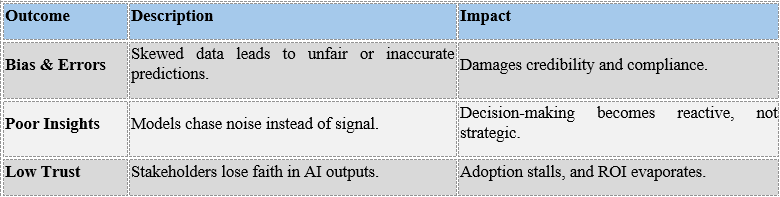
The Outcomes — Bias, Poor Insights, and Low Trust
The Approach That Works
There is no shortcut here. But there is a sequence that works — and it does not require to throw away everything we have built.
Step 1 — Build a Single Source of Truth
Before any AI, we need a data foundation. We call this a data lakehouse — a central platform (Microsoft Fabric or Azure Synapse) where data from all systems lands, gets cleaned, and becomes consistently available. Think of it as building a shared library that every system in the organisation can read from.
The CRM publishes its customer data here. Billing publishes transactions. Risk publishes scores. Suddenly, AI can see the complete picture — with one agreed definition of every field.
Step 2 — Break Silos With Events, Not Integrations
The traditional approach to connecting systems is direct integration: System A queries System B. This creates tight coupling — if System B changes, System A breaks.
The better approach is event streaming. When something happens in any system — a new customer is created, a payment is received, a credit score changes — that system publishes an event to a central stream (we use Azure Event Hub). Every system that cares about that event subscribes and reacts. The systems never talk directly to each other. Adding a new AI component means subscribing to the right events — no changes to existing systems.
Step 3 — Modernise the Monolith Without Replacing It
This is where most organisations get stuck. The monolith is working. A full rewrite would take three years and probably fail. The answer is the strangler fig pattern — named after the vine that grows around a tree and gradually replaces it.
You wrap the existing monolith behind an API gateway (Azure API Management). New features get built as independent services alongside it, not inside it. One module at a time, you extract functionality into modern services. The monolith shrinks. The new platform grows. Nobody notices a big-bang cutover because there is not one.
Step 4 — Build a Feature Store
This is the piece most organisations miss, and the one that makes AI actually work at scale.
A feature store is a centralised repository of pre-computed inputs for AI models — things like a customer’s average transaction value, their risk score, their days since last login. Without it, each data scientist builds their own version of these calculations. You end up with five different definitions of “income” across five models that produce contradictory decisions.
A feature store enforces one definition, computed once, available to every model. It is the difference between AI that scales and AI that creates new problems.
The Trade-offs — Being Honest
This approach works. It also takes time and costs money upfront — before you see any AI benefit. That is the honest trade-off, and any architect who tells you otherwise is selling you something.
Time: Building a data lakehouse takes 8–12 weeks of foundational work before AI can use it.
Effort: Event streaming requires existing teams to change how they think about system integration.
Discipline: The strangler fig is slower than a rewrite in the short term — but dramatically safer over 3 years.
Visibility: None of this makes a good demo for the board. All of it is the reason the AI actually works at launch.
The organisations that get AI right invest in the boring infrastructure first. The data lakehouse, the feature store, the event streams. The organisations that skip it ship a model that works in testing and fails in production — because the live data looks nothing like the training data.
Conclusion: The Real AI Bottleneck Is Data Discipline
AI doesn’t fail in isolation — it fails because the data beneath it is broken. Silos, inconsistent formats, missing metadata, and weak governance don’t just slow innovation; they quietly erode trust. Every model, dashboard, and prediction built on shaky data foundations inherits those flaws.
The organizations succeeding with AI aren’t those chasing the latest model architectures — they’re the ones investing in data integrity, interoperability, and governance. They treat data as infrastructure, not exhaust.
To make AI truly work, we must shift our focus from algorithms to ecosystems — from training models to training data.
Your Data Is Broken. That’s Why AI Isn’t Working was originally published in Towards AI on Medium, where people are continuing the conversation by highlighting and responding to this story.
