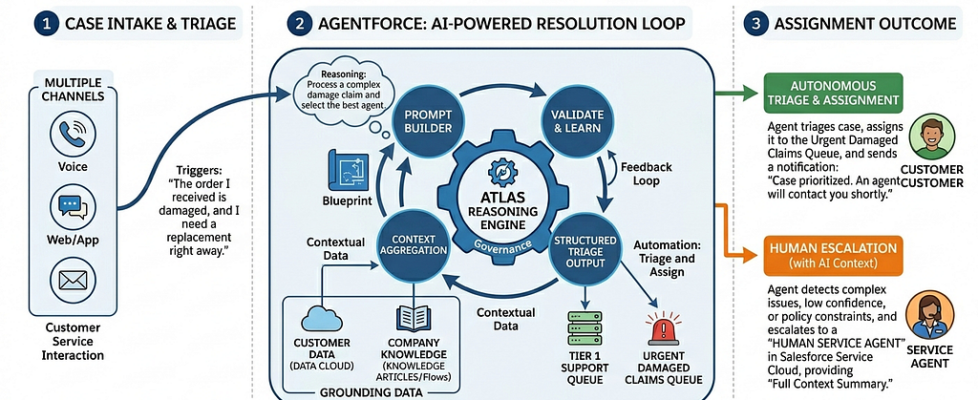
Using Salesforce Agentforce for Enterprise Solutioning, Case Intake, and Assignment

An enterprise architecture perspective on how service organizations can use Prompt Builder to transform unstructured requests into governed triage and routing decisions.
Most enterprise service organizations do not primarily suffer from a case volume problem. They suffer from a context and decision-quality problem.
Most organizations already have intake channels, queues, routing rules, knowledge articles, and escalation paths. What they often lack is a reliable way to convert messy, incomplete, multi-channel requests into structured work that can be triaged and assigned with speed, consistency, and sufficient auditability.
That gap is where Salesforce Agentforce becomes operationally relevant. In enterprise settings, the core question is rarely whether AI is available. The more consequential question is whether it can operate within production workflows, use approved business context, and generate outputs that are sufficiently stable to support downstream decisions. Agentforce is significant because it occupies the middle ground between unconstrained generative capability and governed enterprise execution.
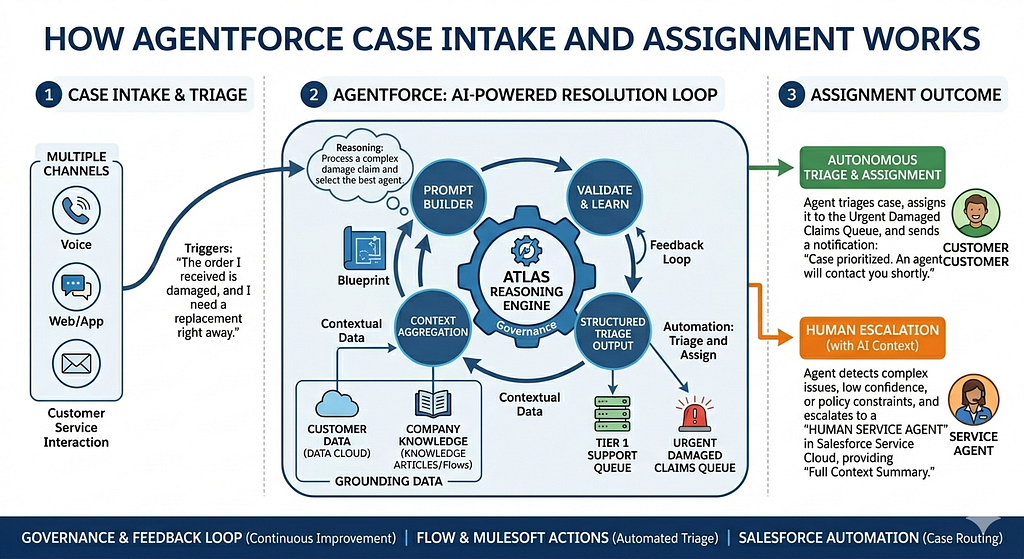
When implemented well, Prompt Builder helps organizations standardize case intake, improve triage quality, reduce manual reassignment, and make routing decisions more explainable. It does this by grounding generative AI in Salesforce data, instructions, and workflow context.
## Core Agentforce capabilities
Before discussing Prompt Builder specifically, it is useful to situate it within the broader Agentforce architecture. Agentforce is not merely a text-generation feature. It is Salesforce’s framework for building AI-assisted agents and guided experiences that reason over CRM context, follow explicit instructions, use approved enterprise data, and participate directly in platform workflows.
From an enterprise design perspective, Agentforce is useful for five reasons. It grounds responses in Salesforce records and knowledge, supports tasks such as summarization and classification, works with Flow and Apex rather than outside them, gives teams tighter control over prompts and outputs, and standardizes how incoming requests are interpreted across channels.
The operating benefits follow directly from that design: faster triage, less manual effort, more consistent decisions, better use of CRM context, stronger first-assignment accuracy, and clearer governance than teams usually get from standalone AI tools.
This is why Agentforce is well suited to enterprise solutioning. It combines AI assistance with process control, which is precisely what case intake and assignment workflows require.
## LLM access and model flexibility in Agentforce
One reason Agentforce is attractive to enterprise architects is that it is not simply an abstraction over a single large language model. Its value lies in the way Salesforce exposes model capability within a governed platform experience. Depending on product configuration, region, and current Salesforce support, organizations can use Agentforce through Salesforce-managed model access and supported provider options rather than coupling every workflow directly to a single external endpoint.
This gives organizations a platform-native way to use LLMs inside CRM workflows, more flexibility to balance model quality, cost, and governance, and a cleaner way to align model access with trust controls, grounded data, and workflow rules.
From a solutioning perspective, that flexibility is consequential. Different case operations may require different properties from the underlying model layer. One workflow may prioritize concise summarization. Another may require stronger classification consistency. A third may need lower latency for high-volume routing. Agentforce gives architects a more credible design surface for these trade-offs than a one-model-fits-all approach.
The practical implication is that enterprises are not simply procuring text generation. They are adopting a governed pathway for applying LLM capability within Salesforce service operations.
## Why Prompt Builder matters in enterprise solutioning
Enterprise solutioning is rarely just about answering a question. It usually involves understanding intent, identifying urgency, classifying the issue, gathering missing details, evaluating policy constraints, and determining ownership of the next action.
A customer email might say:
“We’ve had three failed invoice exports since yesterday and finance can’t close month-end. Please help.”
A human agent reads that and infers several things almost immediately: the issue likely affects production, it impacts finance operations, it may belong to billing or integration support, it is time-sensitive because month-end close is blocked, and it needs triage rather than a generic acknowledgment.
Prompt Builder allows that reasoning pattern to be encoded into a governed prompt experience. Instead of asking AI to “summarize the case,” teams can instruct it to classify issue type, infer business impact, identify missing intake fields, recommend assignment, and generate a structured triage payload for downstream automation.
That distinction separates AI used for content generation from AI used for enterprise solutioning.
## The role of Agentforce Prompt Builder
Salesforce Agentforce Prompt Builder gives teams a way to design prompts that are explicitly tied to business context. In practice, that means defining the AI role, the allowed inputs, the output structure, the instructions and constraints, and the next action in the process.
For case operations, this is valuable because support workflows are already information-dense. Cases carry account information, entitlement details, product context, SLA obligations, prior interactions, installed base information, and historical resolution patterns. Prompt Builder can use that context to improve triage quality before a case reaches a live representative.
From an operating model standpoint, this is important because it shifts effort away from repetitive interpretive work and toward exception handling, resolution, and escalation management. That is typically where enterprise service organizations want human expertise concentrated.
## A practical use case: case intake and assignment
Consider a large enterprise support organization receiving requests from email, portal forms, partner channels, and internal account teams. The intake problem is familiar: request detail is inconsistent, categories are wrong or missing, urgency is often misread, cases land in the wrong queue, and specialist teams spend time re-triaging instead of resolving.
Prompt Builder can introduce a structured intake layer over that variability.
A strong intake prompt should read the submitted issue, pull account and entitlement context, classify the request into standard issue domains, estimate impact and urgency, identify missing information, recommend the right queue, and draft a concise internal summary.
In this design, AI is not replacing routing rules. It is improving the quality of the signal available to them.
## Designing prompts for enterprise outcomes
The most common mistake in Prompt Builder is to write prompts that are overly generic. Enterprise prompts should be explicit, constrained, and operational.
Instead of this:
“Analyze this support case and suggest what to do.”
Use something closer to this approach:
“You are a service triage assistant for enterprise support operations. Review the case description, account context, entitlement details, installed products, and recent support history. Classify the issue into one of the approved support domains. Determine business impact using the company severity policy. Identify any missing information needed for diagnosis. Recommend the correct assignment queue and explain the routing rationale in one sentence. Return the result in a structured format suitable for case update automation.”
This prompt is stronger because it defines the AI role, the business context, the classification method, the decision logic, the output shape, and the downstream use.
In enterprise environments, prompt quality is largely a matter of reducing ambiguity, increasing behavioral consistency, and constraining failure modes.
## Example workflow for case intake
A practical case intake pattern in Salesforce typically looks like this:
1. A new case is created from email, form, or API.
2. Flow or Apex invokes a Prompt Builder experience.
3. The prompt evaluates the case text plus Salesforce context.
4. The output returns structured fields such as category, subcategory, severity recommendation, missing fields, and suggested queue.
5. Salesforce updates the case record.
6. Assignment rules, Flow, or Omni-Channel use those outputs to route work.
7. The assigned rep receives a clean internal summary instead of raw intake text.
This can produce measurable improvements in first-touch quality. It also reduces queue churn, which is costly for both customers and internal teams.
## Improving assignment accuracy
Assignment is where many service organizations lose time and operational efficiency. Traditional rules-based routing works well when inputs are clean and deterministic. It performs less well when the case narrative contains the real signal and the structured fields are incomplete.
Prompt Builder helps bridge that gap by extracting operationally relevant signal from the narrative itself.
In practice, assignment logic can evaluate product family, signals for integration or billing issues, customer segment, entitlement level, geographic or language needs, existing ownership patterns, open incident correlation, and regulatory sensitivity. On that basis, it may recommend Billing Operations, Tier 2 Technical Support, Integration Engineering, Customer Success Escalation, or a Security Response Team.
These recommendations should not be treated as autonomous decisions. They are better understood as decision-support signals that complement deterministic rules. In mature implementations, the stronger pattern is to keep policy and compliance logic deterministic, use Prompt Builder where the narrative contains the missing signal, and combine both in final routing.
That balance provides flexibility without sacrificing governance or operational accountability.
## Structured outputs matter more than eloquent outputs
In enterprise solutioning, a fluent paragraph is usually less useful than a reliable schema.
If the output will drive automation, the prompt should return a stable schema: primary and secondary issue type, severity recommendation, business impact summary, missing information, recommended queue, routing rationale, and suggested next action.
That matters because structured outputs are easier to validate, audit, store, report on, feed into Flows and assignment logic, and compare against human overrides.
The more operational the use case, the less value there is in unconstrained AI output.
## Governance and trust
Enterprise teams will not adopt AI-based intake at scale if they cannot explain how decisions are being made. Prompt Builder helps, but governance still has to be designed deliberately.
Key controls are straightforward: constrain prompts to approved classifications, ground them in trusted Salesforce data, log inputs and outputs where appropriate, separate recommendations from final actions in high-risk cases, require human review for legal or regulated workflows, and monitor override rates for drift and taxonomy issues.
A sound implementation does not aim for full autonomy on day one. It aims for useful, reviewable augmentation that can be improved over time.
For most organizations, the design objective should be controlled augmentation rather than immediate autonomy. That means defining where human approval is mandatory, where AI recommendations are advisory, and where low-risk actions can be automated with confidence.
## Where Prompt Builder delivers the most value
The strongest enterprise use cases usually share three characteristics: high volume, repetitive triage work, and important but pattern-based decisions.
That makes Prompt Builder a strong fit for service case intake, partner support classification, internal help desk routing, escalation summaries, renewal risk review preparation, complaint intake, and claims or exception pre-triage in industry workflows.
If teams are spending significant time reading unstructured submissions and rewriting them into CRM fields, there is a strong likelihood of a viable Prompt Builder use case.
## What success looks like
The value of Prompt Builder in case intake and assignment is not measured by whether the generated text sounds intelligent. It is measured by operational outcomes.
The metrics that matter are lower manual triage time, higher first-assignment accuracy, fewer reassignments, faster time to first meaningful action, better intake completeness, lower queue aging, and more consistent severity classification.
If those metrics improve, the prompt is contributing meaningful operational value.
## A simple implementation strategy
For organizations starting out, the most credible path is phased adoption.
Phase 1:
Use Prompt Builder to generate internal triage summaries and missing-information prompts for agents.
Phase 2:
Add classification recommendations for category, subcategory, and severity.
Phase 3:
Use AI outputs to inform assignment recommendations while keeping human approval or deterministic routing controls.
Phase 4:
Automate low-risk routing scenarios where prompt accuracy is consistently high.
This progression helps teams build trust, validate impact, and calibrate governance before expanding autonomy.
## Final thought
Salesforce Agentforce Prompt Builder is most valuable when it is treated as a business process instrument rather than merely an AI authoring feature.
For enterprise solutioning, the real opportunity is not to make support interactions sound smarter. It is to make intake cleaner, routing faster, and decisions more consistent. In case intake and assignment, Prompt Builder can become the layer that translates messy human requests into structured operational action.
That is also why Agentforce is more compelling in enterprise settings than generic AI tooling. It brings together prompt design, workflow orchestration, trusted business context, and access to LLM capability in a form that service organizations can operationalize with reasonable governance.
For architects and transformation leaders, the key point is straightforward: the value is not in the model alone. The value is in the system design around the model, including context selection, decision boundaries, workflow integration, and governance controls.
That is where generative AI starts to earn its place in the enterprise.
Using Salesforce Agentforce for Enterprise Solutioning, Case Intake, and Assignment was originally published in Towards AI on Medium, where people are continuing the conversation by highlighting and responding to this story.
