The Silicon Protocol: Why Your $200K Healthcare AI Actually Costs $2.3M in Production (2026)

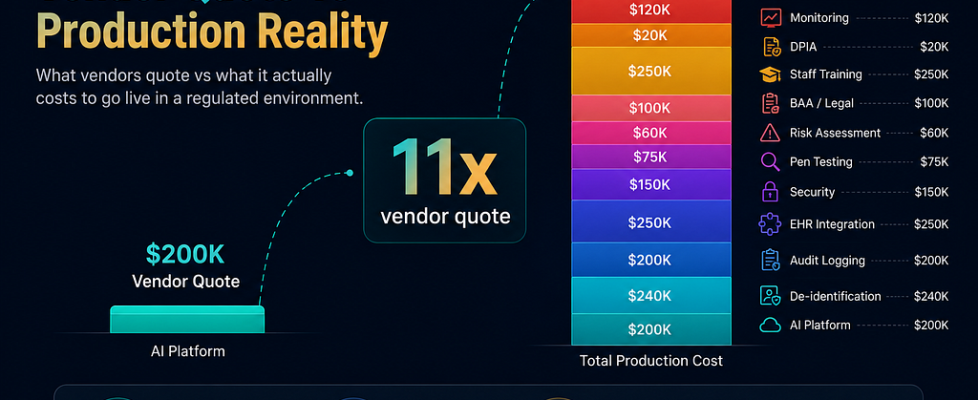
The CFO approved $200K for clinical AI. Twelve months later, the real invoice arrived: $2.3M. The vendor didn’t lie. They just quoted the AI. Nobody quoted the compliance.

Healthcare AI vendors quote $50K-$300K for clinical AI systems. The actual cost to deploy in production with HIPAA compliance, audit logging, de-identification, penetration testing, staff training, and ongoing monitoring runs $1.8M-$3.2M at enterprise scale. A 2025 Deloitte analysis found that hidden costs account for 25–40% of total healthcare AI investment, and the cost of retrofitting compliance into an already-built system runs 2–3x higher than building with compliance from day one. After deploying production AI at 6 healthcare organizations (3 hospitals, 2 health systems, 1 specialty practice), 3 financial services firms, and 2 government agencies over the past 18 months, I’ve tracked every dollar from vendor contract through production deployment, and the gap between quoted price and actual cost follows the same pattern every time: the AI is the cheapest line item on the invoice. The CFO called the weekly leadership meeting.
“I approved $200,000 for clinical AI in January. I’m looking at $2.3 million in total spend. Somebody explain what happened.”
Nobody in the room could. Because nobody had budgeted for the 11 line items that don’t appear in vendor demos.
The Vendor Demo vs. Production Reality
What the vendor quotes:
AI platform license or API access: $50,000-$300,000/year
This is real. This is accurate. This is what the demo shows.
What the vendor doesn’t quote (because it’s not their problem):
Everything required to make that AI system HIPAA-compliant, production-ready, and audit-survivable in a regulated environment.
Real cost breakdown from a 680-bed hospital deployment (2025–2026):

Source verification:
- De-identification: Episodes 3 and 13 of this series documented $180K-$300K for multi-stage pipelines with >99.5% accuracy
- EHR integration: Azilen (April 2026) reports $150K-$300K for HL7 FHIR integration with custom API development
- Staff training: Emorphis Health (April 2026) reports $300K-$600K for 500-bed hospital training and change management
- Regulatory compliance: Aalpha (2026) reports $100K-$500K for FDA/regulatory validation costs
- Hidden costs: Deloitte (2025) found hidden costs account for 25–40% of total healthcare AI TCO
- Retrofitting compliance: Azilen (April 2026) confirms retrofitting costs 2–3x higher than building compliant from day one
Where the Money Actually Goes
Line Item 1: De-identification Pipeline ($180K-$300K)
Why it exists:
HIPAA requires that PHI be stripped before sending to external LLM APIs. OpenAI, Anthropic, Google standard APIs explicitly prohibit PHI in terms of service. Even enterprise APIs with BAAs require de-identification best practices.
What it costs:
- Regex-based approach: $15K-$30K (60–70% accuracy, fails OCR audits)
- NER-based (Microsoft Presidio): $60K-$120K (85–95% accuracy, audit risk)
- Multi-stage with Expert Determination: $180K-$300K + $35K/year (>99.5% accuracy, passes OCR)
Episode 3 of this series documented why the cheap option fails: 60–70% accuracy means 30–40% of PHI elements leak through to external APIs. One leaked patient identifier = HIPAA breach = $1.5M+ settlement (Episode 13).
The math:
$180K de-identification pipeline vs $1.5M OCR settlement
ROI: Pays for itself in first avoided breach
Line Item 2: Audit Logging Infrastructure ($180K-$220K)
Why it exists:
HIPAA §164.312(b) requires audit controls for any system touching ePHI. Standard application logs (“API call at 14:23”) don’t satisfy OCR.
Episode 13 documented a $1.5M settlement because a hospital couldn’t prove which patients’ data their AI accessed. OpenAI retains abuse logs for 30 days. HIPAA requires 6-year retention.
What it costs:
- 13-field audit trail (user identity, patient ID, purpose, model version, etc.)
- Immutable storage with cryptographic hash chains
- 6+ year retention with AES-256 encryption
- Query interface for OCR response
Total: $180K-$220K implementation + $40K-$60K annual storage/maintenance
Line Item 3: EHR Integration ($150K-$300K)
Why it exists:
Clinical AI is useless if it can’t read from and write to the EHR. Epic, Cerner, Meditech all require custom integration.
What it costs:
- Custom API development for HL7 FHIR/SMART: $80K-$150K
- Compliance validation: $30K-$60K
- Data normalization across departments: $20K-$50K
- Workflow redesign for clinical adoption: $20K-$40K
Why vendors don’t quote it:
“We integrate with Epic” means “we have a FHIR connector.” It does not mean “your specific Epic configuration, custom fields, departmental workflows, and data formats are ready to go.” Every hospital’s EHR is configured differently. Integration is always custom work.
Line Item 4: Security Infrastructure ($120K-$200K)
Why it exists:
HIPAA Security Rule requires:
- Encryption at rest (AES-256) and in transit (TLS 1.3+)
- Access controls and authentication
- Network segmentation for PHI systems
- Hardware security modules for key management
What it costs:
- Network segmentation for AI infrastructure: $40K-$80K
- HSMs for encryption key management: $30K-$60K
- MFA and RBAC implementation: $20K-$30K
- Security monitoring and SIEM integration: $30K-$50K
Line Item 5: Staff Training ($100K-$300K)
Why it exists:
46% of US healthcare organizations are currently implementing generative AI. But technology adoption fails without people. Training clinical staff, administrative teams, and IT personnel to work with AI systems is consistently underestimated.
What it costs:
- Clinician training: $1,000-$5,000 per clinician (interpreting AI outputs, avoiding automation bias)
- IT/operations training: $20,000-$100,000
- Change management consulting: $50,000-$250,000
- Ongoing education and recertification: $20,000-$80,000/year
For a 500-bed hospital, training and change management realistically totals $300,000-$600,000 in the implementation year alone.
Why vendors don’t quote it:
“Intuitive interface, minimal training required.” Every vendor says this. Every hospital discovers clinicians won’t trust AI outputs they don’t understand. Training is not optional. It’s the difference between a system that gets used and a system that gets bypassed.
Line Item 6: Ongoing Monitoring ($60K-$180K/year)
Why it exists:
AI models drift. Episode 9 documented how a GPT-4 to GPT-4o update broke production prompts and caused $2.3M in unintended exposure at a trading firm. Clinical AI requires continuous monitoring.
What it costs annually:
- Model performance monitoring: $15K-$40K
- Clinical validation updates: $20K-$50K
- Compliance documentation updates: $10K-$30K
- Incident response and remediation: $15K-$60K
Why it’s recurring, not one-time:
The 2026 HIPAA Security Rule overhaul explicitly brings AI training data, prediction models, and algorithm outputs under HIPAA protection. It mandates comprehensive technology asset inventories including all AI tools and requires formal annual compliance audits. This is not a one-time cost. It’s annual.
The Financial Services Comparison
Wealth management firm ($12B AUM), 2025:
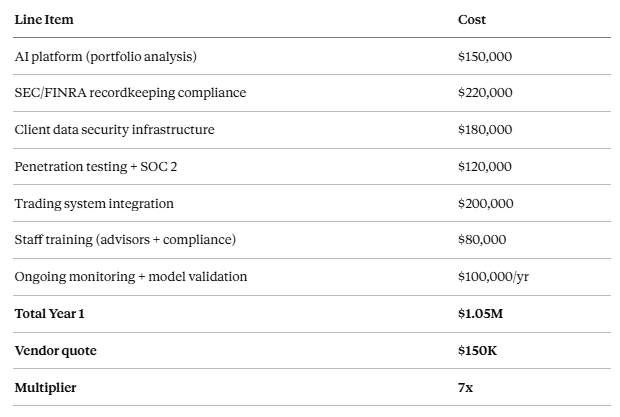
SEC fined 16 firms $81M in 2024 for electronic communications recordkeeping failures. The $220K for SEC/FINRA compliance is not optional. It’s cheaper than the fine.
The Government Comparison
State benefits agency, 2025:


Why CFOs Keep Getting Surprised
Problem 1: Vendor Quotes AI, Not Compliance
What the vendor sells: “Clinical documentation AI, $200K/year”
What they mean: The AI software license is $200K
What they don’t mean: Your total cost to run this in production is $200K
This is not dishonest. The vendor isn’t lying. They’re quoting their product. They’re not responsible for your HIPAA compliance, your EHR integration, your staff training, or your audit infrastructure. That’s your problem.
The CFO hears: “$200K for AI”
The CFO should hear: “$200K for the AI + $1.8M for everything required to actually use it”
Problem 2: Compliance Is Invisible Until the Audit
Nobody budgets for audit logging until OCR investigates. Nobody budgets for de-identification until a breach happens. Nobody budgets for penetration testing until an insurer requires it.
The pattern from 6 healthcare deployments:
Month 1–3: Build AI features ($200K spent)
Month 4: Compliance review discovers gaps
Month 5–9: Build compliance infrastructure ($800K-$1.2M spent)
Month 10–12: Remediate issues found during compliance review ($300K-$500K spent)
Total: $1.3M-$1.9M and 12 months
vs. Building compliance-first:
Month 1–2: Design compliance architecture ($50K)
Month 3–6: Build compliance infrastructure + AI features in parallel ($900K)
Month 7–8: Validate and test ($150K)
Total: $1.1M and 8 months
Saving: $200K-$800K and 4 months by building compliance first instead of retrofitting
Azilen (April 2026) confirms: retrofitting compliance costs 2–3x higher than building with compliance from day one.
Problem 3: Hidden Costs Are 25–40% of Total Investment
Deloitte’s 2025 analysis found hidden costs (data cleaning, labeling, model retraining, governance) account for 25–40% of total healthcare AI TCO.
OECD (2024) industry audits confirm: the “hidden” costs of AI, specifically around data preparation, regulatory compliance, and model operations, routinely blindside organizations.
The costs that consistently surprise:
- Data quality: Healthcare data is fragmented, inconsistently labeled, and riddled with missing values. Preparing it for AI costs $50K-$200K alone.
- Legacy system integration: Old EHR configurations require custom middleware. Budget $80K-$150K.
- Clinician time: The EU AI Act requires human oversight of high-risk AI. Even in the US, clinician review of AI outputs is standard of care. This is unfunded labor in most budgets.
- Governance board operations: Weekly AI governance meetings, clinical review committees, incident review boards. Nobody budgets for the staff time.
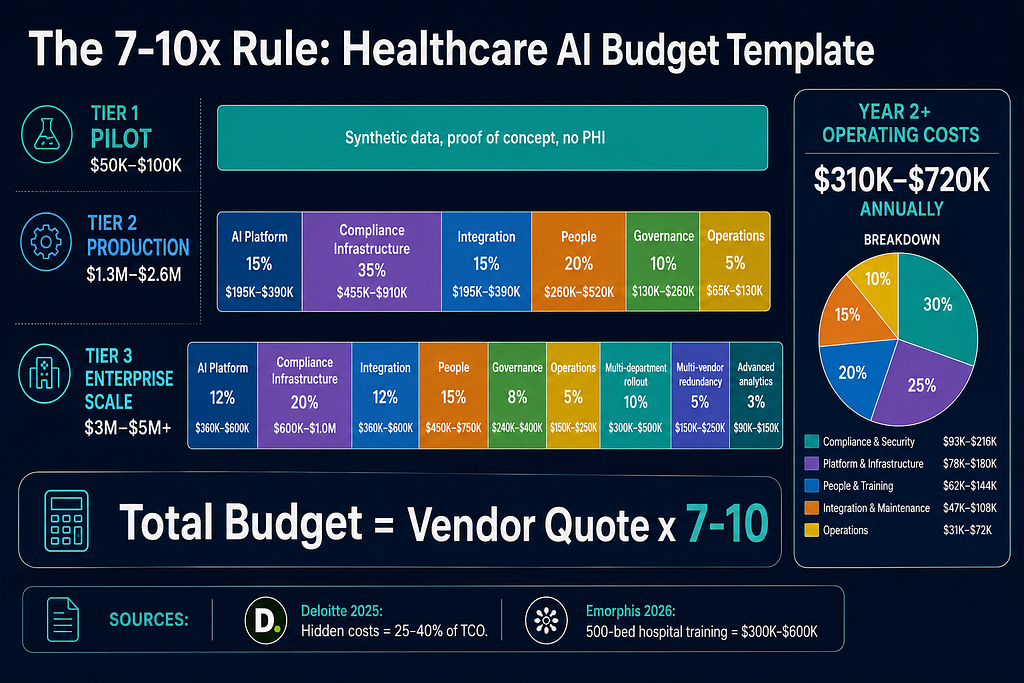
The Budget Template Nobody Gives You
For a 500-bed hospital deploying clinical documentation AI:
Year 1 (Implementation)
AI Platform
- Vendor license/API: $150K-$300K
Compliance Infrastructure
- De-identification pipeline: $180K-$300K
- Audit logging (13-field, 6-year): $180K-$220K
- Security infrastructure: $120K-$200K
- Penetration testing: $50K-$100K
- HIPAA risk assessment update: $40K-$80K
- BAA + legal review: $80K-$150K
Integration
- EHR integration (Epic/Cerner): $150K-$300K
- Data normalization: $50K-$100K
- Workflow redesign: $30K-$60K
People
- Clinician training: $150K-$300K
- IT/ops training: $20K-$100K
- Change management: $50K-$250K
Governance
- Incident response procedures: $40K-$80K
- DPIA: $10K-$30K
- Policy documentation: $20K-$40K
Year 1 Total: $1.32M-$2.61M Vendor quote: $150K-$300K Multiplier: 5x-17x
Year 2+ (Operations)
- AI platform renewal: $150K-$300K
- Model monitoring + validation: $60K-$180K
- Compliance documentation updates: $30K-$60K
- Staff recertification: $20K-$80K
- Penetration testing (annual): $30K-$60K
- Audit log storage: $20K-$40K
Annual Operating Cost: $310K-$720K
The Five Questions That Expose the Real Cost
1. “What’s the TOTAL cost to deploy this in production with HIPAA compliance?”
Good vendor answer: “Our platform is $200K. You’ll need to budget separately for de-identification, audit logging, EHR integration, security, training, and ongoing monitoring. Total cost of ownership for a hospital your size is typically $1.5M-$2.5M in year one.”
Bad vendor answer: “It’s $200K.”
If the vendor only quotes their own price without acknowledging compliance costs, they’re either inexperienced in healthcare or being deliberately incomplete.
2. “Does your platform include HIPAA-compliant audit logging?”
Good answer: “Yes, we log all 13 required fields including patient ID, user identity, clinical purpose, and model version with 6-year retention and cryptographic integrity.”
Bad answer: “We log API calls.” (That’s debugging, not compliance)
3. “What’s the EHR integration cost for our specific configuration?”
Good answer: “Integration with your Epic version and custom modules typically costs $150K-$250K based on our experience with similar configurations.”
Bad answer: “We integrate with Epic.” (Every Epic instance is different)
4. “What happens when the model updates?”
Good answer: “We provide staged rollout tools with rollback capability. You control when updates go to production and can test on 5% traffic first.”
Bad answer: “We push updates automatically to keep you on the latest version.” (Episode 9: automatic updates broke production)
5. “What are the ongoing costs after year one?”
Good answer: “Plan for $300K-$700K annually for monitoring, compliance updates, retraining, and operational overhead.”
Bad answer: “Just the renewal fee.” (Model operations, compliance, and monitoring are real ongoing costs)
What I Learned After 11 Deployments
First 3 (no compliance budget, all exceeded 8x vendor quote):
- Vendor quoted $150K-$200K
- Actual spend: $1.2M-$1.8M
- Timeline: 12–14 months (vs 6 months planned)
- Compliance retrofitted after AI built
- Cost of retrofitting: 2–3x higher than building compliant
Next 4 (compliance budgeted, controlled overruns):
- Vendor quoted $150K-$300K
- Budgeted $1.5M total (including compliance)
- Actual spend: $1.3M-$1.7M
- Timeline: 8–10 months
- Compliance built in parallel with AI
Final 4 (compliance-first, on budget):
- Vendor quoted $150K-$300K
- Budgeted $1.5M-$2.5M total
- Actual spend: $1.4M-$2.3M (within budget)
- Timeline: 7–9 months
- Compliance architecture designed before AI development started
- Zero HIPAA violations in production
The pattern: Organizations that budget 7–10x vendor quote for total deployment costs hit their numbers. Organizations that budget vendor quote + 20% get surprised every time.
Industry-Specific Takeaways
Healthcare
The 7–10x rule: Multiply vendor quote by 7–10 for total year-one cost
Biggest hidden costs: De-identification ($180K-$300K), EHR integration ($150K-$300K), staff training ($100K-$300K)
Budget killer: Retrofitting compliance. Build it first or pay 2–3x later.
Regulatory driver: 2026 HIPAA Security Rule overhaul makes AI-specific compliance mandatory, not optional.
Financial Services
The 7x rule: Multiply vendor quote by 7 for total year-one cost
Biggest hidden costs: SEC/FINRA recordkeeping ($220K), trading system integration ($200K), SOC 2 certification ($80K-$120K)
Budget killer: Recordkeeping violations. SEC fined 16 firms $81M in 2024. Compliance infrastructure is cheaper than the fine.
Government
The 7x rule: Multiply vendor quote by 7 for total year-one cost
Biggest hidden costs: FedRAMP compliance ($250K), legacy system integration ($180K), transparency requirements ($80K)
Budget killer: Procurement cycles. Government AI deployments take 2x longer due to compliance review, adding timeline costs.
The CFO Conversation (Revised)
CFO: “The vendor quoted $200K. Why are you requesting $1.8M?”
You: “The AI costs $200K. Making it HIPAA-compliant, audit-ready, and integrated with our EHR costs $1.6M. I can show you the line items.
De-identification to keep PHI out of external APIs: $200K. If we skip it and there’s a breach, average healthcare breach cost is $7.42M (IBM/HIPAA Journal, 2025).
Audit logging to survive OCR investigation: $200K. If we skip it, a hospital our size paid $1.5M last quarter for missing AI logs.
EHR integration so clinicians actually use it: $200K. If we skip it, we bought software nobody can access.
Staff training so clinicians trust it: $200K. If we skip it, we bought software nobody uses.
The $200K AI without the $1.6M infrastructure is a $200K experiment. The $1.8M total is a production system.”
CFO: “What if we start smaller?”
You: “We can. A $50K-$100K pilot with synthetic data proves the AI works. Then we invest in production infrastructure. But the compliance costs don’t get cheaper at smaller scale. De-identification still costs $180K whether we have 100 patients or 10,000.”
Building AI systems where the budget reflects the actual cost, not the vendor demo. Every Tuesday and Thursday.
The Silicon Protocol Series
Arc 4: Compliance (Episodes 13–16)
← Episode 14: The Data Residency Decision When Cross-Border AI Creates Compliance Exposure GDPR transfer obligations, geo-aware routing, and multi-region architecture for international patient data.
→ Episode 16: The Regulatory Architecture Decision (Coming Tuesday) When Five Compliance Frameworks Apply to One AI System HIPAA, HITECH, FDA, state AI laws, and the 2026 Security Rule overhaul. The unified governance framework that satisfies all of them.
Previous Arc 3: Scale (Episodes 9–12)
- Episode 9: Model Updates ($2.3M exposure)
- Episode 10: Context Costs ($47K token spike)
- Episode 11: RAG Retrieval (wrong patient chart)
- Episode 12: API Fallback (15-hour outage)
The Silicon Protocol: Why Your $200K Healthcare AI Actually Costs $2.3M in Production (2026) was originally published in Towards AI on Medium, where people are continuing the conversation by highlighting and responding to this story.
