
The Inference Reckoning: How to Stop Burning Millions on Cloud LLM Tokens

Imagine checking your enterprise cloud billing dashboard on a Monday morning and seeing a sudden, violent $45,000 spike.

You trace the anomaly down the pipeline, past the application layers, straight to an autonomous R&D data extraction loop. A single, minor edge-case bug in an agentic script caused it to enter a recursive loop, repeatedly feeding 100,000-token enterprise architecture context windows into a frontier cloud model over a single weekend.
This isn’t a hypothetical horror story. In the current enterprise landscape, it’s a weekly reality.
When the generative AI boom began, paying a fraction of a cent per thousand tokens to third-party cloud APIs felt like a bargain. It bypassed hardware procurement lead times, required zero infrastructure management, and got MVPs out the door in days. But as applications transition from simple text boxes to heavy production pipelines — handling continuous document classification, sub-second financial extraction, and massive multi-agent workflows — the economic math completely falls apart.
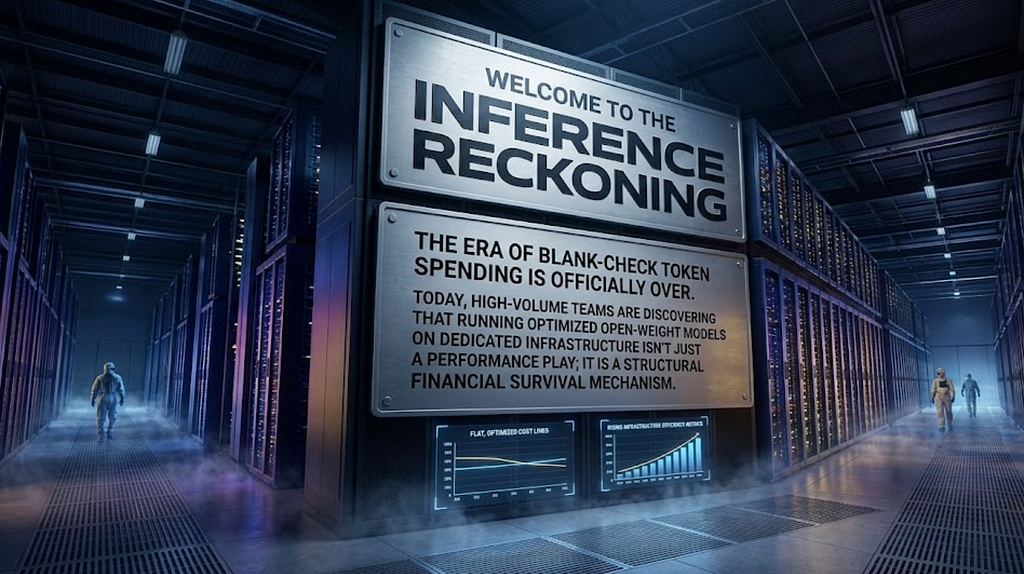
Welcome to the Inference Reckoning. The era of blank-check token spending is officially over. Today, high-volume teams are discovering that running optimized open-weight models on dedicated infrastructure isn’t just a performance play; it is a structural financial survival mechanism.
The Compounding Math of the Token Tax
To understand why cloud APIs become a financial trap at scale, you have to look at how modern AI features are built. Early use cases were simple: a human user typed a 50-word prompt, and the model generated a 100-word response.
Today, we build Agentic Systems.
An autonomous data extraction or quality control agent doesn’t talk to a human; it talks to other software systems. To complete a single corporate task, an agent might execute a multi-step chain of thought involving 15 to 30 sequential model calls.
- Each step requires feeding in historical state, system prompts, database schemas, and tool definitions.
- A single user action that used to cost $0.002 in tokens can easily balloon into a $0.50 automated chain.
- Multiply that across millions of automated transactions a day, and your API bill scales linearly with your success.
[Cloud API Model]  ---> Pay-Per-Token Pricing ---> More Scale = Linearly Exploding Costs
[Local/Edge Model] ---> High Upfront Hardware ---> More Scale = Zero Marginal Token Cos
Furthermore, cloud providers naturally penalize you for data density. If you feed deep context windows into a third-party API, you are billed for every single token processed during the “prefill” phase, over and over again, even if the model only replies with a one-word answer like {“status”: “valid”}. You are effectively paying a premium rent on a technical asset you could own.
The Pivot to “Physical MLOps” and Local Inference
The alternative isn’t a step backward in capability; it’s a step forward in architectural maturity. The open-source model ecosystem has advanced so rapidly that models you can run on a single hardware node now routinely match or outperform the proprietary frontier cloud giants of yesterday on specialized enterprise tasks.
When you shift to running open-weights models locally or on dedicated, private cloud compute instances, the financial paradigm flips completely:
- Zero Marginal Cost: Once you buy the silicon or rent a dedicated bare-metal GPU instance, your cost per token effectively drops to zero. Whether your R&D pipelines process 10,000 tokens or 100,000,000 tokens a day, your infrastructure bill remains flat.
- Data Privacy and Sovereignty: Passing sensitive data (like financial records, proprietary engineering drawings, or operational logistics) through third-party web endpoints introduces massive compliance friction. Local inference keeps data strictly inside your regional perimeter.
- Latency Liberation: Network roundtrips to crowded cloud API endpoints introduce a massive latency floor (often 500ms to 2 seconds per call). For real-time applications, sub-second responses are non-negotiable. Eliminating the public web bottleneck can cut your time-to-first-token (TTFT) by massive margins.
Architectural Blueprint for High-Throughput Efficiency
Moving away from cloud APIs doesn’t mean you have to write custom CUDA kernels from scratch. The open-source production ecosystem provides incredibly robust, enterprise-grade serving engines designed to squeeze maximum performance out of dedicated silicon.
If you are architecting a private inference cluster to escape the token tax, your stack should leverage three foundational pillars:
1. High-Efficiency Serving Engines (e.g., vLLM)
Modern serving frameworks like vLLM utilize revolutionary memory management systems such as PagedAttention. In standard setups, a massive chunk of precious GPU VRAM is wasted because the system pre-allocates memory for the maximum possible response length of every incoming request. PagedAttention fragments the Key-Value (KV) cache into virtual pages, completely eliminating memory waste and allowing engines to handle up to tens of times more concurrent requests on the exact same hardware.
2. Smart Parallelism Strategies
When your workloads scale past what a single graphic card can handle, your serving layer must dynamically shard models using advanced parallelization layouts:
- Tensor Parallelism (TP): This splits individual matrix multiplication operations across multiple local GPUs simultaneously. It is incredibly fast, drastically lowering generation latency, but it requires ultra-high-speed physical interconnects between the cards (like NVIDIA’s NVLink bridges) to avoid internal bottlenecks.
- Pipeline Parallelism (PP): If you are running deep models across systems without specialized high-speed interconnects, pipeline parallelism segments the model layer-by-layer like an assembly line (e.g., GPU 0 runs layers 1–20, GPU 1 runs 21–40). It slashes memory requirements per card, making it ideal for large architectures.
- Data Parallelism (DP): For massive operational throughput where latency per request is already acceptable, you simply replicate the entire model across separate independent cards, using an orchestration layer to balance incoming user requests linearly across the replicas.
3. Advanced Quantization
You do not need to run models at uncompressed 16-bit precisions ($BF16$) in production. Modern compression techniques like FP8 precision or highly optimized 4-bit/8-bit quantization weights (AWQ, GPTQ) allow you to shrink the memory footprint of a model by 50% to 75%. This lets you fit highly intelligent, heavy models onto far cheaper, readily available hardware nodes without observing noticeable drops in real-world extraction or processing accuracy.
The Hybrid Paradigm: Sizing for Median Load
For most mid-to-large enterprises, the smartest path forward isn’t an overnight, dogmatic migration away from the cloud. The goal is to build a highly tactical Hybrid Inference Framework.
Instead of buying enough local hardware to handle massive, unpredictable traffic spikes, smart teams size their dedicated infrastructure to handle their p50 median baseline load.
Traffic Volume
    ^
    |       /              /          <-- Peak Spikes: Burst out to Cloud APIs
    |------/--------------/----------
    |     /              /
    |    /       _______/             <-- Median Baseline: Handled by Local Inference Nodes
    |___/                         ____
    +-----------------------------------> Time
Your local or dedicated private instances run 24/7 at a beautifully steady, cost-optimized 85% utilization rate. Then, when a massive operational spike or a seasonal product launch hits, your system architecture automatically bursts the overflow traffic out to third-party public cloud endpoints.
This guarantees that you never pay for expensive, idle hardware during off-hours, while simultaneously ensuring that your day-to-day operational token costs drop to near zero.
The token gold rush allowed teams to build quickly, but long-term profitability belongs to those who control their own infrastructure. By taking control of your inference stack, optimizing your serving layers, and treating compute as a core asset rather than an unmonitored utility bill, you turn AI from a runaway financial liability into a highly scalable engine of operational efficiency.
The Inference Reckoning: How to Stop Burning Millions on Cloud LLM Tokens was originally published in Towards AI on Medium, where people are continuing the conversation by highlighting and responding to this story.
