
The Context Window Trap: Stop Drowning Your AI in Data

Bigger context doesn’t mean better reasoning. It means more noise, higher costs, and a model that forgets how to think.
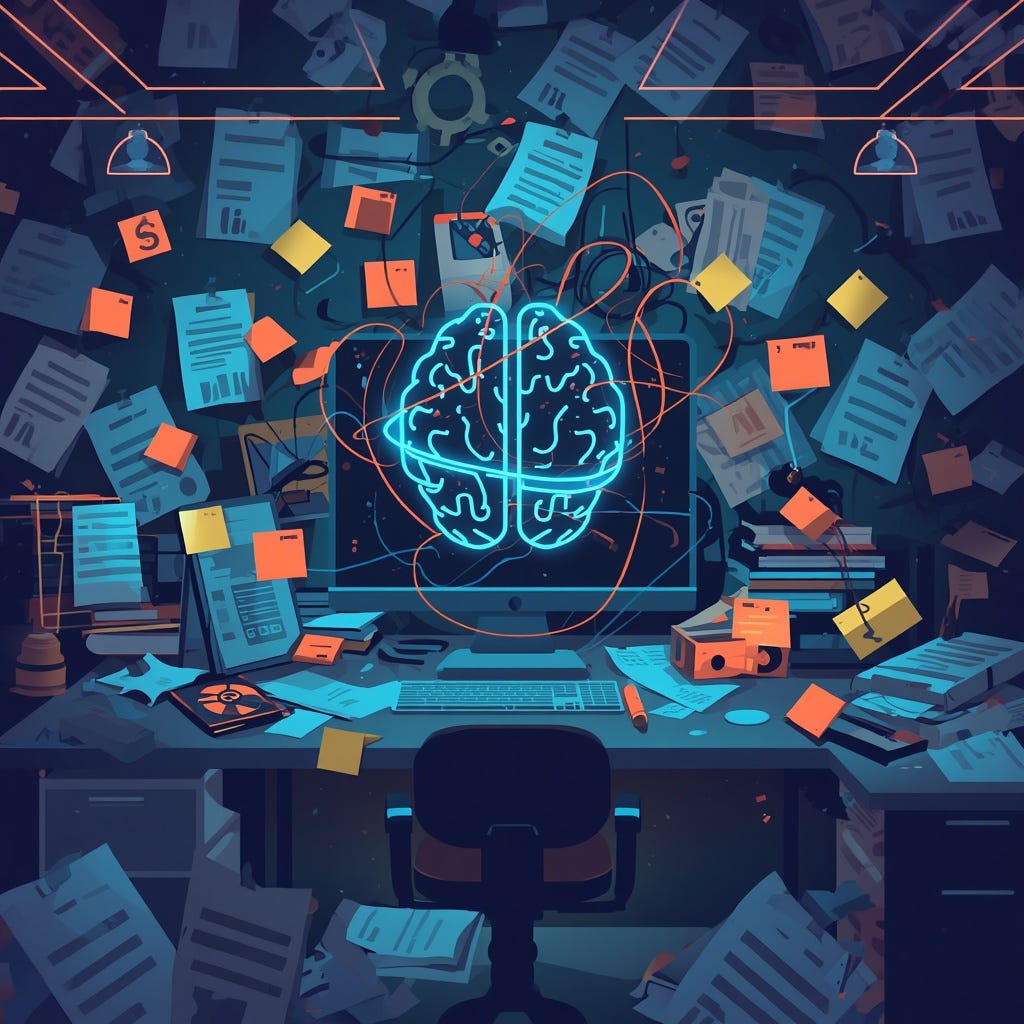
Your LLM has a 2-million-token context window. That’s not a superpower it’s a junk drawer. You think you’re giving it “more memory,” but you’re just training it to hallucinate. Here is the engineering truth nobody tells you: more context is actively killing your system’s reliability.
Most developers are treating context windows like infinite RAM. They think that if they dump the entire codebase into the prompt, the model will just understand the intent. That is how you build a slow, expensive, and fragile system.
When you feed an LLM 500,000 tokens, you aren’t giving it more intelligence. You are giving it a signal-to-noise ratio nightmare. The model’s attention dilutes. It misses the small, critical instruction in the middle of page 40 because it is too busy trying to keep track of the noise on pages 1 through 39.
You have probably seen this go wrong. Your model is smart on a focused prompt, but it turns into a confused intern when you give it massive context. It is not a lack of capacity,it is a lack of focus.
The cocktail party problem
Think of an LLM context window like a crowded cocktail party.
If you are at a table with two people, you can hear every word and hold a deep, intelligent conversation. That is a 4,000-token context window. Everything is clear.
Now, imagine I force you to sit at a table with 500 people, all talking at once, while I demand you answer a complex legal question based on what someone in the back row just whispered. That is a 2-million-token context window. Sure, the data is technically in the room. But can you actually process it? No. You are going to guess. You are going to get overwhelmed. You are going to make a mistake.
That is why your massive context window is failing you. The model isn’t “thinking” over the data; it is drowning in it.
The loss of the engineering craft
There is an unsettling truth here that most tutorials ignore. We are losing the art of data engineering.
When we rely on massive context windows to solve our problems, we are essentially giving up on the craft of software development. We used to spend our time building clean data pipelines, establishing clear schemas, and architecting systems that were modular and precise. We took pride in knowing exactly where our data lived and how it flowed.
AI is replacing the parts of your job that made you feel like an engineer. It is replacing the nuance of understanding your own system. When you outsource your architecture to a context window, you stop being an architect and start being a glorified data janitor.
You are no longer building systems you understand; you are creating a black box you pray will output the right answer. This isn’t just about jobs it’s about the erosion of the professional satisfaction that comes from mastering your tools. If you want to be a serious engineer in this field, you have to push back against this. You have to prove that you understand your data better than the model ever will.
How to survive the context era
Most tutorials stop at “use a vector database.” Do not stop there. You need context engineering. This is the difference between a system that works and a system that breaks in production.
If you want to keep building systems that actually work and not just systems that guess follow me here for more engineering-first strategies that cut through the marketing noise.
To survive, stop dumping raw text. Use a reranker to ensure that only the most relevant, high-fidelity chunks enter your prompt. Use database metadata to prune irrelevant information before the LLM even sees it. Finally, use provider-native prompt caching to store the heavy, static parts of your prompt so you aren’t paying for the same data on every single request.
Here is the pattern I use to keep my context clean. I do not use a bloated prompt. I use a regression script that runs every time I commit a prompt change.
# A simple example of pruning context before sending it to the model

def get_pruned_context(raw_data, query, top_k=3):
    # Retrieve only the most relevant chunks from your store
    chunks = vector_db.search(query, k=top_k)

    # Rerank to ensure only high-quality data survives the filter
    reranked = reranker.rank(chunks, query)

    # Format for the LLM
    context = "n".join([item.content for item in reranked])
    return context

# This ensures the model gets exactly what it needs to solve the problem
final_prompt = f"Use this context to answer: {get_pruned_context(data, user_query)}"
If the model fails these tests, the build fails. It is not magic. It is just engineering.
Stop trusting the vibe
You have been sold the lie that more memory equals better AI. It does not. It just equals more distraction.
Build your system to be precise. If you want to stop the hallucinations and cut your API bill in half, stop trying to force the model to hold the entire world in its head. Give it the one thing it actually needs to do the job.
Everything else is just noise.
Resources
- BGE-Reranker: For improving retrieval quality.Hugging Face Repository
- Prompt Caching Strategies: Official documentation on optimizing token costs. OpenAI API Docs
- Evaluation Frameworks: A look at how to build your own golden dataset.RAGAS Documentation
Note: I am a software engineer focused on building robust AI systems. If you found this useful, follow me for more deep dives into production-grade AI.
The Context Window Trap: Stop Drowning Your AI in Data was originally published in Towards AI on Medium, where people are continuing the conversation by highlighting and responding to this story.
