The AI War Is Moving From Models to Machines

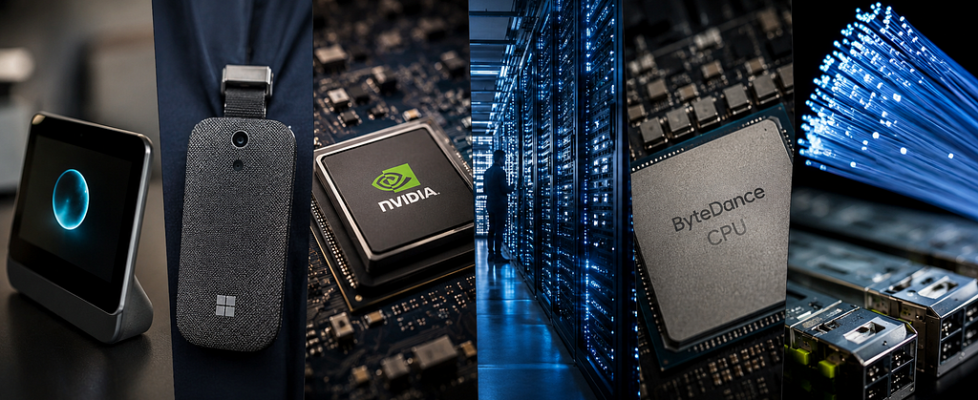
Microsoft, Nvidia, ByteDance, and infrastructure players are pointing to the same shift: AI is leaving the chatbot tab and becoming a hardware-and-inference race.
For the past two years, the AI industry has been obsessed with a single question: whose model is smarter? Which benchmark did it beat? Which chatbot feels more human? It was a loud, legible competition. Open a browser, type a prompt, compare the answer. The product was the model, and the model lived somewhere far away in a data center.
That phase is ending.
AI is no longer just becoming better software. It’s becoming infrastructure. The question that’s starting to matter isn’t “which model is best?” It’s “where does the intelligence actually run?”
The Chatbot Was Only the Beginning
The chatbot made AI legible to the public. It gave everyone a clean interface: type something, get something back. But a chatbot isn’t the final form of AI. A chatbot waits. An agent acts. And that difference changes everything about the underlying infrastructure problem.
A chatbot can live comfortably in a cloud data center. It receives a prompt, generates a response, sends it back. Latency matters, but the interaction is still mostly conversational. An agent is a different animal. It needs context: access to apps, files, calendars, cameras, microphones, local device state, enterprise systems, authentication, and long-running workflows. It needs to observe, decide, act, and come back later. It needs to operate close to the user, not just close to a server.
This is why the model race is slowly turning into a placement race. Should the agent run in the cloud? On the PC? On a phone? On a badge? Inside an enterprise device? The company that figures this out doesn’t just control an app. It controls the interface between human intent and machine execution. That’s a much bigger prize than a leaderboard ranking.
Microsoft Is Quietly Testing the Shape of Agent Hardware
Microsoft’s Project Solara doesn’t look like a normal consumer product launch. It’s not a new laptop. It’s not another Copilot button. It’s a platform idea: devices built around AI agents rather than traditional applications.
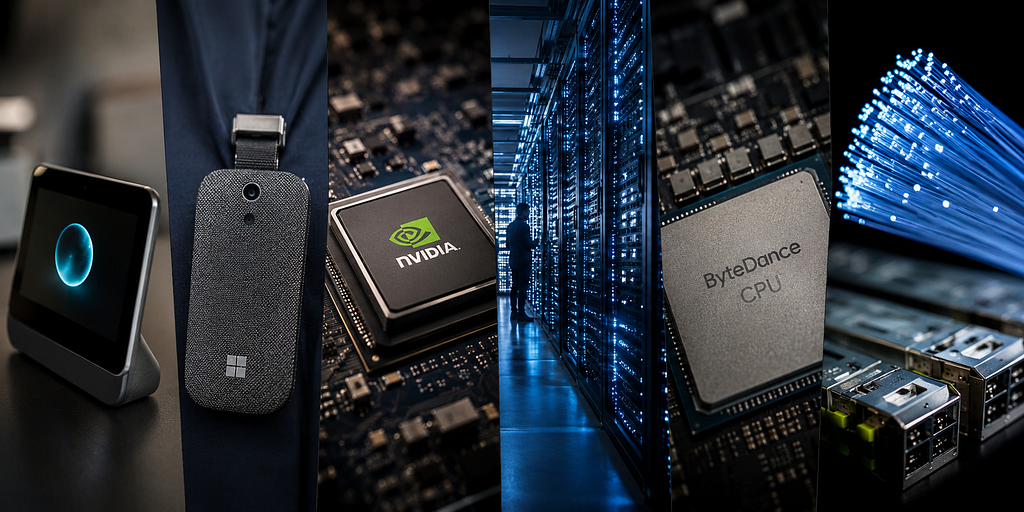
The reference designs say a lot. One concept resembles a smart display for a desk. Another is a badge-like wearable with a camera and biometric input. That sounds niche, but the direction matters. Microsoft is imagining AI agents as something you don’t just open on a screen. Something that can sit in a room, listen when permitted, see what you see, authenticate who you are, and plug into enterprise systems.
It’s also reportedly built on Android rather than Windows, which makes sense. Windows is powerful, but it carries decades of assumptions baked in: desktop apps, files, windows, keyboards, mice, the whole enterprise PC model. Agent-first devices need something lighter, more embeddable, easier for hardware partners to adapt. Microsoft isn’t trying to shrink Windows into a badge. It’s trying to define what an AI-native device should look like from the ground up.
Nvidia Wants the Agent on Your Desk
At the same time, Nvidia is pushing AI into personal computers through RTX Spark, and that challenges a quiet assumption the industry has been running on: that serious AI work must always live in the cloud.
The cloud is powerful, but it has real costs. Latency. Bandwidth. Privacy concerns. Enterprise control requirements. If meaningful AI inference can happen locally, the personal computer becomes important again, not as a document machine but as an AI workstation.
For years the consumer PC market looked mature. Faster chips mattered, but the basic usage model didn’t change much. AI gives chipmakers a reason to reframe the PC entirely. If agents are going to summarize, plan, observe, write code, reason, search, and automate against local context, the machine sitting in front of the user becomes strategically valuable again. The cloud will still matter. But the edge is now worth fighting over.
Inference Is the New Infrastructure Layer
Training gets the headlines. Inference gets the bill.
Training is when a model is created or improved. Inference is when that model is actually used: every answer, every agent action, every generated image, every workflow step, every enterprise automation. As AI products move from demos to daily usage, inference becomes the recurring infrastructure problem.
That’s why companies are racing to build distributed inference capacity. It’s not enough to have one giant training cluster somewhere. If AI agents are running across workplaces, devices, regions, and real-time workflows, compute has to be closer, faster, and more available. This is where the boring infrastructure story becomes the real story. Data centers. Networks. GPUs. Memory. Power. Cooling. Latency. The AI product may look like a magical assistant. Underneath it is a brutal infrastructure business.
The CPU Is Back in the Conversation
The public AI narrative has mostly been about GPUs, and understandably so. Nvidia became the symbol of the AI boom because GPUs powered the training race. But agentic workloads are not purely GPU workloads.
Agents involve orchestration. They call tools. They retrieve context. They manage state. They interact with software systems. They run many smaller steps rather than one clean model call. That brings CPUs back into the picture.
Reports of ByteDance developing custom CPUs are worth paying attention to for exactly this reason. It suggests that large AI companies are no longer thinking only about buying more GPUs. They’re thinking about the full workload: what runs where, what costs too much, what creates bottlenecks, and which parts of the stack they need to own. That’s the hyperscaler playbook. When a workload becomes core enough, companies stop treating hardware as a commodity and start customizing it. Google did it. Amazon did it. Microsoft did it. Now more companies will follow, because AI has become too expensive and too strategically important to run entirely on other people’s assumptions.
Even the Cables Are Part of the Race Now
One of the least glamorous but most consequential parts of the new AI infrastructure build-out is data movement. AI systems don’t only compute. They move enormous amounts of data between chips, servers, racks, and data centers. As models and workloads scale, the connections between processors become the bottleneck.
That’s why silicon photonics is attracting serious attention. It sounds like a niche semiconductor topic, but it points to a deeper truth: the AI race is stressing every single layer of computing infrastructure. It’s not enough to have faster chips if the system can’t move data efficiently between them. The future of AI may depend not only on better models, but on better ways to connect the machines running those models.
The Next Platform Is Not an App
Every major computing shift creates a new default interface. The PC era had desktop software. The internet era had websites. The smartphone era had apps. The AI era probably won’t have a single clean equivalent.
It may have agents spread across devices, operating systems, local machines, cloud infrastructure, enterprise platforms, and specialized hardware. The user will simply experience it as AI that’s always available. But the business battle underneath will be about who owns the layers that make that possible: a local AI PC for heavy personal work, a phone agent for daily context, a wearable for real-world input, a cloud inference layer for scale, enterprise devices for controlled environments, custom chips for cost and performance, and optical networks for data movement.
The next platform may not arrive as one beautiful product launch. It may arrive as a stack.
Why This Moment Actually Matters
The AI industry spent its first major phase proving that models could be useful. Now it has to make them deployable everywhere. That’s a much harder problem.
It requires hardware, operating systems, identity, security, privacy controls, developer tools, device management, inference economics, and data center capacity. It requires companies to solve not just intelligence, but distribution. This is where many AI startups may find themselves exposed. A good model or a clever wrapper is no longer enough. If agents become deeply embedded into devices and enterprise infrastructure, the advantage moves toward companies that already control platforms.
Microsoft has Windows, Azure, Office, GitHub, and deep enterprise relationships. Nvidia has GPUs, developer mindshare, and the AI infrastructure narrative. Cloud providers have data center reach. Hyperscalers have capital and custom silicon on the roadmap.
The AI race is becoming more physical, more expensive, and more platform-driven. The companies asking “who has the smartest bot?” are starting to lose the thread. The ones asking where the agent lives, how close it is to the user, whether it can access private context safely, whether enterprises can manage it, and whether it can run when the cloud is expensive, those are the ones building for what comes next.
The AI war is moving from models to machines. And that’s when it gets real.
References
[1] T. Warren, “Microsoft’s Project Solara is an OS for AI agent gadgets,” The Verge, 2026.
[2] Reuters, “Microsoft expected to showcase new PC, cloud AI tools at developer conference,” Reuters, 2026.
[3] Reuters, “Nvidia launches new chip to bring AI directly to personal computers,” Reuters, 2026.
[4] Reuters, “ByteDance developing custom CPU chips to support AI rollout,” Reuters, 2026.
[5] Reuters, “Megaport secures AI infrastructure deals and raises funds to build inference cloud,” Reuters, 2026.
[6] Reuters, “STMicro weighs Crolles fab expansion as AI optics demand rises,” Reuters, 2026.
The AI War Is Moving From Models to Machines was originally published in Towards AI on Medium, where people are continuing the conversation by highlighting and responding to this story.
