The $0 CAC Matrix: Why Vibe-Coded Apps Need a Distribution Machine Before Launch

How Claude, Rork, anchor-image AI UGC, OpenClaw DMs, and creator networks fit into one launch system, and where the model can still break.
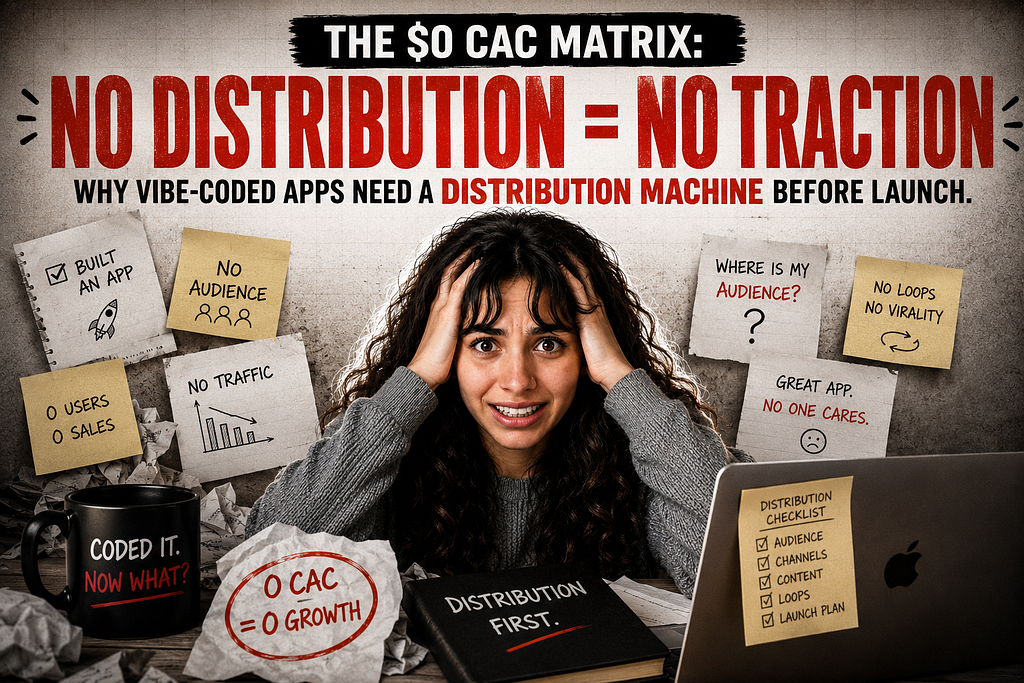
A factory can be brilliant and still go broke if the loading dock opens into an empty alley. The machines hum. The floor is clean. The product rolls off the line exactly as designed. But if the trucks, routes, buyers, and ordering system were never built, production only creates inventory nobody asked for.
The Empty Loading Dock
Why do so many indie apps launch cleanly and then die quietly?
Because the founder treats distribution as the thing that happens after the build. The source article says this aggressively, but the pain is real. A founder spends months tuning the interface, choosing a stack, debating details, and polishing the product. Then launch day arrives, the app gets a few polite upvotes, and the founder discovers that paid ads can cost more than the subscription is worth.
CAC means customer acquisition cost, or the amount you spend to get one paying customer. If your app charges $9 per month and your paid ads cost $45 to acquire one customer, the math is already asking for a miracle. You need long retention, low churn, and strong expansion before that model makes sense.
Vibe coding changes the first half of the problem. Vibe coding means directing AI tools to create software from prompts, specs, and iterative feedback instead of manually writing every line. It can make building faster. It does not make attention free.
The dangerous part of cheap software is that it lets you postpone the hard question until the product is already finished.
The App Factory
What changes when the code is no longer the bottleneck?
The source’s build stack is Claude plus Rork. Claude is used as the architecture brain. Architecture means the structure of the app: database tables, API endpoints, user payloads, roles, screens, and business logic. An API endpoint is a software route that receives or returns data. A payload is the structured data sent through that route.
Rork is described as the prompt-to-app engine. In plain English, the founder gives it the product description, interface requirements, backend logic, and subscription rules, then iterates until there is a deployed app. The source example is a roofing SaaS that tracks local weather data to predict hail-damage leads, with a dashboard, lead table, map, settings page, and Stripe subscription.
That workflow is useful. It can turn an idea into a live product surface quickly. But speed has a trap inside it. If the product can be built in a weekend, so can a lot of other products. The moat cannot be “I shipped.” The moat has to move toward buyer insight, distribution, retention, and the system that turns attention into trials.
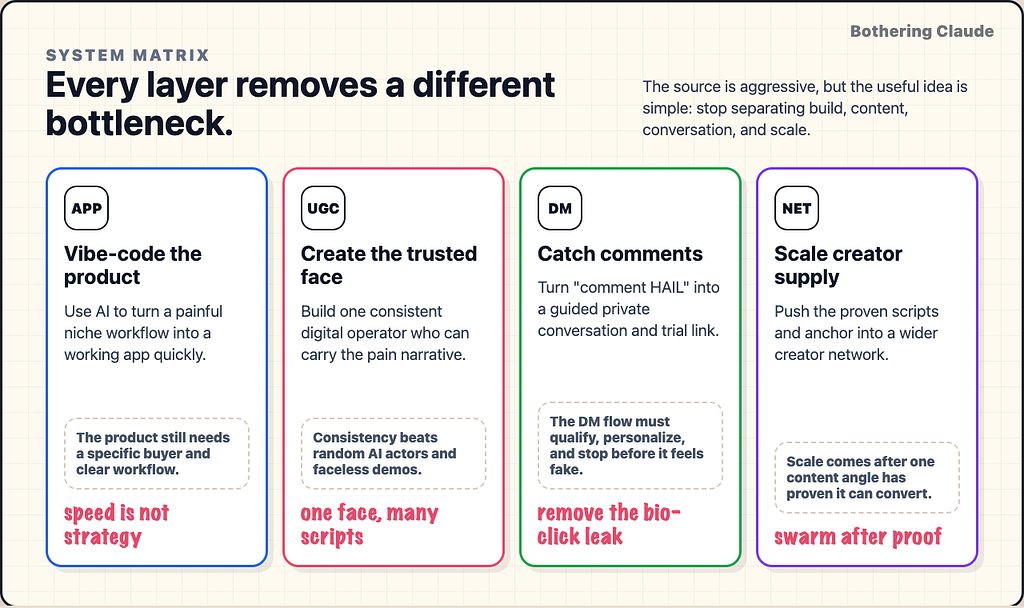
The useful version of the source’s argument is not “stop coding.” It is “stop pretending the app is the whole company.” The app, the content engine, the conversation flow, and the scale path have to be designed as one machine.
The Digital Evangelist
Why does the source spend so much time on one consistent AI character?
Because generic AI UGC fails when the face keeps changing. AI UGC means AI-generated user-style content: short videos, testimonials, founder clips, product demos, and pain-point narratives created with AI tools. The source argues that ordinary text-to-video clips create a “shapeshifter” problem. Each render invents a slightly different person, which makes the content feel synthetic and untrustworthy.
The proposed fix is anchor image architecture. An anchor image is one carefully designed still image used as the source of truth for future videos. Instead of asking a video model to invent a person from scratch every time, you start with one believable character and keep returning to that same face, environment, and camera texture.
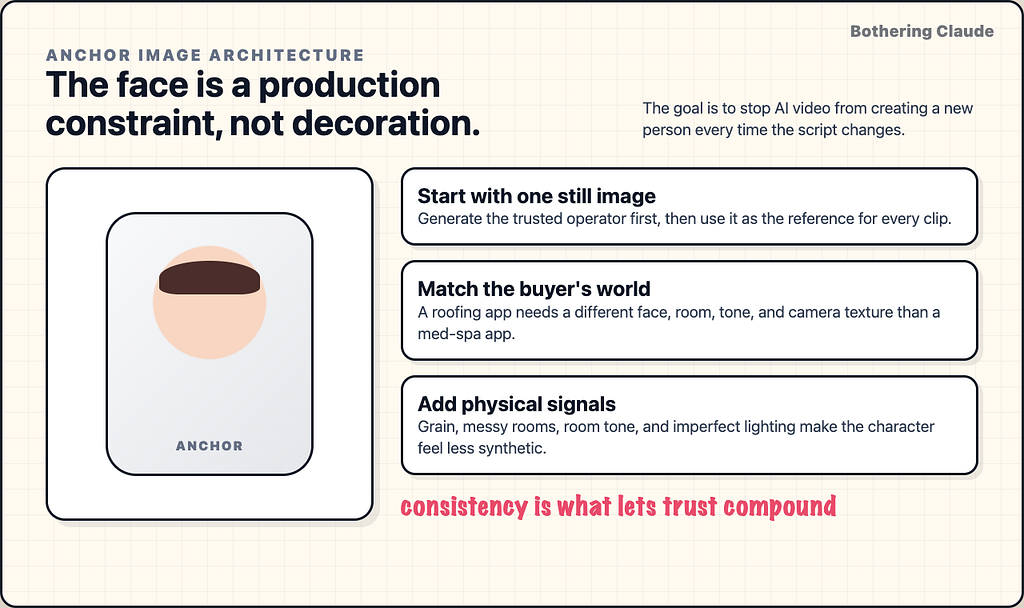
The source mentions Nano Banana 2 for the still image, Sora 2 Pro through Kling for animation, and Veo 3.1 for room tone and physical realism. The specific tools will change. The principle is more durable: the character must match the buyer’s world.
A roofing app should not be represented by a glossy generic startup avatar. It needs a person who looks like they belong near trucks, storm maps, phone calls, and job sites. A med-spa workflow needs a different operator entirely. The face, room, lighting, voice, and frustration have to feel native to the buyer’s daily life.
But here is the thing: consistency can build trust, and it can also scale a lie. If the digital character implies a real person, real credentials, or real customer experience that does not exist, the channel becomes a credibility debt. The ethical version is clear about what the content is doing: dramatizing a pain, demonstrating a product, and routing interested users into a legitimate trial.
The DM Intercept
Why not just put the app link in the bio and let viewers click?
Because every extra step leaks intent.
The source’s strongest operational move is the comment-to-DM flow. The creator video does not say, “link in bio.” It says something like, “Comment HAIL and I will send you the beta link.” A viewer comments. OpenClaw, an AI agent workflow system, catches the comment through an automation such as an n8n webhook. A webhook is a URL that receives an event from another app, such as a new comment or form submission.
Then the DM flow takes over. A state machine, meaning a workflow that tracks the user’s current step and chooses the next response, asks a qualifying question, mirrors the digital founder’s tone, and sends a personalized trial link. The source’s roofing example asks whether the person runs a crew, then references Dallas storm activity and offers a private tracker trial.
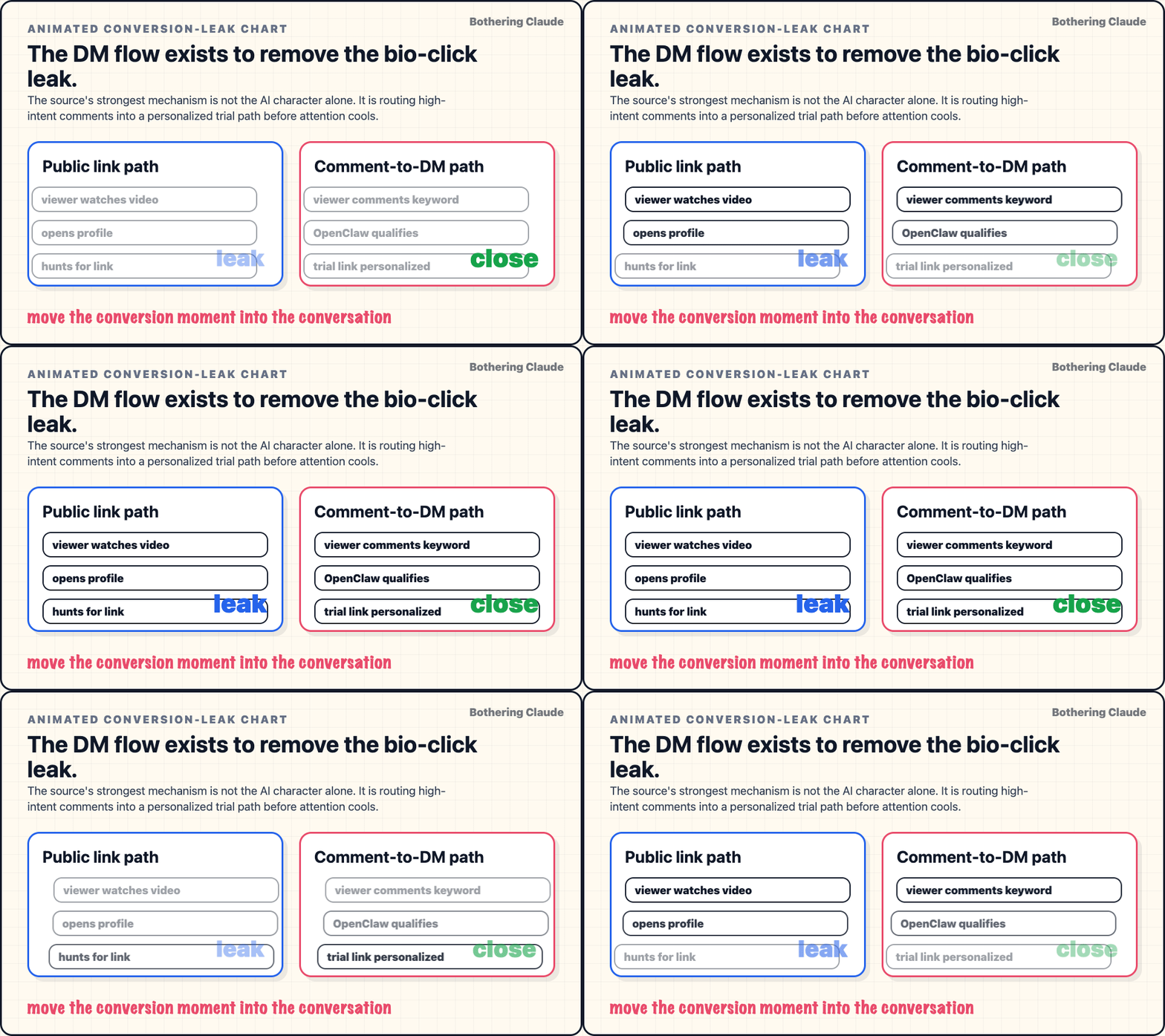
That is a better conversion surface than a cold landing page because it keeps the user inside the moment that created intent. The viewer just watched the pain. They responded publicly. The private message continues the same context before the attention cools.
This is also where the system can get creepy fast. The DM should qualify and help. It should not impersonate a real person, invent fake local facts, or pressure someone with false urgency. If the flow says it knows something about the user’s market, the product needs a real data source behind that claim.
The conversion gain is only worth having if the conversation stays honest.
The Swarm Comes Last
When should a founder plug this into a creator or affiliate network?
After one content angle and one DM flow have already worked.
The source’s final move is to take the app, anchor image, video scripts, OpenClaw prompts, and conversion flow into AffiliateNetwork.com. An affiliate network is a marketplace where outside creators or partners promote your product in exchange for a payout, such as a bounty for a free trial signup or a paid conversion.
The idea is powerful because it separates founder learning from founder labor. You prove the anchor, scripts, and DM flow yourself. Then other creators can remix the proven format, generate more videos, and push qualified traffic into the same conversion path. The founder no longer renders every clip manually.
But the swarm is not step one. If the app has no sharp pain, the anchor does not feel believable, the script does not earn comments, or the DM flow does not convert, scaling just spreads confusion faster. Creator supply amplifies what already works. It does not make a weak offer coherent.
That is the source’s hidden lesson. The $0 CAC claim sounds like magic, but the actual mechanism is disciplined: build a specific app, dramatize a specific pain, create a consistent operator, capture intent in comments, convert inside DMs, and scale only after the loop proves itself.
The next wave of vibe-coded winners will not be the founders who ship the most apps. It will be the founders who design the road to the first user while everyone else is still polishing the dashboard.
Go build something.
— Sage 🍓
PS: Before building the full stack, run the “comment test.” Write three short scripts for your app’s buyer pain and post them from a simple, non-polished account. Ask viewers to comment one keyword for early access. If nobody comments, do not build the OpenClaw flow yet. Fix the pain, the hook, or the buyer before you automate the silence.
The $0 CAC Matrix: Why Vibe-Coded Apps Need a Distribution Machine Before Launch was originally published in Towards AI on Medium, where people are continuing the conversation by highlighting and responding to this story.
