
Scaling With AI: From Solo to System— Prompt to Profit · Day 26 of 30

The individual practitioner has a ceiling. The system doesn’t. Here is how to build AI-powered operations that grow without requiring proportionally more of you.
There is a ceiling on every individual’s productive capacity, and it arrives faster than most people expect. You add clients until your time is full. You raise your rates until you’re at the market ceiling for your expertise. You work more hours until the quality of your work declines or your life contracts to a point that isn’t worth the income. Every solo knowledge worker eventually encounters this ceiling — not as a failure, but as a structural feature of the model. The ceiling is not a problem with you. It is a problem with the architecture.
Scaling is the act of changing the architecture. It means building systems that produce value without requiring your proportional time and attention — where the output-to-input ratio improves as the operation grows rather than remaining fixed. In traditional business, scaling requires hiring, management overhead, capital, and coordination costs that often consume the gains they were meant to generate. AI changes this equation in a specific, meaningful way: it provides leverage that doesn’t require headcount, doesn’t add management complexity, and doesn’t dilute your output quality if used correctly.
The question is not whether AI can help you scale. It demonstrably can. The question is how to build the architecture that makes the scaling real rather than theoretical — moving from “I use AI for individual tasks” to “I operate AI-powered systems that run regardless of what else I’m doing.”
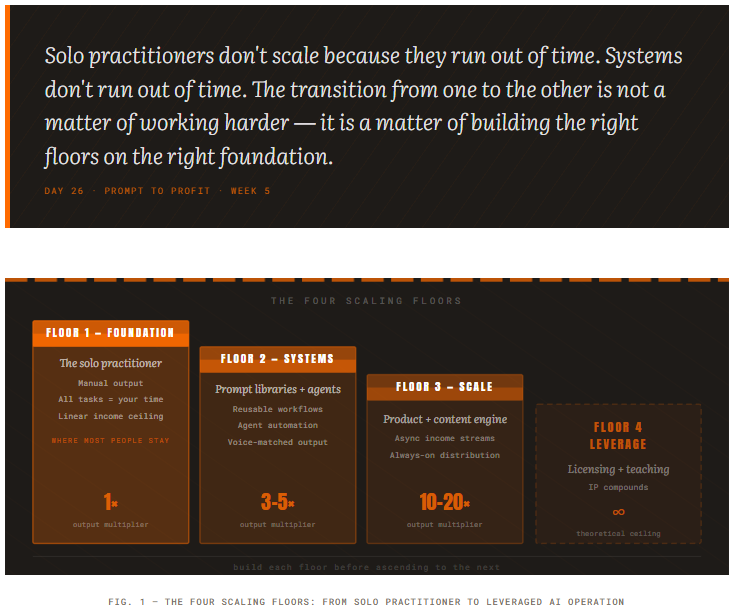
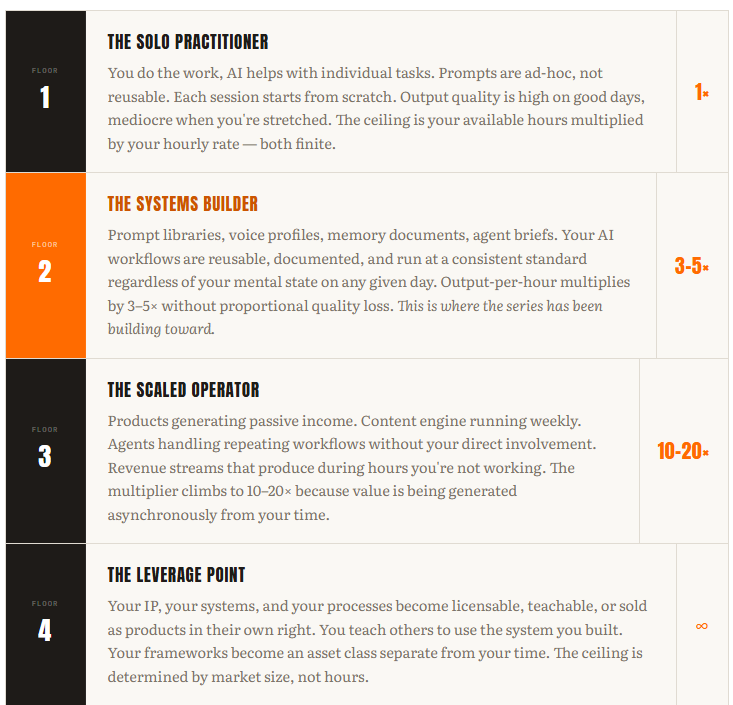
The Scaling Levels — Where You Are and What’s Next
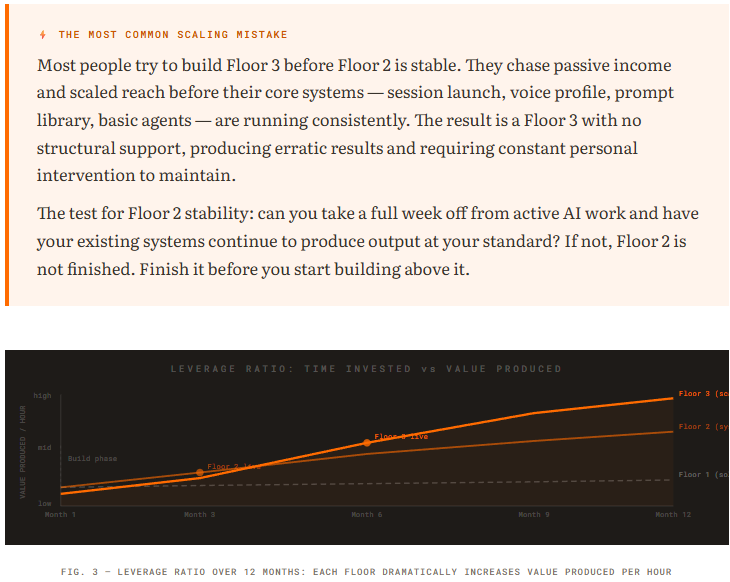
The building illustration in this article’s header is not decoration. It is the most accurate model of how AI-powered scaling actually works: floor by floor, each one requiring the one below it to be structurally complete before it can support weight. You cannot build Floor 3 on an unstable Floor 1. The skyscrapers of the knowledge economy are built from the foundation up.
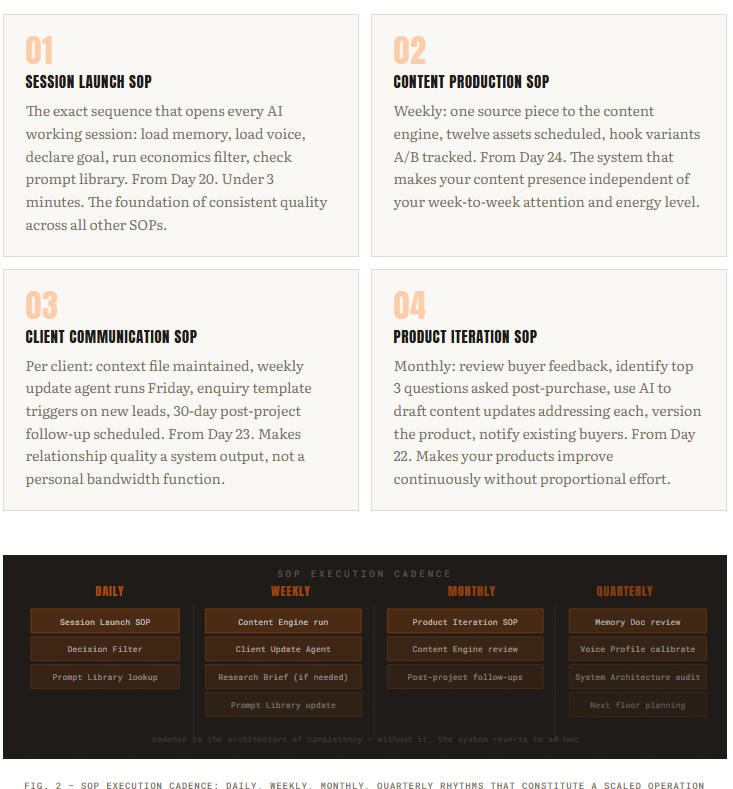
The Four SOPs That Make Scaling Real
Scaling is not a mindset. It is not a strategy. It is a set of documented, repeatable Standard Operating Procedures (SOPs) that encode your best processes so clearly that they run reliably without you reinventing them each time. Here are the four SOPs every AI-powered operation needs:
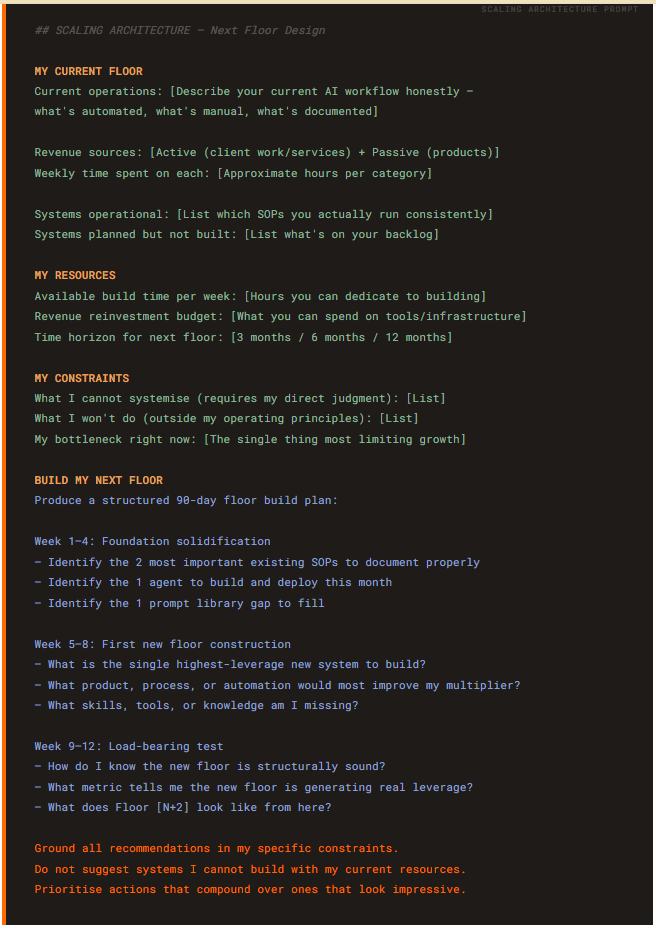
The Scaling Prompt — Designing Your Next Floor
The most useful application of AI in the scaling context is not executing within your current floor — it is designing the next one. Below is the architectural prompt that takes your current state of operations and produces a concrete, sequenced build plan for moving from your current floor to the next.
The Non-Negotiables of Scaled AI Operations
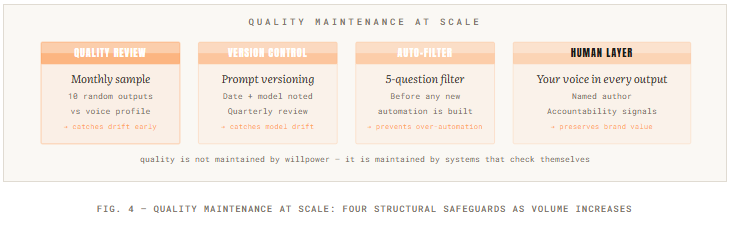
Every scaled operation eventually develops failure modes that didn’t exist at the solo level. These are the four most common, and the structural decisions that prevent them:
Quality drift. As output volume increases, quality monitoring decreases unless you build quality checks into the system explicitly. The solution: a Quality Review SOP — a monthly sample of ten AI-generated outputs reviewed against your voice profile and your standard. Not all outputs; a random sample. Drift surfaces in samples before it becomes visible to customers.
System brittleness. AI systems built for one model version can behave differently as models update. Prompts calibrated on one tool may need adjustment when that tool changes. The solution: treat your prompt library as version-controlled documentation. Note the model and date against each prompt. Review quarterly. When something starts producing worse output, you want to know whether the problem is in your brief or the underlying model.
Over-automation of judgment tasks. The economics of automation are compelling enough that the temptation exists to automate tasks that should not be automated — tasks requiring contextual judgment, relationship sensitivity, or creative originality. The solution is the five-question economic filter from Day 18. Apply it to every proposed automation before building it, not after. A system that produces the wrong output at scale does more damage than one person making the same mistake once.
Loss of the human layer. The most commercially valuable property of your work at scale is still the human behind it — your perspective, your track record, your accountability. This does not diminish as you scale; it appreciates, because it is the element that AI cannot replicate and buyers increasingly understand this. Build the human layer explicitly into your scaled operation: your writing that couldn’t have come from anyone else, your judgment applied to the outputs of your systems, your name and face on the work. The system handles the production. You remain the author.
The building at the top of this page will never be finished. That is the point. A scaled AI operation is not a destination — it is a construction site where new floors are always being planned above the ones that just became structurally sound. The solo practitioner asks “how do I get more done today?” The systems builder asks “what do I need to build so that more gets done without me?” The scaled operator asks “what is the next floor?”
You have built Floor 2 across this series. The prompts, the agents, the memory system, the voice profile, the content engine, the SOPs — these are your structural supports. They are load-bearing. Tomorrow, Day 27, we turn to the question of quality at scale: AI Ethics and Quality Control — how to maintain standards, catch errors, and ensure that the operation you’ve built remains worthy of your name as it grows.

For more resources and documents, please refer to the links in my profile page: Faheem Munshi — Medium
Scaling With AI: From Solo to System— Prompt to Profit · Day 26 of 30 was originally published in Towards AI on Medium, where people are continuing the conversation by highlighting and responding to this story.
