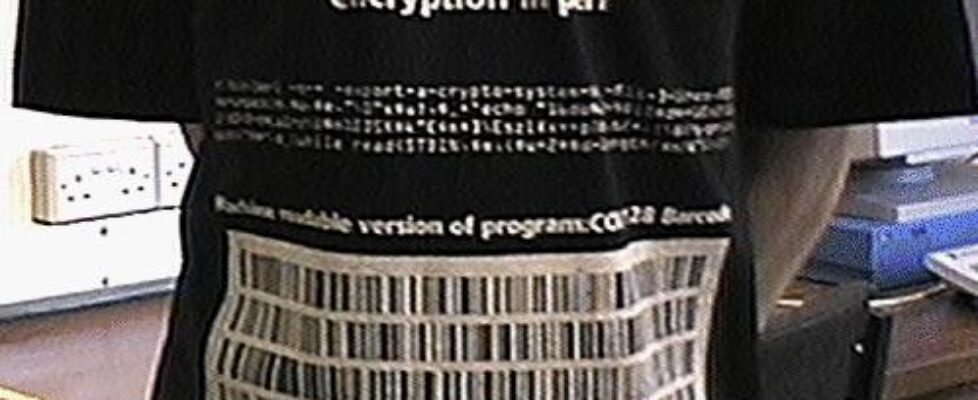
RSA munitions T-shirt

Back when the US government classified strong encryption as “munitions,” RSA public key cryptography was technically illegal. In 1995, Adam Back protested this by creating a terse, obfuscated implementation of RSA in Perl code and used it as an email signature.
The code was also printed on T-shirts. The shirt was classified as munitions because it contained source code for strong encryption. More on the shirt here.
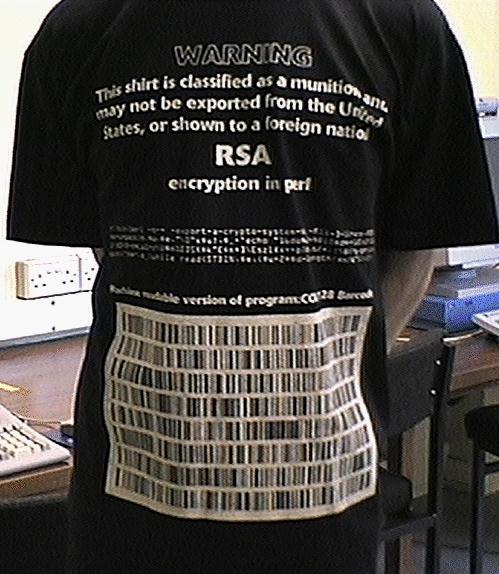
This was the code:
#!/bin/perl -s-- -export-a-crypto-system-sig -RSA-3-lines-PERL
$m=unpack(H.$w,$m.""x$w),$_=`echo "16do$w 2+4Oi0$d*-^1[d2%Sa
2/d0<X+d*La1=zU$n%0]SX$k"[$m*]EszlXx++p|dc`,s/^.|W//g,print
pack('H*',$_)while read(STDIN,$m,($w=2*$d-1+length$n&~1)/2)
My initial intention was to unpack the code, explaining each piece in detail. I don’t have the time or patience for that, and I imagine many readers don’t either. For more of a blow-by-blow commentary, see this commentary from 1995.
dc
In the middle of the code is
echo ... | dc
This is the most dense and most important part of the code. Perl calls the dc calculator to do the arbitrary precision arithmetic that RSA encryption requires.
I’ve written about bc several times. bc (“basic calculator”) was a originally a more user-friendly wrapper around the reverse-Polish dc (“desktop calculator”). dc is still part of every Unix and Unix-like system, but I imagine bc is far more popular.
The important feature of dc for this post is that it is stack-based, meaning that users would push data and commands on to the stack and pop results off the stack. A sequence of commands that might be understandable when interactively using dc might look cryptic in a transcript. This is part of what makes the code so cryptic.
I’ll parse just a tiny bit of the dc code to give a flavor of what it does. The first four characters 16do instructs dc to push 16 on to the stack and, duplicate it, and set the output radix to 16, i.e. these four characters tell dc to work in hexadecimal.
Believe it or not, the dc code is computing
mk mod n
using fast exponentiation, which is the key step in the RSA algorithm.
Textbook RSA
Note that Adam Back’s code is computing what we would now call textbook RSA, not RSA as it has been refined over the years and is currently implemented.
Related posts
The post RSA munitions T-shirt first appeared on John D. Cook.
