Predictable Chaos: A Survival Guide for Modern Software Teams

Introduction: The Eternal Tug-of-War
If you spend more than five minutes in a software project management meeting, you will inevitably hear the question: “Are we doing Waterfall or Agile?” The discussion that follows is often colored by tribal loyalty rather than practical reasoning. Developers fresh out of a bootcamp might swear Agile is the only way to save a project, while a veteran enterprise architect might clutch the Waterfall Gantt chart like a life raft in a stormy sea.
The truth is neither approach is inherently superior. They are tools, like a hammer and a screwdriver. You would not use a screwdriver to frame a house, nor would you use a hammer to repair a pair of glasses. The art of software project management lies in understanding the context — the terrain of the project — and choosing the methodology that minimizes risk and maximizes value delivery.
In this expanded guide, we will move beyond the superficial bullet points. We will dissect the anatomy of both models, examine the psychological and contractual forces that make one more suitable than the other, and provide a decision-making framework you can use in your next project kick-off meeting.
Part 1: The Waterfall Model — The Blueprint of Certainty
Origins and Philosophy
The Waterfall model is not a software invention; it is an engineering and manufacturing import. First formally described by Winston W. Royce in 1970 (though Royce himself advocated for iteration and is often misquoted), Waterfall applies the logic of physical construction to software. You cannot put the roof on a house until the foundation is set and the walls are up. The philosophy is: Measure twice, cut once.
The Sequential Phases in Depth
Understanding why Waterfall resists change requires understanding the output of each phase.
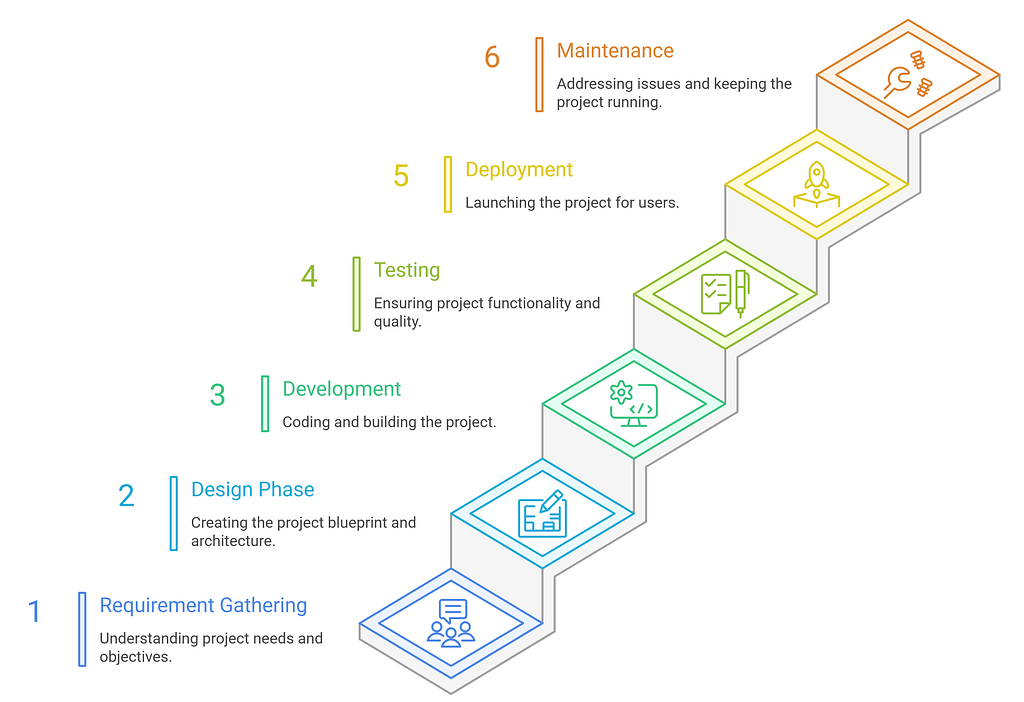
- Requirements Specification (The Contract): This phase produces a Software Requirements Specification (SRS) document that can run hundreds of pages. Every button, every calculation, every data field is defined. This document becomes the legally binding or politically binding agreement between the client and the vendor.
Risk Implication: If the client signs off on this and later says, “Actually, I meant for the button to be blue,” the project manager opens the document and points to the signature. This is a Change Request, which requires renegotiation of time and budget. - System Design (The Blueprint): This phase translates the SRS into technical architecture. It defines the database schema, the server infrastructure, the class diagrams, and the pseudo-code logic. A flaw here is fatal. If the database is designed without considering future reporting needs, fixing it six months later requires a data migration project of its own.
- Implementation (The Construction): This is the phase most people think of as “the project.” Developers write the code strictly adhering to the design document. There is little room for “creative coding.” The goal is fidelity to the spec, not innovation.
- Testing (The Inspection): In Waterfall, testing is a distinct, late-stage phase. This is the model’s Achilles’ Heel. If a fundamental usability flaw was missed in the Requirements phase, it is discovered here, after the budget is 80% spent. Fixing a requirements error at this stage can cost up to 100x more than fixing it during the design phase.
- Deployment and Maintenance: The “Big Bang” release. The software is handed over, the team celebrates, and then the maintenance team fields calls about why the “Submit” button is in the bottom left corner instead of the right.
The Non-Negotiable Use Cases for Waterfall
Despite its rigidity, Waterfall is not obsolete. It thrives in environments where failure is not an option and process audit is mandatory.
- Government and Defence: A missile guidance system cannot be “iterated” after launch. It must work exactly as specified, and every line of code must be traceable back to a requirement signed by a general. The documentation is the proof of safety.
- Medical Device Software (FDA Regulated): Class III medical devices (like pacemaker firmware) require a rigorous Design History File (DHF). Agile’s “working software over documentation” mantra is literally illegal in this context. The FDA demands to see the sequence of documents: Requirement -> Risk Analysis -> Design Output -> Verification Test.
- Fixed-Price Outsourcing: If you are a vendor in India or Eastern Europe building a system for a client in the US on a fixed bid of $500,000, you cannot afford scope creep. You need a locked SRS to protect your profit margin. Every extra line of code you write beyond the spec is money out of your pocket.
Part 2: The Agile Mindset — The Art of the Possible
The Manifesto and the Mindset Shift
The Agile Manifesto (2001) was a reaction against the “death march” projects of the 1990s — projects that delivered software that was perfectly documented but completely useless to the business. Agile is not a process; it is a value system:
- Individuals and interactions over processes and tools.
- Working software over comprehensive documentation.
- Customer collaboration over contract negotiation.
- Responding to change over following a plan.
The Anatomy of an Iteration (Sprint)
Agile recognizes that the human brain cannot fully grasp the complexity of a software system upfront. We learn by seeing and touching.
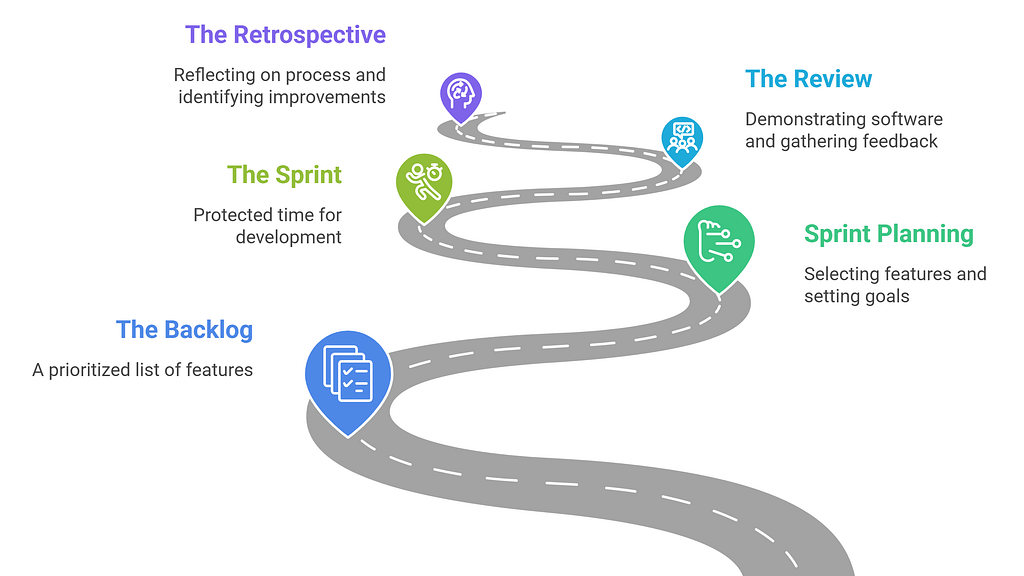
- The Backlog: A living, breathing, prioritized list of features. It is never complete.
- Sprint Planning: The team pulls the highest value item from the top of the backlog and asks, “Can we deliver a working, tested increment of this in 2 weeks?”
- The Sprint: A protected time-box. The Product Owner is not allowed to throw new requirements at the team (unless it’s a true emergency). This allows developers to achieve “flow.”
- The Review: The team demonstrates actual working software to stakeholders. This is the moment of truth. The stakeholder says, “Oh, I see it now. That’s not quite what I meant.” This is a triumph in Agile, not a failure. Catching a misunderstanding after 2 weeks is vastly cheaper than catching it after 6 months.
- The Retrospective: The team looks inward: “How did we work together? Did we waste time on that slow test suite? Let’s fix it this week.” This is continuous improvement baked into the calendar.
The Fallacy of “Agile Means No Planning”
This is the most damaging myth about Agile. Agile requires more discipline, not less. It requires Just-In-Time Planning. You plan the high-level roadmap (the “Epic”), but you only lock in the detailed technical decisions for the immediate sprint. You defer commitment until the Last Responsible Moment — the moment when delaying further will cause more harm than good. This is a risk management strategy: you are betting that in two weeks, you will know more about the problem than you know today.
When Agile Shines (and When It Burns)
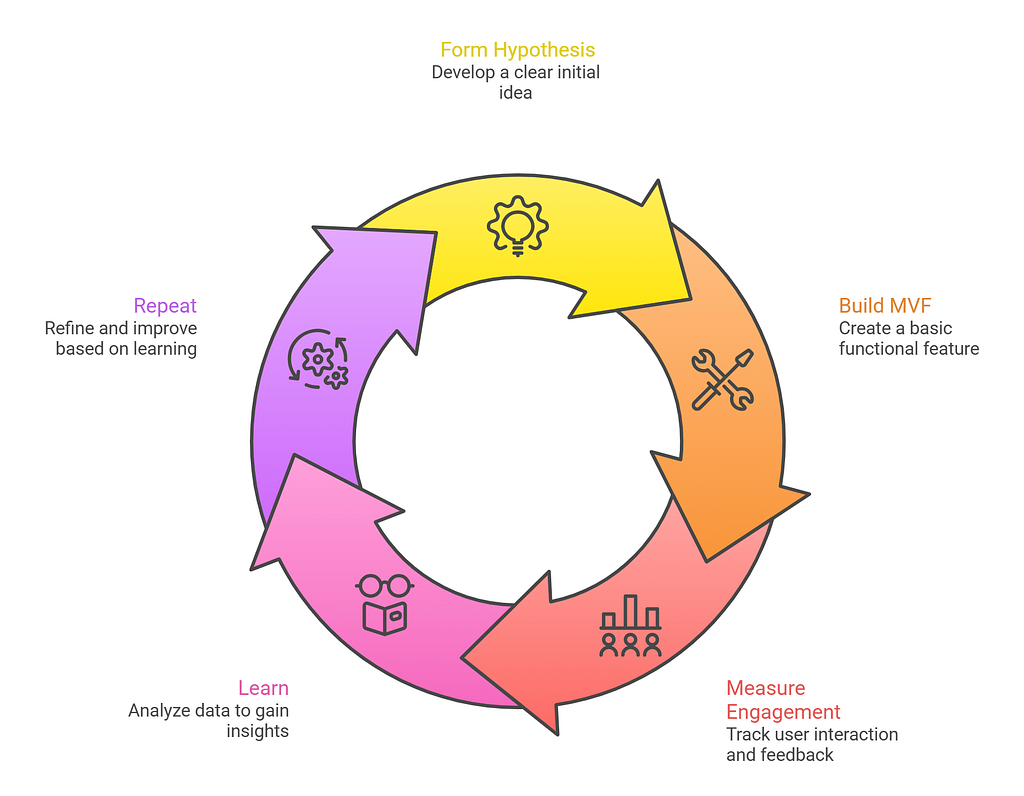
- Startups and New Product Development: You are searching for Product-Market Fit. You don’t know what the user wants. Agile is a scientific method:
- Greenfield Projects: Building something from scratch on new technology. The unknowns are high. Agile allows the architecture to emerge organically rather than being over-engineered upfront.
Warning: Agile fails spectacularly when the culture is not ready. If management still demands a fixed date and fixed scope for a project 12 months away, applying “Scrum” labels to the work will only result in a “Scrummerfall” disaster — a chaotic mess where the team is expected to be flexible while being held to an inflexible, invisible Waterfall deadline.
Part 3: A Pragmatic Framework for Decision Making
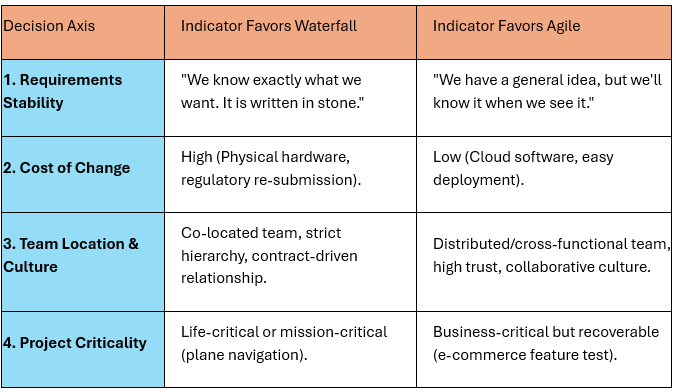
Given the strengths and weaknesses of both, how do you choose? Use the following four-axis evaluation during your project intake.
The Rise of the Hybrid Model (Wagile)
In the real world, pure models are rare. Most large enterprises operate in a Hybrid mode.
- The “Waterfall Sandwich”: The project is funded using a Waterfall Business Case (Year 1 Budget = $2M). However, the actual execution of the work is done using Agile Sprints. This allows the CFO to sleep at night (fixed budget) while the development team remains productive (flexible scope). The trade-off: If the Agile team discovers a better, cheaper way to meet the business goal, they may not be allowed to do it if it violates the pre-approved, Waterfall “Scope Statement.”
- Upfront Architecture, Agile Delivery: For complex systems integration, you must design the interfaces between systems upfront (a Waterfall mini-phase). Once the “contracts” between the different software components are set, each component team can use Agile to build the internals of their component as fast as they want.
Conclusion: The Manager’s Role
As a software project manager, your job is not to be a purist. Your job is to manage risk. Sometimes the biggest risk is building the wrong thing (use Agile). Other times the biggest risk is building the thing wrong due to lack of coordination (use Waterfall). Listen to the project’s unique heartbeat before prescribing the medicine. The best methodology is the one that the team and the stakeholders agree to follow with discipline.
Predictable Chaos: A Survival Guide for Modern Software Teams was originally published in Towards AI on Medium, where people are continuing the conversation by highlighting and responding to this story.
