
Open-Source AI vs. Proprietary AI

The Real Battle Isn’t About Intelligence
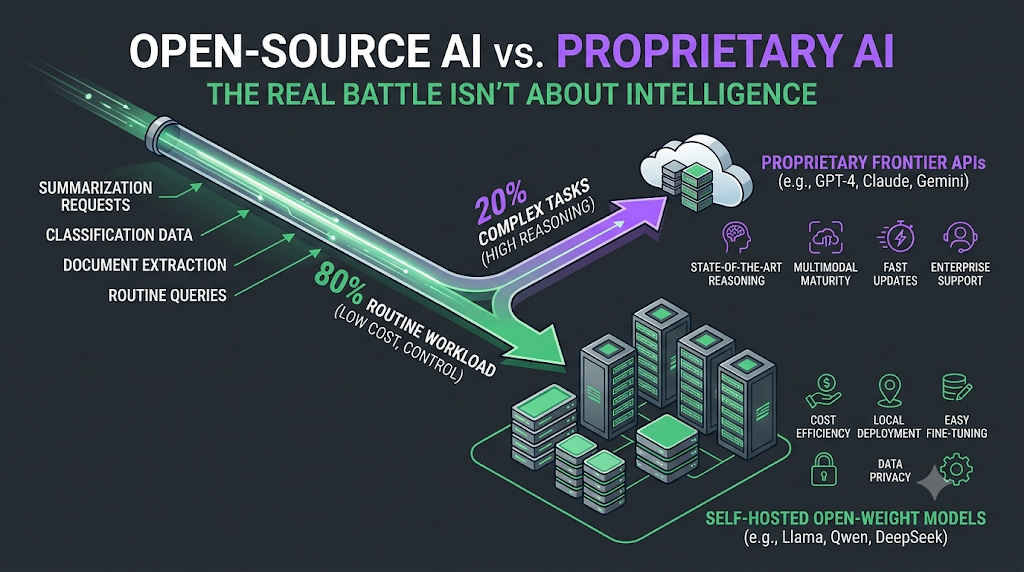
Every few months, a new leaderboard resets the conversation. A model tops MMLU-Pro, or edges out a rival on a coding benchmark, and the headlines write themselves: open-source catches up to closed AI, or proprietary AI pulls ahead again. It’s a tidy narrative, and it’s been wrong for long enough that most technical audiences have already absorbed the correction: it was never about which model is smarter. It’s about cost, privacy, customization, and who holds the controls when the vendor changes the terms.
That correction is right. It’s also starting to calcify into its own kind of laziness.
“We’re self-hosting an open-weight model for data sovereignty and to avoid vendor lock-in” has become the reflexive line handed to a board or an engineering all-hands before anyone actually runs the arithmetic. And when you run it, a meaningful share of the organizations invoking that justification would be spending less money and shipping faster on a proprietary API. The interesting fight in 2026 isn’t open versus closed. It’s whether an organization is honest with itself about its own operational maturity before it commits to running inference infrastructure at all — because “control” is only an advantage if you’re actually capable of exercising it.
What Counts as Open-Source (or Open-Weight) AI?
The label “open-source AI” gets applied loosely enough to cover models that have almost nothing in common with open-source software as the term was originally understood. The distinction has legal and operational teeth, so it’s worth being precise.
Meta’s Llama 4 family — Scout and Maverick, with the larger Behemoth model still unreleased as of this writing — ships under the Llama Community License, not an OSI-approved open-source license. You can download the weights, self-host, and fine-tune freely, but the license carries a specific commercial ceiling: once a downstream product crosses 700 million monthly active users, Meta requires a separate license. That threshold excludes almost everyone reading this, but it’s a real restriction, and it’s why Llama is more accurately described as open-weight than open-source.
Mistral, the French lab, takes the same open-weight approach across Mistral Large 3 and the newer Small 4 and Medium 3.5 releases, mixing permissive and restricted terms depending on the tier.
DeepSeek and Alibaba’s Qwen family sit on the more permissive end. DeepSeek’s V4 generation — the 1.6-trillion-parameter V4-Pro and the leaner V4-Flash — ships under the MIT license, about as unrestricted as terms get for a frontier-class model. Qwen 3.5 follows the same pattern under Apache 2.0. Both permit commercial use, modification, and redistribution with essentially no strings beyond a copyright notice, which is why Apache 2.0 and MIT have become the closest thing this industry has to a genuine open-source gold standard.
The pattern worth noticing: the labs racing hardest for developer adoption — DeepSeek, Alibaba, and a growing cluster of Chinese labs including Zhipu’s GLM and Moonshot’s Kimi — have converged on fully permissive licensing as a deliberate go-to-market strategy. Meta, despite popularizing “open” as a brand identity, still ships under custom terms. “Open-weight” and “open-source” are not interchangeable, and the fine print determines which one you’re actually deploying.
What Makes Proprietary AI Different?
Proprietary AI — ChatGPT, Claude, Gemini, and the API surfaces behind them — sells something categorically different from a set of downloadable weights. It sells a managed service: inference infrastructure you never provision, model updates you never test and redeploy yourself, uptime SLAs, dedicated enterprise support tiers, and one throat to choke when something breaks.
The commercial structure follows from that. Subscription tiers for individual users, usage-based API pricing for developers, negotiated enterprise agreements that bundle in security review, data-handling guarantees, and compliance documentation. You’re not just buying tokens; you’re buying the outsourcing of an operational burden — GPU procurement, quantization, load balancing, monitoring, and the constant work of keeping a serving stack current as architectures evolve.
For a lot of organizations, that trade is the entire point. Nobody wants their three ML engineers spending a quarter debugging expert-parallelism configuration when the actual business problem is document classification.
Where Proprietary AI Still Leads
The performance gap between open and closed models has compressed faster than almost anyone predicted two years ago. But near-parity on aggregate benchmarks is not the same as equivalence in production, and proprietary AI keeps a real edge in a few places that matter disproportionately at enterprise scale:
- State-of-the-art reasoning on the genuinely hard tasks. On multi-step agentic reasoning and ambiguous real-world problems without clean training signal, frontier proprietary models still tend to sit at or near the top, even as open models close in on nearly everything else.
- Multimodal maturity. Native, tightly integrated handling of vision, audio, and long-context documents remains more consistent on the leading proprietary platforms, even as open labs close this gap quickly.
- Update cadence without operational cost. A proprietary model improvement ships transparently behind the same API. An open-weight upgrade means someone on your team evaluates, tests, and redeploys every version bump manually.
- Enterprise accountability. Formal SLAs, dedicated account teams, audit trails, and a single vendor to hold responsible — this is difficult to replicate with a self-hosted stack, no matter how good the model underneath it is.
None of this is permanent. It’s the honest current state of a gap that’s been shrinking every quarter, not a hypothetical future one.
Why Open Models Are Growing Fast Anyway
If proprietary AI still leads at the frontier, why is open-weight adoption accelerating so hard? Because most enterprise AI workloads were never operating at the frontier to begin with — and the economics of open deployment, at real volume, have become impossible to ignore.
Cost is the biggest lever, and it’s not subtle. DeepSeek’s V4-Flash lists at a small fraction of the per-token price of a comparable proprietary flagship — the gap between roughly $0.14 per million input tokens and the several-dollars-per-million range frontier proprietary APIs command isn’t a rounding error, it’s an order-of-magnitude difference that compounds hard at production volume.
Local deployment isn’t a preference in regulated industries; it’s the only option that clears legal review. Defense-adjacent work, healthcare, and anything with data residency requirements often can’t send certain data to a third-party API at all, full stop.
Data privacy follows the same logic. Every token sent to a proprietary API leaves your infrastructure boundary, however strong the contractual guarantees. Self-hosted models never leave the building.
Fine-tuning for narrow, high-value tasks is dramatically easier with open weights, where you have full access to model internals, than through a closed API where customization is limited to prompting, retrieval, or a constrained fine-tuning product the vendor decides to offer.
Vendor lock-in avoidance has become a boardroom-level concern in its own right. Pricing changes, model deprecations, and increasingly geopolitical friction over chip export controls have made “what happens if our provider changes the terms” a question CFOs now ask before signing.
Worth separating out here, because it changes the rest of this analysis: only two of those five advantages — data residency and full data privacy — actually require self-hosting. Cost, fine-tuning access, and most of the lock-in relief are available through hosted open-weight providers — Together AI, Fireworks, Groq — that run the same DeepSeek or Qwen weights on their own infrastructure and sell inference by the token, the same transaction shape as a proprietary API. That’s a third deployment mode sitting between “pay OpenAI per token” and “run your own GPU cluster”: same open license, someone else’s utilization, a price close to the open-weight sticker rather than the proprietary one. It captures most of the economic upside of open weights without requiring an organization to operate inference infrastructure at all.
The result: combined adoption across proprietary, hosted open-weight, and self-hosted open-weight has shifted hard toward the open-weight column — led by DeepSeek and Qwen, from roughly one percent to around fifteen percent of global AI usage share in about a year. That shift has almost nothing to do with those models being smarter and everything to do with them being cheaper and less encumbered. But it’s not one shift — it’s two different ones with very different risk profiles, and the industry conversation usually collapses them into a single “open-weight is winning” headline.
The maturity argument that follows applies to one of those two, specifically: self-hosting. Hosted open-weight sidesteps it almost entirely.
What Businesses Actually Care About
Here’s the arithmetic the self-hosted route specifically skips — the one nobody runs before choosing it over the hosted-open-weight middle path above.
DeepSeek’s 0.14−per−million−tokenlistpriceisa∗hostedAPI∗price — DeepSeek′sowninfrastructure,atDeepSeek′sutilization.Itisnotwhatyourorganizationpayspertokenonceyouself−hostthesameweights.AproprietaryAPIproviderspreadsGPUcostacrossthousandsoftenantswithcontinuousbatchingrunningnear−constantutilization,whichispreciselywhatmakescheapper−tokenpricingpossibleinthefirstplace.Asingleenterpriseself−hostingamixture−of−expertsmodel — DeepSeekV4−Proactivates49billionofits1.6trillionparameterspertoken,Qwen3.5activatesacomparablefractionofits397billion — hastohitsimilarutilizationonitsowntoseesimilareffectivecosts.Belowthatvolume,GPUssitidlebetweenrequestsandtheeffectivecostpertokencanrunwellabovethestickerpriceoftheproprietaryAPIitwasmeanttoreplace.Prefill(processingtheprompt)anddecode(generatingoutput)alsocarrydifferentcostprofilesthatanaive”0.14-per-million-token list price is a *hosted API* price — DeepSeek’s own infrastructure, at DeepSeek’s utilization. It is not what your organization pays per token once you self-host the same weights. A proprietary API provider spreads GPU cost across thousands of tenants with continuous batching running near-constant utilization, which is precisely what makes cheap per-token pricing possible in the first place. A single enterprise self-hosting a mixture-of-experts model — DeepSeek V4-Pro activates 49 billion of its 1.6 trillion parameters per token, Qwen 3.5 activates a comparable fraction of its 397 billion — has to hit similar utilization on its own to see similar effective costs. Below that volume, GPUs sit idle between requests and the effective cost per token can run well above the sticker price of the proprietary API it was meant to replace. Prefill (processing the prompt) and decode (generating output) also carry different cost profiles that a naive “ 0.14−per−million−tokenlistpriceisa∗hostedAPI∗price — DeepSeek′sowninfrastructure,atDeepSeek′sutilization.Itisnotwhatyourorganizationpayspertokenonceyouself−hostthesameweights.AproprietaryAPIproviderspreadsGPUcostacrossthousandsoftenantswithcontinuousbatchingrunningnear−constantutilization,whichispreciselywhatmakescheapper−tokenpricingpossibleinthefirstplace.Asingleenterpriseself−hostingamixture−of−expertsmodel — DeepSeekV4−Proactivates49billionofits1.6trillionparameterspertoken,Qwen3.5activatesacomparablefractionofits397billion — hastohitsimilarutilizationonitsowntoseesimilareffectivecosts.Belowthatvolume,GPUssitidlebetweenrequestsandtheeffectivecostpertokencanrunwellabovethestickerpriceoftheproprietaryAPIitwasmeanttoreplace.Prefill(processingtheprompt)anddecode(generatingoutput)alsocarrydifferentcostprofilesthatanaive”/million tokens” comparison flattens out entirely, and most in-house TCO calculators never model that asymmetry.
Then there’s the accuracy tax nobody puts on the slide. Getting a trillion-parameter open-weight model onto hardware a mid-market company can actually afford usually means quantizing it — running it at 8-bit or 4-bit precision instead of the full weights. That saves real money and real memory. It also costs real accuracy, in ways that don’t show up until the model is already in production and a support workflow starts giving subtly worse answers than it did in evaluation.
None of this means self-hosting is a bad idea. It means self-hosting is a good idea conditional on volume and operational maturity that most organizations claiming to want it don’t yet have. The break-even point for self-hosting typically lands somewhere between fifteen and forty million tokens processed per month, sustained — not peak, sustained. Below that, a proprietary API is very often cheaper once engineering time is priced in. Above it, self-hosting starts winning decisively, but only for teams that already have the ML infrastructure discipline to run it well.
That’s the piece the “control” narrative quietly skips: control isn’t free, and organizations that lack the operational maturity to exercise it end up with the worst of both worlds — the cost profile of self-hosting without the utilization to make it cheap, and the reliability profile of a project nobody is fully staffed to maintain. Worth being precise about the evidence here rather than overreaching it: widely cited industry research this year put the failure rate of generative AI pilot programs at roughly 95 percent, measured by whether they produced any measurable financial impact. That figure covers GenAI pilots broadly — it isn’t a self-hosting-specific breakdown, and the research points to workflow integration and organizational misalignment as the cause, not model or deployment choice. It’s not evidence that self-hosting fails more often. It is evidence that deployment architecture is rarely the variable actually deciding whether an AI initiative works, which is exactly why choosing self-hosting for the sovereignty narrative, without the operational discipline to run it, adds infrastructure risk without buying the outcome it was meant to protect.
A rough decision map, stripped of the sovereignty rhetoric:
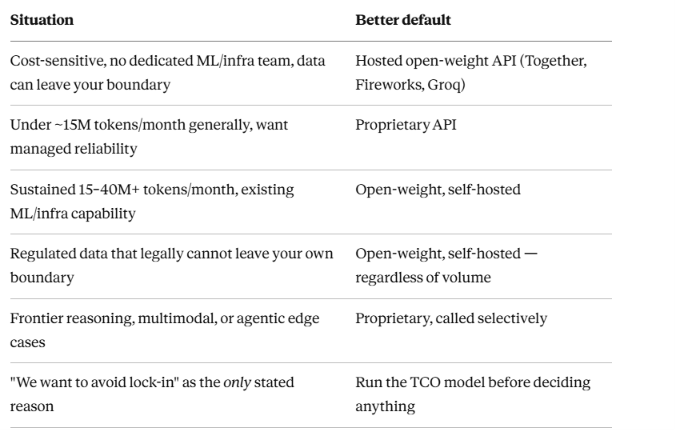
Note the honest limit of that top row: hosted open-weight solves the utilization problem, not the trust problem. Your data still leaves your boundary — just to Together or Fireworks instead of OpenAI or Anthropic — and you’ve swapped one infrastructure vendor’s terms for another’s, on an open license. It’s a genuine middle path for cost and flexibility, not a full sovereignty solution, and treating it as one is the same reflexive mistake in a cheaper wrapper.
Reliability, compliance, scalability, and integration cost still matter enormously — they’re just downstream of getting this first calculation right. A cheap model that requires infrastructure you can’t yet run reliably isn’t actually cheap.
The Future Isn’t One Winner
The framing of “open-source vs. proprietary” assumes organizations eventually converge on one answer. Every signal from the current market says the opposite: the winning pattern is a portfolio, not a pick.
Request
   |
   v
+-------------------+
|   Routing layer    |  -- classifies task: complexity, sensitivity, volume
+-------------------+
   |                              |
   v                              v
Open-weight model            Proprietary frontier model
(routine, high-volume,       (hard reasoning, multimodal,
 sensitive/regulated data)    low-volume edge cases)
A router that sends the bulk of routine, high-volume requests — classification, extraction, summarization, first-pass drafting — to a self-hosted or hosted open-weight model, while reserving expensive proprietary frontier calls for the smaller slice of tasks that genuinely need top-tier reasoning or multimodal capability, is quickly becoming the default enterprise architecture rather than the exception. Current deployment patterns suggest something close to an 80/20 split along these lines: most volume on cheaper models, a minority of harder tasks escalated to frontier proprietary ones.
That shifts the real engineering skill away from model selection and toward the router itself: quality monitoring across providers, graceful degradation when one provider changes pricing or deprecates an endpoint, and model-agnostic serving infrastructure that lets you swap providers without a rebuild. With Chinese labs increasingly optimizing new model generations for domestic chip ecosystems and export controls periodically reshaping which models and hardware are accessible where, betting an entire AI stack on one vendor, one region, or one licensing regime is a strategic risk in a way it simply wasn’t three years ago. The orchestration layer is turning into a more durable competitive advantage than any single model choice underneath it.
Conclusion
The open-source-versus-proprietary debate keeps getting framed as a capability contest, and it keeps producing the wrong headline. Capability convergence is real and will likely keep going. It was never the variable actually driving enterprise decisions.
But the corrective take — it’s about cost, privacy, customization, and control, not intelligence — has become comfortable enough that organizations now reach for it without doing the arithmetic underneath it. Intelligence is being commoditized toward zero. Cost structure, deployment flexibility, and organizational readiness are what’s scarce, and “control” is only worth what an organization is actually equipped to do with it. Before any strategy gets adopted reflexively, the honest question isn’t “open or proprietary.” It’s not even a binary — there’s a real middle path in hosted open-weight inference that most of this debate ignores. The actual question is whether you’ve run the numbers on your own volume, your own team, and your own operational maturity, and picked the deployment mode — proprietary, hosted open-weight, or self-hosted — that your organization can actually execute. That’s the calculation deciding this, not the leaderboard.
Open-Source AI vs. Proprietary AI was originally published in Towards AI on Medium, where people are continuing the conversation by highlighting and responding to this story.
