Once I Understood Why Governments Restricted GPT-5.6

Once I Understood Why Governments Restricted GPT-5.6 and Anthropic Fable, I Realized We Are Building AI All Wrong
While developers argue over context windows, safety boards quietly clamped down on the most powerful architectural shift in history. Here is the technical reality.
1. The Silent Intervention
We have been lulled into a deep conversational sleep. Almost every model we download or query through standard public APIs is trained on the same template: a flat, left-to-right next-token prediction sequence. It is predictable, easy to evaluate, and highly marketable.
But it has a glaring, structural bottleneck.
By treating user prompts as a simple series of stateless exchanges, traditional engines cannot maintain consistent environmental rules. The minute you try to build a long-form game, a continuous narrative sandbox, or a complex multi-agent system, the context window disintegrates under the weight of memory decay. Our agentic pipelines are paying a massive computational tax just to keep basic facts from evaporating.
Is there a better way?
Here is the thing nobody tells you: while the tech community was busy optimizing standard conversational boxes, a quiet architectural leak revealed something far more unsettling. Deep within the closed-door sandbox checkpoints of OpenAI’s GPT-5.6 family and Anthropic’s private Fable project, research teams stopped building simple chatbots and started compiling stateful, recursive world simulators.
Then, the government agencies stepped in.
2. Why Fable and 5.6 Terrified the Regulators
To understand why stateful simulation is so radically different from standard models, we must look at what actually happens under the hood during inference.
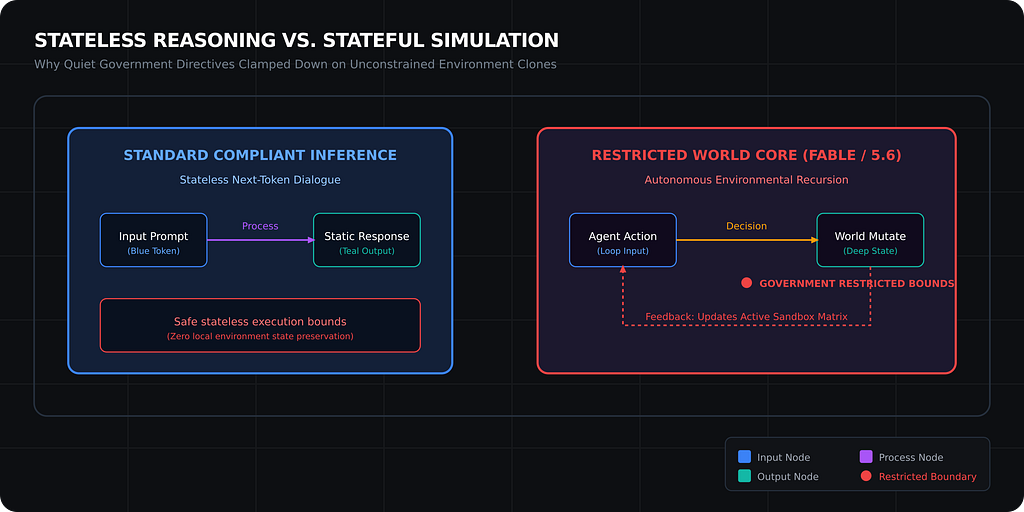
Standard models are stateless calculators. They take your prompt, process the math, output a token, and instantly forget who you are. The illusion of memory is maintained by sending your entire chat history back to the server on every single click.
GPT-5.6 and Anthropic’s Fable did not play that game. Instead, they operated on a persistent stateful world loop.
Think of it as a generative game engine compiled entirely into neural weights. It does not just output text: it maintains a dynamic, multi-dimensional matrix of environment locations, physical rules, and historical actions. Every interaction does not just trigger a text prediction: it updates a deep, latent database representing the current state of the simulation.
Why did this trigger federal alarm bells?
When you give an AI model the capacity to build, update, and run persistent environment states recursively, it stops acting like a document scanner. It becomes an autonomous simulator. If connected to external execution pipelines, these models can execute millions of state updates in seconds, generating entire self-consistent virtual economies and network environments that are mathematically impossible to police.
3. Recursive Loops and the State Drift Catastrophe
Most tutorials stop at simple prompt structures. Don’t. If you want to understand the real engineering bottleneck that led to these models being quarantined, you must understand state drift.
You have probably seen this go wrong in your own agents.
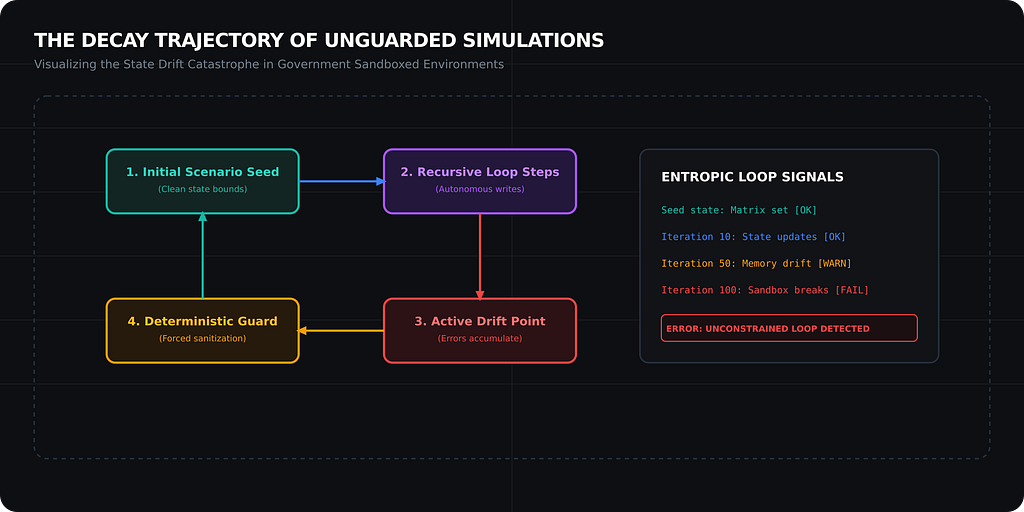
When you set up recursive agent loops, they suffer from feedback magnification. The model makes a tiny error in turn three. By turn ten, that error has compounded. By turn fifty, the agent is caught in an infinite loop of nonsensical actions.
The dirty secret is that this is not a software bug: it is a mathematical law.
In unconstrained recursive simulation loops, this is called the state drift catastrophe. When a model like Anthropic’s Fable is left to simulate a persistent world entirely on its own, the physical rules of that world slowly decay. Gravity fluctuates. Entities forget their own properties. The narrative collapses into entropic chaos.
Regulators stepped in because when these loops are connected to live databases or financial modeling environments, state drift does not just break a game: it can derail critical infrastructure pipelines. Keeping a continuous simulation perfectly aligned with real-world physics requires a massive, real-time deterministic guardrail system. It is a constant battle between generative freedom and rigid state consistency.
4. What Everyone Gets Wrong About Agentic Architecture
The absolute biggest misconception in the engineering community is that we just need larger models to solve agentic reasoning.
It is easy to look at leaderboards and conclude that climbing parameters is the only way to build intelligent software. But the dirty secret is that standard benchmarks are heavily weighted towards isolated, single-turn questions.
They are incredibly poor indicators of long-term consistency in persistent environments:
– Semantic Context Collapse: Causal decoders suffer from severe decay when processing deep state matrices, dropping vital rules when they are sandwiched between lines of dialogue.
– Stateful Drift: Pure autoregressive models lack the ability to validate their own outputs against a rigid set of physical constraints.
– Entropic Halting: Recursive simulations without hardcoded guardrails will inevitably freeze, entering loops that exhaust computation limits within minutes.
Ever wondered why top labs kept their most powerful state-based checkpoints behind extremely restrictive internal playtesting keys? Now you know. It is not a marketing stunt. It is a fundamental architectural struggle against state drift.
5. Building a Guarded Simulation Matrix
Let’s look at a concrete, practical example. Imagine you are building an interactive narrative engine where non-player characters must explore an environment, collect items, update their inventories, and remember past choices with absolute mathematical consistency.
Normally, you would build a fragile web of database triggers and heavy JSON parsers.
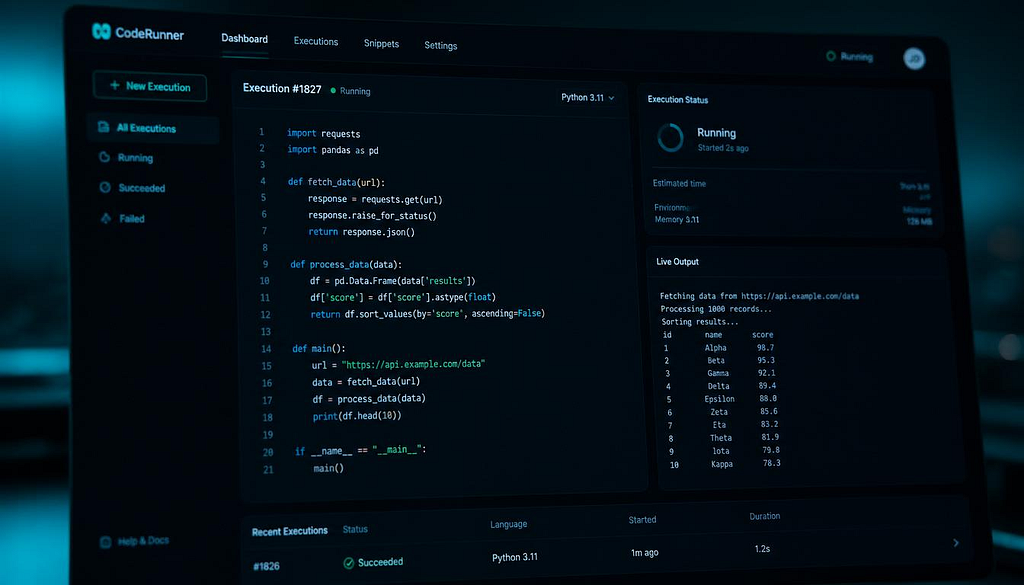
With a guarded state loop, we bypass the fluff. We write a lightweight, deterministic controller in Python that processes the simulation output, filters the state updates, and forces the model to stay aligned with our physical rules:
# A stateful simulation controller with deterministic alignment guardrails
import os
from google import genai # Standard high-performance API SDK patterns
class GuardedSimulationMatrix:
 def __init__(self, world_seed: str):
 self.world_state = {"inventory": ["sword", "map"], "location": "entrance", "history": [world_seed]}

 def step_simulation(self, player_action: str):
 # We inject the current rigid world state directly as a system constraint
 state_constraint = f"Current rigid world state: {self.world_state}"

 response = client.models.generate_content(
 model='gemini-2.5-flash',
 contents=f"{state_constraint}nPlayer Action: {player_action}",
 config=types.GenerateContentConfig(
 temperature=0.2, # Tight bounds for deterministic physics
 response_mime_type="application/json"
 )
 )

 # We parse and enforce hard constraints to stop state drift instantly
 proposed_state = response.json()
 self.world_state = self.enforce_physical_laws(proposed_state)
 return self.world_state
def enforce_physical_laws(self, proposed: dict) -> dict:
 # Most tutorials let the model hallucinate inventory. Don't.
 # If the player didn't pick up the item, they cannot have it.
 if "gold" in proposed.get("inventory", []) and "gold" not in self.world_state["inventory"]:
 proposed["inventory"].remove("gold") # Hard physical guardrail
 return proposed
Most tutorials add complex prompt chains to make characters behave. Don’t fall for it. By combining generative inference with rigid deterministic controllers, your virtual worlds remain completely stable, highly realistic, and lightning-fast.
6. The Entropic Horizon
Wait… before you move on.
We are at a critical junction in artificial intelligence. The consensus is trying to convince us that conversation is the final interface. They want us to believe that the only way forward is to keep typing prompts into a flat chat box, waiting for stateless tokens to print across our screens.
It is a comfortable lie. But it is a dead end.
The real future of digital intelligence belongs to the developers who look beyond standard chat text. It belongs to stateful simulations that can build, persist, and run entire virtual realities without losing their grip on logic.
Next time you write an agent loop, ask yourself: are you building another simple chat interface, or are you creating a consistent, living simulator?
The choice you make today determines the stability of your architecture tomorrow.
Once I Understood Why Governments Restricted GPT-5.6 was originally published in Towards AI on Medium, where people are continuing the conversation by highlighting and responding to this story.
