My First $5,000 Month Writing About AI Engineering on Medium

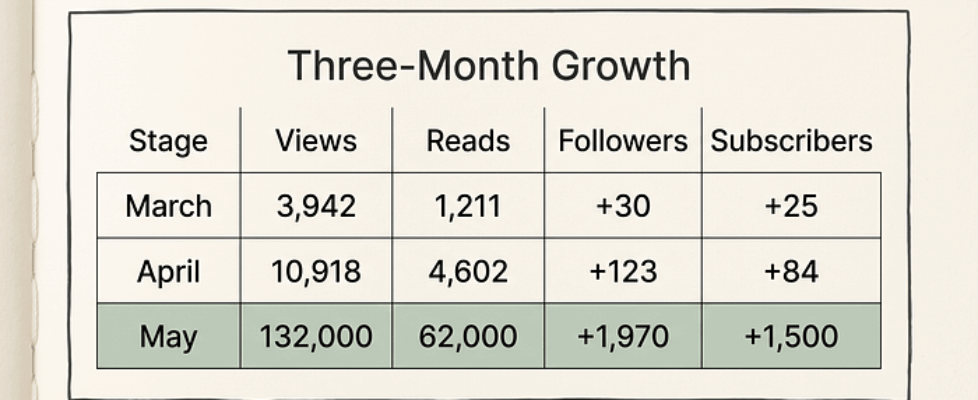
Author(s): Anubhav Originally published on Towards AI. My First $5,000 Month Writing About AI Engineering on Medium In May, my Medium earnings crossed $5,000 from writing about AI engineering. A month earlier, the same account had done 10.9K views. Two months earlier, it was at 3.9K. The jump looks like an overnight success if you only look at the final revenue screenshot. The tempting explanation is that two posts exploded and carried the entire month. That’s true, but it misses the point. If I had published the exact same viral posts on a brand new account, they would have spiked and died. Instead, they spiked and woke up fifteen other articles. Readers clicked on a post about local LLMs, finished it, looked at my profile, and clicked through three more posts on retrieval-augmented generation and agent architectures. The Month That Changed The Account March was quiet. I was publishing consistently and seeing small signals of life — a stray comment here, a highlighted code snippet there. The traffic was random. By mid-April, the compounding started to become visible. I wasn’t getting viral hits, but my baseline daily views were rising. I would publish a new article and older pieces would get a secondary wave of traffic. The catalog was waking up as readers who found one piece of my work started clicking through to the others. Entering the second week of May, the breakout happened. The recommendations stopped being random. The same kind of builder-focused reader kept showing up. When a post took off, the traffic spilled over into the rest of the catalog. I remember refreshing the dashboard on a Tuesday morning and seeing an old RAG post from March suddenly back on the daily charts, sitting right next to an article I had published twelve hours prior. The Wrong Lesson Would Be “Write Viral Posts” When people see a big month, they immediately try to reverse-engineer the biggest hits. Looking at my May dashboard, a few specific articles did most of the numbers. My guide on Claude Code setup pulled in 39,000 views and nearly 20,000 reads, earning about $1,360. A breakdown of the best local LLMs for coding did 39,000 views and 18,900 reads, bringing in just over $2,000 — my single highest-earning post. A curated list of 12 AI books brought in another 28,000 views, 12,800 reads, and $714. The obvious conclusion is that I should just write more listicles and setup guides. Outliers gave me the spike. But the spike only mattered because there were 20 other posts for those readers to land on next. When a developer clicked on the Claude Code setup guide, they got a useful tutorial. At the bottom of that page, however, they saw links to my other work. They found deep technical dives like “RAG Chunking That Works,” “Multi-Agent Systems” and a detailed comparison of LangGraph vs Temporal. If my profile had only contained generic AI news, that developer would have closed the tab. Because it contained dense engineering articles, they realized I was a builder. They hit the follow button, joined the email list, and clicked through to older posts. The Niche Was Narrower Than “AI” I drew a hard boundary around my topics. The niche was not artificial intelligence broadly, but AI engineering specifically. If I wrote about AI in general, I would be competing with news sites and generic content farms. I’d end up writing about how AI is going to change the future of work, which no engineer wants to read. Instead, I broke my niche down into very specific lanes. This specific mapping worked. It had enough search volume to matter, but the code snippets naturally filtered out people looking for ChatGPT prompt hacks. It was also deeply connected. If someone reads an article about RAG chunking, they are a natural fit for a piece about reranking or hybrid search. I had to stay disciplined here. Writing a great article about Python agents today and a generic productivity piece tomorrow would just dilute the exact reader base I was trying to build. Compounding Looked Boring Until It Was Obvious By late April, I realized that compounding in content creation looks like absolutely nothing for weeks. It looks like small, boring movements. I would publish an article and get 50 views. I’d publish another and get 70. Then, older posts started firing together. The pattern repeated every time. One new post would catch attention. Readers clicked on it, finished reading, and the recommendation engine pulled up an article from three weeks ago at the bottom of the page. The Claude Code spike directly helped my older AI coding workflow posts. The AI Books article drove traffic back to my roadmap pieces. The RAG Chunking article kept my technical RAG authority alive and fed traffic to my reranking guide. You cannot judge a technical article by its first week of traffic, because an article about Python agents might sit dead for a month until a related LangGraph piece suddenly revives it. Technical Deep Dives Worked, But Not Alone I used to think you had to pick: deep tutorials or broad overviews. May taught me you need both, for different reasons. Deep technical dives proved my competence. My article on RAG Chunking was dense, filled with regex patterns for markdown parsing and detailed explanations of semantic boundaries. It didn’t go viral. It did 2,700 views and 1,100 reads. But the people who clicked it read it, holding a read ratio around 40%. Meanwhile, my deep-dive architectural comparison of LangGraph vs Temporal did only 959 views, but it earned $119.91. That is a high earnings-per-view ratio. It monetized well because it answered a specific architectural question that senior engineers were searching for. They were trying to decide between state machines and durable execution for their agent orchestration, and they spent ten minutes reading every word of that post. The biggest discovery came from posts with broader entry points. The Claude Code setup guide and the Local LLMs […]
