MiniMax M3 Decodes 1M Tokens 15x Faster — and It Shouldn’t Be This Cheap

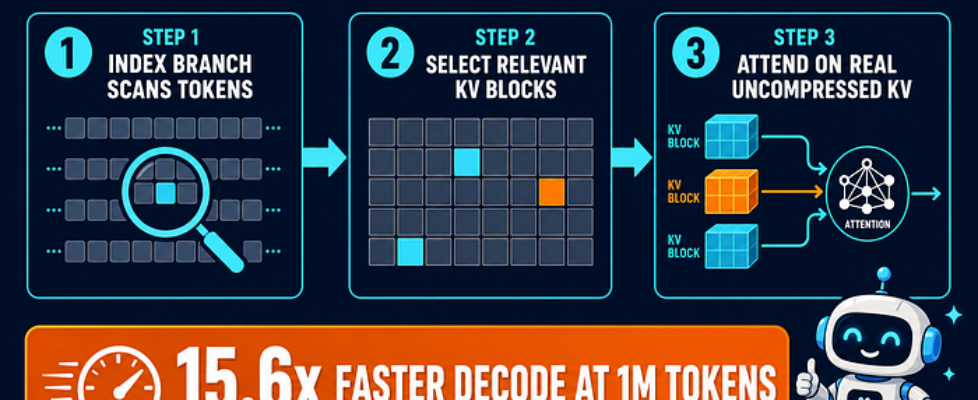
Author(s): Chew Loong Nian – AI ENGINEER Originally published on Towards AI. MiniMax M3 Decodes 1M Tokens 15x Faster — and It Shouldn’t Be This Cheap On June 1, a Shanghai lab quietly shipped a model that decodes a 1-million-token context 15.6x faster than its own previous generation — and charges you roughly 8% of what Claude Opus costs to do it. I spent two days poking at MiniMax M3 through the API, and the part that actually rewired how I think about long-context isn’t the benchmark table everyone is screenshotting. It’s the attention mechanism underneath it. After the lead, the article argues that MiniMax’s real breakthrough isn’t just the speed claims or headline SWE-Bench results, but the model’s architecture: MiniMax Sparse Attention (MSA). The author explains why standard attention becomes prohibitively expensive at 1M-token context lengths and contrasts MSA with other approaches like DeepSeek’s latent attention (MLA) and native sparse attention (NSA). MSA is described as using a lightweight index branch on top of grouped-query attention to select relevant KV cache blocks for queries, running attention only on those selected blocks while using real (uncompressed) key-values and optimizing GPU memory access via a “KV outer gather Q” pattern. The piece then revisits reported benchmarks with caveats that scores are vendor-reported and independent testing wasn’t possible at launch because weights weren’t released, noting that while M3 is competitive for coding, it is weaker in multimodal grounding and hallucination-related performance. It emphasizes that the pricing is the standout differentiator—especially the very low per-million-token input and output costs—making long-context agentic workflows economically feasible. The author provides quick-start guidance for using M3 via OpenRouter or MiniMax’s API, suggests practical tests for long-context behavior, and concludes with a nuanced verdict: M3 may not be the absolute smartest overall, but its cost and 1M-token economic viability are a genuinely new product category, with remaining uncertainty tied to benchmark independence and the still-pending open weights. Read the full blog for free on Medium. Join thousands of data leaders on the AI newsletter. Join over 80,000 subscribers and keep up to date with the latest developments in AI. From research to projects and ideas. If you are building an AI startup, an AI-related product, or a service, we invite you to consider becoming a sponsor. Published via Towards AI
