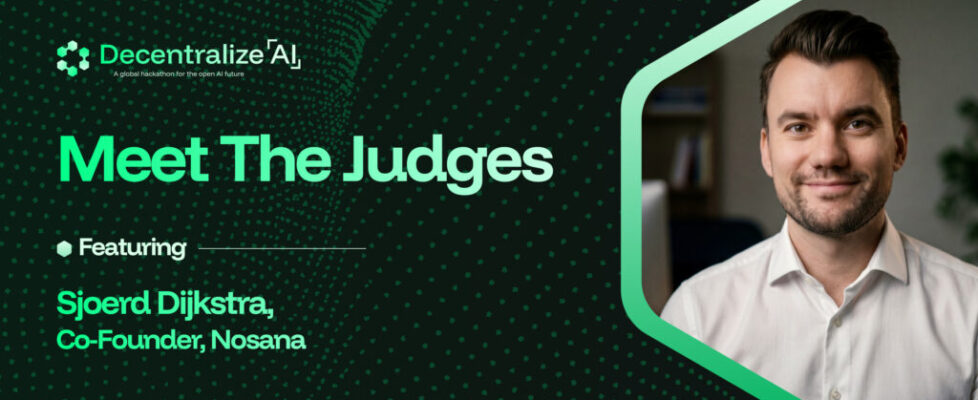
Judge Spotlight: Sjoerd Dijkstra, Co-Founder of Nosana, on Powering AI with Decentralized Compute

This interview is part of the Judge Spotlight series for the Decentralize AI Hackathon, where we sit down with our judges to explore their work, perspectives, and advice for builders.
As a judge for the Decentralize AI Hackathon, Sjoerd Dijkstra, Co-Founder of Nosana, brings years of experience building at the intersection of AI and Web3, along with deep insights into what makes decentralized infrastructure practical for real-world use. In this interview, he reflects on Nosana’s journey, shares his vision for the future of decentralized AI, discusses what he’ll be looking for in hackathon submissions, and offers practical advice for builders creating the next generation of open AI applications.
Nosana has become one of the leading decentralized GPU networks powering AI workloads. Looking back, what inspired you to build Nosana, and how has that vision evolved?
Nosana started from a simple observation: there was a huge amount of underused computing power around the world, while at the same time access to compute was becoming one of the biggest bottlenecks for developers.
Initially, our focus was broader distributed computing, but the rapid growth of AI made the opportunity much clearer. AI teams need reliable and affordable GPU access, yet the market is still highly concentrated among a small number of large providers. We saw an opportunity to create a more open alternative by connecting distributed GPU resources and making them accessible through one network.
The vision has evolved from simply providing decentralized compute to building infrastructure that developers can genuinely use in production. Today, we are focused on making it easier to deploy, run, and scale AI workloads without forcing teams to depend entirely on centralized cloud platforms.
You’ve been building at the intersection of AI and Web3 for years. What’s one lesson or insight that has surprised you the most?
One of the biggest lessons is that the technology itself is rarely the hardest part. The real challenge is making decentralized infrastructure feel as simple and reliable as the tools developers already use.
Builders do not want decentralization just for the sake of decentralization. They want better access, greater flexibility, competitive pricing, and fewer dependencies on a small group of providers. If decentralized infrastructure cannot deliver a strong developer experience, the underlying technology alone will not be enough.
That has shaped how we think about Nosana. The goal is not to ask developers to compromise in order to use decentralized infrastructure. The goal is to make it a practical and attractive choice.
On the Decentralize AI Hackathon
What made you want to join the Decentralize AI Hackathon, and why do you think events like this matter for the decentralized AI ecosystem?
Hackathons are one of the best ways to move an ecosystem forward because they encourage people to build, experiment, and test ideas in the real world.
Decentralized AI is still a relatively young space, and many of its most important use cases have probably not been discovered yet. Events like the Decentralize AI Hackathon give builders the opportunity to explore new models, infrastructure, agents, and applications without being limited by conventional assumptions.
For Nosana, it is also an opportunity to support developers directly and see how decentralized GPU infrastructure performs across a wide variety of workloads. The most valuable insights often come from watching builders use the technology in ways we did not originally anticipate.
What are the first things you look for when evaluating a hackathon project?
The first thing I look for is whether the project solves a real and clearly defined problem. A technically impressive product is interesting, but it becomes much more compelling when the team can explain who needs it and why.
I also look at how well the project uses the available technology. The strongest submissions do not add decentralized infrastructure or blockchain elements simply because they are part of the hackathon. They demonstrate why those components make the product better, more accessible, more resilient, or more open.
Finally, execution matters. Even if the scope is small, a working product with a clear direction is usually more convincing than an ambitious concept that has not been properly demonstrated.
What separates a good submission from a truly standout one?
A good submission shows that the team can build a working product. A truly standout submission also demonstrates a clear and meaningful use of Nosana’s decentralized GPU compute.
The strongest projects do more than deploy a workload to the network. They show why decentralized compute is important to the product, whether that means making AI inference more accessible, reducing reliance on centralized providers, supporting continuous agent workloads, or enabling an application to scale more efficiently.
Clarity also matters. Judges should be able to understand what is running on Nosana, how the compute is integrated into the architecture, and what role it plays in the user experience. A strong live demo, supported by clear deployment details and evidence of real GPU usage, can make the project much more convincing.
Standout teams usually focus on one well-defined use case, implement it properly, and demonstrate how the product could continue using Nosana beyond the hackathon rather than treating the integration as a temporary requirement.
Are there any common mistakes participants should avoid before they hit “submit”?
One common mistake is trying to do too much. Hackathons have limited time, so it is usually better to deliver a focused and functional product than a very broad platform with several unfinished features.
Another mistake is failing to explain the technical architecture. Judges should not have to guess how the project works, what was actually built during the hackathon, or how the infrastructure is being used.
Teams should also avoid leaving the demo until the final moment. A clear video, working deployment, readable documentation, and simple onboarding can have a major impact on how the submission is evaluated.
Most importantly, test the full experience before submitting. Make sure the links work, the repository is accessible, the instructions are clear, and the main use case can be demonstrated without unnecessary friction.
AI infrastructure is becoming increasingly centralized. How do you see decentralized AI changing the landscape over the next few years?
Decentralized AI can play an important role in making compute more sovereign, open, and resilient. Today, much of the AI ecosystem depends on a small number of large cloud providers, which gives those companies significant control over pricing, access, infrastructure availability, and the conditions under which AI products can be built.
Overreliance on these providers creates strategic risks for developers, companies, and even entire regions. If access to compute is controlled by a few centralized giants, smaller teams can face higher costs, limited availability, vendor lock-in, and less control over where and how their workloads are run.
Decentralized networks can offer an alternative by distributing compute across independent providers and giving builders more choice over their infrastructure. This does not mean centralized clouds will disappear, but it can create a healthier and more competitive market where teams are not forced to depend on a single provider.
Over the next few years, I expect sovereign compute to become increasingly important, especially as AI becomes more critical to businesses and public infrastructure. The decentralized networks that succeed will be those that combine this independence with the reliability, performance, transparency, and developer experience required for real production workloads.
What opportunities in decentralized AI are you most excited for builders to explore?
AI agents are one of the most exciting areas because they create ongoing demand for compute rather than a single training or inference task. Agents need infrastructure for deployment, execution, monitoring, evaluation, and coordination, and there is still a lot of room for innovation across that entire lifecycle.
I am also interested in open AI services that can be deployed across distributed infrastructure, including inference APIs, model marketplaces, privacy-focused applications, and tools for communities or languages that are currently underserved by mainstream platforms.
Another important area is infrastructure orchestration. Making distributed GPUs easier to discover, benchmark, schedule, and manage will be essential if decentralized AI is going to scale.
What’s one piece of advice you’d give participants who want to maximize their chances of impressing the judges?
Use the time to build something that could exist beyond the hackathon.
A ten-month program gives participants the opportunity to go much further than a prototype. The strongest teams will validate the problem, test their product with real users, improve it through multiple iterations, and show that the project can grow into something genuinely useful.
Judges will still value clarity, but they will also look for depth of execution. Show how the product evolved, what you learned, how Nosana’s compute supports the core use case, and why the project has long-term potential. A strong submission should not feel like a weekend experiment. It should feel like the beginning of a serious product.
Any final message or words of encouragement for everyone participating in the Decentralize AI Hackathon?
Do not be afraid to experiment. Decentralized AI is still being defined, which means builders have a genuine opportunity to influence what the ecosystem becomes.
Your project does not need to solve every problem or become a complete company during the hackathon. Focus on building something useful, test your assumptions, speak with other participants, and learn as much as possible from the process.
Even if the first version is imperfect, shipping it is already an important step. The ideas and projects developed during this hackathon could become part of the next generation of open AI infrastructure, and I am excited to see what everyone creates.
About the Decentralize AI Hackathon
The Decentralize AI Hackathon brings together builders, developers, and AI innovators to shape the future of decentralized intelligence. With a $51.75K+ prize pool combining cash rewards, token incentives, compute credits, and ecosystem infrastructure support, this hackathon spans two competitive rounds running from May 2026 through February 2027. The grand prize winner will receive the Decentralize.tech domain and website.
Meet our sponsors:
Nosana: Build faster with Nosana. An open-source GPU cloud for startups and builders with instant access, lower costs, and no long-term contracts. Move fast and scale on demand. Try Nosana!
Arweave: Permanent data at any scale – Join the permaweb.
MEXC: At MEXC, we MEXCmize opportunities by offering 0-Fee, deep liquidity, and the broadest access to emerging assets — enabling users to capture value at every stage of the market. Learn more.
