Introduction to Natural Language Processing — Applications, Challenges, and Real-World Examples

By Aniruththen | Research Series at Uki — Yarl IT Hub
Hey everyone! Welcome to the first article of my 4-day series where I’ll be breaking down NLP and Generative AI in the simplest way possible. If you’ve ever wondered how your phone finishes your sentences or how ChatGPT understands what you’re typing, you’re in the right place. Let’s start from the very basics.
What is Natural Language Processing?
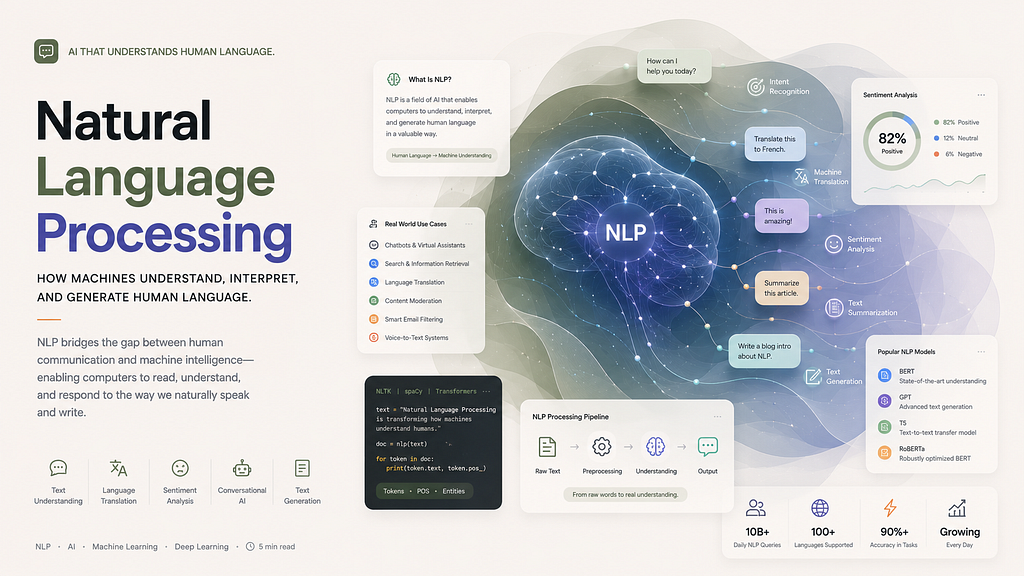
Natural Language Processing, or NLP, is basically the field where computers try to understand human language. Think about it — we humans speak in messy, complicated ways. We use slang, we make grammar mistakes, we say one word but mean something else depending on the situation. Computers don’t naturally get any of that. NLP is the bridge that connects human language to something a machine can actually process.
In simple words, NLP takes text or speech, breaks it down into smaller pieces, and tries to make sense of it using math and rules. That’s it. It’s not magic, it’s just a lot of clever techniques working together.
Before we go into the technical part, let’s understand why this field even exists. Human language has a lot of hidden layers. For example, if I say “I saw the man with the telescope,” it’s not clear if I had the telescope or the man had it. This is called ambiguity, and it’s one of the biggest headaches in NLP.
Why NLP Matters So Much Today
Every single day, we produce huge amounts of text data. Emails, tweets, reviews, chat messages, articles — all of this is unstructured data. It doesn’t come in neat rows and columns like a spreadsheet. NLP helps companies and researchers pull useful information out of this mess.
Here are some real reasons why NLP became such a big deal:
- Businesses want to know what customers feel about their products
- Search engines need to understand what you’re actually asking
- Voice assistants need to convert your speech into commands
- Translation apps need to convert one language into another accurately
Without NLP, all of this would still be stuck in the dark ages where computers only understood strict commands like old DOS systems.
Real World Applications of NLP
Let me walk you through some applications that you probably use without even realizing it’s NLP working behind the scenes.
1. Sentiment Analysis
This is when a system reads a piece of text and decides if it’s positive, negative, or neutral. Companies use this a lot to check product reviews or social media comments. If thousands of people are complaining about a new phone battery, sentiment analysis tools can catch that trend fast, way faster than a human reading every single comment.
2. Machine Translation
Google Translate is the most obvious example here. It takes text in one language and produces the same meaning in another language. This used to be done with strict rule-based systems, but now it uses much smarter approaches which I’ll explain in tomorrow’s article.
3. Chatbots and Virtual Assistants
Siri, Alexa, Google Assistant — all of these rely heavily on NLP. They need to understand what you’re saying, figure out your intent, and respond properly. This involves multiple NLP tasks working together at once.
4. Text Summarization
Imagine having a 10-page document and needing just a short summary. NLP systems can do this by identifying the most important sentences or by generating new sentences that carry the same meaning in fewer words.
5. Spam Detection
Your email inbox filters out spam automatically. This is NLP classifying text as spam or not spam based on patterns it has learned from millions of examples.
6. Named Entity Recognition
This is used to pick out names of people, places, organizations, and dates from a piece of text. News agencies and research tools use this to organize huge amounts of information quickly.
Common Technical Terms You Should Know
Since this is a technical research article, let me introduce a few important terms early on. Don’t worry, I’ll keep the explanation simple, but I want you to get familiar with the vocabulary because you’ll see these words everywhere in NLP material.
Tokenization — This is the process of breaking a sentence into smaller pieces called tokens. A token can be a word, a part of a word, or even a punctuation mark. For example, the sentence “I love NLP” becomes three tokens: “I”, “love”, “NLP”.
Stemming — This is a technique where a word gets cut down to its root form, but the result might not even be a real word. For example, “running”, “runs”, and “runner” might all get reduced to “run” or sometimes even “runn” depending on the stemming algorithm. It’s a rough and quick method.
Lemmatization — This is similar to stemming but smarter. Instead of just chopping off letters, lemmatization actually looks at the word’s meaning and grammar to bring it back to its proper dictionary form, called the lemma. So “better” would become “good” through lemmatization, but stemming would probably not catch that at all.
Lexical Analysis — This refers to analyzing the vocabulary and structure of words in a text. It’s about understanding words at a surface level, meaning what the word literally is, before we even get into what it means in context.
Stop Words — These are common words like “the”, “is”, “at”, “on” that usually get removed during preprocessing because they don’t carry much meaning on their own.
Corpus — A large collection of text data used to train or test NLP models. Think of it as the “textbook” that a model learns from.
I know these terms might feel like a lot right now, but once you see them in action tomorrow when I explain the actual algorithms, everything will click into place.
Why NLP is Genuinely Hard
A lot of people think teaching a computer language should be easy since we do it every day without thinking. But honestly, it’s one of the hardest problems in computer science. Here’s why.
1. Ambiguity
Human language is full of double meanings. Words can mean different things in different situations. “Bark” could be about a dog or about a tree. Machines struggle to pick the right meaning without proper context.
2. Context Dependency
The meaning of a sentence often depends on what was said before it. If I say “It was great,” you need to know what “it” refers to from the previous sentence. Machines have historically found this really tough to track.
3. Sarcasm and Tone
If someone writes “Oh great, my flight got delayed again,” a human instantly understands the sarcasm. A machine might read this as a positive sentence just because of the word “great.” This is still an unsolved challenge in many systems today.
4. Multiple Languages and Dialects
NLP models trained on English data don’t necessarily work well for Tamil, Sinhala, or other languages with different grammar structures. Since I’m writing this from Jaffna, this point personally matters a lot to me because our local languages don’t get nearly as much NLP research attention as English does.
5. Data Quality Issues
Text data from the internet is messy. Spelling errors, slang, emojis, abbreviations — all of this makes it harder for models to learn clean patterns.
6. Lack of Common Sense
Humans use common sense to fill in gaps in conversations. Machines don’t have this naturally, so they can misinterpret perfectly normal sentences that a five-year-old child would understand instantly.
A Small Example to Tie It Together
Let’s say we have this sentence: “The kids were playing happily in the park, but it started raining suddenly.”
For a human, this is simple. For a machine using NLP, here’s roughly what happens step by step:
- Tokenization breaks it into individual words
- Stop words like “the,” “in,” “but,” “it” might get removed depending on the task
- Stemming or lemmatization reduces words like “playing” to “play”
- The system then tries to understand relationships, like who was doing what
- Finally, depending on the goal, it might classify the sentiment (neutral to slightly negative because of the rain interrupting fun) or extract entities like “park”
This whole process happens within seconds, and it’s what powers so many of the tools we use daily.
Wrapping Up Day 1
That’s it for the first article. Today we covered what NLP actually is, why it matters, its major applications, and the real struggles that make this field so complex. Tomorrow, in Day 2, I’ll go deeper into the actual algorithms and techniques behind NLP — things like Bag of Words, TF-IDF, Word Embeddings, and how models like BERT actually work under the hood. That article will be a bit more technical since we’ll be looking at the engineering side of things.
Thanks for reading, and I hope this gave you a solid foundation before we go deeper tomorrow.
References
Some of the concepts and definitions referenced in this article were supported by research material and academic resources from the University of Jaffna. Additional general concepts were cross-referenced from standard NLP literature and documentation commonly used in academic research circles.
- Jurafsky, D. and Martin, J.H., Speech and Language Processing
- Manning, C.D., Raghavan, P., and Schütze, H., Introduction to Information Retrieval
- Some reference material sourced from University of Jaffna academic resources
Introduction to Natural Language Processing — Applications, Challenges, and Real-World Examples was originally published in Towards AI on Medium, where people are continuing the conversation by highlighting and responding to this story.
