Choosing Your AI Stack: Models, Tools & Platforms in 2026 — Prompt to Profit · Day 9 of 30

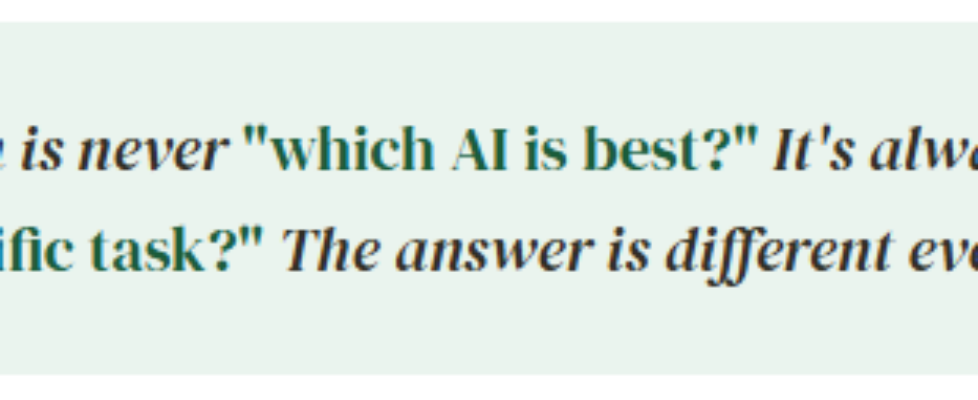
The AI landscape has never moved faster — or been more confusing. This is the no-hype guide to matching the right tool to the right task, every time.
Every week, a new AI model launches with claims of being “the most powerful ever.” Every month, a new tool emerges promising to automate everything. Most people respond by either chasing every shiny thing — constantly switching tools — or by paralysis, sticking with the first AI they tried and never exploring what else exists.
Both approaches leave significant value on the table. Today, we cut through the noise. You’ll leave this article knowing exactly which tools belong in your stack, what each is genuinely best at, and how to build a simple AI setup that covers your real work — without the overwhelm.

Models vs tools — the distinction that matters most
Before we go any further, let’s clear up a confusion that trips up almost every beginner: the difference between a model and a tool. These are not the same thing and mixing them up leads to bad decisions about your stack.
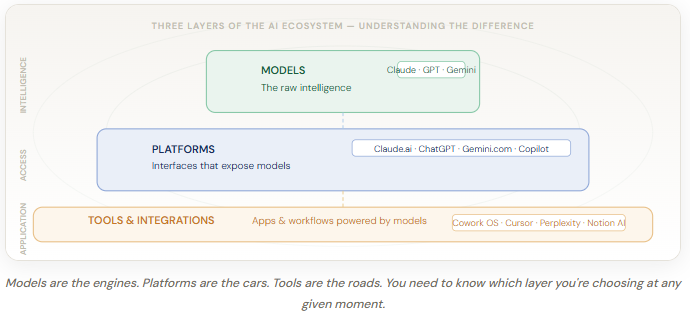
A model is the underlying intelligence — the trained system that can read, reason, and write. Claude, GPT-4o, and Gemini are models. You almost never interact with a model directly.
A platform is an interface that gives you access to one or more models. Claude.ai, ChatGPT, and Gemini.com are platforms. They wrap the models in a usable product.
A tool is a specialised application built on top of a model, designed for a specific kind of work. Claude Cowork OS runs on Claude. Cursor runs on multiple models. Perplexity uses search-enhanced models. These are tools — and the tool you pick matters as much as the model underneath it.
The 2026 landscape — what actually matters
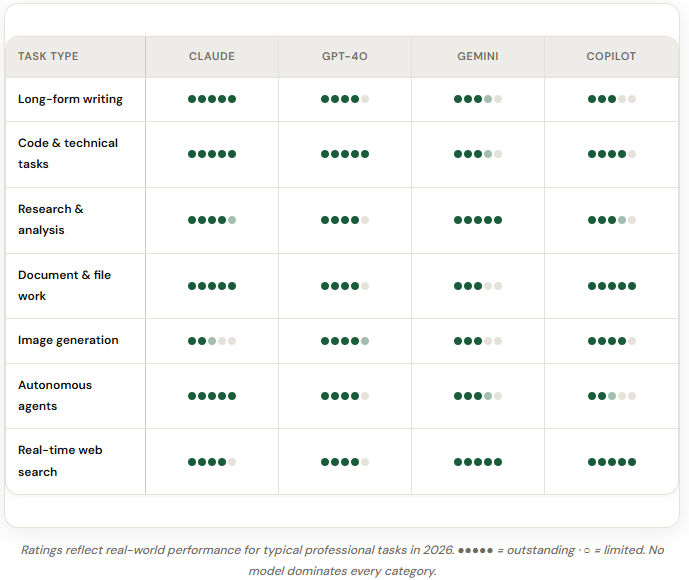
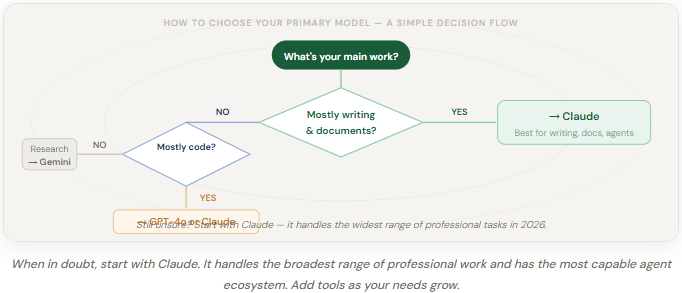
The AI landscape in 2026 has consolidated around five models that genuinely matter for professional use. Everything else is either a variant of these, a niche specialist, or hype. Here’s how they stack up on the tasks that matter most.
The three decisions that define your stack
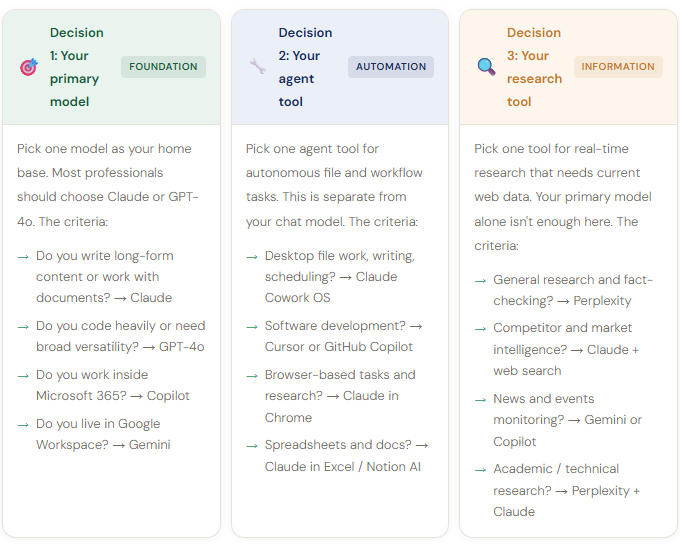
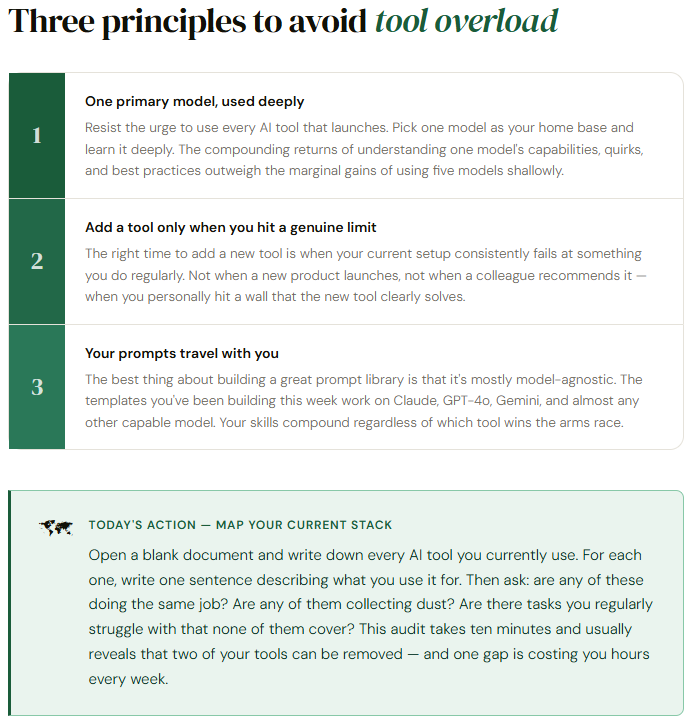
Building an AI stack isn’t about collecting every tool. It’s about making three clear decisions — and getting each one right. Most people who feel overwhelmed by the AI landscape are simply trying to make all three decisions at once without a framework.

Four real-world stacks — ready to copy
Theory is one thing. Here are four actual stacks for four different types of professional work, each with specific tools and a concrete example of how they interact in a real workflow.

Tomorrow, on Day 10, we complete Week 2’s foundation with Your First AI Workflow — a step-by-step walkthrough of automating a real task from start to finish, combining everything you’ve learned in the first nine days into one complete, repeatable system.
Next up · Day 10 of 30:
Your First AI Workflow: Automating a Real Task in Under an Hour
For more resourcces and documents, please refer to the links in my profile page: Faheem Munshi — Medium
Choosing Your AI Stack: Models, Tools & Platforms in 2026 — Prompt to Profit · Day 9 of 30 was originally published in Towards AI on Medium, where people are continuing the conversation by highlighting and responding to this story.
