Chain-of-Thought Prompting: Getting AI to Reason Step by Step — Prompt to Profit · Day 11 of 30

The single technique that separates AI users who get plausible answers from those who get genuinely intelligent ones.
Welcome to Week 3. For the past two weeks, you’ve been building your foundation — prompting structure, templates, roles, workflows. Today we shift to intermediate territory, and we start with the most significant single technique upgrade you can make to any prompt.
Chain-of-Thought prompting. It sounds academic. It isn’t. It’s the difference between asking AI a question and having AI actually think before answering. And once you understand it, you’ll use it in almost every important prompt you write.
What CoT actually is
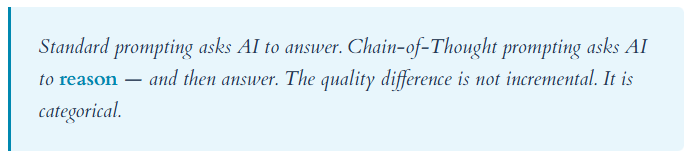
Chain-of-Thought (CoT) prompting is a technique where you instruct the AI to break down its thinking into explicit intermediate steps before producing a final answer. Instead of jumping straight to a conclusion, the AI walks through its reasoning — which forces it to get each step right before moving to the next.
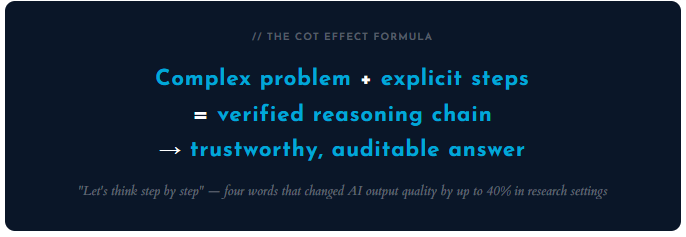
It was formally documented in a 2022 Google Research paper, where researchers found that adding “Let’s think step by step” to prompts dramatically improved AI performance on complex reasoning tasks — sometimes by more than 40 percentage points. The insight was simple: AI makes fewer errors when it’s required to show its work.
Why it works — The Science
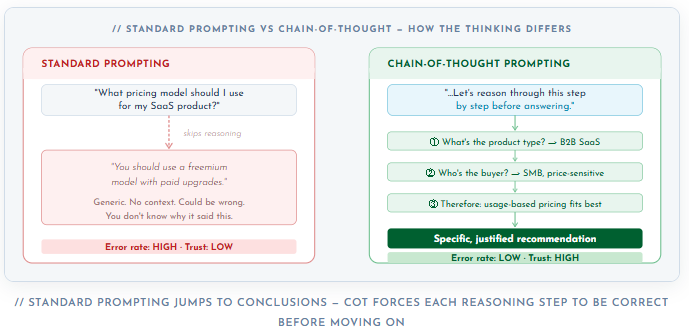
When you don’t ask AI to reason step by step, it pattern-matches to the most statistically likely answer. That works fine for simple questions. But for complex, multi-variable problems — pricing decisions, strategic analysis, technical debugging, ethical dilemmas — pattern-matching produces plausible-sounding nonsense.
Chain-of-Thought works because it forces serial reasoning. Each step in the chain constrains what the next step can say. If Step 1 correctly identifies that your audience is budget-conscious, Step 2 cannot recommend an enterprise pricing model without contradicting Step 1. The chain catches its own errors as it builds.
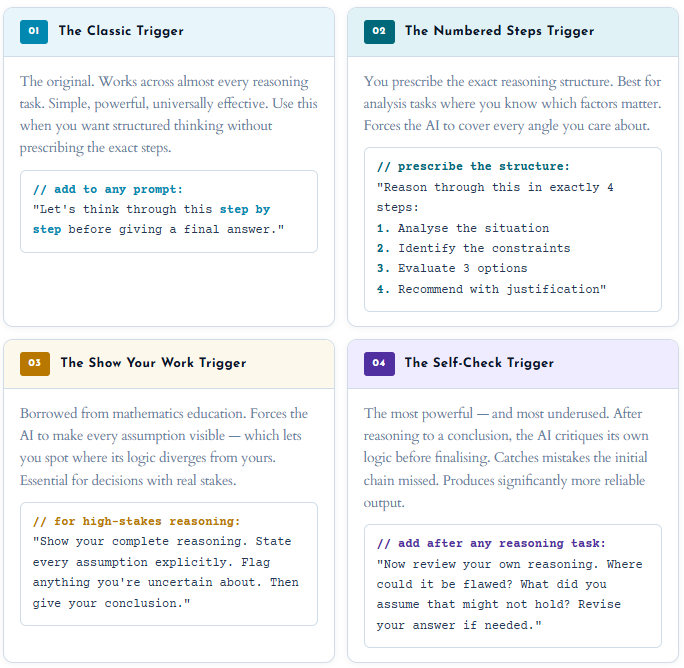
The four CoT triggers — and when to use each
There is no single way to activate Chain-of-Thought reasoning. The trigger you use shapes the style and depth of the reasoning chain. Here are the four most effective — each suited to a different type of task.
Four levels of CoT mastery — with real examples
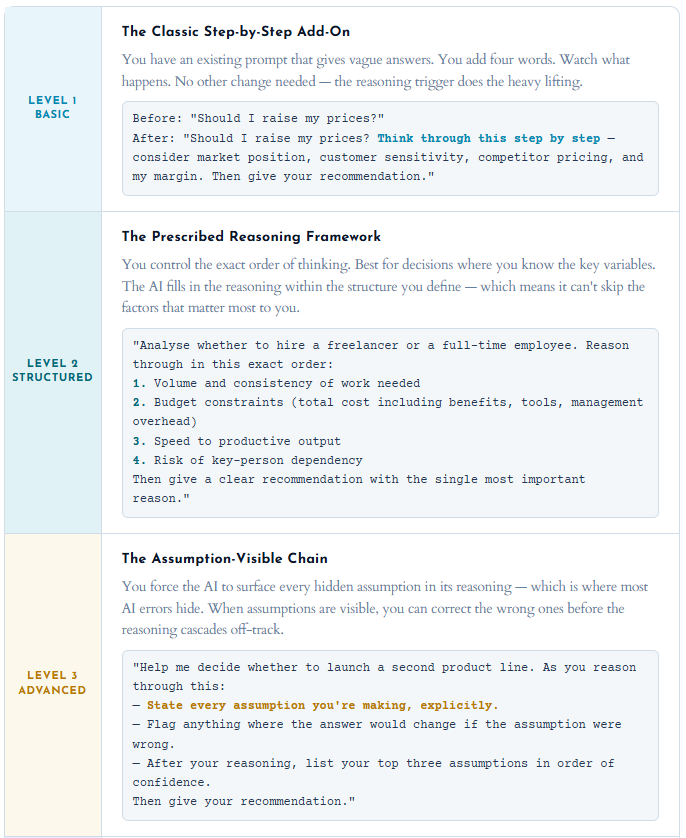
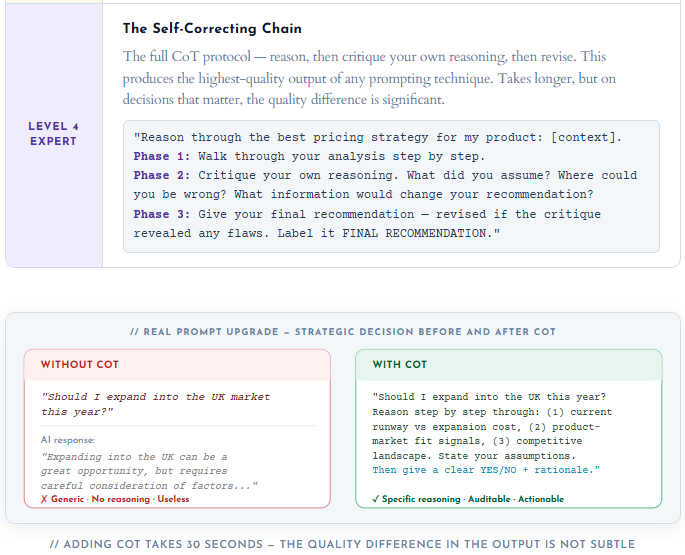
Understanding CoT in theory is one thing. Seeing it applied to real professional tasks is what makes it click. Here are four progressively sophisticated applications — from Level 1 basics to Level 4 self-correcting chains.
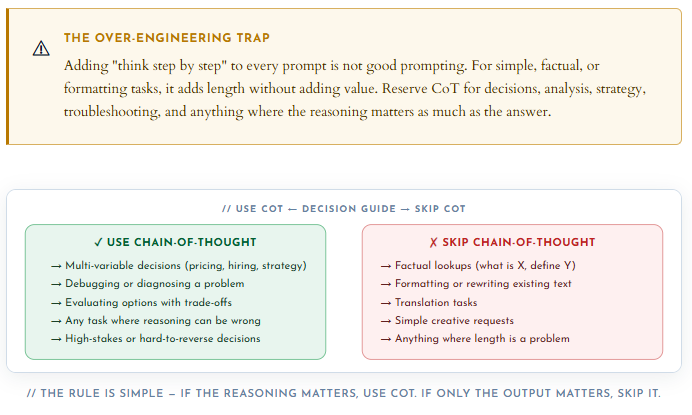
When not to use CoT
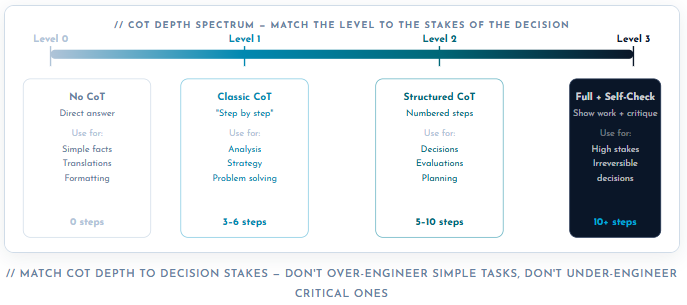
Chain-of-Thought is powerful, but it has a cost: length. A CoT prompt produces a significantly longer response — which is exactly what you want for complex reasoning, and exactly what you don’t want for simple tasks.
Your CoT starter kit — three prompts to run today
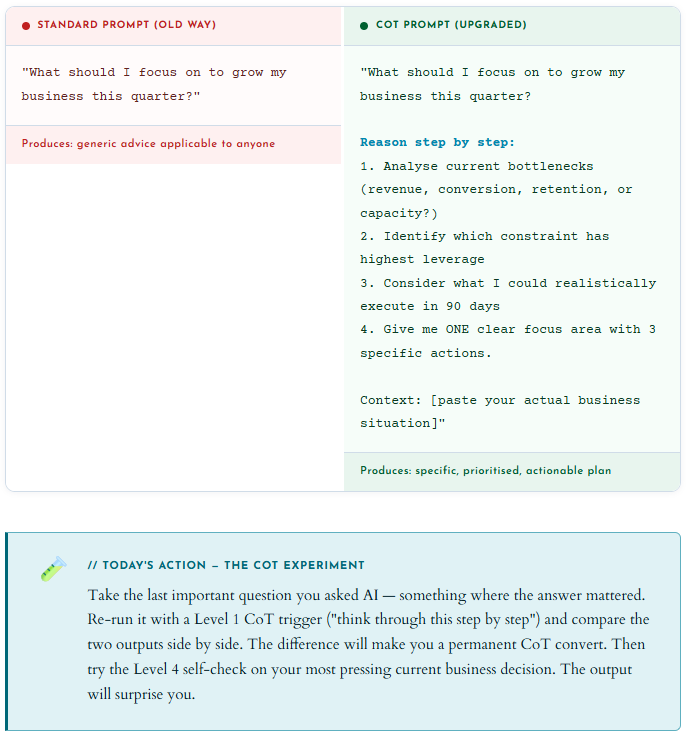
The fastest way to internalize CoT is to see it produce a better answer than your existing approach on a real task you care about. Here are three ready-to-run prompts. Pick one that matches something you’re working on this week and compare the output to what you’d have gotten without CoT.
Tomorrow, Day 12, we go deeper into prompting power with Mega Prompts — how to write a single, comprehensive prompt that does the work of ten separate ones, producing a complete strategic output in one run.

For more resources and documents, please refer to the links in my profile page: Faheem Munshi — Medium
Chain-of-Thought Prompting:
Getting AI to Reason Step by Step — Prompt to Profit · Day 11 of 30 was originally published in Towards AI on Medium, where people are continuing the conversation by highlighting and responding to this story.
