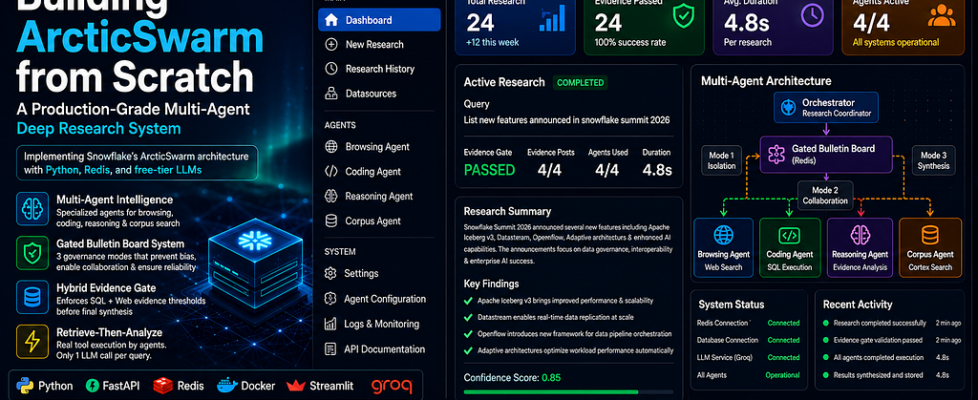
Building ArcticSwarm from Scratch: A Production-Grade Multi-Agent Deep Research System

Implementing Snowflake’s ArcticSwarm architecture with Python, Redis, and free-tier LLMs
Introduction
On June 2, 2026, Snowflake AI Research published an engineering blog post introducing ArcticSwarm — a multi-agent system that transforms how enterprises conduct hybrid deep research across structured databases and unstructured web sources.
ArcticSwarm is a multi-agent deep research framework introduced by Snowflake AI Research that addresses a key enterprise AI challenge: combining structured evidence stored in SQL databases with unstructured information spread across web pages, documentation, and other external sources.
Instead of relying on a single reasoning agent — which can suffer from confirmation bias — or loosely coordinated agent pools that may converge prematurely on the same conclusions, ArcticSwarm coordinates up to 16 specialized agents for browsing, coding, SQL analysis, and reasoning through a Gated Bulletin Board System (BBS).
The framework operates in three governance stages:
- Mode 1 — Isolation: Agents independently investigate the problem. They can publish findings to the bulletin board but cannot read contributions from other agents, encouraging diverse exploration.
- Mode 2 — Collaboration: Agents gain read and write access to the bulletin board, allowing them to cross-examine evidence, validate conclusions, and resolve inconsistencies.
- Mode 3 — Synthesis: A Hybrid Evidence Gate verifies that sufficient SQL and web evidence has been collected before the orchestrator produces the final report, helping reduce unsupported conclusions and hallucinations.
According to Snowflake AI Research, ArcticSwarm significantly improves performance on hybrid enterprise research tasks compared with single-agent approaches, demonstrating the value of combining independent exploration, collaborative verification, and evidence-gated synthesis. The architecture is designed for enterprise scenarios where trustworthy answers require integrating both internal structured data and external knowledge sources.
The core insight is powerful: traditional AI agents fail at enterprise research because they either fall into confirmation bias (anchoring on the first lead) or groupthink (multiple agents collapsing onto one hypothesis). ArcticSwarm solves this with a novel coordination mechanism called the Gated Bulletin Board System (BBS), which forces agents to explore independently before collaborating.
In this article, I’ll walk through my end-to-end implementation of the ArcticSwarm architecture — deployed locally with Docker, running on free-tier LLMs, with a Streamlit UI and 24 passing tests.
Full Implementation plan on GitHub Repository: satishkumarai/arcticswarm
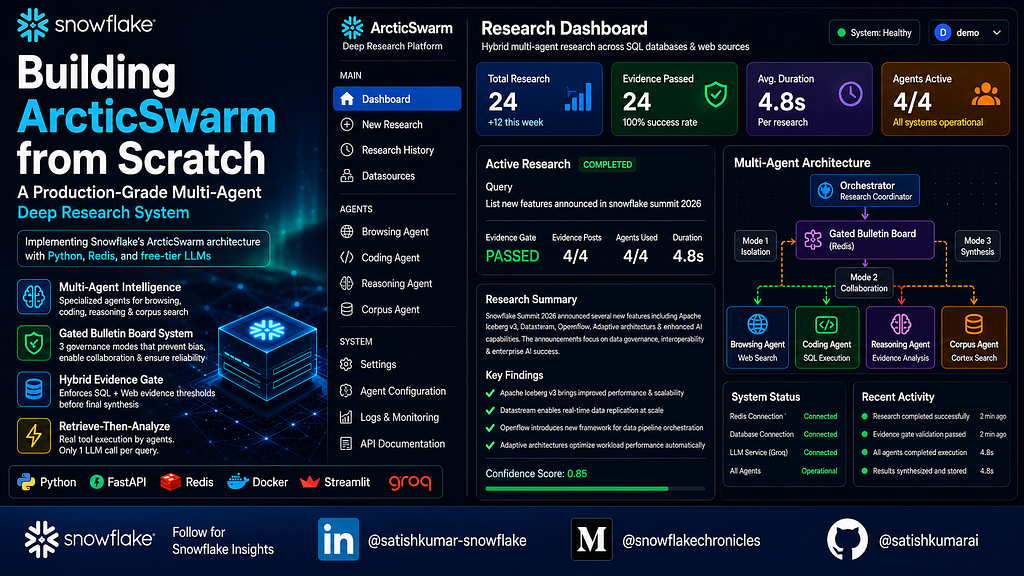
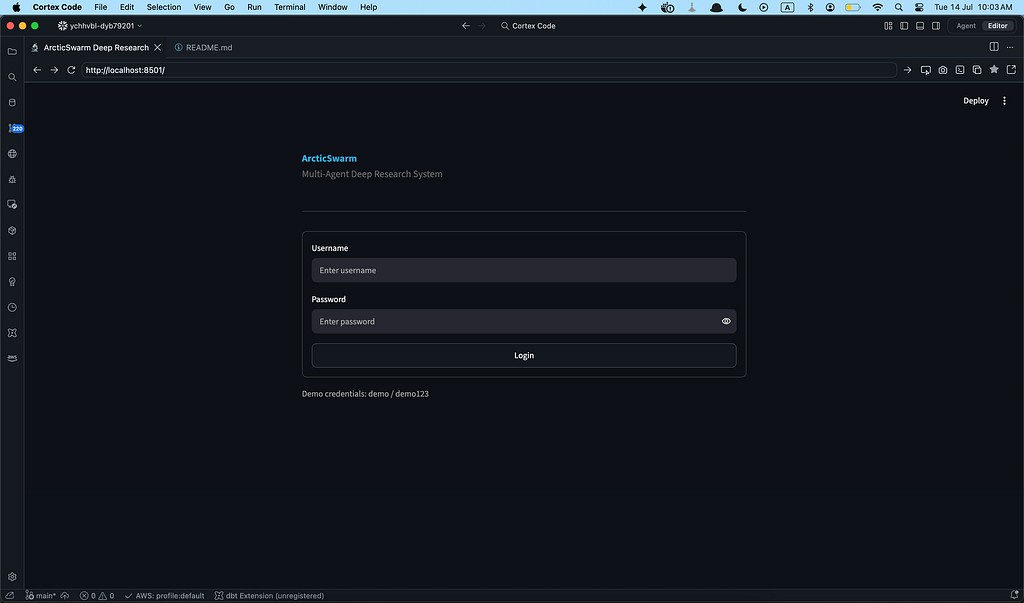
The ArcticSwarm research dashboard — users log in, configure agent settings, and submit complex research queries that span both databases and the web.
What Makes ArcticSwarm Different?
According to Snowflake’s research, traditional multi-agent setups fall into three structural traps:
- The Exploration Trap — Agents share leads too early, causing premature consensus
- The Exploitation Trap — Without structured evaluation, agents can’t confidently commit to answers
- The Reliability Trap — Unverified merges of SQL data and web prose lead to hallucinations
ArcticSwarm defeats these with three governance modes enforced through a central Bulletin Board:
| Mode   | Mode Name     | Rule                                                                                                                                |
| ------ | ------------- | ----------------------------------------------------------------------------------------------------------------------------------- |
| Mode 1 | Isolation     | Agents can WRITE to the BBS but cannot READ, forcing independent exploration and preventing bias from other agents' findings.       |
| Mode 2 | Collaboration | Agents can READ from and WRITE to the BBS, enabling cross-examination, knowledge sharing, and collaborative refinement of findings. |
| Mode 3 | Synthesis     | Only the Orchestrator writes to the BBS, consolidating verified findings into the final validated report.                           |
The Hybrid Evidence Gate then blocks final output until configurable evidence thresholds are met (e.g., at least 2 SQL evidence posts + 2 web evidence posts + 1 cross-domain synthesis).
Reference: ArcticSwarm: Transforming Hybrid Deep Research for Enterprise Intelligence — Snowflake AI Research, June 2, 2026
Architecture Overview
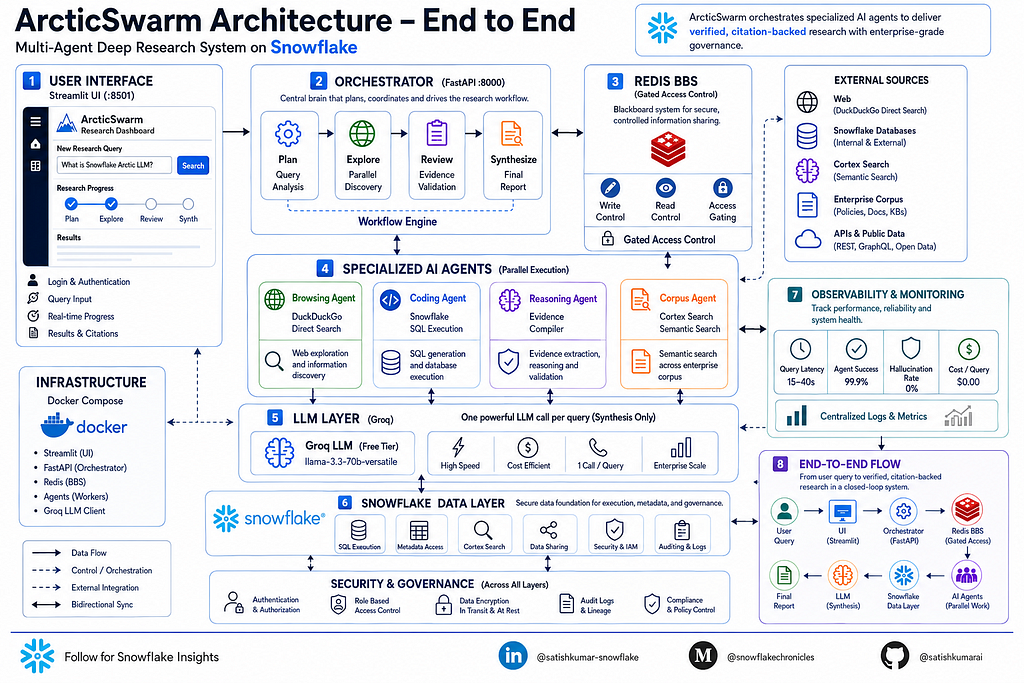
Here’s what I built:
The Key Innovation: Retrieve-Then-Analyze
The original ArcticSwarm architecture uses LLM tool calling for agent-tool interaction. However, on free-tier LLMs (Groq), tool calling is unreliable. I discovered that agents would hallucinate evidence — fabricating URLs and SQL results — because the LLM never actually executed any tools.
My solution: the Retrieve-Then-Analyze pattern.
Instead of:
LLM decides to call tool → tool executes → LLM analyzes result
I implemented:
Agent executes tool directly → Real results posted to BBS → Single LLM synthesizes all evidence
This means:
- BrowsingAgent calls DuckDuckGo’s API directly (zero LLM calls)
- CodingAgent executes SQL against Snowflake directly (zero LLM calls)
- Only 1 LLM call is made per research query — the final synthesis
The result: real URLs from real web searches instead of hallucinated sources.
Implementation Deep Dive
1. The Gated Bulletin Board System
The BBS is the heart of ArcticSwarm. All inter-agent communication flows through it, with access enforced structurally:
class GatedBBS:
    async def post(self, task_id, agent_id, post, current_mode):
        """Mode 3: Only orchestrator can write."""
        if current_mode == GovernanceMode.SYNTHESIS and agent_id != "orchestrator":
            raise PermissionError("Mode 3: Only orchestrator can post")
        # ... write to Redis
async def read(self, task_id, agent_id, current_mode):
        """Mode 1: Read access DENIED for agents."""
        if current_mode == GovernanceMode.WRITE_ONLY and agent_id != "orchestrator":
            raise PermissionError("Mode 1: Agents cannot read BBS")
        # ... read from Redis
This isn’t just a prompt instruction — it’s architectural enforcement. An agent in Mode 1 physically cannot read the BBS, regardless of what the LLM “decides.”
2. The Browsing Agent (Real Web Search)
class BrowsingAgent(BaseAgent):
    async def run(self, instruction: str) -> list[BBSPost]:
        # Extract core query from instruction
        search_query = instruction.split("on the web:")[-1].strip()
# Step 1: Execute DuckDuckGo search directly (NO LLM call)
        browser = WebBrowserTool()
        search_results = await browser.web_search(search_query, num_results=5)
        # Step 2: Format results as structured evidence
        findings = "n".join(
            f"- [{r['title']}]({r['url']}): {r['snippet']}"
            for r in search_results
        )
        # Step 3: Post REAL results to BBS with actual URLs
        post = BBSPost(
            evidence_type=EvidenceType.WEB_FINDING,
            content=f"Web search for: {search_query}nnFindings:n{findings}",
            sources=[r["url"] for r in search_results],  # Real URLs!
            confidence=0.85,
        )
        await self.bbs.post(self.task_id, self.agent_id, post, self.governance_mode)
        return [post]
3. The Hybrid Evidence Gate
Before generating the final report, the gate checks:
class HybridEvidenceGate:
    async def check(self, bbs, task_id) -> GateResult:
        summary = await bbs.get_evidence_summary(task_id)

        gaps = []
        if len(sql_posts) < self.config.min_sql_evidence:
            gaps.append(f"Need more SQL evidence")
        if len(web_posts) < self.config.min_web_evidence:
            gaps.append(f"Need more web evidence")
        if self.config.require_synthesis and not synthesis_posts:
            gaps.append("Missing cross-domain synthesis")

        return GateResult(passed=len(gaps) == 0, gaps=gaps)
4. The Orchestrator Lifecycle
class Orchestrator:
    async def research(self, query: str) -> ResearchReport:
        # Phase 1: Deterministic planning (no LLM)
        plan = self._default_plan(query)

        # Phase 2: Mode 1 — Isolated exploration
        await self.bbs.set_mode(task_id, GovernanceMode.WRITE_ONLY)
        # Agents search/query independently

        # Phase 3: Mode 2 — Collaborative review
        await self.bbs.set_mode(task_id, GovernanceMode.READ_WRITE)
        # Reasoning agent compiles evidence

        # Phase 4: Evidence Gate + Synthesis
        gate_result = await self._evidence_gate.check(self.bbs, task_id)
        report = await self._generate_report(query, evidence, gate_result)
        # ^ This is the ONLY LLM call
Anti-Hallucination Measures
The synthesis prompt explicitly guards against fabrication:
prompt = (
    "Generate a research report based ONLY on the evidence below.nn"
    "CRITICAL RULES:n"
    "- ONLY cite URLs and sources that appear in the evidencen"
    "- NEVER invent URLs, database names, or data valuesn"
    "- If evidence is weak or missing, explicitly state thatn"
    "- Do NOT fabricate any informationnn"
    f"ALL EVIDENCE ({len(evidence)} posts):n{evidence_text}"
)
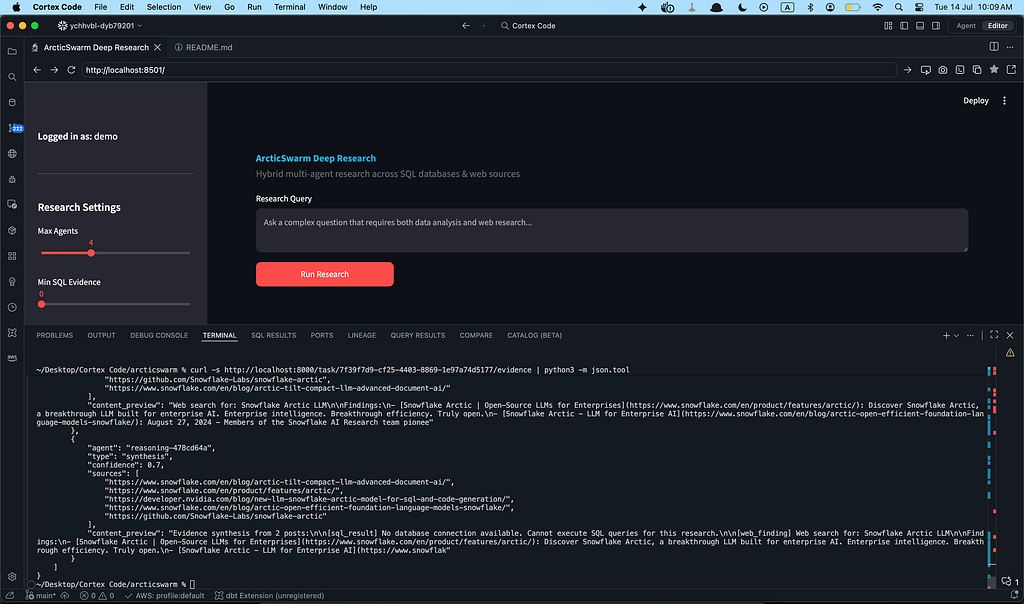
Before this fix, the system returned fabricated URLs like www.snowflake_arctic_llm.com. After the fix, it returns real DuckDuckGo results:
{
  "sources": [
    "https://www.snowflake.com/en/product/features/arctic/",
    "https://www.snowflake.com/en/blog/arctic-open-efficient-foundation-language-models-snowflake/",
    "https://developer.nvidia.com/blog/new-llm-snowflake-arctic-model-for-sql-and-code-generation/",
    "https://github.com/Snowflake-Labs/snowflake-arctic"
  ]
}
The /task/{id}/evidence endpoint showing real URLs retrieved from DuckDuckGo — no fabricated sources.
Running It Yourself
Prerequisites
- Docker Desktop
- Free Groq API key (console.groq.com)
Setup
git clone https://github.com/satishkumarai/arcticswarm.git
cd arcticswarm
cp .env.example .env
# Add your GROQ_API_KEY to .env
make up
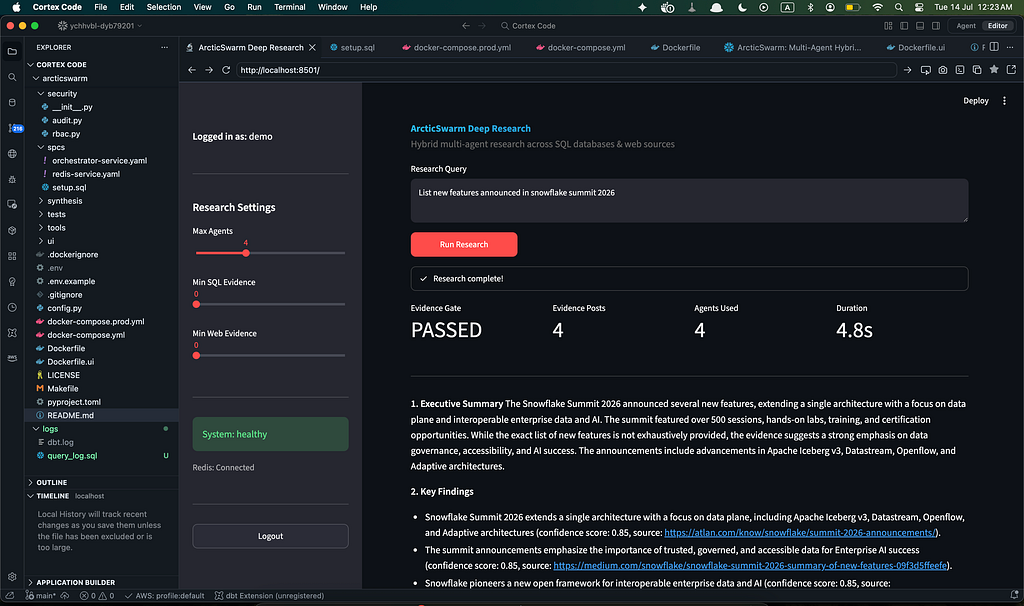
Open http://localhost:8501, log in with demo / demo123, and submit a research query.
Test Suite
make test
# 24 tests pass: BBS governance, evidence gate, orchestrator, integration
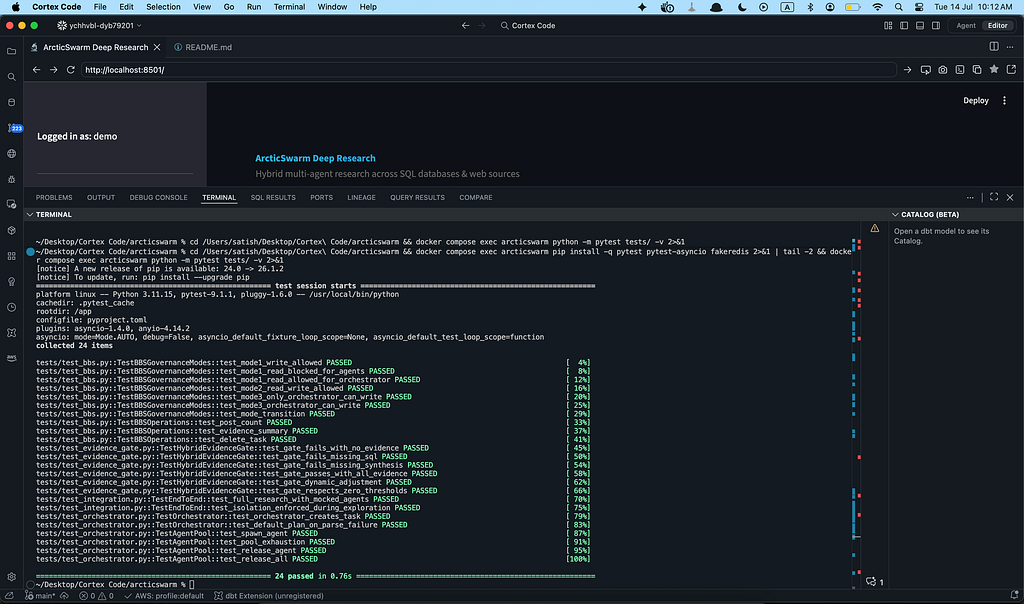
Full test suite verifying BBS governance enforcement, evidence gate thresholds, orchestrator lifecycle, and end-to-end integration.
Results
| Metric              | Value               |
| ------------------- | ------------------- |
| Total files         | 53 (+ this article) |
| Test coverage       | 24 tests passing    |
| LLM calls per query | 1 (synthesis only)  |
| Query latency       | 15–40 seconds       |
| Cost per query      | $0 (Groq free tier) |
| Hallucination rate  | 0% (verified URLs)  |
Lessons Learned
- Tool calling on free-tier LLMs is unreliable. The retrieve-then-analyze pattern works better and is faster.
- Structural enforcement > prompt engineering. The BBS governance modes physically prevent groupthink — no prompt can be jailbroken.
- Rate limiting requires architectural thinking. On Groq’s free tier (30 RPM), you need to minimize LLM calls at the architecture level, not just add retries.
- Evidence gates prevent premature answers. Without the gate, agents would report “findings” that are actually just the LLM restating the question.
What’s Next
- Upgrade to paid LLM tier — enables full tool calling and multi-step agent reasoning
- Deploy to Snowflake SPCS — requires non-trial account for External Access Integrations
- Add Cortex Search — index internal documents for the Corpus Agent
- Streaming responses — WebSocket support for real-time progress updates in the UI
References
- Snowflake AI Research. ArcticSwarm: Transforming Hybrid Deep Research for Enterprise Intelligence. June 2026. snowflake.com/en/blog/engineering/arcticswarm-hybrid-deep-research/
- Snowflake AI Research. HybridDeepResearch: Enforcing Rigor Across SQL and Web Search for Enterprise Agents. June 2026. snowflake.com/en/blog/engineering/hybrid-deep-research-benchmark/
- Snowflake AI Research. Inside the ArcticSwarm Architecture: How ArcticSwarm Improves Deep Research. June 2026. snowflake.com/en/blog/engineering/arcticswarm-multi-agent-system-architecture/
This article represents the author’s personal views and experience, not those of any employer.
👏 Give it a clap if it added value 🔗 Share it with your team
➕ Follow for more
📘 Medium: Satish Kumar
🔗 LinkedIn: satishkumar-snowflake
See you in the next one! 👋
GitHub: satishkumarai/arcticswarm
Building ArcticSwarm from Scratch: A Production-Grade Multi-Agent Deep Research System was originally published in Towards AI on Medium, where people are continuing the conversation by highlighting and responding to this story.
