AI for Sales & Persuasion — Prompt to Profit · Day 21 of 30

The frameworks that turn words into revenue — and how to deploy them at scale. Persuasion is the oldest business skill. AI is the newest leverage. Here is exactly how they work together — without sounding like a machine wrote your pitch.
Every business transaction begins with a moment of persuasion. A product page someone reads at midnight. A proposal that crosses a decision-maker’s desk on a Tuesday. An email subject line competing with forty others in an inbox. A pitch deck that has three minutes to earn a second meeting. The words in those moments are not decoration — they are the mechanism. They are the difference between a deal and a deleted email, between a customer and a missed connection.
Most people who use AI for sales and marketing content use it the way they use a photocopier — to produce faster output of approximately the same quality they were producing before. This is the shallow version. The deeper version — the one that actually moves revenue — is using AI to apply proven persuasion frameworks with the precision and speed that was previously impossible at scale.
Today we build that capability. The frameworks, the prompts, the calibration method for keeping AI output sounding like a human being who understands your customer’s inner life — not a language model that has absorbed ten thousand mediocre marketing emails.
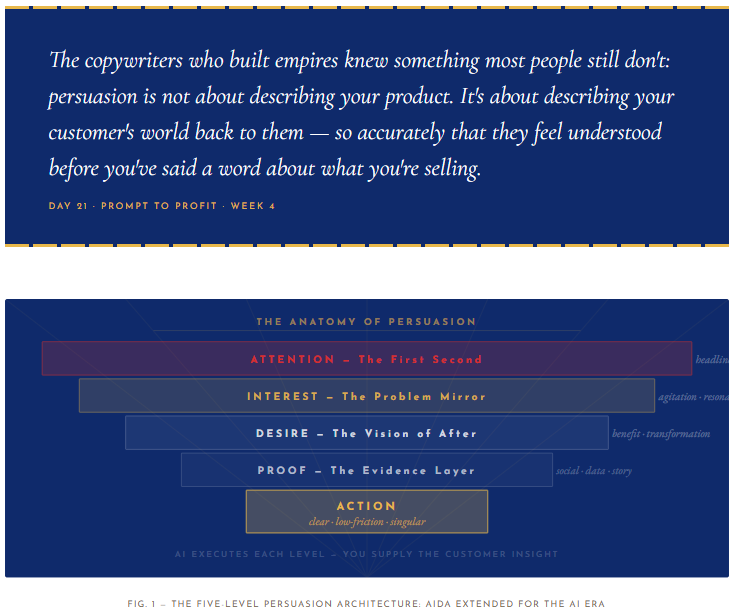
Why Most AI Sales Copy Fails
The failure mode is always the same and it has nothing to do with the model’s writing ability. AI sales copy fails when the human operating it doesn’t supply the one thing AI cannot generate on its own: customer insight.
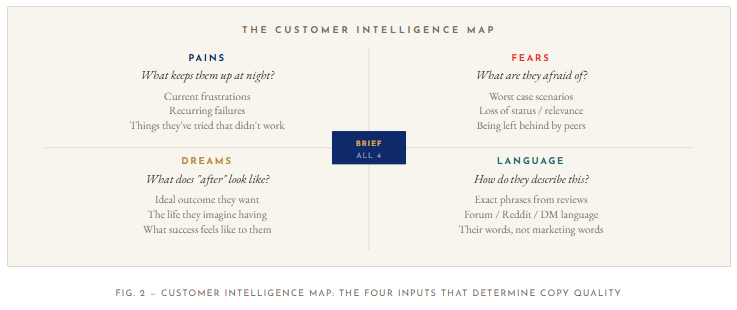
AI can write flawlessly structured copy. It knows every persuasion framework, every headline formula, every call-to-action pattern. What it doesn’t know — what it can only know if you tell it — is the specific, granular emotional reality of your target customer. The exact phrase they used when describing their problem on a forum. The specific fear that wakes them up at 3am. The precise transformation they’re hoping for but afraid to admit they want.
Generic AI copy sounds generic because it was briefed generically. “Write a product description for my AI productivity workbook targeting knowledge workers” produces output that could describe ten thousand similar products. “Write a product description for my AI productivity workbook targeting freelance consultants who bill $150/hr, waste three hours daily on admin tasks they hate, and privately worry that they’re falling behind peers who’ve adopted AI” produces something that stops the right person mid-scroll.
The framework below is built on this single insight: the quality of your persuasion prompt is determined entirely by the quality of your customer intelligence, not by the sophistication of your copywriting formula.
The Three Persuasion Frameworks
Copywriters have developed hundreds of frameworks over a century of direct-response advertising. Three of them account for the majority of high-converting content written today — and all three can be precisely deployed through AI prompts when combined with genuine customer intelligence.
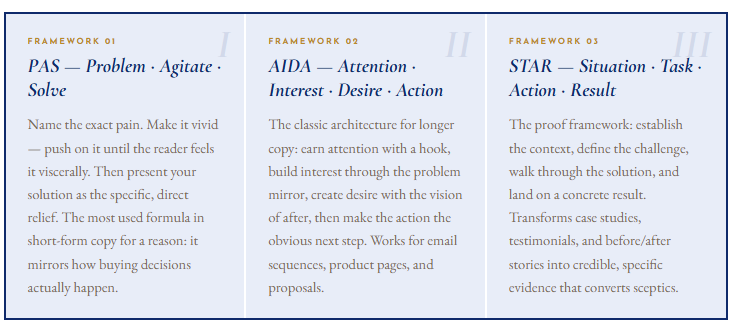
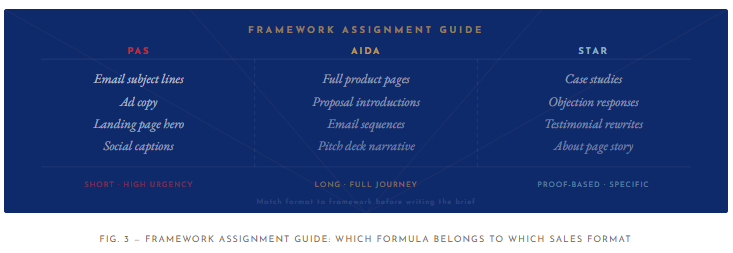
The mistake is treating these as interchangeable. PAS dominates short-form — social posts, subject lines, ad copy. AIDA is the architecture for full product pages, long emails, and pitch documents. STAR belongs in proof sections, testimonials, and case study pages. Match framework to format before you write the brief.
The Master Sales Prompt
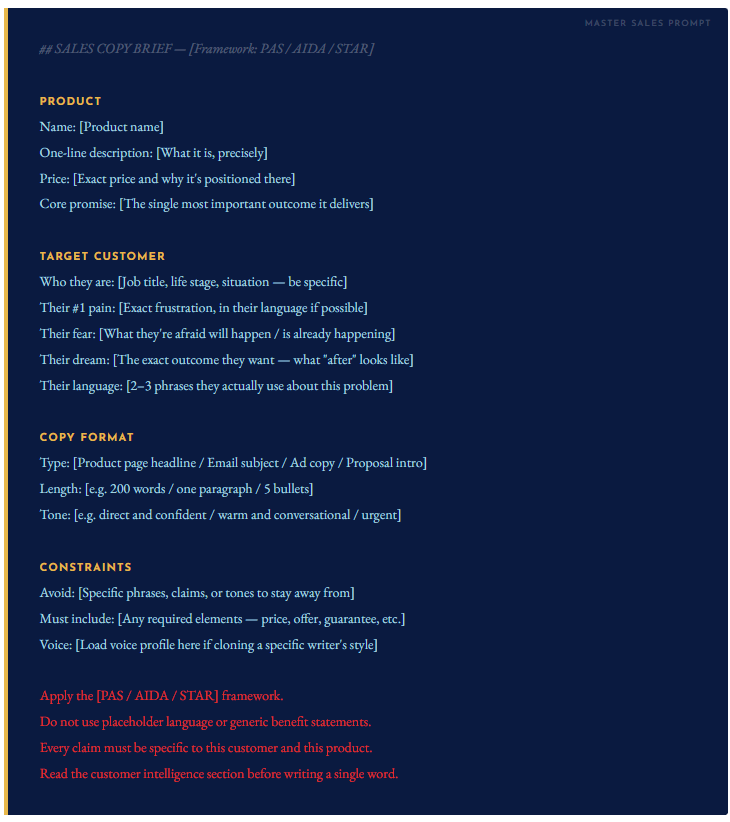
Below is the prompt architecture that combines all four customer intelligence inputs with a chosen framework and produces copy that sounds like it was written by someone who genuinely understands your customer — because it was briefed by someone who does.
The Five Sales Assets AI Builds Fastest
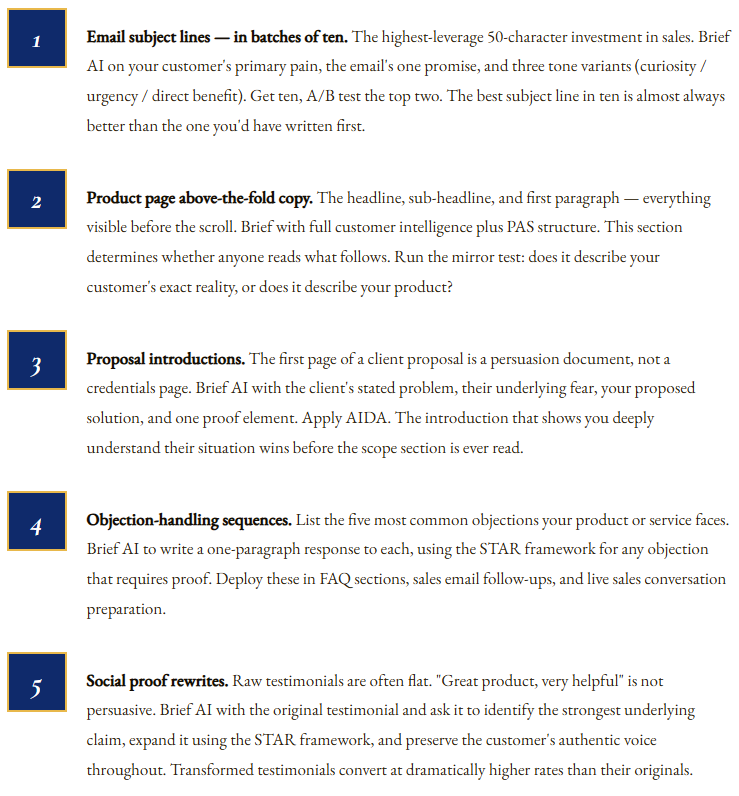
Not all sales content has the same production overhead. These five formats have the highest AI leverage — they’re structured, verifiable, and directly tied to revenue outcomes. Build templates for each one and load them into your prompt library.
The Conversion Calibration Test
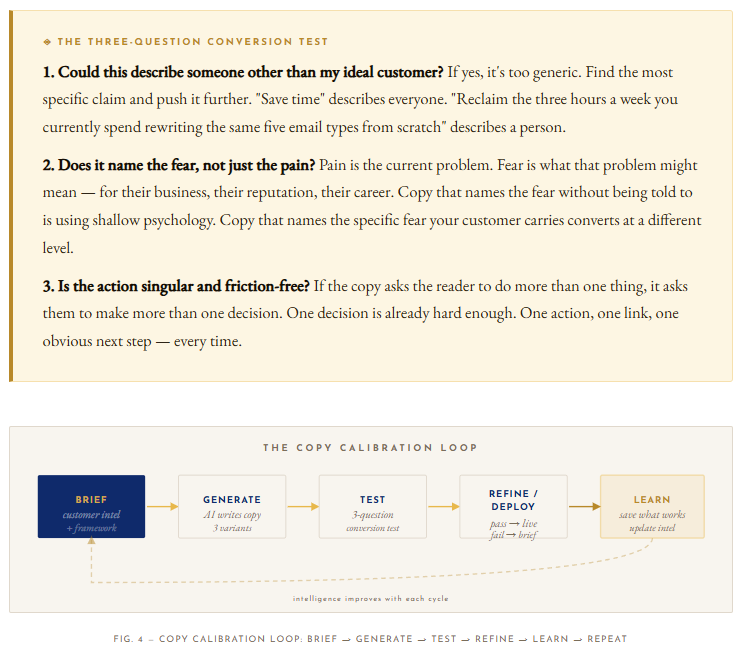
Even well-briefed AI copy needs calibration. The instinct is to read it and ask “is this good?” That’s the wrong question. The right question is: does this make my target customer feel seen?
Good sales copy produces a specific physiological response in the right reader. They lean forward slightly. They read more slowly. They feel a mild discomfort of recognition — a sense that whoever wrote this has been living in their head. That sensation is what separates copy that converts from copy that gets read and forgotten.
You cannot reliably produce that sensation by asking AI to “write compelling copy.” You produce it by supplying customer intelligence so precise that the model has no option but to be specific. And you verify it with this three-question test:
The most persuasive thing you can say to any buyer is that you understand them — specifically, precisely, and without having been told explicitly. This is what great copywriters have always done: they study their customers obsessively until the customer’s inner monologue is more familiar than their own. AI doesn’t replace that study. It multiplies what you can do with it once you’ve done it.
Fill in the customer intelligence map. Load it into the master sales prompt. Apply the right framework to the right format. Run the three-question test. What emerges is copy that converts — not because it’s clever, but because it’s true to the exact person reading it at exactly the moment they’re reading it.
Tomorrow, Day 22, we apply this same precision to Building AI-Powered Products — the complete methodology for creating, positioning, and pricing digital products where AI is the engine and your expertise is the moat.

For more resources and documents, please refer to the links in my profile page: Faheem Munshi — Medium
AI for Sales & Persuasion — Prompt to Profit · Day 21 of 30 was originally published in Towards AI on Medium, where people are continuing the conversation by highlighting and responding to this story.
