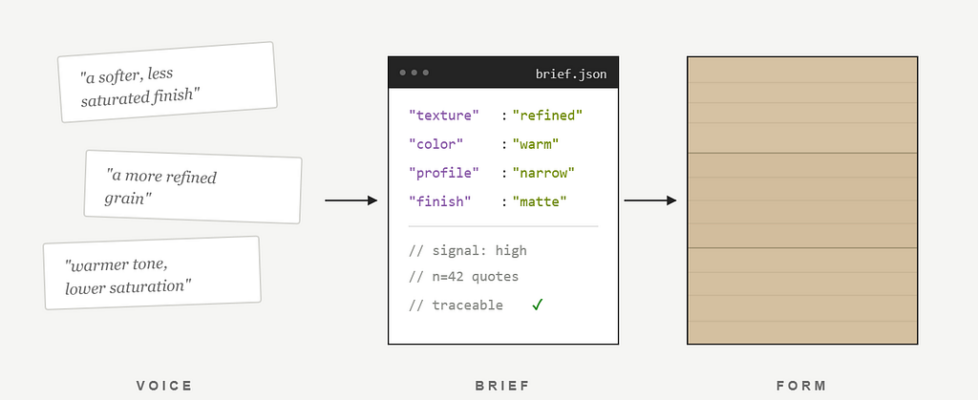
The Future of Product Design Isn’t just Generative. It’s Grounded.

The Future of Product Design Isn’t Just Generative with AI — It’s Grounded in Voice of the Cutsomer.
There’s a moment in every research project that I find both rewarding and quietly frustrating.
You finish synthesizing weeks of interviews. The themes are clear. The pain points are mapped. The verbatim quotes are striking enough that you save a few in a personal folder because they capture something true. You write the report. You present the findings. People nod. Slides get screenshotted into other slides.
And then, more often than not, very little happens.
Not because anyone meant for it to stall. Research findings rarely sit untouched because someone decided to ignore them. They stall because the translation step is missing. The step where insight actually becomes a new product. Where “customers want a softer, less saturated finish with a more refined grain” becomes an actual proposed design that a product team can react to.
That step is where a lot of qualitative research quietly dies.
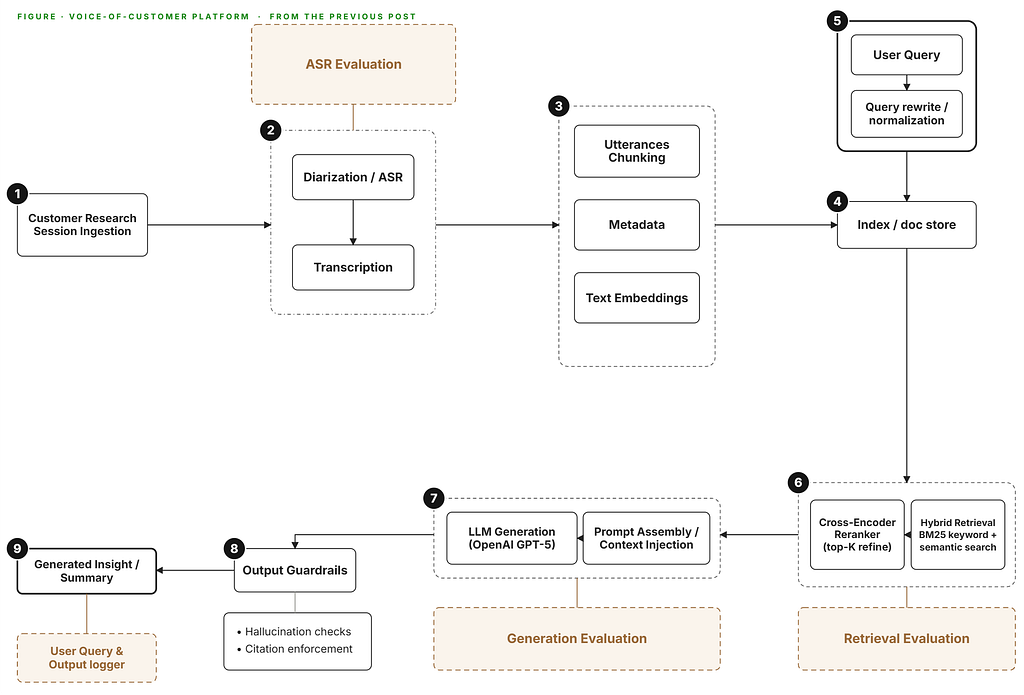
In my last post, I shared how I built an AI-powered Voice of the Customer platform that turns hours of conversation into a searchable, reasoning-ready intelligence layer. A RAG system that can listen. It can synthesize. It can answer questions about what customers think, feel, and want, grounded in their own words.
But listening is only half the loop.
And this post is about the other half. What happens when the platform stops just describing the customer’s voice and starts using it to shape new products that we make.
The Gap Between Knowing and Building
If you’ve ever worked in product, design, or R&D, you know this gap.
A research study uncovers that a segment of homeowners wants a “warmer, more refined exterior”. A different group reacts negatively to overly “saturated color tones”. A builder mentions, almost in passing, “that the texture of one product reminds them of something synthetic”.
Each of these is a real signal. Each represents hundreds of hours of conversation distilled into a finding. Then the design team has to translate them.
“Customers want a more refined grain” is not a design brief. It’s a hint at one.
Someone has to take that hint, infer what it would look like in practice, sketch a few directions, run them past stakeholders, gather opinions, and iterate. That process can take months. By the time a concept is on the table, the research has been filtered through several rounds of interpretation, and the connection back to the original customer voice has become loose, sometimes lost entirely.
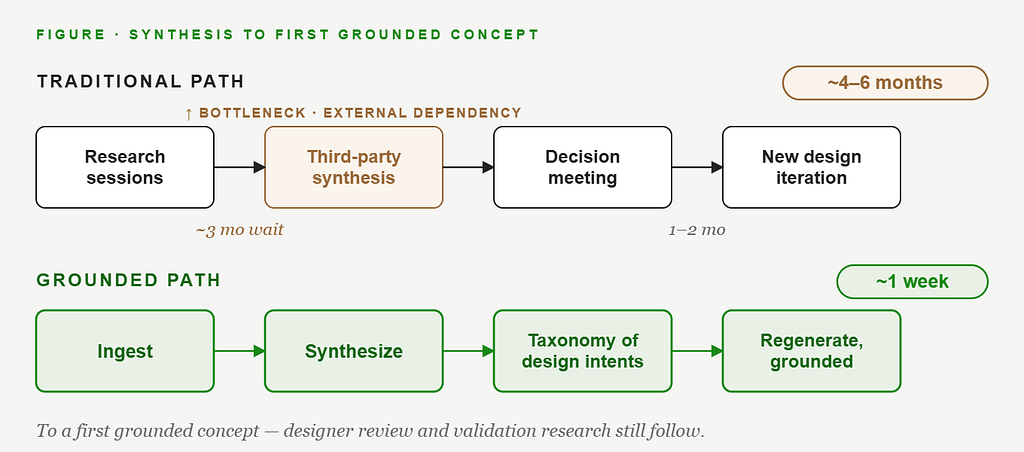
Put the two paths side by side and the difference isn’t effort, it’s structure. The traditional path serializes through a synthesis wait before anyone can act; the grounded path runs the same journey, from raw sessions to a first concept, as one continuous pipeline.
The harder part is that the people doing the translating are skilled. They aren’t doing it badly. They’re doing what humans have always done, which is to take signal and turn it into form through judgment and craft. The problem isn’t capability. The problem is the translation is slow, and the trail back to the customer often disappears along the way.
From Listening to Designing
When I finished the Voice of the Customer platform, the natural next question was what it could do with what it understood.
The platform already had structured, queryable access to thousands of hours of customer dialogue through a hybrid retrieval index: vector embeddings for semantic similarity, lexical search for linguistic precision. The synthesis was no longer the bottleneck.
The bottleneck was downstream. Specifically, two things.
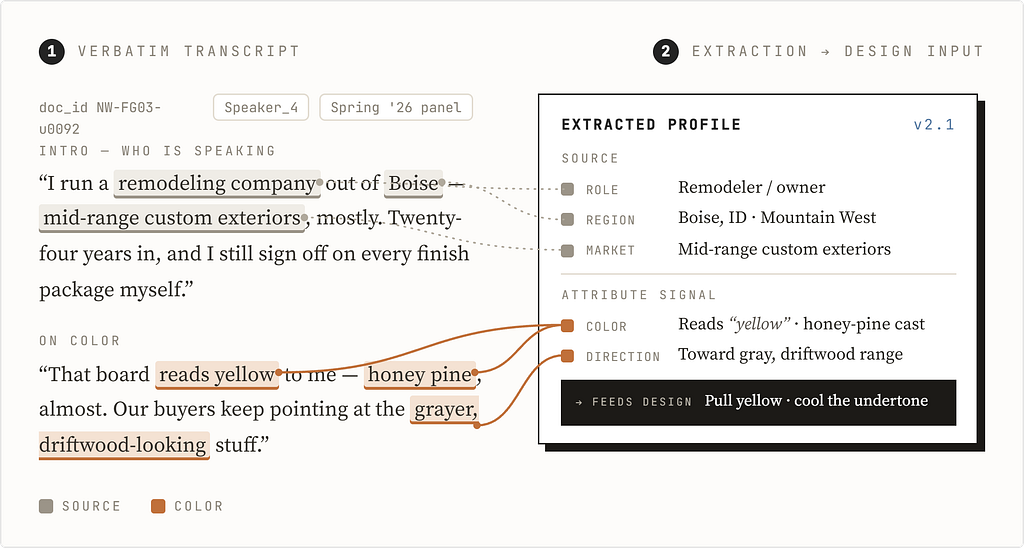
- The unstructured-to-structured gap. Customer dialogue is naturally messy. Half-sentences, hedges, contradictions across participants, attributes mentioned implicitly rather than directly. To feed that into a generative model in any controlled way, the dialogue has to first be transformed into structured, machine-readable signal, a representation that preserves the customer’s voice but can also be programmatically reasoned over.
- The grounded-generation gap. Generative image models, left unconstrained, collapse toward their prior, whatever the training distribution leans toward. That’s fine for art; it’s disqualifying for product design, where the entire value of the system is that an output is traceable to specific, evidenced customer signal. Grounding the output takes two things working together: a directive that says what to change, and a constraint that physically limits what can change.
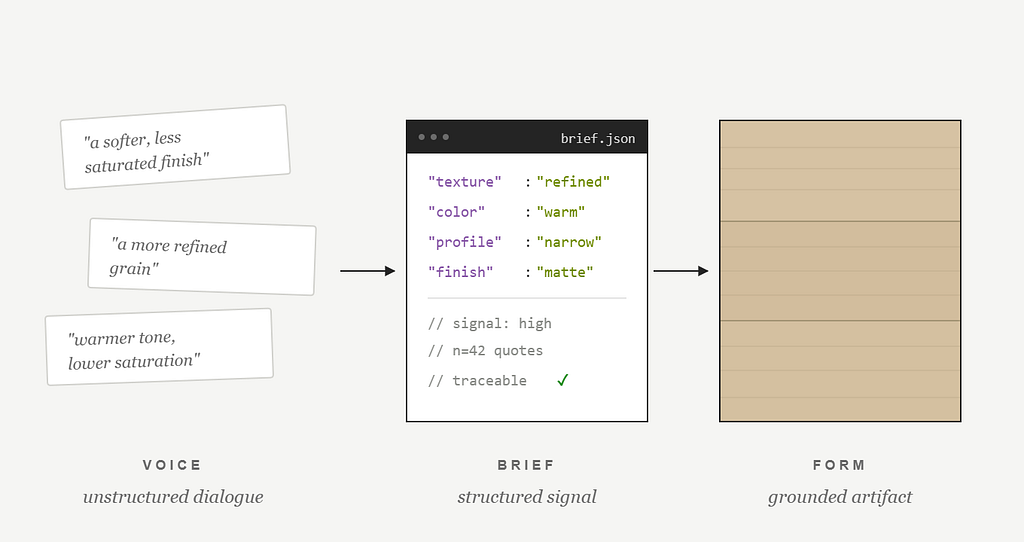
Closing that first gap looks like this: a few seconds of focus-group talk on one side, and the structured, design-ready profile it becomes on the other. Every field still anchored to the exact words that produced it.
Both gaps had to be closed for the studio to be useful. This post is the story of how.
Think of it as turning conversations into proposals. The customer voice doesn’t just inform the design. It shapes it directly.
System Architecture
At a high level, the studio takes a product, retrieves the per-attribute customer signal already extracted for it, assembles that signal into a structured edit directive, and runs a mask-guided image edit on a baseline product image with GPT Image 2, compositing the result back over the baseline. Every output preserves the trail back to the source quotes.
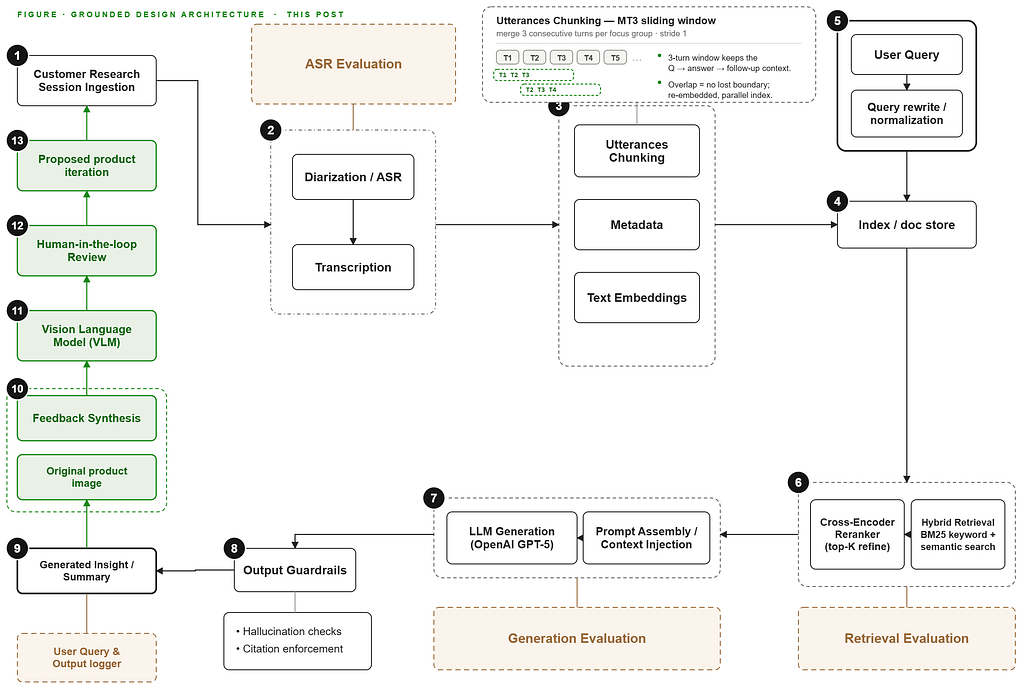
Four layers do the real work. I’ll walk through each one.
1. The Offline Extraction Layer
Customer voice on any given product is distributed across sessions, segments, participant types, and attribute dimensions. Synthesizing it well is expensive. So the studio doesn’t do it when a design request arrives. It does it once, offline, during ingestion.
As research sessions land in the prior platform, an extraction pass walks each product’s dialogue attribute by attribute, color, texture, size, profile, and overall aesthetic, and writes a per-attribute signal to a cache keyed by product.
Conceptually, the offline pass looks like this:
# offline, on the ingestion path: runs once per product, then cached
for session in sessions_for(product):
    for attribute in ["color", "texture", "size", "profile", "aesthetic"]:
        signal = extract_attribute_feedback(session, attribute)
        cache.upsert(product, attribute, signal)   # keyed by product

# at generation time we only READ this cache; no synthesis on the hot path
signal = cache.get(product)
The output of this layer isn’t a directive yet. It’s a cache of evidenced signal per attribute, per product, every entry carrying a pointer back to its source session, participant, and surrounding context, ready to be read in milliseconds when a design request lands.
2. The Directive Assembly Layer
At generation time, assembling the directive is cheap: read the cached signal for the product and normalize it into the JSON the image-edit step consumes. No synthesis, no retrieval gymnastics, just a lookup and a shape.
Each directive entry carries:
- A natural-language edit instruction (e.g., warm the facade palette toward warm taupe, swap lap siding for board-and-batten)
- Sentiment: what was loved, disliked, or mixed
- The source quotes that justify it, with participant and session references intact
- Signal strength: how many distinct participants raised the attribute, with what consistency
A simplified directive object looks roughly like this:
{
  "product": "home-exterior-A",
  "baseline_image": "samples/home-A/elevation.jpg",
  "edit_directives": [
    {
      "attribute": "color",
      "instruction": "shift the color from cool grey toward warm taupe",
      "sentiment": "strongly preferred",
      "signal_strength": "high",
      "source_quotes": [
        { "quote": "...", "participant": "P-014", "session": "S-22" },
        ...
      ]
    },
    {
      "attribute": "facade",
      "instruction": "use board-and-batten in place of lap siding",
      "sentiment": "preferred",
      ...
    }
  ],
  "keep_unchanged": ["roofline", "windows", "doors", "structure"]
}
The directive is not a summary. It’s a structured representation of customer voice, with the evidence still attached.
3. The Mask-Conditioned Generation Layer
The studio uses GPT Image 2 as the generation backbone, specifically its image-edit endpoint (images.edit) rather than text-to-image (images.generate). It takes three inputs, a baseline image, a mask, and a prompt. The mask matters, but not in the way people usually assume, and getting that distinction right is the whole design.
Here is the mechanism, step by step:
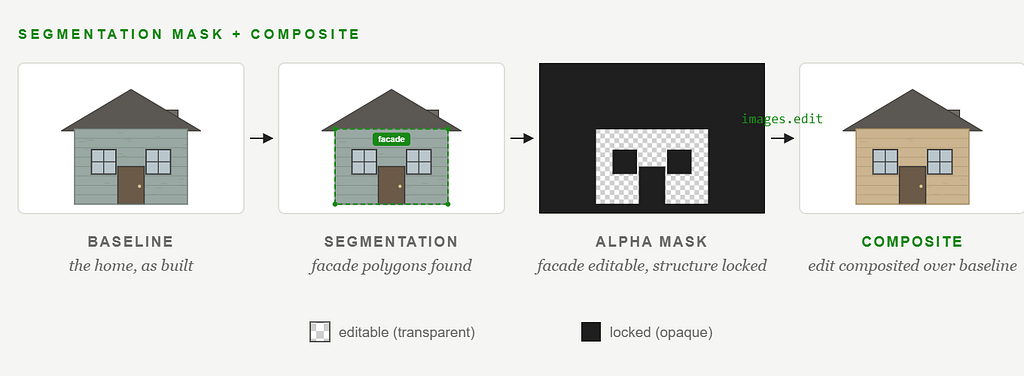
- Segment. A segmentation step runs over the baseline product image and produces polygons for the facade.
- Build the alpha mask. Facade pixels are transparent — the region to edit. Every other pixel — roofline, windows, doors, structure, sky — is opaque: the region to leave alone.
- Call the edit endpoint. The baseline image, the mask, and the directive text go to images.edit. Easy to get wrong: the endpoint treats the mask as guidance. Per OpenAI’s own docs it regenerates the entire image and may not honor the mask’s exact shape — pixels outside the facade can, and in practice do, shift.
- Composite. The mask alone is a strong hint, not the guarantee. After the edit returns, the pipeline composites the model’s output back onto the baseline through the same mask: inside the facade, keep the generated pixels; everywhere else, keep the original baseline pixels.
The call itself is small:
# the directive's natural-language instructions are injected into the prompt
prompt = render_prompt(directive.edit_directives)   # plain text, no numbers

result = images.edit(
    model="gpt-image-2",
    image=baseline_image,        # the tested product sample
    mask=facade_alpha_mask,      # guidance only: the endpoint can still drift
    prompt=prompt,
)
# the endpoint regenerates the whole frame, so we enforce preservation ourselves:
final = composite(baseline_image, result, facade_alpha_mask)
# inside the mask: model pixels. outside: original baseline pixels.
4. The Traceability Layer
Every generated concept carries its provenance. A designer reviewing an output can ask the system why did you propose this? and get a real answer. These attributes came from these conversations, supported by these specific quotes, surfaced by these sessions. The image is not a black-box product. It’s an artifact with a documented chain of reasoning leading back to actual humans.
Mechanically, this is straightforward: the schema preserves source references at every step, and the studio UI surfaces them alongside each generation. Conceptually, it’s the most important part of the system. Without traceability, grounded generation is just a claim. With it, the claim becomes auditable.
Concretely, a single generated concept resolves to a chain you can walk end to end:
concept_8f2a1c.png
  └─ directive.edit_directives["color"]  "shift toward warm taupe"
       └─ evidence:  quote P-014 (S-22),  quote P-031 (S-14)
            └─ baseline:  samples/home-A/elevation.jpg   # tested product sample
                 └─ blob_lineage → content_hash:  sha256:3b9f2e…c7d
The Grounded Design Loop
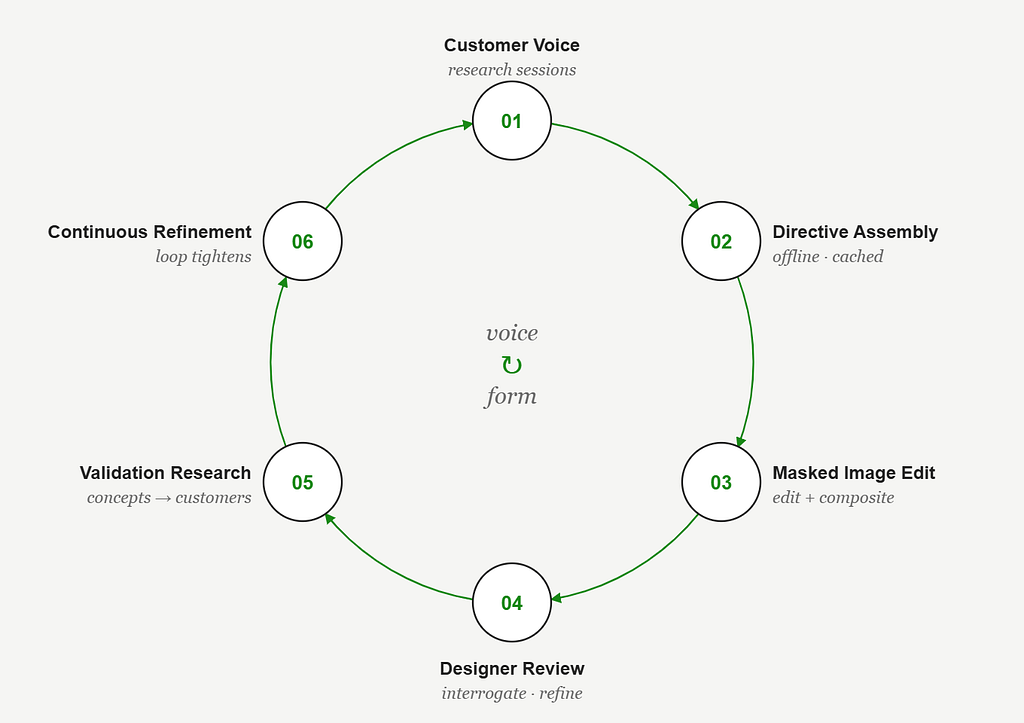
What makes the studio meaningful isn’t the model. It’s the loop that the model sits inside.
- Customer Voice: Real participants share experiences, preferences, frustrations, and desires in research sessions, ingested into the RAG index.
- Offline Attribute Synthesis: Per-attribute signal extracted once at ingestion, cached with its quotes.
- Mask-Conditioned Generation: Cached signal becomes the directive; mask-guided edit, composited over the baseline.
- Designer Review: Designers and product teams interrogate, refine, and select directions worth pursuing further.
- Validation Research: Selected concepts return to customers for reaction, generating new dialogue that feeds back into the index.
- Continuous Refinement: The loop tightens with every iteration, sharpening grounding and the team’s design intuition.
This isn’t generative AI replacing designers. It’s generative AI giving designers a new starting point. Instead of facing a blank page after a research synthesis, they face a set of grounded proposals, each one a hypothesis the customer voice itself produced. The designer’s craft moves upstream: from “what should this look like” to “which of these directions deserves to become real, and how do we refine it.”
What Is the Impact?
The studio doesn’t replace research. It doesn’t replace designers. It changes the shape of what each of them can do.
Findings stop being slides and start being concepts. The translation step that used to take months happens in days, and a research synthesis can produce visible, debatable proposals while the conversations are still fresh in everyone’s memory. A product team reviewing a concept doesn’t have to wonder where it came from; decisions can be debated on the merits of the underlying customer voice, not on whose intuition is louder.
The compression doesn’t come from cutting corners. It comes from removing the manual translation step entirely, and the evidence trail survives precisely because the model is doing what a human would otherwise do by hand, in a way that stays auditable.
The future of design isn’t generative. It’s grounded.
Thanks for reading. If you have feedback or want to talk about this work, I’m only a few clicks away.
The Future of Product Design Isn’t just Generative. It’s Grounded. was originally published in Towards AI on Medium, where people are continuing the conversation by highlighting and responding to this story.
