The Hidden Cost of Multi-Agent AI Systems: Why More Agents Are Not Automatically Better

The current wave of agentic AI has created a strong impression that more agents mean more intelligence .In practive , the opposite can happen once coordination , state sharing , routing and debugging become part of the system .Anthropic and openai both describes from specialization and decomposition ‘ both also warn the complexity , cost and overhead rise quickly as you add more moving parts.
Why people build multiple agents in the first place ?
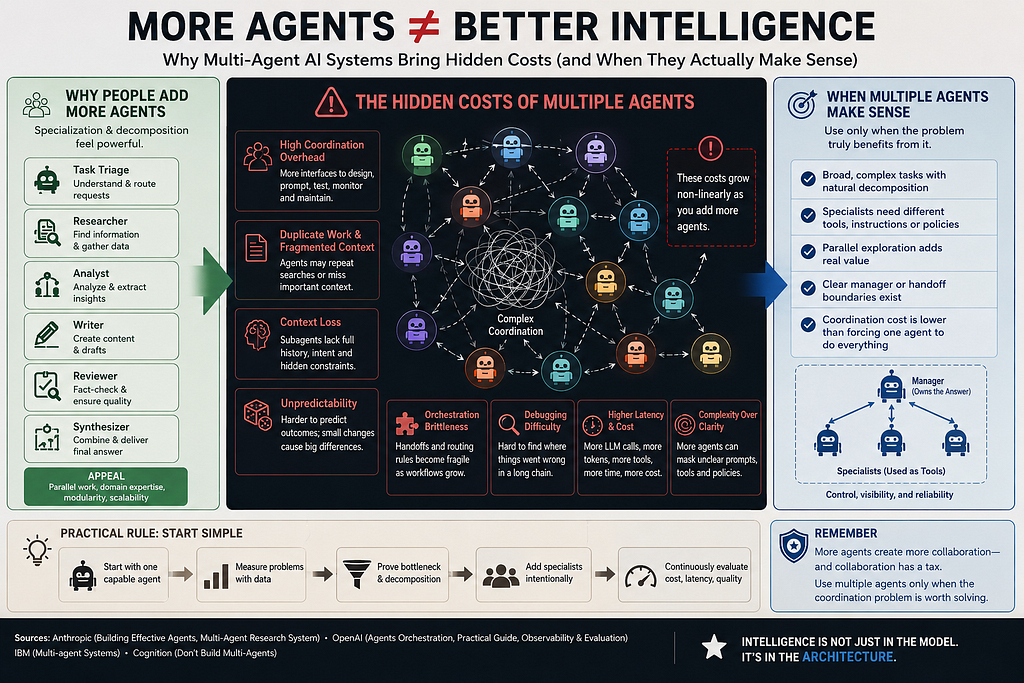
The appeal is easy to understand. A single model can be turned into a system of specialists: one agent triages, another researches, another writes, another checks safety, and another synthesizes the final answer. OpenAI describes this as either a manager pattern, where one central agent calls specialists as tools, or a decentralized pattern, where agents hand off execution to one another. Anthropic similarly frames agentic systems as either workflows with predefined code paths or agents that dynamically direct their own tool use. Both companies treat specialization as a real design pattern, not a gimmick.
That said, the very feature that makes multi-agent systems appealing also creates their biggest weakness: once you split work across agents, you are no longer optimizing only task quality. You are also optimizing communication quality, routing quality, state transfer quality, and the reliability of the entire collaboration graph. Anthropic explicitly notes that multi-agent systems have a rapid growth in coordination complexity.
The real disadvantages of having many subagents
The first and most important disadvantage is coordination overhead. Every new agent creates an additional interface that must be designed, prompted, tested, traced, and monitored. OpenAI says more agents can provide intuitive separation of concepts, but they also introduce additional complexity and overhead, and a single agent with tools is often sufficient. Anthropic goes further and recommends finding the simplest solution possible first, because agentic systems trade latency and cost for better task performance.
The second disadvantage is duplicate work and fragmented context. Anthropic’s own multi-agent research system initially produced pathological behavior such as spawning 50 subagents for simple questions, searching endlessly for sources that did not exist, and distracting each other with excessive updates. In the same post, Anthropic says the lead agent had to be taught how to delegate with clear objectives, output formats, tool guidance, and task boundaries, because vague instructions caused subagents to repeat the same searches or leave gaps in coverage. That is not a small implementation detail; it is the core failure mode of naive multi-agent design.
The third disadvantage is context loss. A subagent often does not have the full history, intent, or hidden constraints of the parent workflow. Cognition’s critique is blunt here: a subtask agent lacks context from the main agent that would otherwise be needed to do more than answer a well-defined question. Their argument is that if you let multiple subagents work in parallel without enough shared context, you may get conflicting responses and lower reliability. They note that one benefit of a subagent is simply that investigative work can stay out of the parent’s history, helping the system avoid running out of context, but that benefit does not remove the coordination cost.
The fourth disadvantage is unpredictability. IBM’s overview of multi-agent systems highlights coordination complexity, agent malfunctions, and unpredictable behavior as core challenges. It also notes that shared weaknesses in the underlying foundation model can create system-wide failures, which is especially important when several agents are built on the same model stack and inherit the same blind spots or attack surface. In other words, more agents can mean more places for the same failure to propagate.
The fifth disadvantage is orchestration brittleness. Once you depend on agent-to-agent handoffs, the routing layer becomes part of the product. OpenAI’s orchestration guidance says handoffs are best when a specialist should own the next response, while agents as tools are better when a manager should remain in control. It also says to keep the routing surface legible, give each specialist a narrow job, keep the handoff description short and concrete, and split only when the next branch truly needs different instructions, tools, or policy. That guidance is effectively a warning against over-fragmenting the system.
The sixth disadvantage is debugging difficulty. In a single-agent workflow, a bad answer is hard enough to diagnose. In a multi-agent system, you must identify whether the failure came from task decomposition, retrieval, tool use, handoff routing, synthesis, or conflicting intermediate outputs. OpenAI’s docs recommend tracing as the default way to debug workflows because traces record model calls, tool calls, handoffs, guardrails, and custom spans. They also recommend moving from traces to graders, datasets, and eval runs once you know what “good” looks like. That tells you something important: multi-agent systems are not just harder to build, they are harder to validate at scale.
The seventh disadvantage is latency and cost. Every additional agent adds at least one more model invocation, and often more tool calls, more context passing, more retries, and more synthesis steps. Anthropic explicitly says agentic systems often trade latency and cost for better task performance. OpenAI’s practical guide likewise recommends maximizing accuracy first and then optimizing cost and latency by replacing larger models with smaller ones where possible, which is a strong signal that cost control is a first-class concern even before you add multiple agents.
The eighth disadvantage is that multi-agent can become a substitute for clarity. OpenAI specifically notes that when complexity grows, an effective strategy without switching to multi-agent is to use prompt templates with policy variables. Anthropic also says the strongest systems usually use simple, composable patterns rather than complex frameworks. That means a lot of “we need more agents” conversations are actually “our prompts, tools, or routing rules are too messy” conversations in disguise.
When multiple agents really do make sense
This does not mean multi-agent systems are bad. It means they should be a response to a real structural need. OpenAI says multiple agents become useful when agents fail to follow complicated instructions or consistently select incorrect tools, and when the workflow has many conditional branches or overlapping tools that are difficult to manage cleanly in one prompt. Anthropic says agents become the better option when flexibility and model-driven decision-making are needed at scale.
The best multi-agent use cases tend to share a few properties. The task is broad rather than narrow, the work can be decomposed into genuinely different specialties, the specialists need different instructions or tools, and the cost of coordination is lower than the cost of forcing one agent to do everything. OpenAI’s documentation is especially clear that a central manager pattern works when the manager should stay responsible for the final answer, while handoffs are better when a specialist should own the next branch of the conversation.
In Anthropic’s own multi-agent research system, the multi-agent architecture is justified by breadth-heavy research, where parallel exploration and specialized subagents can cover more surface area than one agent could in the same time. Even there, Anthropic had to build a separate CitationAgent to attribute claims properly and had to spend significant effort on prompt design and evaluation to keep the system from wandering or duplicating itself. That is an important signal: the successful multi-agent case is not “many agents by default,” but “many agents with strict coordination and a strong synthesis layer.”
The architecture lesson: favor control before autonomy
The cleanest mental model is this: use a single capable agent until you can clearly prove that one agent is the bottleneck. Anthropic recommends starting with the simplest solution possible and only increasing complexity when needed. OpenAI says to maximize a single agent’s capabilities first and only split when tool clarity, instruction complexity, or performance constraints demand it. That is the most practical anti-hype rule in the entire space.
From a systems point of view, the manager pattern is usually safer than a fully decentralized swarm. A manager keeps ownership of the reply and uses specialists as bounded capabilities, which makes reasoning, logging, policy enforcement, and rollback easier. Decentralized handoffs can work well, but only when ownership really should move to the specialist and the state transfer boundary is carefully designed. OpenAI’s docs explicitly distinguish those two patterns and tie them to different ownership semantics.
What production teams should measure before adding another agent
Before adding subagents, the real question is not “Can we split the work?” It is “What failure are we trying to eliminate, and will another agent actually remove it?” OpenAI’s evaluation guidance says generative systems are variable and need structured evals, datasets, and repeatable tests. Its tracing guidance says to use traces to debug a workflow run and then feed higher-signal examples into systematic evaluation. Anthropic’s posts reinforce the same point by describing simulation-based prompt iteration and step-by-step inspection of agent behavior.
In practice, that means you should measure route accuracy, tool selection accuracy, handoff correctness, duplication rate, latency, total token cost, escalation frequency, and final-answer consistency before and after splitting a workflow. Those metrics are an inference from the failure modes and observability patterns described in the sources, but they are the right metrics because the main risks of multi-agent systems are coordination, reliability, and cost rather than raw text quality alone.
A practical rulebook for deciding whether to add more agents
The safest production rule is simple: keep one agent when the task is narrow, the toolset is manageable, the instructions are already clear, and the main issue is model quality rather than workflow structure. Add specialists only when a clear decomposition exists, the specialists need different tools or policies, and a manager or handoff boundary can be defined in a way that stays legible to both the model and your engineering team. That rule is directly aligned with Anthropic’s “simplest solution possible” guidance and OpenAI’s “maximize a single agent first” recommendation.
The deeper lesson is that multi-agent design is an architecture choice, not an achievement badge. More agents do not automatically create more intelligence. They create more collaboration, and collaboration has a tax. When that tax is paid carefully, multi-agent systems can be powerful. When it is ignored, they become expensive, fragile, and difficult to trust. Anthropic’s and OpenAI’s current guidance both point to the same conclusion: use multiple agents only when the coordination problem is genuinely worth solving.
The Hidden Cost of Multi-Agent AI Systems: Why More Agents Are Not Automatically Better was originally published in Towards AI on Medium, where people are continuing the conversation by highlighting and responding to this story.
