The EU AI Act Won’t Hit Your AI Team First — It Will Hit Your Supply Chain

Everyone Is Watching the Wrong Deadline
Most conversations about the EU AI Act [1] focus on AI developers: model providers, deployers, and compliance teams building risk-management systems for high-risk AI. That conversation matters — but it misses where the regulation’s practical impact will be felt first.
Not in the AI lab. The first people to feel it will be procurement managers fielding questionnaires they have never seen before, asking about AI usage in manufacturing processes that nobody in their organization has ever thought to document.
If your company supplies components, materials, or subsystems that end up in CE-marked products sold in the EU, the AI Act is already your problem — even if you never build, deploy, or operate an AI system yourself.
The Timeline Everyone Needs to Update
The EU AI Act was adopted in 2024 with a staggered implementation schedule [1]. But that schedule changed in May 2026 with the Omnibus amendments [2] — and the change matters for supply-chain planning.
Already in effect:
- Feb 2, 2025: Prohibited AI practices
- Aug 2, 2025: GPAI obligations (including foundation-model rules)
Not postponed:
- Aug 2, 2026: Transparency obligations (Article 50) [1]
- Dec 2, 2026: Machine-readable watermarking (delayed from August per the May 2026 Omnibus amendments) [2]
Postponed:
- Dec 2, 2027: Standalone high-risk AI (Annex III) — recruitment, credit scoring, critical infrastructure, medical diagnostics, education AI [1]
- Aug 2, 2028: High-risk AI embedded in regulated products (Annex I) — AI in medical devices, toys, machinery, lifts, radio equipment [1]. This later date reflects the fact that embedded-AI compliance piggybacks on existing sectoral legislation revision cycles, which require additional coordination time.
The delay applies only to high-risk AI. Transparency, GPAI, and prohibited-practice rules remain on schedule.
The part that catches companies off guard: supply-chain information requests do not wait for legal deadlines. They precede them, often by a year or more.
How CE Marking Creates Supply-Chain Pressure
CE marking is the EU’s conformity assessment system [3] — the regulatory gateway for any product sold in the European market. Manufacturers must demonstrate compliance with all applicable EU regulations by producing technical documentation covering design information, manufacturing processes, quality management, and risk assessment.
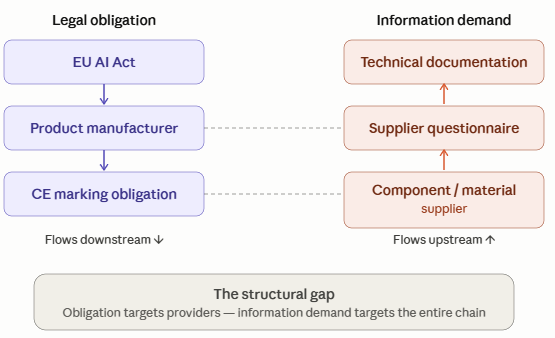
The obligation sits with the final product manufacturer, not the upstream supplier. But to complete their technical documentation, manufacturers need information from suppliers.
This creates a dynamic that anyone who lived through REACH [4] (the EU’s chemical registration regime that reshaped global supply chains starting in 2007) will recognize immediately: the legal obligation sits with the manufacturer at the bottom of the chain, but the information demand travels upward, reaching suppliers who had no idea they were in scope until the questionnaire landed on their desk.
The AI Act will do exactly the same thing.
Where AI Enters the Manufacturing Process
Even if a supplier does not consider itself an “AI company,” AI may appear in:
- Design: property-prediction models, formulation optimization
- Manufacturing: process-parameter optimization, anomaly detection
- Quality control: automated visual inspection, dimensional analysis
If AI influences any characteristic of a supplied component, the downstream manufacturer must document it. The next section maps exactly what documentation these uses will trigger — and the level of engineering detail that suppliers should expect to provide.
What the Questions Will Look Like (Engineering Level)
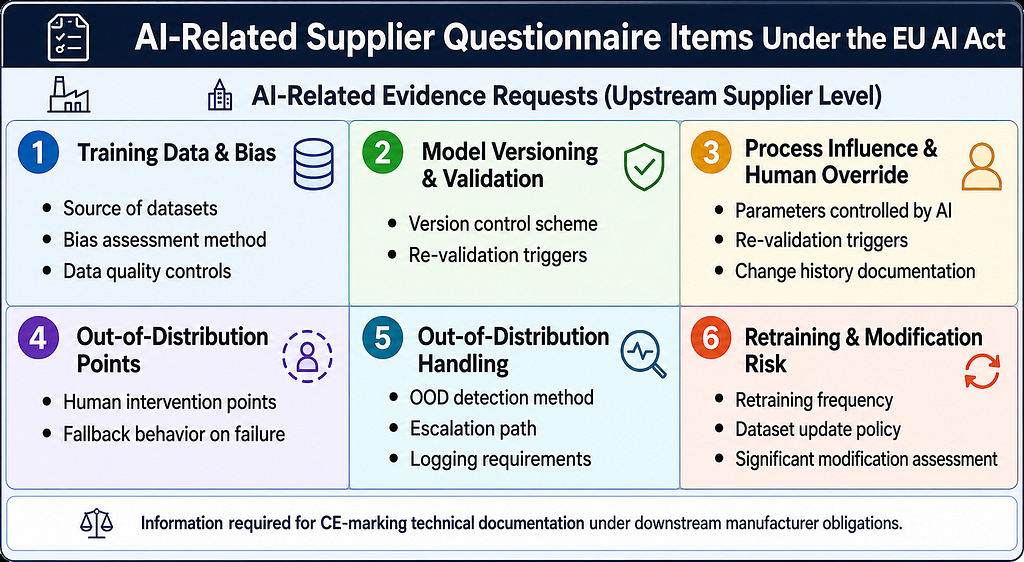
In practice, the questions that reach suppliers will not stop at “Do you use AI in this process?”. They will target the technical characteristics required for CE-marking documentation.
The structure resembles engineering change-control:
- Training Data & Bias — dataset sources, bias-assessment method, data-quality controls
- Model Versioning & Validation — version-control scheme, re-validation triggers, change-history documentation
- Process Influence & Human Override — parameters controlled by AI, human-intervention points, fallback behavior on failure
- Out-of-Distribution Handling — OOD detection method, escalation path, logging requirements
- Retraining & Modification Risk — retraining frequency, dataset-update policy, significant-modification assessment
These are engineering evidence requirements, not legal questions. And they will arrive long before the high-risk deadlines.
Which Products and Materials Are Exposed
Any component that ends up in a CE-marked product is potentially in scope — but the exposure is not about the material itself. It is about where ML models influence the characteristics of that material during production.
EV high-voltage cable insulation: When elastomer insulation is extrusion-formed, ML models often monitor thickness uniformity, detect die-swell anomalies, or classify surface defects. These models — not the rubber — become the AI-relevant element for CE-marking documentation.
Medical-grade polymer films: If an ML model predicts mechanical properties or flags micro-defects during calendaring, the model becomes part of the conformity-assessment evidence chain.
Battery-material slurry mixing: If AI optimizes viscosity or detects abnormal rheology patterns, the downstream manufacturer must document the model’s behavior, not the slurry.
Nobody is going to ask you to document the rubber. They are going to ask you to document the model that decided the rubber was good enough to ship.
High-Risk vs Non-High-Risk: The Real Boundary
The Omnibus package [2] narrows what qualifies as a safety-relevant AI component. For suppliers, classification depends entirely on how the downstream manufacturer integrates the AI-affected component.
Likely outside high-risk scope:
- Visual inspection used only for yield improvement
- Process-parameter optimization
- Predictive maintenance without safety-critical actions
Likely within high-risk scope:
- AI determining whether a medical-grade material meets diagnostic thresholds
- AI triggering emergency-stop functions in machinery
- AI-based anomaly detection in EV cable systems influencing safety decisions
In practice, this boundary is messier than it looks on paper. A yield-optimization model that rejects parts before they reach a safety-critical assembly — is that yield optimization or safety screening? The answer depends on how the downstream manufacturer frames it in their conformity assessment, and suppliers usually find out after the fact. This is exactly why the classification conversation needs to happen during contract negotiation, not during an audit. This is why suppliers must pre-document the Intended Purpose and Specification Boundaries of any AI model they use — establishing a defensive boundary against unauthorized high-risk classification by downstream customers. A supplier who has clearly documented “this model optimizes yield; it does not make safety determinations” has a stronger position than one who left the purpose unstated and must accept whatever classification the manufacturer assigns.
The Non-Retroactivity Trap
Article 111 of the AI Act [1] exempts systems placed on the market before the deadline — unless they undergo significant modification. For supply chain planning, this connects directly to a practical question: can a supplier ship a component before the deadline and avoid high-risk obligations permanently?
Almost certainly not. AI systems are not static artifacts — they retrain, they ingest new data, their parameters shift, their architectures get revised. Any of these changes can qualify as significant modification, resetting the regulatory clock. Even a routine retraining triggered by new data can alter a model’s performance characteristics or decision boundaries — which, under the AI Act, constitutes a significant modification [1]. If you run a Continuous Training pipeline, you have effectively built a machine that generates its own regulatory re-classification events on a schedule.
One caveat: implementing acts defining the precise threshold for “significant modification” have not yet been finalized. The direction, however, is clear: the Commission’s approach treats changes to performance, intended purpose, or risk profile as modification triggers [5]. Suppliers should plan for this interpretation rather than waiting for the final text.
For engineering teams, the implications are concrete: a model updated after December 2027 or August 2028 may be treated as a new system; CI/CT pipelines can unintentionally trigger re-classification; and “ship before the deadline” is not a viable long-term strategy.
This is why supply-chain AI mapping cannot wait. The stability of the AI system after launch determines whether non-retroactivity protection applies at all.
What This Means for Supply-Chain Strategy
The AI Act’s supply-chain impact is not a 2027 or 2028 problem. It is already a 2026 problem. For some supply chains, it is a last-quarter-of-2025 problem that nobody noticed.
Transparency obligations take effect in August 2026 [1]. Manufacturers preparing technical documentation are already mapping their supply chains for AI exposure. The REACH precedent [4] suggests supplier questionnaires will proliferate before, not after, formal deadlines.
Companies supplying into CE-marked product chains should map their own AI usage across design, manufacturing, and quality processes now — not because they are legally obligated, but because their customers will ask.
The regulation is aimed at AI providers and deployers. But the information demand? That reaches everyone who touches the product. Most AI Act commentary focuses on who is legally obligated. The more useful question is who is practically exposed — and the answer is the entire supply chain.
One more thing worth noting from the REACH era. The companies that built substance documentation capabilities early did not just achieve compliance faster. They became the suppliers that manufacturers stopped having to worry about — and the ones that quietly replaced competitors who could not produce paperwork on demand.
The AI Act will sort supply chains the same way. Not by rewarding the prepared, but by removing the unprepared. Slowly, politely, via procurement decisions that never mention the regulation by name.
References
[1] European Parliament and Council of the European Union, “Regulation (EU) 2024/1689 laying down harmonised rules on artificial intelligence (Artificial Intelligence Act),” Official Journal of the European Union, 2024. Available on the EUR-Lex portal.
[2] European Commission, “Omnibus Simplification Package — Amendments to the AI Act implementation timeline,” May 2026. Available on the European Commission legislative proposals page.
[3] European Commission, “CE marking — ensuring products meet EU standards,” official guidance. Available on the European Commission CE marking page.
[4] European Chemicals Agency (ECHA), “REACH Regulation (EC) No 1907/2006 — Registration, Evaluation, Authorisation and Restriction of Chemicals.” Available on the ECHA REACH information page.
[5] European Commission, “Guidelines on significant modification of AI systems under the AI Act (forthcoming implementing act).” Based on publicly available drafts and Commission communications as of May 2026.
The EU AI Act Won’t Hit Your AI Team First — It Will Hit Your Supply Chain was originally published in Towards AI on Medium, where people are continuing the conversation by highlighting and responding to this story.
