Vibecoding Was the Easy Part

Building used to be the bottleneck. Now it’s everything that comes after.
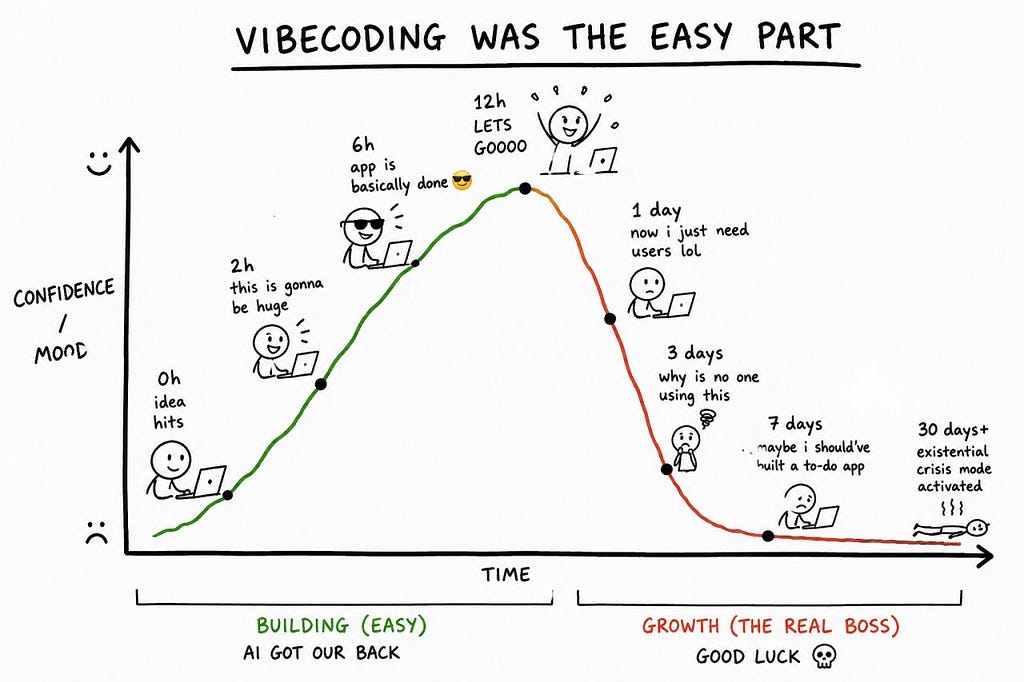
You ship a working product in twelve hours. Auth, payments, a clean dashboard, even some halfway-decent onboarding copy. The model keeps up, you keep prompting, and somewhere around hour ten you start feeling that specific kind of high — the one where you’re convinced this is the thing.
You post the link. You lean back. You wait.
Three days later, your only signups are you, your cofounder, and one bot from a server farm somewhere in Eastern Europe.
If you’ve shipped anything in the last six months, you know this curve. Abhiram Kakarla drew it perfectly in a recent LinkedIn post — confidence climbing through the build, peaking at “12h LETS GOOOO,” and then absolutely collapsing the moment you realize you have to find users. By day seven you’re wondering whether you should’ve just built a to-do app. By day thirty you’re in what he generously calls “existential crisis mode.”
The chart is a joke. It’s also an unnervingly accurate description of what’s happening to indie founders right now.
The bottleneck moved
For most of software’s history, building was the hard part. You needed to know how to architect things, debug things, deploy things. The skill ceiling was high, and the floor — actually getting a working product into the world — was high too. That meant once you’d built something, you had a moat. The fact that it existed was its own form of distribution. Other people couldn’t just spin up your competitor in a weekend.
That moat is gone. With models like GPT-5.5 and Opus 4.7, building is no longer where the difficulty lives. You can describe a product into existence faster than you can write the README for it. A solo founder can now ship what would’ve taken a five-person team eighteen months in 2022. The technical floor has dropped through the basement.
Which sounds like good news, and is, until you realize the implication: every advantage you had from being able to build is now an advantage everyone has. The bottleneck didn’t disappear. It moved.
It moved to distribution.
Why distribution is harder than building
Here’s the part nobody warned us about. Building a product, even a complicated one, is a closed system. You define the inputs, you define the outputs, you control the variables. There’s a right answer and you can iterate toward it. AI is exceptional at closed systems — that’s why vibecoding works in the first place.
Distribution is an open system. You’re not optimizing against a spec. You’re optimizing against thousands of strangers’ attention, taste, mood, and whatever they happen to be doing on a Tuesday afternoon. You can’t unit-test a launch. You can’t git revert a bad first impression. The feedback loops are slow, noisy, and lagging — by the time you know something worked, the moment has usually passed.
It’s also a competitive system. Every other vibecoder is also shipping. The week you launch, fifty people launch something adjacent to yours. The frontier model that built your product also built theirs. So the bar isn’t “does it exist?” anymore — it’s “why does it deserve someone’s attention this week, given everything else clamoring for it?”
That’s a much harder question. And it’s the one nobody who fell in love with prompting was prepared to answer.
What actually moves the needle
If you talk to founders who’ve cracked traction in the post-vibecoding era, you start to hear the same three things on repeat. None of them are tools. They’re systems.
The first is outreach automation. Not the spammy LinkedIn kind — the version where you build a tight ICP, scrape signal-rich data sources, draft genuinely personalized messages with AI, and run them through a deliverability-aware pipeline. The point isn’t volume. The point is being able to consistently put your product in front of the exact 200 people who would actually care, every week, without it eating your life. Founders who do this well treat outreach the way they used to treat their build pipeline: instrumented, iterated, and version-controlled.
The second is content systems. Singular content — one good post, one good video — is essentially worthless now. The signal it generates gets buried inside an hour. What works is a system: a recurring format, a clear point of view, a publishing rhythm you can sustain for ninety days without breaking. AI helps here, but only if you’re using it to amplify a real perspective. Models are excellent at producing fluent, forgettable prose. They’re useless at having a take. The take has to come from you. Once it does, AI becomes the most powerful content multiplier ever built.
The third is growth loops. This is the boring, structural one — the part where you ask whether using your product makes the next user more likely to find it. Referral mechanics. Public artifacts. Embeddable outputs. SEO-friendly pages generated as a byproduct of normal usage. A growth loop is a piece of engineering, not a marketing campaign, which means the people who built the product are usually best placed to design it. Most vibecoders skip this entirely and then wonder why their funnel leaks.
AI for distribution, not just creation
The reframe that’s started to click for me — and I think this is what Abhiram is pointing at — is that we’ve been using AI for the wrong half of the job.
We’ve spent the last two years getting AI to write code. That’s a solved problem now. The more interesting question is: how do you use AI to actually bring an idea to life — meaning everything from finding the people who’d want it, to writing the words that make them stop scrolling, to running the experiments that tell you which channel is your real channel.
This is a different muscle. It’s less about prompting a model to produce a thing and more about designing systems where AI runs in the background — qualifying leads while you sleep, drafting next week’s content from your raw notes, A/B testing copy across hundreds of micro-variations, summarizing what’s working in your analytics so you don’t have to stare at dashboards. The output isn’t a product. The output is traction.
Founders who figure this out in the next six months are going to compound past everyone else. Not because their products are better. Their products will be roughly as good as everyone else’s, because the building floor is the same floor for all of us now. They’ll win because they figured out the distribution stack first, while everyone else was still posting “just shipped 🚀” into the void.
The new founder skillset
If you’re an indie builder right now, the most valuable thing you can do is stop measuring yourself by what you can build and start measuring yourself by what you can move. That doesn’t mean abandoning the craft. It means recognizing that craft has stopped being scarce.
The scarce thing is taste — knowing what to build. The scarce thing is conviction — knowing why anyone should care. The scarce thing is patience — being able to run a content system or an outreach loop for ninety days when the first thirty produce nothing measurable. AI can generate the artifacts of distribution. It can’t generate the willingness to keep going.
So yes, vibecoding has solved creation. That’s real, and worth celebrating. But the founders who treat that as the finish line are about to learn what Abhiram’s chart already told them: the build is the green part of the curve. Everything that matters happens after the peak.
The good news is that distribution, like building, can be engineered. It just takes longer to learn, and longer to admit you have to learn it. Which is probably why most people won’t.
And that, weirdly, is the opportunity.
Vibecoding Was the Easy Part was originally published in Towards AI on Medium, where people are continuing the conversation by highlighting and responding to this story.
