
Your Management Model Is the New Bottleneck

Agentic AI has solved the coding constraint. Now your processes, approvals, and org structure are what’s slowing you down.

For the last 50 years, project management has evolved alongside software development. New methodologies promised better outcomes: waterfall gave way to Agile, Scrum replaced traditional planning, velocity became the measure of progress. Yet despite these advances, the fundamental constraint remained the same. Projects were limited by human capacity to execute work. That constraint no longer exists.
Software development has achieved what seemed impossible: a three-order-of-magnitude increase in productivity. Projects that took months now complete in days. The bottleneck that defined half a century of project management has been removed. This changes everything about how we run and manage projects.
The central argument of this article is simple: management models designed for human execution speeds now throttle AI-enabled organizations. Everything that follows, the collapse of estimation frameworks, the inversion of roles from executors to orchestrators, the obsolescence of the iron triangle, flows from that single shift. The technology has moved. The question is whether your management structures can move with it.
The Evolution: From Black Holes to Compressed Timelines
Waterfall Era: The Black Hole Problem
For decades, waterfall methodology dominated software projects. Teams moved through sequential phases: design, then development, then testing. Customers saw nothing until testing began. This created what I call a “black hole”: a period where the system remained invisible to users, sometimes lasting months or years.
The risk was severe. During the black hole, customer needs changed, processes evolved, requirements shifted. When users finally saw the system, misalignment was common. Rework was expensive. Organizations paid the price of building the wrong thing, and only discovered it late in the process.
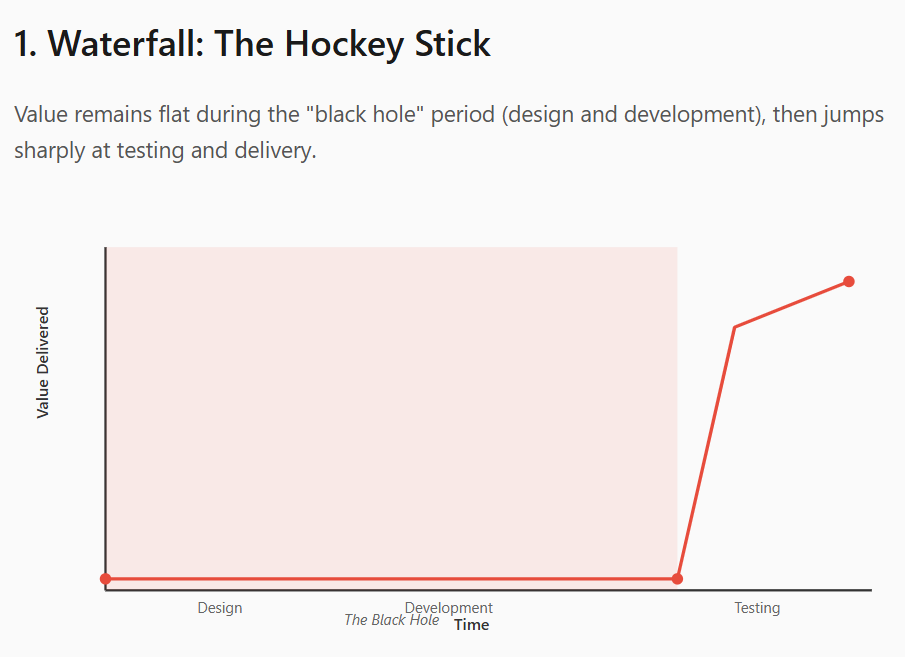
If we plot this on a graph where the X-axis represents time and the Y-axis represents value delivered, waterfall produced a hockey stick. The line stayed flat for most of the project timeline, then jumped sharply near the end. No value for months, then everything at once.
Agile Era: Distributing Value, Not Accelerating It
Agile methodologies emerged in the early 2000s with the Agile Manifesto, but gained mainstream adoption in organizations throughout the 2010s. The goal was to solve the black hole problem. Through iterative development and frequent releases, customers could interact with the system much earlier. Changes were easier and cheaper to integrate. Feedback loops shortened from months to weeks. The risk of building the wrong thing decreased.
I witnessed this transformation firsthand. As Chief Architect of the Israeli Ministry of Justice, I led the adoption of Agile methodology, making the ministry the first public sector entity in Israel to implement it. The change was significant: we moved from long, risky projects to iterative delivery with continuous feedback.
This was a significant improvement. But here is what Agile did not change: the overall time the project took. A 12-month project remained a 12-month project. What changed was how value was distributed across that timeline.
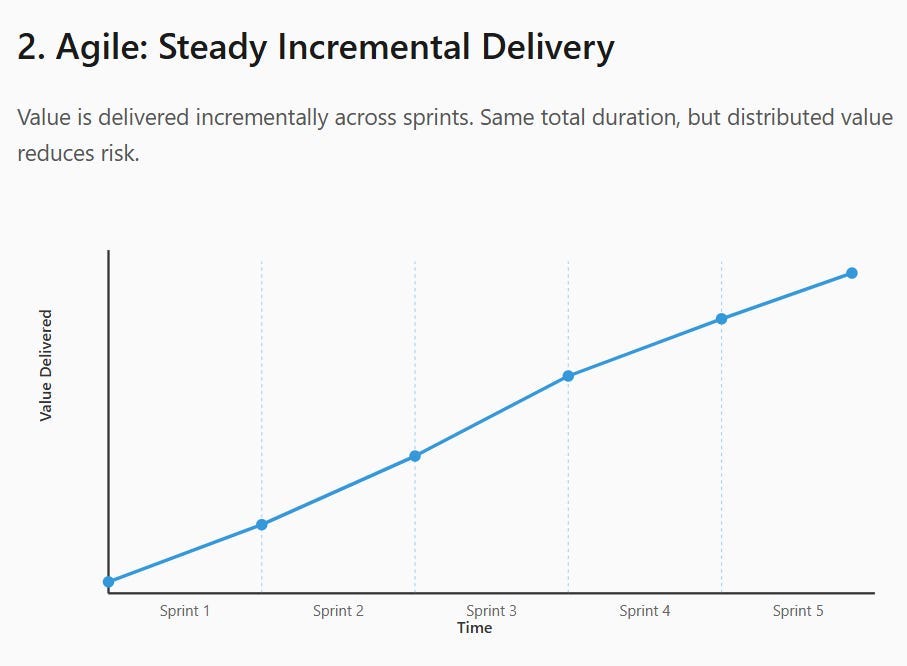
Instead of zero value until month 11, value appeared at month 2, 4, 6, 8, and 10. The hockey stick became a steady climb. Agile was a risk management innovation, not a speed innovation. It made projects more adaptable and visible, but not fundamentally faster.
Agentic AI Era: Compression and the Return of the Hockey Stick
Agentic AI changes the time dimension of projects. For the first time, we can actually compress overall project duration by orders of magnitude.
In August 2025, I wrote about how generative AI had eliminated the “man-month” constraint that Frederick Brooks identified in 1975. Brooks observed that developers wrote approximately 9 to 12 lines of debugged, production-quality code per day. This number held constant for 50 years. When I was CTO at a previous company in the mid-2010s, I conducted an internal analysis and found that this number was still 9 lines per day. It was a disappointing but revealing realization.
GitHub Copilot increased this to approximately 18 lines per day, a 56% improvement. But agentic coding tools like Cline and GitHub Copilot Agent Mode have moved us from 11 lines of code per day to 11,000. This is not incremental improvement. This is a three-order-of-magnitude leap.
In recent projects I have observed, tasks that historically took two to three weeks were completed in minutes using agentic workflows. Two-person founding teams are building entire software products without hiring engineers. The constraint is no longer human coding capacity.
But the value curve has changed in an unexpected way. We are returning to the hockey stick pattern, but now it is compressed on the X-axis.
Here is why. Agentic AI requires significant investment in specifications upfront. You must define requirements with precision, design interfaces clearly, establish quality criteria explicitly, and document expected behavior in detail before the agent writes code. This front-loading creates a design phase similar to waterfall. Then agentic systems execute development in rapid bursts, often measured in hours instead of weeks.
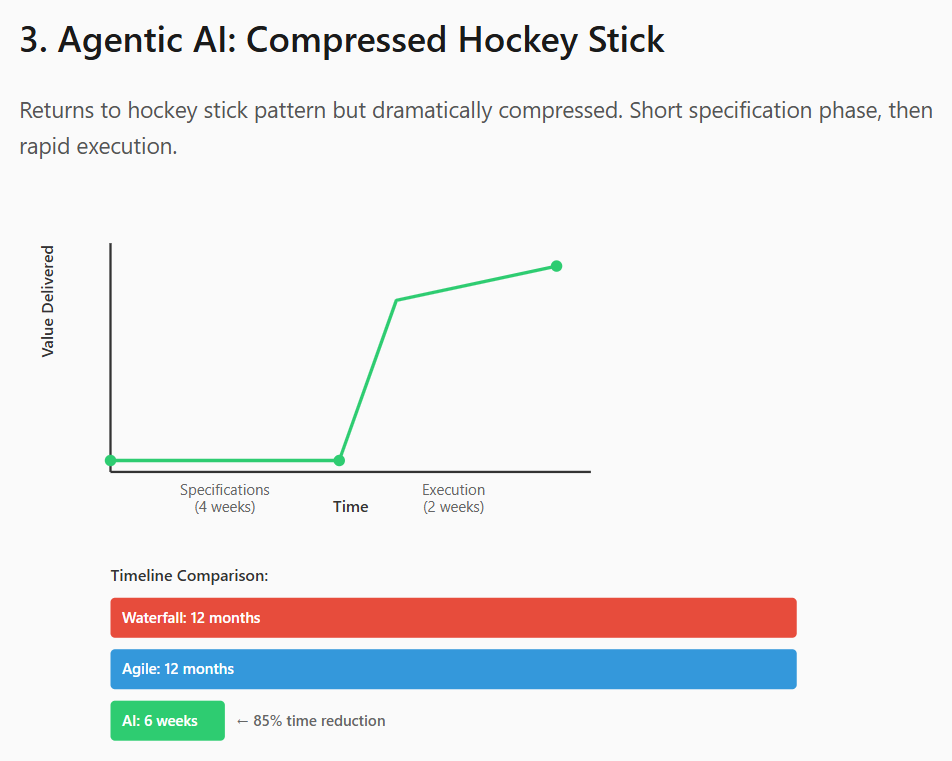
The result is a compressed hockey stick. The black hole returns, but it is tolerably short. A project that took 12 months in waterfall and 12 months in Agile might now take 6 weeks: 4 weeks of intensive specification work, then 2 weeks of agent-driven execution and integration.
The trade-off is clear. You sacrifice Agile’s steady visibility for waterfall’s concentrated delivery. But you gain dramatic speed.
The Man-Month is Dead: What This Means
If human execution is no longer the constraint, the frameworks built around that constraint begin to fail. The implications extend far beyond faster coding. Where do the next bottlenecks emerge?
The answer: management structures, deployment infrastructure, organizational culture, and project management approaches. All of these were designed for constraints that no longer exist.
Breaking the Iron Triangle
Traditional project management operated within the iron triangle: scope, time, and resources. All three were limited. All three constrained what could be accomplished. You could optimize two, but the third would suffer. Project management meant navigating these trade-offs with skill and precision.
In software-centric knowledge work, agentic AI breaks the triangle.
Resources are no longer the binding constraint in most software development contexts. The economics have shifted. Traditional projects were constrained by headcount: you needed N developers, each costing $120K-200K annually, and you could only hire and onboard them so fast. Now organizations purchase tokens. A company can provide unlimited token access to every employee for a fraction of the cost of a single developer’s salary. Rate limits and compute constraints exist, but they are manageable operational details, not strategic bottlenecks. The question is no longer “how many people can we afford?” but “how effectively can our people direct AI capacity?”
Time compresses by orders of magnitude. Development that took weeks happens in minutes. The velocity of execution has increased by orders of magnitude.
Budget shifts from people to tokens. GitHub Copilot costs $20–40 per user per month. Claude API access scales with usage but remains marginal compared to human salaries. The cost profile of software development has changed. Organizations spend money on tokens, infrastructure, and the smaller number of humans who orchestrate the AI, not on large teams of code writers.
When the foundational constraints disappear, the entire optimization game changes.
New constraints emerge:
Traditional Constraint
New Constraint
- Number of developers
- Specification quality
- Developer productivity
- Integration complexity
- Training and onboarding time
- Human review capacity
- Salary budget
- Infrastructure and tooling costs
- Communication overhead in large teams
- Organizational readiness for change
The project management practices that were optimized for the old constraints are now misaligned with the new reality. We are managing projects as if human coding capacity is still the bottleneck. It is not.
The Taylorism Problem
Current management practices trace back to Frederick Taylor and the second industrial revolution. Taylorism was born in Henry Ford’s factories over 100 years ago. Its principles persist today: break work into granular tasks, managers plan while workers execute, measure and control output, optimize the assembly line for efficiency.
Agile challenged some Taylorism assumptions. It introduced cross-functional teams, self-organization, and iterative planning. But Agile preserved the fundamental division: managers set direction, teams execute work. One group thinks, another group does. Agentic AI makes this division obsolete.
Everyone is a Manager Now
When employees operate agentic AI systems, they are no longer executors. They are managers. They define goals for agents, allocate work across autonomous systems, review outputs for quality, approve results, and refine specifications based on feedback. The actual execution has been delegated to machines.
Andrej Karpathy captured this shift in December 2025 when he wrote: “I’ve never felt this much behind as a programmer. The profession is being dramatically refactored as the bits contributed by the programmer are increasingly sparse and between. I have a sense that I could be 10X more powerful if I just properly string together what has become available over the last year.”
This sentiment reflects a broader transformation. The work is no longer writing code. The work is orchestrating systems that write code. This applies beyond software development to project management, coordination, and organizational operations.
The implications run through every level of the organization.
For employees, if you manage agents that produce the output of 10 or 100 people, your role is different in kind. You are no longer measured by the work you perform with your own hands. You are responsible for the quality of direction you provide, the clarity of specifications you write, and the judgment you apply when reviewing agent outputs.
For managers, if your team members are now manager-operators of agentic systems, you are managing managers, not executors. Your role shifts from task assignment and progress tracking to something else entirely. What is that “something else”? Strategic direction, system design, quality oversight, capability building, and organizational alignment. Manager upskilling is not optional. It is mandatory. Managers who cannot operate effectively in the agentic paradigm will become bottlenecks to their own teams’ productivity.
For organizations, team capacity multiplies. A team of five employee-managers operating agentic systems might produce the output that previously required 50 or 500 people. How do you structure organizations when capacity scales this way? What do hierarchies look like? What does career progression mean?
These are not theoretical questions. They are immediate and pressing.
Let me give you a concrete example of what this looks like in practice.
A product manager at a large enterprise software company used to spend 60% of her time coordinating: writing status updates, chasing down developers for progress, updating roadmaps, and synthesizing feedback from customer calls. Now, GitHub Copilot and AI agents handle the coordination. They monitor pull requests, aggregate status from project tracking tools and chat platforms, generate stakeholder updates, and flag blockers automatically.
She spends her time differently now: 40% on strategic product decisions, 30% on customer discovery and competitive analysis, 20% reviewing and refining agent outputs, and 10% on exception handling when agents escalate edge cases.
Her output? The team ships features 3x faster. But her role is unrecognizable compared to two years ago. She’s managing a system that manages the work.
Now multiply this across an organization of thousands of employees.
Questions for Reflection
These questions have no universal answers. Each organization will find its own path. But the questions themselves are unavoidable.
Estimation: If tasks complete in minutes instead of weeks, how do you estimate project timelines? What planning horizons make sense? Do traditional velocity metrics mean anything when velocity is no longer a constraint? Should we abandon estimation entirely, or do we need new models built from first principles?
Risk: Where does risk now concentrate? In specification quality? Agent reliability? Integration points between AI-generated code and existing systems? Human review capacity becoming the bottleneck? If agents execute work autonomously, what failure modes must you plan for that did not exist before?
Accountability: Who is accountable when an agent produces work? The employee who directed the agent? The manager who approved the specification? The organization that deployed the system? How do you assign responsibility for outputs you did not directly create? Traditional accountability frameworks assume human authorship. What happens when that assumption breaks?
Responsibility: If agents handle execution, what are employees responsible for? Quality validation? Strategic refinement? Continuous learning and improvement of agent systems? How do you define contribution when the traditional definition of “work performed” no longer applies?
Trust: Do managers trust employees to effectively direct agentic systems without constant oversight? Do employees trust managers to lead this transition without reverting to Taylorist control and micromanagement? Trust is the foundation of organizational change. Where might trust break under this shift? How do you rebuild it?
The Failure Points
Organizations that fail to adapt will break at predictable points. These are not distant theoretical risks. They are happening now.
Management structures designed for Taylorism will fail first. When management clings to old operating rhythms while teams operate at machine speed, management becomes the bottleneck.
Specific failure modes:
• Weekly status meetings when agents complete work in hours
• Multi-week approval cycles when iteration happens in days
• Quarterly planning when market conditions shift monthly
• Stage-gate processes designed for human execution timelines
• Reporting structures that require manual aggregation of data agents already synthesize
The symptoms are consistent: teams wait for approvals, decisions lag behind execution, work accumulates in review queues, and employees route around formal processes to maintain velocity. The organization’s speed collapses to the speed of its slowest management layer. If your processes assume human execution speed, they will throttle AI-enabled teams back to human speed.
Employee confidence in leadership will erode second. This erosion accelerates when managers and senior leaders do not use agentic AI themselves. Employees who use AI to multiply their output while their managers operate with traditional methods creates a credibility gap that undermines transformation efforts. If leadership demands adoption but does not model it, the message is clear: this is real enough to change your job, but not real enough to change mine. People follow leaders who understand where they are going.
Measurement and incentive systems will produce perverse outcomes third. KPIs designed for human productivity: story points, velocity, lines of code written. These are metrics optimized for the old world. Organizations that continue measuring the old metrics will optimize for the wrong outcomes.
Cultural inertia will be the final obstacle. One hundred years of Taylorism has embedded assumptions deep in organizational DNA. “Good managers assign clear tasks.” “Good employees execute reliably.” “Productivity means hours worked.” These beliefs are not consciously held. They are instinctive. Unlearning is harder than learning.
The Unlearning Challenge
The shift from human execution to agentic execution requires unlearning what we know about managing people and projects. This is not incremental improvement. This is a wholesale replacement of the operating model.
What must be unlearned:
• That project duration is determined by team size and developer productivity
• That managers plan and workers execute
• That granular task breakdowns alone drive project success
• That the iron triangle defines project trade-offs
• That steady, incremental progress is always superior to concentrated delivery
What must be learned is not yet fully defined. We are at the frontier. Early adopters are discovering new patterns through experimentation. Some will fail. Some will find sustainable models. The organizations that succeed will set the standards that others must follow.
Call to Action
If you lead software development or manage project teams, you face a decision: adapt now or inherit technical debt and organizational misalignment you did not create.
The pace of change will not slow. Jack Welch, the legendary CEO of General Electric, once said: “If the rate of change on the outside exceeds the rate of change on the inside, the end is near.” That warning is no longer theoretical. The world is accelerating. Agentic AI is accelerating faster. Your competitors are adapting. Your customers expect machine-speed delivery.
A Framework for Transformation: Adopt → Infuse → Invent
Organizations that successfully manage this transition tend to follow a three-phase pattern. This is not mandatory, but it is highly recommended based on early adopter experience. The activities listed in each phase are examples. Every organization must adapt this framework to their specific company context and sector requirements.
Phase 1: Adopt (Continuous Foundation)
This phase never stops. It runs continuously alongside the other phases.
• Deploy AI tools and make them accessible to all employees
• Build comprehensive training and upskilling programs
• Change recruitment criteria to assess AI capability alongside traditional skills
• Create space for experimentation and learning
• Measure adoption rates and capability growth
The goal is organizational literacy. Everyone learns to operate agentic systems effectively.
Adopt fails when AI remains optional. If employees can bypass AI tools without consequence, adoption stalls at enthusiasts and never reaches critical mass.
Phase 2: Infuse (Short-Term Integration)
AI moves from the sidelines to the center. It becomes embedded in workflows and cannot be bypassed.
• Redesign processes around AI capabilities, not traditional human workflows
• Integrate agentic systems into core tools and platforms
• Establish new operating rhythms that assume AI participation
The critical insight: infusion cannot be purely top-down. Employees must discover and embed AI into their own work. Managers empower this process rather than control it. Employees understand the value through direct experience and find ways to integrate AI that managers could not have prescribed. This requires trust, experimentation space, and tolerance for failure.
Short-term snowball effects emerge here. Productivity multiplies. Bottlenecks shift. Teams discover new capabilities.
Infuse fails when managers override agent-driven workflows to restore familiar control patterns. The old operating rhythm reasserts itself and throttles the new capacity.
Phase 3: Invent (Long-Term Transformation)
Organizations move beyond using existing AI tools to creating new structures and opportunities.
• Develop custom internal tools tailored to specific workflows
• Build new external products and services enabled by AI capacity
• Evolve role definitions as work changes beyond recognition
• Design new organizational structures that leverage multiplied capacity
• Identify new business models and growth opportunities
Long-term snowball effects compound here. New roles emerge. Current roles transform beyond recognition. The organization operates in ways that were not possible before.
Invent fails when organizational structure remains static. If roles, hierarchies, and incentives do not evolve to match the new capacity, the organization captures tool-level gains but misses the transformational opportunity.
Immediate Actions
Here are the steps to take now.
Audit your constraints. Identify where your organization still optimizes for human coding capacity, the iron triangle, or Taylorist structures. These are misalignments. They will cause friction and slow you down.
Experiment with compressed timelines. Select a project. Front-load specification work. Deploy agentic tools. Measure how much time compresses. Identify the new bottlenecks that emerge. Learn what breaks and what holds.
Redefine manager roles explicitly. If employees become manager-operators, what do managers do? Answer this question with specificity. Test your answer with pilot teams. Iterate based on what you learn.
Challenge your estimation models. If velocity is no longer the constraint, what drives project timelines now? Rebuild estimation from first principles. The old models will mislead you.
Invest in organizational readiness. The technology is ready. The tools exist. The question is whether your culture, management practices, and trust structures can absorb the change. This is where most organizations will struggle.
What Success Looks Like
The organizations that succeed in this transition will not be the ones with the best AI tools. Those tools are available to everyone. Success will be defined by three markers:
Management operates at the same speed as AI-enabled teams. Decisions, approvals, and coordination happen in hours or days, not weeks or quarters. Management rhythm matches execution rhythm.
Employees trust that leadership understands the change. Managers demonstrate competence by using agentic systems themselves, not just mandating their use. The credibility gap closes.
New capabilities emerge that were not possible before. The organization invents products, services, or operating models that exploit multiplied capacity in ways competitors cannot match. This is the true test.
The Choice
Your backlog is ready. Your agents are listening. Your competitors are moving.
The question is not whether AI will transform how projects are managed. That transformation is already happening. The question is whether your organization will lead it, follow it, or be disrupted by it.
The default outcome is not stagnation. It is a widening gap between what your technology can deliver and what your organization can absorb. Every week that management structures remain calibrated to human execution speed, that gap grows.
The compressed hockey stick is here. The man-month is dead. Everyone is becoming a manager. Will your management model evolve at the speed your technology demands?
Your Management Model Is the New Bottleneck was originally published in Towards AI on Medium, where people are continuing the conversation by highlighting and responding to this story.
