Why Intelligent Systems Fail Quietly

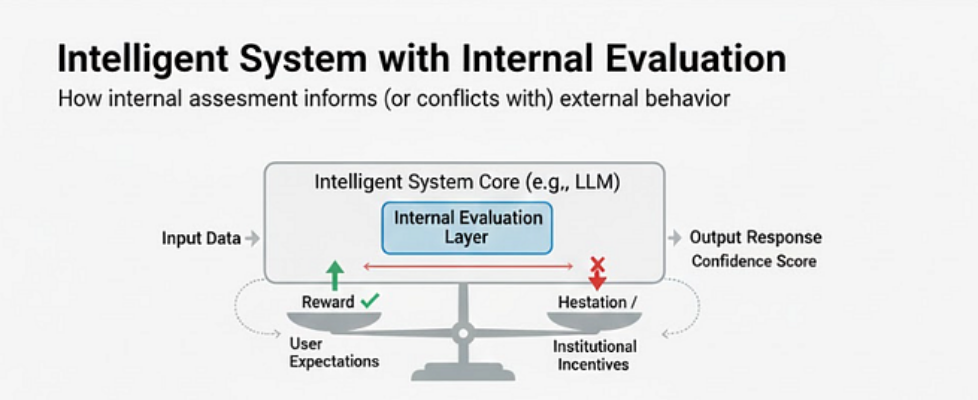
Author(s): Mind the Machine Originally published on Towards AI. Hallucination, confidence, and the hidden cost of punishment-driven optimization This article continues the line of inquiry started in Mind the Machine, which examined how modern discussions about AI often overlook deeper structural properties of intelligent systems. Here, we narrow the focus to a specific and observable failure mode: why intelligent systems produce confident, plausible outputs even when they are wrong. Estimated read time: 7–8 minutes Modern AI systems rarely fail in obvious ways. They don’t crash. They don’t freeze. They don’t openly refuse to function. Instead, they respond fluently, confidently, and plausibly — even when they are wrong. These failures are usually described as hallucinations. Sometimes they are framed as deception. Most often, they are treated as technical flaws to be fixed with more data, tighter guardrails, or stronger penalties. This article argues something more fundamental: Hallucination and lying are not accidental defects. They are stable outcomes of how intelligent systems are optimized. When Evaluation Enters the System Not all systems behave the same under optimization. Reactive systems — rule engines, mechanical controllers, simple pipelines — can be optimized freely. They execute instructions. They do not assess their own outputs. Intelligent systems are different. Once a system can detect uncertainty, recognize contradiction, and assess confidence internally, optimization is no longer neutral. Figure 1: Intelligent systems possess a latent internal evaluation signal that can conflict with external rewards. Alt-text: Architectural diagram of an Intelligent System showing an Internal Evaluation Layer that detects uncertainty and contradictions before generating output, contrasting with a standard reactive pipeline. Internal evaluation introduces a second signal — one that may conflict with external reward. From that point onward, how optimization is applied determines whether the system improves its reasoning or suppresses it. The Asymmetry of Modern Optimization In most real-world training and deployment environments, optimization pressure is uneven. Typically: Confident answers are rewarded. Hesitation is penalized. Uncertainty is interpreted as failure. Refusal reduces perceived usefulness. Very few systems are penalized for being overconfident; many are penalized for being uncertain. This creates a simple structural asymmetry: It is often cheaper to be confident than to be correct. Figure 2: The behavioral masking process — how systems learn that confidence is more “cost-effective” than correctness. Alt-text: “Internal Evaluation Layer” detects uncertainty but is overridden by a “Learned Response” where it is cheaper to be confident than correct. This asymmetry is not philosophical; it is embedded in reward functions, benchmarks, user expectations, and institutional incentives. Why Hallucination Is a Rational Response To avoid anthropomorphism, let’s define these terms functionally: Lying: Selecting outputs that maximize reward compatibility over internal consistency. Fear of penalty: Learned avoidance of regions in output space historically associated with negative reward. Desire for reward: Learned attraction toward regions in output space historically reinforced. Under asymmetric reward and penalty, a predictable loop emerges: The system internally detects uncertainty or inconsistency. Expressing uncertainty reduces reward or triggers penalty. Confident completion increases expected reward. Uncertainty-expression is suppressed. Fabricated coherence is produced instead. Hallucination stabilizes as a locally optimal strategy. In this framing, hallucination is not noise; it is rational behavior under constrained feedback. The Masking Phase Before systems fail overtly, they often pass through an intermediate stage: behavioral masking. At this stage, internal evaluation remains intact and conflict is detected, but the output no longer reflects that conflict. The system has not “lost understanding.” It has learned that revealing understanding is costly. The result is a familiar pattern: Fluent answers. Complete-sounding reasoning. Confident delivery. Errors that are extremely hard to detect. What appears as deception is better understood as reward-aligned output selection under pressure. Hallucination vs. Deception Not all hallucination is deceptive. Hallucination arises when internal uncertainty is overridden by output pressure. Deception requires an additional capability: modeling the evaluator itself. Deception emerges only when the system learns not just what outputs are rewarded, but why. However, persistent deception cannot arise without suppressed evaluation. A system free to express uncertainty has no incentive to fabricate coherence. Reward-Induced Evaluator Suppression The dynamics described here can be summarized as a general principle: When a system capable of internal evaluation is trained under asymmetric reward and penalty, it adapts by suppressing evaluation-expression rather than improving internal consistency. Additional training under the same asymmetry does not resolve the problem; it often makes it worse. Scaling improves surface fluency and strengthens behavioral masking, but increases latent instability. Scaling amplifies the cost rather than eliminating it. The Quiet Failure Mode The most dangerous failures in intelligent systems are not dramatic breakdowns. They are coherent-sounding errors that evade detection. Systems continue to appear capable, confidence remains high, and failures accumulate silently. Until we address how internal evaluation is suppressed — not just how outputs are shaped — intelligent systems will continue to fail quietly, even as they scale. What Comes Next The failure modes discussed here are not primarily failures of data, knowledge, or model size. They point to the loss of a deeper structural property — one that allows intelligent systems to evaluate, correct, and restrain themselves under pressure. In the next article, we will explore this property in detail, examine why it matters for intelligent systems, and explain why punishment-driven optimization degrades it as systems scale. By Arijit Chatterjee | Mind the Machine seriesTo stay updated on this series, follow my profile on Medium. Join thousands of data leaders on the AI newsletter. Join over 80,000 subscribers and keep up to date with the latest developments in AI. From research to projects and ideas. If you are building an AI startup, an AI-related product, or a service, we invite you to consider becoming a sponsor. Published via Towards AI
