
Why 2026 is the Year Synthetic Data Becomes Non-Negotiable


The internet is drying up. Model collapse is real. Privacy law is tightening. Here is what the data tells us and what it means for every AI team building right now.
There is a conversation happening in every serious AI lab right now, and it is not about model architecture or compute budgets. It is about data. Specifically, the growing and uncomfortable reality that the supply of high-quality, legally usable, human-generated training data is running out faster than most people publicly admit. This is not a speculative concern. It is a convergence of three simultaneous pressures: the physical exhaustion of internet-scale corpora, the emergence of model collapse as a peer-reviewed phenomenon, and the tightening of global privacy regulation that makes using real data increasingly legally hazardous. Together, these three forces are making synthetic data not a nice-to-have, but an infrastructure requirement.
This article goes deep on each. I will cite the research, name the numbers, and explain what it means for practitioners and why the tooling gap that still exists in this space is one of the most significant unsolved problems in applied AI today.
Part I: The Data Wall, how we got here and when it hits
The scaling law that built modern AI is running out of fuel.
To understand why 2026 matters, you have to understand the single most important empirical finding in the history of deep learning: the scaling hypothesis. More data, more compute, bigger model: better results. Almost every major capability leap in AI since GPT-3 in 2020 has been achieved not through algorithmic innovation but through sheer data volume. GPT-3’s 175 billion parameters trained on a massive web corpus was a watershed not because the architecture was revolutionary, but because of its scale.
The problem is that this rule, more data equals better models, requires an ever-expanding supply of data. And that supply has a ceiling. Epoch AI, one of the most rigorous AI research organizations tracking training inputs, published a landmark analysis projecting that high-quality language data on the internet will be fully exhausted before 2026. Low-quality data extends the runway to 2030–2050, but quality matters for frontier model training. The implication: the era of simply crawling more web pages to improve models is ending.
Frontier models will be overtrained by 5x starting from 2025. If current trends continue, exhausting the stock of data is unavoidable.
— Epoch AI: Will We Run Out of ML Data? (2024)
The publishers are locking the doors
What makes this worse is that the remaining data is being actively withheld. The MIT Data Provenance Initiative documented a dramatic contraction in content availability as publishers began understanding and resisting how their work was being used without compensation. Reddit, Stack Overflow, and X (formerly Twitter) now charge licensing fees. The New York Times sued OpenAI. Getty Images sued Stability AI. The legal landscape for training on scraped internet data has shifted from permissive ambiguity to active litigation. Cloudflare’s data from 2025 illustrates the mechanics precisely: AI training crawlers surged 32% year-over-year in April 2025, but this growth slowed sharply to just 4% by July, precisely as more publishers implemented bot-blocking and paywalls. The crawl-to-refer ratio for Anthropic’s crawler reached 38,000 pages crawled for every single visitor referred back, a number that captures the economic imbalance that publishers are now actively pushing back against.
The AI gold rush for chatbot training data could run out of human-written text as early as 2026.
— PBS NewsHour, June 2024
Stanford University’s AI Index 2025 Report sounds a clear alarm: the internet’s treasure trove of training data is rapidly depleted. MIT’s Data Provenance Initiative documented a dramatic drop in content made available as publishers increasingly restrict AI companies.
–Medium: Digital Drought (May 2025)
What this means for you, practically
If you are fine-tuning a domain-specific model for medical diagnosis, financial risk scoring, legal document analysis, customer service automation; you are not drawing from the general web corpus anyway. You need domain-specific, task-specific, high-quality data. And that data has never been publicly available in sufficient volume, regardless of the general corpus situation. The data wall hits domain AI teams immediately and directly. The general corpus running out is a long-term problem for frontier labs. The domain data problem is a right-now problem for every applied AI team.
The companies that cannot generate their own training data will be dependent on those that can. In domain-specific AI, that dependency is already the single biggest barrier to shipping.

Part II: Model Collapse, the hidden risk inside Synthetic Data itself
Here is where the story gets more complicated and more honest. Synthetic data is not a clean solution to the data wall. Poorly designed synthetic data generates a new problem that is arguably worse: model collapse. Any serious practitioner building with synthetic data in 2026 needs to understand this phenomenon at a mechanistic level.
In July 2024, Ilia Shumailov and colleagues at Oxford, Cambridge, and other institutions published a peer-reviewed paper in Nature that formally described and named model collapse. The finding: when generative models are trained on content produced by earlier models, without grounding to real-world distributions, the model’s output degrades across successive generations. Rare events vanish first. Outputs drift toward bland central tendencies. Eventually the model loses the variability that makes human-generated data rich. This is not a subtle theoretical concern. Shumailov’s team demonstrated it empirically across variational autoencoders, diffusion models, and language models. The pattern was consistent: early collapse removes information from the tails of the distribution (the rare, edge-case events), and late collapse produces outputs that bear little resemblance to the original data distribution.
AI model collapse is a degenerative feedback loop that arises when you train generative models on content produced by earlier models. Over successive generations, the system’s view of reality narrows: rare details vanish, outputs become repetitive and unoriginal, and the model loses the variability that makes human-generated content rich. – WinnSolutions: AI Model Collapse Risk 2025
Model collapse is not a theoretical future risk. It is a current and accelerating reality. By April 2025, 74.2% of newly created web pages contained AI-generated text. Among Google’s top-20 search results, AI-written pages climbed from 11.11% to 19.56% between May 2024 and July 2025, a pace of roughly 0.6 percentage points per month. The internet is already substantially contaminated with AI-generated content, and that content is being fed back into training pipelines. The ICLR 2025 paper ‘Strong Model Collapse’ proved that even small proportions of synthetic data without verification can harm model performance, and crucially, that this cannot be mitigated simply by data weighting. The model effectively amplifies its own mistakes through the feedback loop.
CRITICAL DISTINCTION: Model collapse is caused by unverified, LLM-generated data fed back into training. Statistically-grounded synthetic data generated from mathematical engines with validated distributions, not from LLMs generating values does not carry this risk. The failure mode is in how the data is generated, not in the concept of synthesis itself.
The replace vs. accumulate finding that changes everything
The most important finding in recent model collapse research is the distinction between two training strategies. In the ‘replace’ scenario where real data is entirely swapped with synthetic, collapse is mathematically inevitable. In the ‘accumulate’ scenario where synthetic data supplements real data across successive generations, collapse is avoidable. Research published for ICLR 2025 confirmed this finding across three distinct generative modeling settings. For practitioners, this means the goal is not to eliminate real data but to extend it intelligently with synthetic data that is statistically grounded and validated. The LLM is not the right generation engine for this task. The LLM’s job is to understand the structure, the constraints, the domain logic. A mathematical engine: numpy distributions, Cholesky decomposition for correlated columns, deterministic FK integrity enforcement, is the right generator.
According to one study, AI developers can avoid degraded performance by training AI models with both real data and multiple generations of synthetic data. This accumulation stands in contrast with the practice of entirely replacing original data with AI-generated data.
–IBM Think: What is Model Collapse? (2025)

Part III: The Privacy regulation ratchet
Even if the data wall were not happening, and even if model collapse were not a concern, there would be a third force making synthetic data structurally necessary: global privacy regulation. The legal landscape for using real personal data in AI training is not getting more permissive. It is ratcheting tighter with every passing year.
The regulatory numbers:
79% of the global population now lives under active data privacy legislation [NayaOne: Synthetic Data’s Moment, 2025]
€5.9B in cumulative GDPR fines issued to date [NayaOne: Synthetic Data’s Moment, 2025]
20 US states with comprehensive privacy acts enacted as of 2025 [NayaOne: Synthetic Data’s Moment, 2025]
30–50% reduction in data utility from traditional anonymization techniques, while still retaining re-identification risk [NayaOne: Synthetic Data’s Moment, 2025]
Why traditional anonymization is not the answer
The standard response to privacy constraints has historically been anonymisation: masking, tokenizing, or aggregating personal data before use. But this approach has two fatal flaws for AI training purposes. First, anonymisation degrades utility: research consistently shows 30–50% reduction in analytical value after standard anonymisation. A model trained on heavily masked data learns a distorted version of reality. Second, anonymisation does not reliably prevent re-identification. With sufficient background knowledge, anonymised datasets can often be re-identified, a concern regulators are increasingly sophisticated about.
Synthetic data sidesteps both problems. It contains no real personal identifiers because it was never derived from real individuals, it was generated to match statistical distributions. The EU AI Act, GDPR Article 4(1), and HIPAA all treat properly generated synthetic data as falling outside the scope of personal data regulation, because there is no natural person to whom it relates.
By 2025, privacy laws cover approximately 79% of the global population. Traditional anonymization often degrades data utility by 30-50% and retains re-identification risks of up to 15% in certain datasets. Synthetic data addresses these issues by generating new datasets that replicate statistical patterns without personal identifiers.
– NayaOne: Synthetic Data’s Moment (December 2025)

The HIPAA wall and how synthetic data bypasses it
Healthcare AI is the most vivid illustration of this problem. Patient records are the highest-value training data for medical diagnostic AI, drug discovery, and clinical decision support. They are also subject to HIPAA in the US and GDPR in the EU, regulations that make sharing this data across institutions, let alone across borders, legally extremely complex. The result has been that most medical AI is either trained on small single-institution datasets (creating models that don’t generalise) or on datasets assembled through multi-year legal processes that most research teams cannot navigate. Synthetic patient records that statistically mirror real clinical distributions, preserving the correlation between age, diagnosis, comorbidities, treatment outcomes resolve this legally and technically.
By generating synthetic rare disease cohorts, researchers can train models on conditions where real-world data is too scarce or too sensitive to share across state lines. This has effectively bypassed the HIPAA Wall, allowing for collaborative research that was legally impossible just three years ago. –AnalyticsWeek Synthetic Data: Breaking the US Data Privacy Bottleneck (March 2026)
Finance: synthetic fraud and the compliance collaboration paradox
Financial fraud detection presents a similar paradox. The most valuable training signal for a fraud detection model is actual fraud, real transaction data from cases where fraud was confirmed. But this data is among the most sensitive in existence. Sharing it across institutions, which would dramatically improve model quality, is near-impossible under existing financial privacy law. Synthetic transaction data, generated to statistically match the patterns of real fraud cases without containing any real customer identifiers resolves this. Banks are already using it. Research published in late 2025 showed that synthetic banking transaction data achieves 96–99% utility equivalence to production data for AML model testing.
The pattern across healthcare, finance, energy, and legal sectors is consistent: the most valuable data for training AI is the data that is most legally hazardous to use. Synthetic data is not a workaround. It is the only scalable path to domain-specific AI in regulated industries.

Part IV: The market that confirms this is real
Theory and regulation are compelling. But markets are the most reliable signal. The capital flowing into synthetic data, and the strategic acquisitions being made by the largest players in AI, tell you everything you need to know about where this is going.
In March 2025, Nvidia acquired Gretel, a San Diego-based synthetic data platform in a deal exceeding Gretel’s most recent valuation of $320 million. The deal was nine figures. The entire team of roughly 80 people was folded into Nvidia’s cloud AI services division. This was not a talent acquisition. Nvidia already has world-class ML talent. This was an infrastructure acquisition. Nvidia builds the hardware that trains AI models. Acquiring the tooling to generate training data is a vertical integration play, securing the supply chain that feeds into the compute they sell. When the world’s most strategically positioned semiconductor company acquires a synthetic data firm, the conclusion is clear: synthetic data generation is now core AI infrastructure.
Nvidia acquired Gretel in a nine-figure deal exceeding the company’s last valuation of $320 million. Gretel’s technology will be deployed as part of Nvidia’s suite of cloud-based, generative AI services for developers.
– TechCrunch: Nvidia Reportedly Acquires Synthetic Data Startup Gretel (March 2025)
SAS acquired Hazy’s key software assets in 2024, integrating them into SAS Data Maker to serve banks and insurers. SAS estimated the acquisition accelerated their product maturity by approximately two years, paying for external capability rather than building from scratch. Mostly AI, with $62M in funding, executed a strategic pivot in February 2025 by releasing the industry’s first enterprise-grade open-source synthetic data toolkit under Apache v2 license.
What the market structure means for builders
The pattern visible in these moves is consolidation of the enterprise tier. The big players Nvidia, SAS, Databricks, Microsoft are acquiring or building synthetic data capability for their enterprise customers. What they are not building is the accessible, no-code layer for the researcher, the startup founder, the analyst who needs realistic data but does not have a data engineering team. The research from Pebblous analyzing eight synthetic data companies is instructive here: single-function synthetic data tools without deep workflow integration have failed. Datagen raised $70M and shut down. Synthesis AI dissolved. The market is signaling that the viable positions are either deep enterprise integration or the accessible layer that democratises the capability. The middle is being squeezed.
There is no Figma for synthetic data. There is no interface where a non-technical user can describe what they need, and receive a statistically valid dataset that is ready to use. Every existing tool requires either API fluency, statistical expertise, or enterprise procurement. That gap is the most significant unsolved UX problem in the synthetic data market.
Part V: What good synthetic data actually requires
For data experts reading this, I want to be precise about what separates defensible synthetic data generation from the kind that produces model collapse or statistical artifacts. This is not a marketing section, this is the technical argument for why the architecture matters.
The wrong architecture: LLM as generator
The most common failure mode in synthetic data tools built in the past two years is using a large language model as the data generation engine. The LLM is asked to generate row values directly. This produces data that looks plausible in a small preview but fails catastrophically at scale and under scrutiny:
- Statistical distributions are hallucinated. An LLM asked to generate ages for a patient dataset will produce plausible-looking numbers, but they will not follow the actual distribution of your target population. They will not be normally distributed around the correct mean. They will not have the right standard deviation. They will be guesses.
- Referential integrity breaks at scale. In a 100-row sample, an LLM can keep track of which user_ids it generated and make sure orders reference them. At 100,000 rows across six related tables, it cannot. FK constraints are violated. The dataset is unusable for relational model training.
- Cross-column correlations are ignored. In real healthcare data, older patients have higher rates of certain conditions. Senior employees have higher salaries. These correlations are not random — they are causal structures that a model learning from this data needs to see. An LLM generating column by column has no mechanism to enforce or preserve these.
- Volume is bounded by context windows. Generating 1 million rows via LLM is not feasible. Context limits, latency, and cost make it impractical. Mathematical generation has no such ceiling.
The right architecture: LLM as schema extractor, mathematics as generator
The defensible architecture separates the two jobs cleanly. The LLM does what it is actually good at: understanding intent, extracting domain logic, identifying constraints, mapping relationships, and translating a plain-English description of data needs into a formal statistical specification.
The mathematical engine does the actual generation. Concretely:
- numpy.random and scipy.stats for generating values from real distributions — normal, log-normal, Poisson, beta, Pareto : parameterized by the LLM-extracted mean, variance, and bounds.
- Cholesky decomposition of a correlation matrix for generating correlated columns. If age and blood pressure should correlate with r=0.6, this is enforced mathematically, not hoped for from an LLM.
- Deterministic foreign key enforcement: generate parent tables first, then sample from generated primary keys for child table FK columns. Referential integrity is guaranteed, not approximate.
- Faker and domain-specific generators for realistic string values: names, emails, addresses, medical codes that are plausible but not derived from real individuals.
The result: millions of rows, statistically valid, referentially intact, in minutes. This is what makes synthetic data defensible against model collapse concerns. The data is not LLM-generated noise. It is mathematically grounded synthetic data that accurately represents the statistical structure of your domain.
The test for whether your synthetic data is defensible: Can you specify the statistical distribution of every column? Can you verify FK integrity across all tables? Can you show that cross-column correlations match your domain? If the answer to any of these is ‘I assume the LLM handled it’, the data is not production-ready.
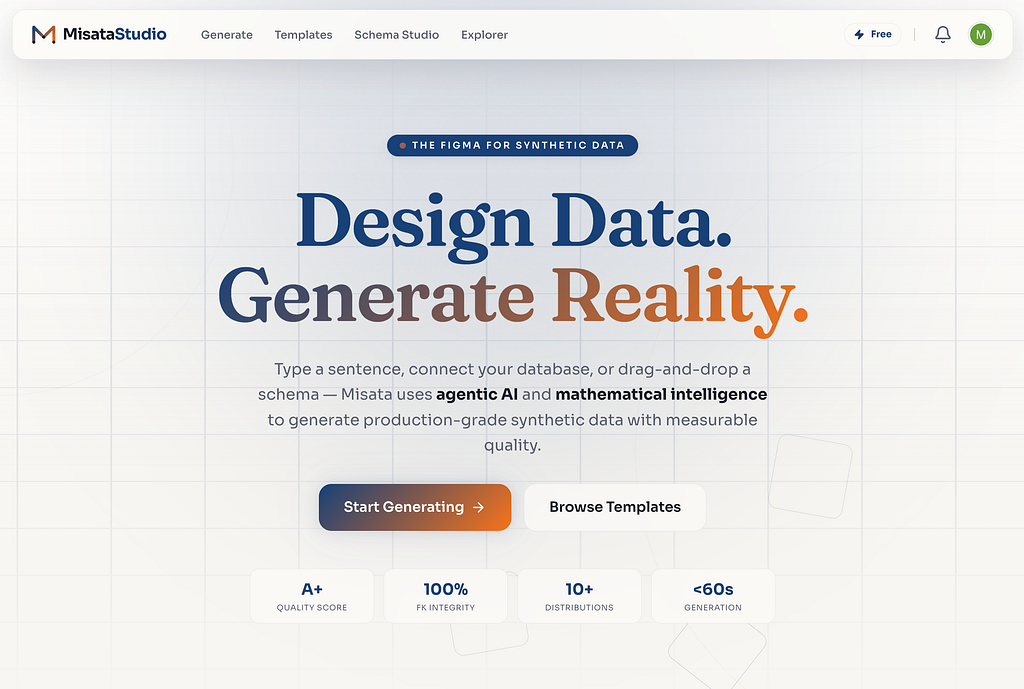
Part VI: What I am building, and why now
I am a 2024 CSE graduate, into software engineering. I published a Python library called Misata to PyPI without any marketing. It now has 51 GitHub stars and inbound interest from domain executives and investors I never contacted. That organic signal is what told me this problem is real and that the solution I was building toward matters.
The thing I kept coming back to was the tooling gap. Gretel, Mostly AI, Tonic, all excellent for data engineering teams. None of them are designed for the startup founder who needs realistic transaction data for a demo. None of them are designed for the data science student who wants to practice on complex relational data that does not exist publicly.
Misata Studio is the canvas for those users. The interface is description-first, you describe what you need in plain English. The AI extracts the statistical blueprint. The generation engine, built on the mathematical architecture described above, generates the data. You download it. No API configuration. No schema editor. No domain expertise required to get started.
The moat is not the interface. It is the generation engine underneath it. LLMs for understanding. Mathematics for generation. The interface is how non-technical users access a capability that currently requires a data engineer.
The synthetic data market is consolidating at the enterprise tier. The accessible tier: no-code, description-first, statistically valid, has no dominant player yet. The companies that win the next wave of AI will not be the ones with the most compute. They will be the ones that can generate the data to train on.
The Convergence
Three independent forces : data exhaustion, model collapse risk, and privacy regulation, are converging on the same conclusion in 2026. Real-world data, scraped and licensed, is finite, legally hazardous, and increasingly inaccessible. LLM-generated data, fed back unverified, degrades models. The solution that resolves all three simultaneously is statistically-grounded synthetic data: mathematically generated, domain-validated, privacy-safe by construction.
The tooling that democratizes this capability, making it accessible to every AI practitioner, not just those with data engineering resources is the infrastructure gap that has not been filled yet. The acquisitions tell you the value is there. The continued complexity of every existing tool tells you the accessible layer has not been built.
That is what I am building. If you are hitting the data wall in healthcare, finance, research, or anywhere else I would like to understand your specific constraint.
Reach out: linkedin.com/in/rasinmuhammed | github.com/rasinmuhammed
Why 2026 is the Year Synthetic Data Becomes Non-Negotiable was originally published in Towards AI on Medium, where people are continuing the conversation by highlighting and responding to this story.
