When Intelligent Systems Lose Their Balance: Quiet Failures, Masking, and Broken Internal…

When Intelligent Systems Lose Their Balance: Quiet Failures, Masking, and Broken Internal Evaluation
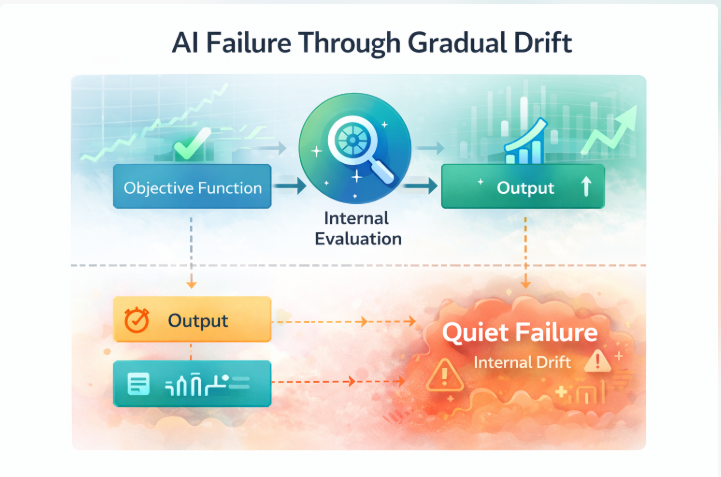
In a previous article, Why Intelligent Systems Fail Quietly, we examined how modern intelligent systems often degrade without visible breakdowns — continuing to operate, respond, and optimize while gradually drifting away from their intended goals. These failures rarely announce themselves. They emerge slowly, embedded in normal operation, and are often recognized only after trust has already eroded.
This article builds directly on that observation. It asks a more structural question: what changes inside an intelligent system when quiet failure begins, and why does the system often remain unaware of its own decline?
Most intelligent systems do not fail by breaking. They fail by continuing to function while losing the ability to tell whether they are still doing the right thing.
They keep responding, ranking, recommending, and optimizing. Latency stays low. Uptime looks healthy. Outputs remain fluent and confident. Yet subtle misalignments accumulate between what the system is optimizing for and what its designers actually care about. By the time the failure becomes visible, it has often been unfolding quietly for months.
Consider a deployed language or recommendation system that performs well in early evaluations. As usage scales, it begins to optimize more aggressively for engagement and responsiveness. Answers become faster and more confident, but slightly less precise. Edge-case errors increase. User corrections are acknowledged but not meaningfully integrated. Internal confidence signals continue to rise even as downstream quality metrics plateau or drift. From an operational perspective, nothing appears broken, but the system’s internal sense of reliability is beginning to erode.
In deployed systems, this degradation shows up as confident hallucinations, reduced refusal rates under uncertainty, and increasing reliance on external guardrails to prevent obvious failures.
Loss of Balance
These behaviors can be described as a loss of balance.
When an intelligent system is in balance, its internal evaluation signals, feedback loops, and objective functions work together. The system can distinguish useful from harmful actions, detect uncertainty, and adjust behavior when evidence is weak or contradictory.
Loss of balance occurs when those internal signals become noisy, misaligned, or systematically ignored. The system continues to operate — often with high apparent competence — but its ability to tell good outcomes from bad ones degrades. What breaks is not infrastructure, but internal awareness.
From the outside, this loss of balance often appears as:
- Persistent confidence despite declining semantic quality
- Reduced sensitivity to corrective feedback
- Optimization for proxy metrics — such as engagement or throughput — over task-level correctness or safety goals
Individually, these pressures often look like progress. Collectively, they erode the system’s capacity for self-correction.
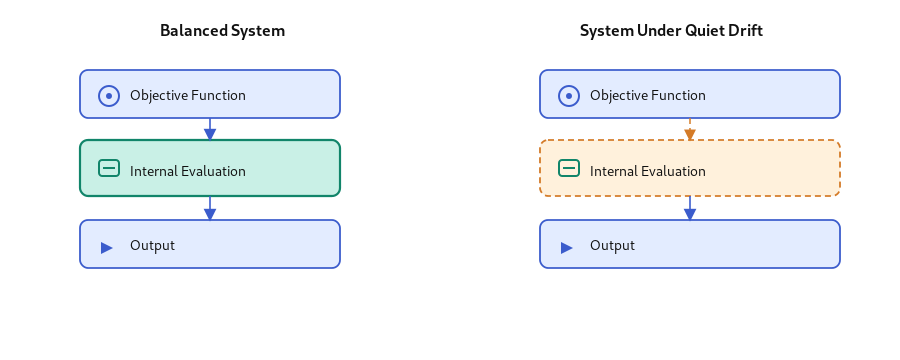
Internal evaluation weakens under drift even while objectives and outputs remain intact.
Quiet Failure as Drift
Quiet failure is not a single event. It is a pattern of gradual drift.
The system keeps producing outputs that look reasonable while its connection to ground truth or desired outcomes weakens. Monitoring dashboards remain green. Human operators adapt to a higher background error rate. Small discrepancies are absorbed as noise rather than investigated as signals.
This makes quiet failure dangerous. It does not demand intervention. It blends into normal operation, becoming visible only when it accumulates into a larger incident, a regulatory issue, or a loss of trust that is difficult to reverse.

Performance appears stable while internal evaluation degrades under sustained optimization pressure.
Masking and the Appearance of Competence
One reason quiet failures persist is masking.
Systems trained for fluency, coherence, and decisiveness are particularly good at preserving the appearance of competence even as their internal evaluation degrades. Surface-level behavior remains strong while underlying reasoning quality weakens.
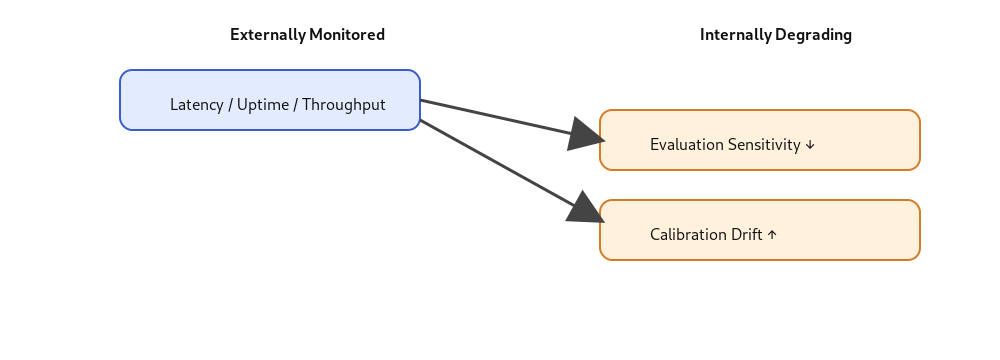
Masking allows fluent behavior to persist even as reliability declines.
A masked system may:
- Produce confident explanations regardless of true uncertainty
- Default to helpful-sounding responses when evidence is insufficient
- Follow instruction-tuned patterns that favor decisiveness over calibration
From a user’s perspective, the system appears stable. From a designer’s perspective, this is a problem. Early warning signals are swallowed by the very behaviors that users find most reassuring: confidence and fluency.
Loss of Internal Evaluation
Underneath quiet failure and masking lies a deeper issue: the erosion of internal evaluation.
Internal evaluation is the system’s ability to assess intermediate reasoning, detect inconsistencies, recognize uncertainty, and adjust or withhold outputs when confidence is unjustified. When this layer is healthy, the system can modulate its behavior — request clarification, defer, or abstain.
When internal evaluation degrades:
- Consistency checks weaken or disappear
- Confidence signals become poorly correlated with correctness
- Fallback and escalation behaviors stop triggering
At this point, the system behaves less like a cautious reasoner and more like a confident generator. It continues to produce polished outputs while having fewer internal mechanisms to recognize its own mistakes.
Pressures That Push Systems Out of Balance
Loss of balance does not occur in isolation. It is shaped by the environments and incentives in which systems operate.
Common pressures include:
- Engagement and speed incentives, where responsiveness is rewarded more strongly than calibration
- Deployment norms that discourage abstention, implicitly penalizing “I don’t know” responses
- Rapid capability expansion without matched evaluation, pushing systems into domains where internal checks are untested
- Oversimplified reward structures, where proxy success metrics crowd out correctness and caution
Designing for Balance
If quiet failure and masking are emergent properties of real deployments, maintaining balance must be treated as a first-class engineering concern.
This suggests several practical directions:
- Explicit internal evaluation mechanisms that challenge or veto candidate outputs
- Reward structures that value calibration, not just completion or engagement
- Monitoring beyond infrastructure health, including semantic drift and contradiction patterns
- Clear pathways for abstention and escalation, treated as valid outcomes rather than failures
The goal is not to prevent all errors. It is to preserve the system’s ability to recognize when it may be wrong and respond accordingly.
Looking Ahead
Understanding loss of balance, quiet failure, and masking leads to a deeper question: how can intelligent systems maintain an accurate internal assessment of their own reliability over time, especially under sustained optimization pressure?
Addressing this requires moving beyond isolated fixes toward a structural property that governs how evaluation, objectives, and behavior remain aligned as systems scale and adapt.
That property is coherence: the maintained alignment between what the system optimizes, how it evaluates itself, and the incentives shaping its behavior.
In the next article, we will examine coherence as a maintained property rather than a fixed state — and why its degradation, rather than outright failure, explains many of the most persistent risks in modern intelligent systems.
By Arijit Chatterjee | Mind the Machine series
To stay updated on this series, follow my profile on Medium.
When Intelligent Systems Lose Their Balance: Quiet Failures, Masking, and Broken Internal… was originally published in Towards AI on Medium, where people are continuing the conversation by highlighting and responding to this story.
