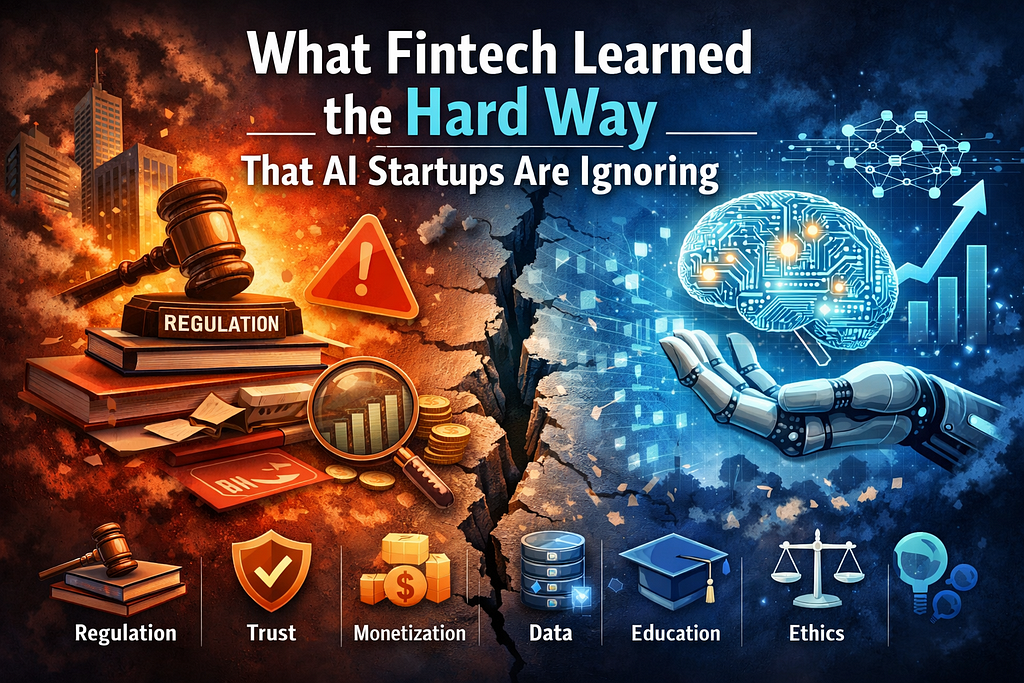
“What Fintech Learned the Hard Way That AI Startups Are Ignoring.”

Why fintech’s painful lessons should be the roadmap — not the ignore list — for the next generation of AI innovators.
In the unicorn-hungry world of tech, AI startups and fintech share an aspirational trajectory: attract capital fast, scale fast, and own a category. But where fintech’s narrative is defined by costly lessons — regulatory setbacks, misaligned incentives, and trust deficits — AI startups are sprinting headlong without pausing to internalize the past.
This isn’t about gatekeeping wisdom. It’s about recognizing that AI isn’t just another technology buzzword — it’s an enabling backbone with real-world impact. What fintech learned at great expense should be a blueprint for AI’s long-term success. Yet many AI startups are repeating others’ mistakes because they don’t think they apply. They do.
Here are the critical lessons:
1. Regulation Isn’t a Barrier — It’s a Baseline Expectation
Fintech’s early era was dominated by companies that treated regulation like a nuisance something to outmaneuver, not engage. The result? Fines, shutdowns, license denials, and traction lost to incumbents who played by the rules.
AI startups especially those working with sensitive data or automated decision-making are on a similar collision course with regulators. From the EU’s AI Act to emerging U.S. frameworks, governments are moving from reactive to proactive oversight. Ignoring regulation now isn’t a strategy; it’s a liability.
Lesson: Get compliant before regulators show up. Build frameworks that anticipate privacy, fairness, and safety requirements as first-class product features.
2. Trust Is Earned — Not Engineered With Marketing
Fintech’s initial boom was accompanied by lavish claims: high returns, low fees, instant access. But when real users encountered outages, opaque terms, or unexplained declines, trust evaporated. Growth stalled; skepticism spread.
AI startups face an even higher bar. When your product makes decisions that impact people’s lives hiring, lending, medical diagnosis, legal outcomes — trust isn’t about brand lines or slick UI. It’s about transparency, auditability, and accountability.
Lesson: Design systems that explain themselves. Not just internally, but publicly. Trust isn’t marketing copy it’s demonstrable reliability.
3. Monetization Without Value Isn’t Sustainable
Fintech’s early monetization experiments free trading, zero fees, gamified investing drove rapid user adoption but created distortions: churn-driven growth, perverse incentives, and unsustainable unit economics.
AI startups frequently fall into a similar trap: prioritize user growth without establishing real, tangible value creation. Discounted access to expensive compute, free model usage, or chasing vanity metrics leads to a dead end when capital tightens.
Lesson: Monetization must align with real value delivered. Charge for outcomes, not access. Let revenue models reflect genuine utility, not just usage.
4. Data Partnerships Are Not Optional — They’re Strategic Assets
Fintech companies that treated data access as a by-product rather than a strategic asset found themselves dependent on third parties with misaligned interests. The result? Choked innovation pathways and competitive disadvantage.
AI thrives on data — the more diverse, relevant, and timely, the better. But data partnerships are often left until after products launch, leading to rushed, costly integrations and regulatory headaches.
Lesson: Secure data partnerships early and properly. Prioritize quality, compliance, and exclusivity where possible. Data isn’t just fuel; it’s intellectual capital.
5. User Education Must Scale With Complexity
Fintech learned that users don’t automatically understand complex financial products just because they’re wrapped in friendly interfaces. Misaligned expectations led to confusion, misuse, and risk.
AI products are inherently complex. Users don’t need to know the math behind an algorithm, but they do need clarity on its limitations, risks, and appropriate use. Over-promising capabilities erodes confidence and invites backlash.
Lesson: Build education into the product experience. Transparency isn’t optional. It’s a guardrail.
6. Ethical Guardrails Are Business Priorities, Not PR Initiatives
Fintech’s ethical lapses — aggressive selling practices, hidden fees, targeting vulnerable demographics — triggered regulatory shake-ups and trust damage. These weren’t just reputational problems; they were business-critical failures.
AI startups often treat ethics as a checkbox or a PR shield. But bias, misuse, and unintended harm can dismantle product adoption faster than a competitor can eat your market share.
Lesson: Ethics should be embedded in product design, not plastered in marketing material. Define principles, enforce them, and measure adherence.
Conclusion: Fintech’s Hard-Earned Blueprint for AI’s Next Wave
Fintech’s history — marked by exuberant growth, regulatory pushbacks, and consumer backlash — isn’t a cautionary tale. It’s a roadmap of structural insights that AI startups can use to scale responsibly and sustainably.
In the rush to define tomorrow, AI innovators must not forget yesterday’s hard lessons:
- Regulation is a guide, not a hindrance
- Trust must be built, not assumed
- Monetization must reflect real value
- Data partnerships are strategic, not transactional
- Education isn’t optional
- Ethics drive longevity
AI startups that internalize these will not just avoid fintech’s stumbles — they’ll redefine what responsible innovation looks like.
“What Fintech Learned the Hard Way That AI Startups Are Ignoring.” was originally published in Towards AI on Medium, where people are continuing the conversation by highlighting and responding to this story.
