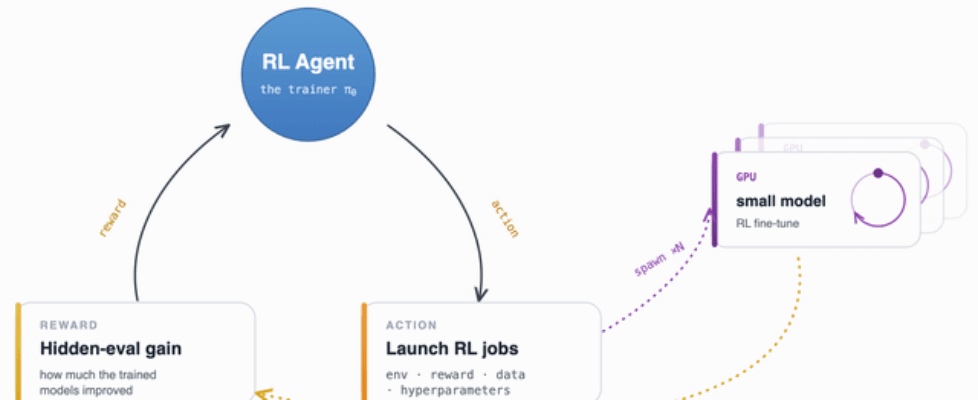
👋 Training my first RL model last year was super fun, now I’ve RL-trained a model that RL-trains other models… wild times! The agent gets a task, writes the full training job (environment, reward, dataset, hyperparameters), and submits it to real GPUs. When the model it trained scores higher on a hidden eval, the agent gets rewarded. An RL loop with RL loops inside it! 🤯
What I did:
- Built a harness where the trainer agent (Qwen3.6-35B-A3B) writes a complete prime-rl training job: a verifiers environment + rubric, dataset, and hyperparameter config
- Each job is dispatched to a warm pool of up to 16 Runpod GPU pods, where prime-rl & verifiers GRPO-train a small Qwen (0.6B or 1.7B) and score it pre/post on a hidden eval
- RL-trained the trainer agent itself with Tinker (LoRA + GRPO), using the inner model’s improvement as the reward
- Made 6 task families. One held out entirely, never trained on, as a generalisation probe
Key results:
- Episode reward climbed ~0.0 → ~0.63 peak over 54 outer-loop steps (~1,750 real GPU training jobs behind it!)
- The skill transferred to the held-out task family: mean reward 0.399 (untrained) → 0.545 at step 34, easing to 0.49 by step 54 (n=10 per arm, so noisy. A rise then a plateau/dip)
- The agent learned to stop picking the weaker 0.6B base model — 1.7B share of its jobs went 42% → 95%, and started actually using the hyperparameter config surface (21% → ~78% of episodes)
- Learning came in two distinct rungs: first “stop failing validation and dying on GPUs”, then “make better models”. GRPO took the steepest gradient first!
- Whole headline arc: ~$1.3k all-in (~$810 Runpod, ~$465 Tinker). Each inner training job cost ~$0.13–0.30 (!)
Technical details:
- Inner loop: prime-rl (GRPO) trains the small model on cheap GPU pairs (mostly A40s); checkpoints scored pre/post with vLLM on a hidden eval the agent never sees
- Outer loop: tinker-cookbook’s importance-sampling GRPO, run async off-policy so one slow episode doesn’t stall the whole batch
- Reward = validation efficiency + job quality (absolute post-training score + uplift over the best untrained baseline) + a small train-speed tie-breaker
- The agent works in a sandboxed workspace with file tools, can query the untrained models’ baseline scores, and gets capped retries after a validation probe
More details:
My GitHub repo open sources it all — the harness, task families, reward code, GPU orchestration, Tinker RL scripts, and retro write-ups of every pilot including the failures. I hope you find it intersting and useful!:
⭐️ https://github.com/Danau5tin/ai-trains-ai
I did this because I think AI systems that improve other AI systems are going to be a huge part of the next few years, and I wanted to know what it actually takes to get the reward moving. Turns out: way more debugging of the process than the policy, and it’s all way more accessible than it looks.
Thanks for reading!
Dan Austin
(Built on prime-rl + verifiers by Prime Intellect, trained with Thinking Machines’ Tinker, GPUs from Runpod — all excellent to work with!)


![[link]](https://i.redd.it/xpx17cj058dh1.png)