Tighter bounds in the prime number theorem

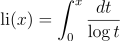
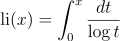
The most elementary form of the prime number theorem says that π(x), the number of prime numbers less than x, is asymptotically equal to x / log(x). That’s true, but a more accurate result says π(x) is asymptotically equal to li(x) where
Five years ago I wrote about a result that was new at the time, giving a bound on |π(x) − li(x)| for x > exp(2000). This morning I saw a result in a blog post by Terence Tao that says

for all x ≥ 2. The result comes from this paper.
The new bound has the same form as the bound from five years ago but with smaller constants.
The post Tighter bounds in the prime number theorem first appeared on John D. Cook.
Like
0
Liked
Liked
