The Risk Engineering Behind a 1 Million SKU Automated Pricing Engine

Most automated pricing systems are built to optimize. n Very few are built to survive failure.
When a system manages 1,000,000+ SKUs and processes 500,000 daily price updates across multiple marketplaces, pricing stops being a growth feature.
It becomes financial infrastructure.
At that scale:
- A single incorrect price can erase 30% margin instantly
- A misinterpreted API response can affect thousands of SKUs within minutes
- A faulty rollout can create $15,000–$20,000 daily exposure per seller
The problem is not that errors occur. n The problem is propagation velocity.
This article breaks down the architecture of a high-load pricing infrastructure engineered to minimize systemic financial risk through blast-radius containment, exposure modeling, and multi-layer validation.
System Scale and Operational Constraints
Before discussing architecture, scale must be understood.
Operational Footprint
- 1,000,000+ SKUs under management
- 500,000 price updates per day
- Up to 70% of updates concentrated during peak hours
- Sustained ~2000 RPS
- 256 distributed workers (scaled from 20)
- Event-driven microservices architecture
SLA Constraints
- Price refresh ≤ 10 minutes
- Anomaly detection ≤ 1 minute
- 99.9% uptime (improved from 80%)
- 100% SKU processing coverage
Financial Exposure Profile
- Average item price: $15–$20
- Margin exposure per incorrect price: ~30%
- Potential daily exposure per large seller: $15,000–$20,000
At this scale:
- Retry logic becomes financial risk logic
- API contract changes become systemic threats
- AI recommendations require containment layers
Architectural Principle: Survivability Over Optimization
The system was designed around a single constraint:
Every price change must be financially survivable.
Not optimal. n Not aggressive. n Survivable.
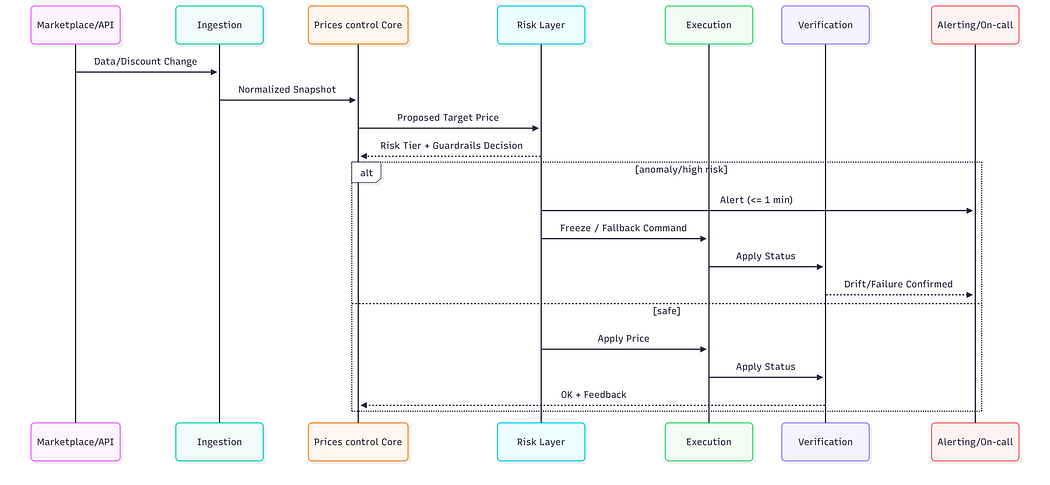
The architecture follows an event-driven microservice model with strict isolation boundaries.
Core Components
- Market Data Ingestion
- Canonical Pricing Model
- Price Control Core
- Risk & Guardrails Layer
- Execution Service
- Post-Apply Verification
- Audit & Metrics
Optimization logic is deliberately separated from risk enforcement.
The pricing engine proposes. n The risk layer governs.
Isolation and Blast-Radius Containment
One of the most underestimated risks in automated pricing is cross-client propagation.
If pricing anomalies spread across:
- Sellers
- Marketplaces
- Product categories
…the blast radius becomes uncontrollable.
Isolation exists at multiple layers:
- Marketplace-level queue segregation
- Seller-level financial boundaries
- SKU-level hard caps
- Category-based staged execution
Queues are not performance tools. n They are containment mechanisms.
Execution pipelines are partitioned by:
- Marketplace
- Store size
- Inventory depth
- Risk tier
Staged Rollout Model
New features are deployed using controlled expansion:
- Internal stores
- Risk-aware voluntary sellers
- Limited SKU segments
- Gradual scaling
Financial simulation precedes rollout. n Rollback mechanisms are prepared before deployment.
Propagation is engineered — not assumed.
The Two-Phase Validation Model
The system does not trust its own output.
Every price passes through multi-layer validation.
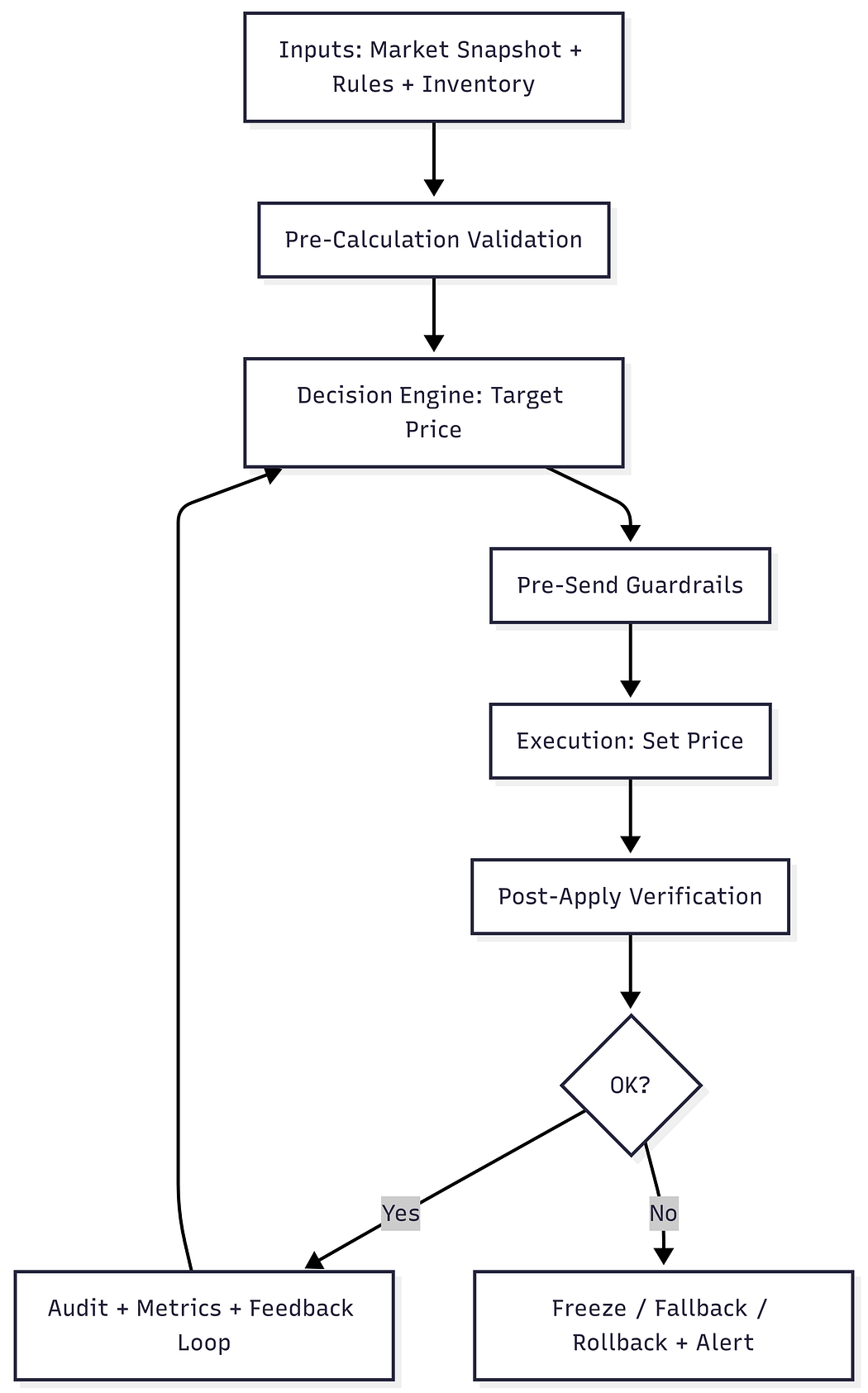
Phase 1: Pre-Calculation Validation
- Data freshness checks
- Canonical normalization
- Type and null enforcement
Phase 2: Pre-Send Guardrails
- Hard min/max bounds
- Percentage change caps (e.g., ±30% for new sellers)
- Margin floor protection
- Price corridor enforcement
Phase 3: Post-Apply Verification
- Marketplace confirmation validation
- Drift detection between calculated and applied values
- Automatic anomaly escalation
This layered model reduced the incident rate from 3% to 0.1% during system evolution.
Engineering the Risk Layer
At scale, pricing mistakes are not bugs.
They are financial events.
The risk layer was designed as an independent subsystem with its own:
- Thresholds
- Escalation paths
- Freeze logic
It is not embedded inside the pricing engine.
It governs it.
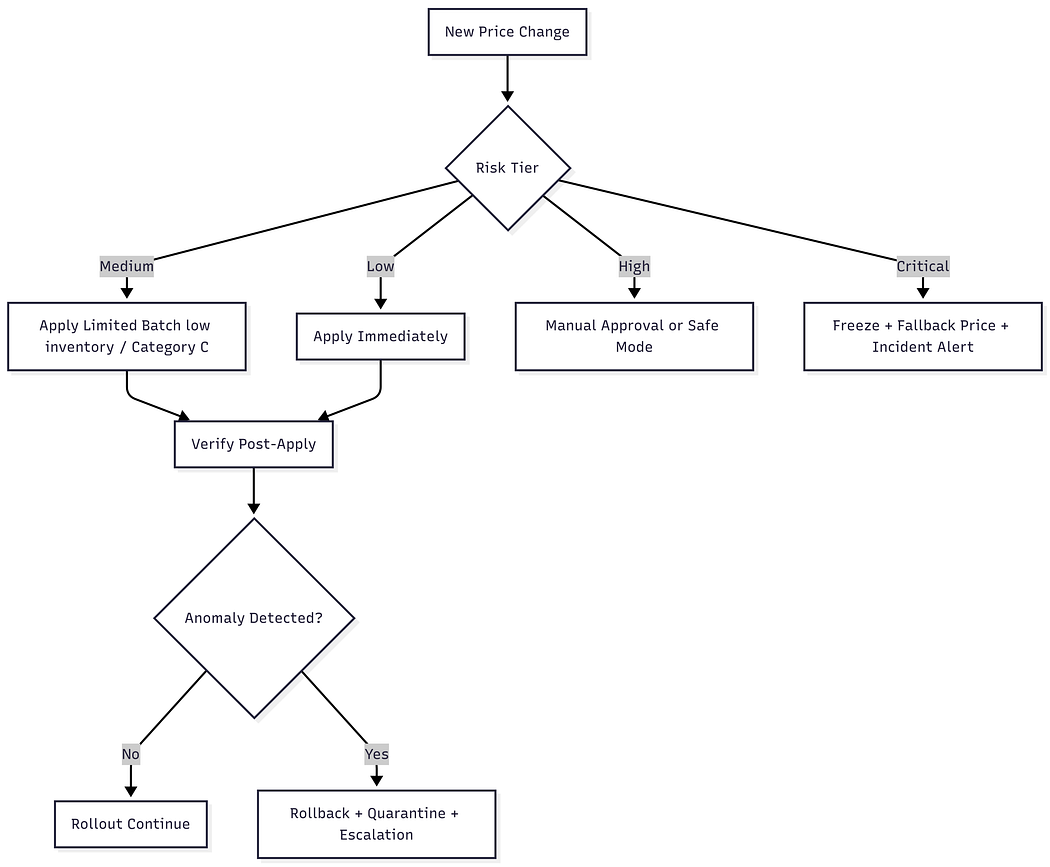
Budget-at-Risk Modeling
Instead of validating SKUs individually, the system models exposure at portfolio level:
Risk Exposure ≈ Inventory × (Cost − Target Price) × Expected Velocity
If projected exposure exceeds seller-defined thresholds:
- Price application is blocked
- Fallback pricing is activated
- Alerts are triggered
- Manual confirmation may be required
Even small price deviations, when multiplied by inventory and velocity, become systemic financial events.
Exposure modeling prevents mass underpricing cascades.
Self-Healing Data Architecture
External APIs introduce volatility:
- Field format changes (e.g., null → 0)
- Discount semantic shifts
- Undocumented contract modifications
- Stale or inconsistent responses
Mitigation mechanisms include:
- Cross-source consistency validation
- Anomaly scoring
- Data quarantine
- Automatic re-fetch and correction flows
Erroneous datasets are isolated before they affect pricing logic.
This increased SKU processing coverage from 80% to 100%.
AI With Guardrails — Not AI in Control
Machine learning is used as an advisory layer only.
ML provides:
- Anomaly detection scores
- Competitive pricing pattern recognition
- Promotion impact modeling
It does not have write authority.
All outputs pass through:
- Hard financial bounds
- Risk-tier enforcement
- Budget-at-risk limits
AI without containment in financial systems is not innovation.
It is volatility amplification.
Incident Case Study: API Contract Shift
A marketplace modified discount semantics without prior notice.
Previously:
- Removing a discount required sending
null
After update:
- The API expected
0
Impact
- ~15% of sellers affected
- Discount values misinterpreted
- Exposure risk could have escalated to six figures
Containment Mechanisms Activated
- Two-phase validation detected abnormal deltas
- Risk-tier escalation triggered freeze logic
- Fallback pricing applied
- Batch rollback restored last safe state
- Alerts notified engineering
Financial losses were contained.
Post-incident improvements included:
- Contract anomaly monitoring
- Semantic abstraction layers
External volatility must be treated as systemic risk.
Measurable Transformation
The architectural redesign produced sustained improvements:
- Incident rate reduced from 3% to 0.1%
- Uptime improved from 80% to 99.9%
- SKU coverage increased from 80% to 100%
- Test coverage expanded from 20% to 95%
- Worker infrastructure scaled from 20 to 256
- Client base grew to 10,000+ active sellers
Support load remained stable despite exponential growth.
This was not incremental optimization.
It was resilience engineering.
Industry Implications
Automated pricing is converging toward financial infrastructure.
Three macro-trends are emerging:
- Consolidation under larger financial institutions
- Marketplace-native pricing infrastructures
- AI-driven systems without adequate guardrails
The third trend is the most dangerous.
At scale, optimization without containment becomes fragility.
Financial automation requires architectural maturity comparable to banking systems.
Conclusion
When a system manages 1 million SKUs and processes 500,000 daily price updates, pricing becomes a financial control surface.
Engineering responsibility increases accordingly.
Automated pricing at scale is not about outperforming competitors.
It is about ensuring that optimization never becomes financial catastrophe.
That requires risk engineering — not just algorithms.
About the Author
Rodion Larin is a Financial Systems Architect and Head of Pricing Automation Engineering specializing in distributed high-load infrastructures for marketplace ecosystems.
He designed and implemented a financially resilient pricing architecture managing 1M+ SKUs and 500k daily price updates, reducing systemic pricing incidents from 3% to 0.1% while achieving 99.9% uptime.
