The impact of direct air carbon capture on climate change

By Michael Nielsen, November
21, 2019
Note: Rough and incomplete working notes, me thinking out
loud. I’m not an expert on this, so the notes are tentative, certainly
contain minor errors, and probably contain major errors too, at no
extra charge! Thoughtful, well-informed further ideas and corrections
welcome.
In these notes I explore one set of ideas for helping address climate
change: direct air capture (DAC) of carbon dioxide – basically,
using clever chemical reactions to pull CO2 out of the atmosphere, so
it can be stored or re-used.
It’s tempting (and fun) to begin by diving into all the many possible
approaches to DAC. But before getting into any such details, it’s
helpful to think about the scale of the problem to be confronted. How
much will DAC need to cost if it’s to significantly reduce climate
change? Let’s look quickly at two scenarios for the cost of DAC, just
as baselines to keep in mind. I’ll discuss how realistic (or
unrealistic) they are below.
As of 2014, the United States emits about 6 billion tonnes of CO2
each year. Suppose it cost about 100 dollars per tonne of CO2 to do
direct air capture. To capture the entire annual CO2 production from
the US would cost about 600 billion dollars.
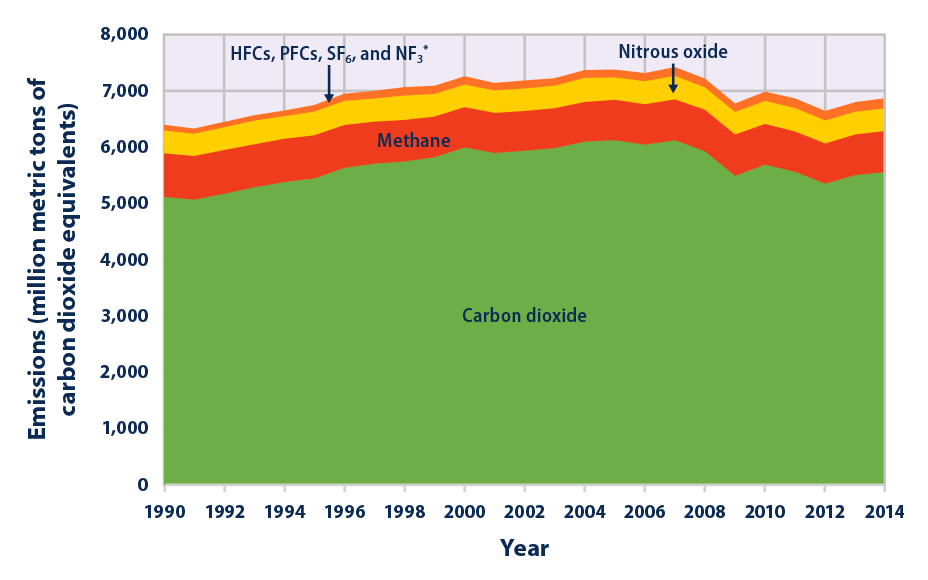
Source: US EPA
That’s a lot of money! As of 2019, the US military budget was about
700 billion dollars, so at 100 dollars per tonne the cost of DAC would
be a little less than the military budget. And it would be a little
over half of total energy spending in the US (about 1.1 trillion
dollars in 2017).
Suppose instead that direct air capture cost 10 dollars per tonne. In
this scenario the cost to capture all the US’s CO2 emissions would be
about 60 billion dollars per year.
That’s still a lot of money, but it’s starting to look like the cost
of a lot of things humans already do, in government, in commerce,
and even in philanthropy.
A particularly striking cost comparison is to the amount we already
spend on cleaning up or preventing air pollution. In 2011 the US
Environmental Protection Agency estimated that compliance with
the Clean Air Act cost about 65.5 billion dollars in 2010.
(The choice of year may sound a little odd and dated – why did I
go all the way back to 2010? It’s not a cherrypicked year –
rather, the EPA only very rarely reports on the costs of the Clean Air
Act, and it happens that 2010 is the most recent year for which an
estimate is available. It is, by the way, in line with the EPA’s
estimates for earlier years, and it seems reasonable to assume with
the cost in more recent years.)
So if DAC cost 10 dollars per tonne of CO2, the cost to make the US
carbon neutral would be comparable to the existing cost of compliance
with the Clean Air Act and associated regulations.
To make the comparison more concrete, let me mention the sort of
regulations (and benefits) the Clean Air Act involves. One example is
the imposition of emissions standards on vehicles, and the requirement
that they use catalytic converters to reduce pollution. Catalytic
converters typically run to a few hundreds dollars, and nearly 20
million cars and trucks are sold annually.
Presto: many billions of dollars each year in compliance costs!
Of course, what we get in exchange for this money is far cleaner skies
over our cities, and a much improved quality of life. I don’t just
mean that it’s pleasant to enjoy smog-free days; I also mean that this
makes a particularly large difference in the quality of life for
asthmatics and people with respiratory diseases, and certainly saves
many, many lives. Overall, it’s a very good exchange, in my opinion,
though I know people who disagree.
Returning to direct air capture, it’s worth keeping these two numbers
in mind as reference points: at 100 dollars per tonne for DAC, the
cost of DAC is comparable to the US military budget; and at 10 dollars
per tonne for DAC, the cost is comparable to the cost of compliance
with the Clean Air Act and related regulations.
None of this tells us at what cost point it’s possible to do DAC. It
doesn’t tell us how to set up a carbon economy to fund this, at any
price point, or how to get the political will for any necessary
changes (as was required for the Clean Air Act). Nor does it tell us
what to do about other greenhouse gases, or other countries.
Still, it’s helpful to have a ballpark figure to aim for. If DAC is
scalable at $100 per tonne, it starts to get very interesting. And at
$10 per tonne, the costs start to resemble things we’ve done before
for environmental concerns.
As we’ll see in a moment, the $100 cost estimate is at least plausible
with near-future technology. $10 per tonne is more speculative, but
worth thinking about.
What I like and find striking about this frame is that many people are
extremely pessimistic about climate change. They can’t imagine any
solution – often, they become mesmerized by what appears to be
an insoluble collective action problem – and fall into
fatalistic despair. This direct air capture frame provides a way of
thinking that is at least plausibly feasible. In particular, the $10
per tonne price point is striking. The Clean Air Act was contentious
and required a lot of political will. But the US did it, and many
other countries have implemented similar legislation. It’s a specific,
concrete goal worth thinking hard about.
Incidentally, in most analyses like this it’s conventional to engage
in a lot of cross-comparison between approaches. Analyses which don’t
do such cross-comparisons tend to get criticised: “but why
didn’t you consider [other approach] which [works better
because]”. Doing such comparisons makes good sense if your goal
is to figure out where to invest resources, or what outcomes are
likely. But those aren’t the point of this analysis. The point here is
to more clearly understand the bounds on the overall complexity of the
problem. If some approach can work at a reasonable price point, then
better solutions are certainly possible. So let me say: I think we can
likely do much better than direct air capture. But I think this
analysis is useful for bounding the difficulty of the problem.
I’ve been talking at an abstract level, in terms of government
programs and so on. It’s also worth putting these numbers in
individual terms. On average, US citizens produce about 20 tonnes of
CO2 emissions each year. At $100 per tonne for DAC, that’s $2,000 each
year. At $10 per tonne, it’s $200 each year. Again, we can see that
the $10 per tonne price point looks very feasible – $200 is
quite a bit of money for most people, but it’s about what they
routinely spend for many important things in their life. And while
$2,000 really is a lot of money for most people, it’s also much less
than the median US citizen routinely spend for many important aspects
of their lives.
There’s a lot of variation in other countries, but among large,
wealthy countries the US is on the high end of per-capita
emissions. In countries like France and Sweden, which have worked hard
on reducing emissions, the numbers tend to be more like 5 tonnes of
CO2 emissions per year. And so $100 DAC comes out to $500 per person
per year, and $10 DAC to $50 per person per year.
I guess it’s not currently popular to memorize numbers and simple
models of climate change. Still, I wish people discussing climate
change knew not just these numbers (or some equivalently informative
set), but also many more. I’ve sat in meetings about climate change
where many attendees appeared to have almost no quantitative awareness
of the scale of the problem. Without such an awareness of, and
facility with, quantitative models, their only chance of making
substantive progress is by accident, in my opinion.
How much will direct air capture cost, in the near future?
So, how much does direct air capture actually cost? And what are the
prospects for driving the costs down?
Unfortunately, it’s not very clear. Although technologies for direct
air capture have been used since the 1930s, it’s usually been done on
a small scale, for reasons unrelated to climate. Doing it at the giant
scales – ultimately, billions of tonnes! – required to
impact the climate is quite another matter.
If you read around about direct air capture, you discover a few
things: there are many approaches, with widely-varying cost estimates;
those estimates are often back-of-the-envelope theory, not even based
on a pilot, much less an operating large-scale plant. There’s nothing
quite as inexpensive as an industrial plant that exists only on
paper. Or, as I once overheard someone say, half cynically, half
optimistically: “my favourite form of science fiction is the
pitch deck.”
One of the most detailed proposals comes from the company Carbon
Engineering, which has been working on direct air capture
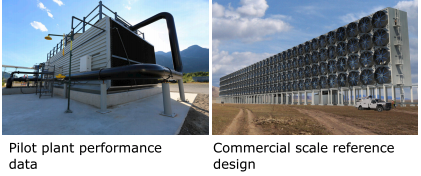
since 2009. In 2018 they published a paper estimating the costs
associated to direct air capture. Their basic proposal is to build
cooling towers, filled with a liquid that absorbs CO2, and run big
fans to blow air from the atmosphere over that liquid. They then run
the resulting material through a second process that produces nearly
pure CO2 as output. That CO2 then needs to either be stored or else
somehow re-used, perhaps as raw material for manufacturing fuel or
something similar. Obviously, this is a very simplified account of
what they’re doing, that leaves many details out!
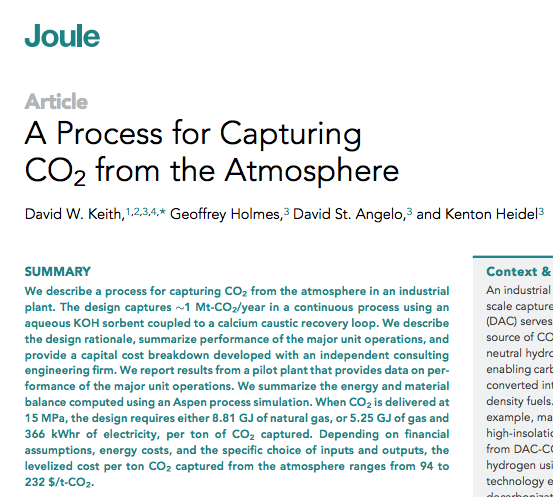
Unlike many proposals, Carbon Engineering isn’t just working on
paper. They’ve built a small pilot plant in the town of Squamish,
British Columbia, an hour north of Vancouver. It runs at a rate of
hundreds of tonnes of CO2 captured per year. They’ve attempted to do
detailed costings of all components necessary to make a large-scale
plant, one with a capacity, if run at full utilization (they estimate
it’ll be run at about 90% utilization), of removing a million tonnes
of CO2 from the atmosphere each year. They estimate that it’ll cost
from $94 to $232 per tonne of carbon removed. The exact amount depends
on details of the configuration the plant is run in, and also reflects
things like possible variations in interest rates on debt, and so on.
It’s tempting to be skeptical of this proposal. For one thing, in the
short term Carbon Engineering has a vested interest in making their
direct air capture scheme look attractive and inexpensive. And there’s
also just natural human entrepreneurial optimism, and the fact that,
by definition, you can’t anticipate the details of unexpected
problems. So caution is called for. I also lack the expertise to
seriously evaluate the technical details of their proposal. While to
my eye, it looks as though Carbon Engineering has been careful, maybe
they’ve missed some important factor, and their estimates are way
off. On the other hand, there are at least quite a few eyes on it
– although the paper was published just a year ago, in 2018,
it’s already been cited 132 times, and it’s clear it’s seen as
something of a gold standard.
There are some interesting critiques of direct air capture in the
scientific literature. For instance, this 2011 paper by House et
al claims a minimal cost of $1,000 per tonne, based on a relatively
general argument, whose main input appears to be the cost of
electricity. The analysis is quite complicated, and I don’t understand
many of the details (working on it, but it’s a real research project
to track everything down!) The essential gist seems to be: when you
separate the CO2 from the atmosphere, you’re ordering the system, and
so necessarily lowering the entropy of the system. The second law of
thermodynamics tells us there will be an intrinsic energy cost
associated to doing this, even if done with maximal efficiency; that,
in turn, puts some constraints on the costs. In any case, they
conclude that “many estimates in the literature appear to
overestimate air capture’s potential”.
The Carbon Engineering paper mentions this paper and similar
critiques, and rebuts it with an argument that amounts to “well,
we actually went and built a plant which works, and we did detailed
costings of how to scale it up”. This is a good start on a
rebuttal, but obviously as an outsider it’d be good to go back and dig
into both pro and con details much more than I have. That may be a
project I do in the future. For the sake of argument, and the
remainder of these notes, let’s stick with Carbon Engineering’s
numbers, but keep in mind that they should be taken with a grain of
salt, until examined much more closely.
I must admit, part of the reason I’m inclined to be sympathetic toward
Carbon Engineering’s estimate is that I read lead author (and Carbon
Engineering’s cofounder) David Keith’s book about a different
topic, solar geoengineering. Keith seemed to me to be very honest
in the book, carefully describing many of his own uncertainties, the
complexities of the problem, and giving charitable explanations of the
position of his critics. None of that makes him correct, but I’m
inclined to believe he’s careful, serious, and worth paying attention
to.
An influential prior study of DAC came in 2011 from an American
Physical Society (APS) study. The costs estimated were much higher,
more in the ballpark of $600 per tonne of CO2.
What accounts for the difference – likely a factor of 3 or more?
In the words of Carbon Engineering’s paper:
The cost discrepancy is primarily driven by divergent design choices
rather than by differences in methods for estimating performance and
cost of a given design. Our own estimates of energy and capital cost
for the APS design roughly match the APS values.
This is then followed by a relatively detailed (and, to my eye,
plausible) account of the differences in design choices, and how
Carbon Engineering improved on the prior design decisions. I’ll say a
bit more about that below.
On its face, the numbers in the Carbon Engineering paper don’t seem so
encouraging. Let’s call it $200 per tonne. At that level, for the US
to achieve carbon neutrality would cost more than the US currently
spends on energy in total.
What about other approaches? Let’s broaden the field, and consider
negative emissions technologies in general, especially those pulling
CO2 directly out of the atmosphere in some way. (In contrast to
technologies which capture carbon at the source of production –
often a less costly but also less general, more bespoke approach.)
Earlier this year, the US National Academies of Sciences, Engineering,
and Medicine released an informative report surveying negative
emissions technologies. In the report, they attempt to estimate both
cost ranges and the scalability of many different technologies. If
you’re interested, there’s a good summary on pages 354-356 of the
report.
I won’t summarize all their results here. But there is much
(cautiously) encouraging news. There are a lot of possible negative
emissions technologies. One approach is coastal blue carbon –
storing carbon in mangroves, marshes, and sea grasses, the kind of
ecosystems one sees along the coastline. This perhaps doesn’t sound
terribly promising. But the big advantage is that the carbon tends to
be stored underground, in the soil, and can be stored there for
decades or centuries. The NAS survey reports a cost estimate of $10
per tonne.
That price point is much more encouraging than Carbon
Engineering’s. Unfortunately, the report also projects a
“potential [global] capacity with current technology and
understanding” of 8-65 billion tonnes. That’s not enough for
even two years of global CO2 production. So at most, this can simply
help out.
Another approach is based on storing carbon in forests. The National
Academies report’s estimated price is somewhat higher – from
$15-50 per tonne of CO2. (I don’t know if that includes proper burial
– when trees die most of their CO2 is typically returned to the
atmosphere). But the approach is also much more scalable, with an
estimated global capacity of from 570 to 1,125 billion tonnes, using
“current technology and understanding”. Per year, the NAS
estimates a capacity of 2.5 to 9 billion tonnes, again using current
technology and understanding. That’s global, so it’s not enough to
make the world carbon neutral (global CO2 emissions are almost 40
billion tonnes per year). But it’s starting to put a sizeable dint in
the problem.
(A caveat to the discussion in this section: I haven’t been careful
about which of these numbers include the cost of storing or utilizing
carbon. That’s a genuine cost. My impression is that it’s likely to
cost less than $20 per tonne, maybe much less, or even turn a
profit. This is based in part on the cost of storing CO2 in the Utsira
formation – a giant undersea aquifer off Scandinavia –
where several million tonnes of CO2 have been stored at a
Wikipedia-reported price of 17 dollar per tonne. If this impression is
correct then the cost of capturing CO2 is likely to either dominate or
in worst case be comparable to the cost of storage and
utilization. Still, a more detailed analysis would be careful about
this costing.)
How much can the costs drop?
These numbers are tantalizing. Apart from the (probably not scalable)
coastal blue carbon, they’re about an order of magnitude away from
where they need to be for climate to be a problem of similar order to
air pollution. But the numbers are also based on “current
technology and understanding”.
How much can these costs drop with improvements in technology? And are
there other ways of dropping the effective costs?
The most famous technology cost curves are those associated to Moore’s
Law – the exponential increase in transistor density in
semiconductors, and associated things like computer speed, memory,
energy efficiency, and so on.
This is, in fact, a common (though not universal) pattern across
technologies. It seems to have first been pointed out in a 1936 paper
by the aeronautical engineer Theodore Wright. Wright observed the cost
of producing airplanes dropped along an exponential curve as more were
produced. Very roughly speaking, for each doubling in production,
costs dropped by about 15 percent. Essentially, as they made more
airplanes, the manufacturers learned more, and that helped them lower
their costs.
This pattern of exponential improvement is seen for many technologies,
not just in semiconductors and airplane manufacture. It’s been common
in energy too. For instance, the cost of solar energy has dropped by
roughly a factor of 100 over the past four decades
(link, link). That cost reduction was driven in part by
technological improvement, and in part by economies of scale.
One wonders: will the cost of direct air capture or some other
negative emission technology follow something like Wright’s Law? If
so, one might hope that it would drive the cost of carbon capture in
some form down below 10 dollars per tonne. Indeed, it’s even possible
to start to think about whether there’s ways it could be made net
profitable.
Unfortunately, while Wright’s Law is interesting, it’s far from a
compelling argument. Indeed, it’s a little silly to call it a Law:
it’s an observed historical regularity, an observation about the past
for certain technologies. If you’re Intel, planning for 5 to 10 or
more years from now, you need to set targets. You may perhaps be
able to project reliably a few years on the basis of in-train
improvements. But longer-term improvements may be more speculative,
and require new ideas, ideas that by definition you can’t directly
incorporate into your current models. Studying history is an
alternative approach to help set plausible targets. But eventually
such historical regularities break down. Indeed, we see this in recent
years where many aspects of Moore’s Law have started to break down.
And so the fundamental problem here is that we don’t know how much the
costs of DAC will go down. At best, we can make guesses. That’s a
nervous position to be in – the usual situation for challenging
problems!
To make this more concrete, let’s come back to Carbon Engineering’s
proposal for DAC. Here, in more detail, is how they cut the cost by a
factor 3 or so from the APS study. The details won’t make much sense,
unless you’ve read the paper (or similar work); what’s important is to
read for the general gist:
The cost discrepancy is primarily driven by divergent design
choices… The most important design choices involved the
contactor including (1) use of vertically oriented counterflow
packed towers, (2) use of Na+ rather than K+ as the cation which
reduces mass transfer rates by about one-third, and (3) use of steel
packings which have larger pressure drop per unit surface area than
the packing we chose and which cost 1,700 $/m3, whereas the PVC
tower packings we use cost less than 250 $/m3. … In rough
summary, the APS contactor packed tower design yielded a roughly
4-fold higher capital cost per unit inlet area, and also used
packing with 6-fold higher cost, and 2-fold larger pressure drop.
The paper continues with a discussion of why the APS made those
different design choicees, and also with a discussion of some
differences in the way input energy was used in Carbon Engineering’s
design versus the APS design.
I’m not an industrial chemist, but to me those changes sound like
low-hanging fruit. But they’re also not the kind of low-hanging fruit
that the APS could have planned for in 2011. If they could have
planned for it, they would have come up with a different cost
estimate.
Of course, low-hanging fruit is what you’d expect. Carbon Engineering
has been, until recently, a tiny company, with a small handful of
staff. They were founded in 2009, and appear to have subsisted on
relatively small grants and seed funding until 2019, when they raised
68 million dollars. It’s interesting to think about what they’ll
achieve with that funding. Hopefully, they’ll be able to pick some
higher-hanging fruit. Assuming their initial cost estimates bear out,
for this design, will it be possible for them (or someone else working
on direct air capture) to achieve another factor of 3 reduction in
cost?
I’ve been focusing on cost reductions due to better design and
technology. In fact, part of the job will be done in a very different
way. The carbon intensity of a country is the CO2 emissions per
dollar of GDP. Carbon intensities in the US dropped more than 18% per
decade from 1990 to 2014, the latest year for which the World Bank
reports numbers. This isn’t surprising: all other things equal, most
people and companies try to keep doing things in more energy-efficient
ways, since energy costs them money. If this drop in carbon intensity
continues, it means that considered as a fraction of the total
economy, the cost of DAC will go down. Effectively, it’s as though
we’re automatically making progress toward $10 DAC, at a rate of about
18 percent per decade. On its own that won’t make DAC economically
feasible. But over two or three decades, it’ll help a lot.
It’s also interesting to think about cost reductions due to plausible
emissions reductions. As noted earlier, in countries such as France,
Sweden, etc, average emissions per capita are something like 4 times
lower than in the US. This is often attributed causally to their
extensive use of nuclear power; nuclear certainly plays a large role,
but as far as I can see it can only be part of the story (since
electricity production is only responsible for a moderate fraction of
total emissions). Rather, it’s that they’ve also been more serious
than the US in other ways about reducing emissions; their use of
nuclear is, in part, a symptom of this seriousness, not the cause. In
any case, such examples illustrate that nuclear plus other moderate
efforts can lead to large emissions reductions.
(I should point out: of course, drops in carbon intensity and
emissions reductions are intertwined, not independent! I’ve mentioned
them separately because there are ways in which they’ve very different
kinds of goals with, for example, different kinds of expression in
policy.)
Of course, neither changes in carbon intensity nor emissions
reductions are literally the same as a drop in price of direct air
capture. But considered as a fraction of the economy they may as well
be; it’s a kind of drop in the effective cost of DAC. And so I think a
factor 10 or more reduction in the effective cost of DAC is plausibly
possible, in part through technological improvements, in part through
emissions reductions as already implemented in countries with similar
standards of living, and in part through reduced carbon intensity. Put
another way: it’s plausible that doing DAC to make the US carbon
neutral ends up costing an amount comparable to or less than the
current cost of the Clean Air Act, as a fraction of the total
economy. That seems encouraging.
I’ve focused a lot on direct air capture, and it sounds like I’m
bullish about this approach. Actually, I’m too ignorant to have a
really strong opinion. From my point of view, a big part of
concentrating here was simply that (a) there was what seemed a
particularly juicy paper to dig into, and (b) as I said at the start,
this could be treated as a boundary case, setting a kind of worst-case
scenario. It’s entirely possible – indeed, likely, – that
other approaches to dealing with climate are considerably better. But
this already looks promising. My tentative conclusions are that
direct air capture offers a promising but far from certain approach
to making major progress on climate change. And, more broadly:
negative emissions technologies offer a promising approach to making
major progress on climate change.
I got interested in direct air capture in part after reading Matt
Nisbet’s survey of US climate and energy foundation funding
(summary here, with a link to the full survey). Here’s his
summary chart. Note that it covers funding from 19 major funders of
climate and energy work, and the years from 2011 to 2015:
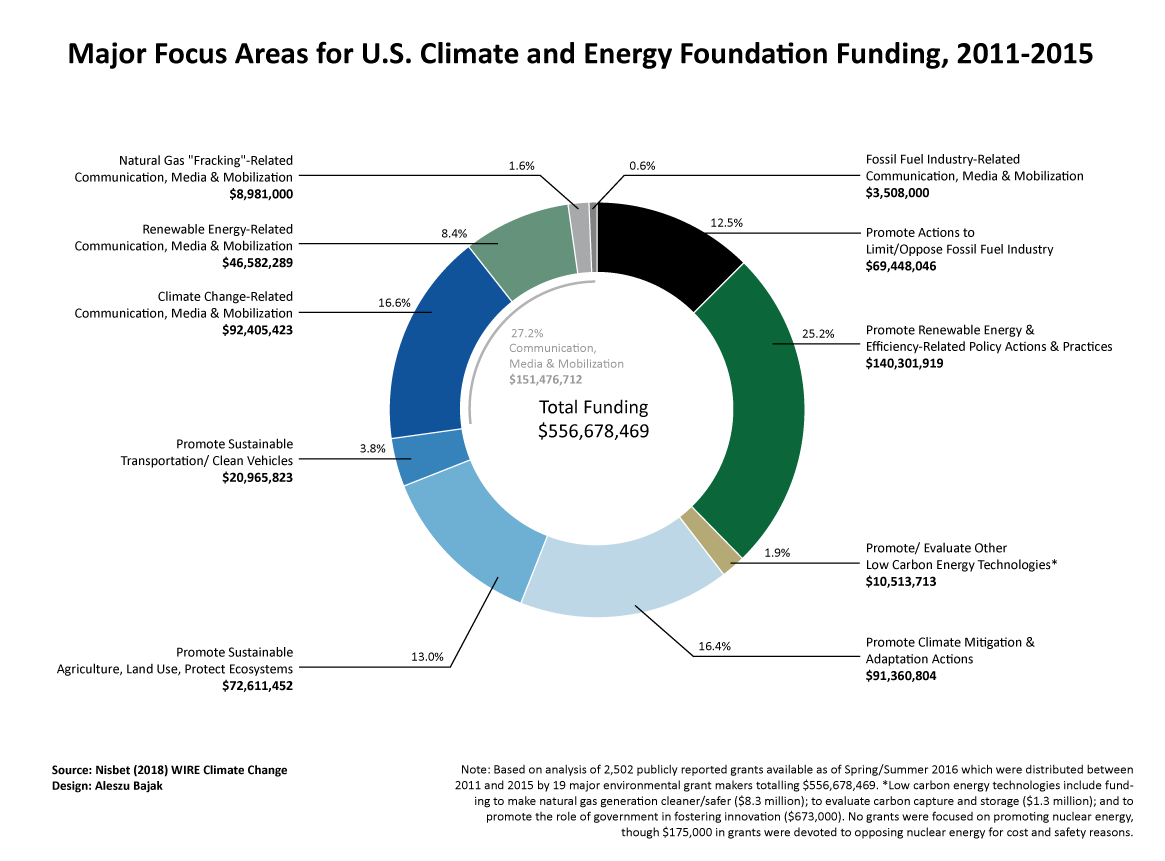
You see enormous sums of money going into renewable energy,
sustainable aagriculture, and into opposing fossil fuels. But just a
tiny fraction of the spending – 1.9%, or just over 10 million
dollars – went to other low carbon energy technologies. And of
that, just $1.3 million went to evaluate carbon capture and storage.
Now, admittedly, these numbers focus on just a tiny slice of the total
funding pie (US foundation funding), and are somewhat outdated. In
particular, the last few years have seen substantial progress on
investment in negative emissions technologies (as witness the $68
million invested in Carbon Engineering). Still, my impression is that
the qualitative picture from Nisbet’s research holds more broadly.
Humanity’s collective priorities are research and development focused
on renewable energy sources, especially solar and wind; and
anti-fossil fuel messaging and lobbying. By contrast, negative
emissions technologies like DAC are receiving relatively little
funding.
As a non-expert, I’m reluctant to hold too firm opinions here. But,
frankly albeit tentatively I think this makes no sense! Of course,
renewables (say) should receive a lot of funding. But if you genuinely
believe climate change is a huge threat, then we should collectively
and determinedly pursue lots of different strategies. Direct air
capture (and, more broadly, negative emissions) look very underfunded
and underexplored. Yes, it requires considerable improvement. But
compared to other historic technologies, it’s within striking distance
of being able to have a huge impact, especially considering the
relatively minor effort so far put into it.
Conclusion
This is a tiny slice through a tiny slice (direct air capture) of the
climate problem. Climate is intimidating in part because the scale of
understanding required is so immense. You can spend a lifetime
studying the relevant parts of just one of: the climate itself, the
energy industry, solar, wind, nuclear, politics, economics, social
norms. It’s extremely difficult to get an overall picture; it’s easy
to miss very big things. I wrote these notes mostly because the only
way I know to get a handle on big problems is to start by doing
detailed investigations of very tiny corners. So consider this one
very tiny corner.
To finish, I can’t resist reporting an uncommon opinion: overall, and
over the long term, I’m optimistic about climate.
I’ve focused on direct air capture, but it seems to me there are many
other promising approaches. I believe humans will figure out how to
address climate change. There will be a lot of suffering along the
way, much of it falling to the world’s poorest people. That’s a
terrible tragedy, and something we’re too late to entirely avert;
indeed, it’s very likely already happening. But over the long term
work on this problem will also lead us to strengthen existing
institutions, and to invent new institutions, institutions which will
make life far better for billions of people. It’s a huge challenge,
but I think we’ll rise to the challenge, and make human civilization
much better off for it.
Acknowledgments: Thanks to Andy Matuschak for conversations about
climate.
Please help support my work on Patreon, and
please follow me on Twitter.
