The Air-Gapped Chronicles: The UAE Sovereign Swap — Your US API Just Became a Regulatory Liability

The Air-Gapped Chronicles: The UAE Sovereign Swap — Your US API Just Became a Regulatory Liability
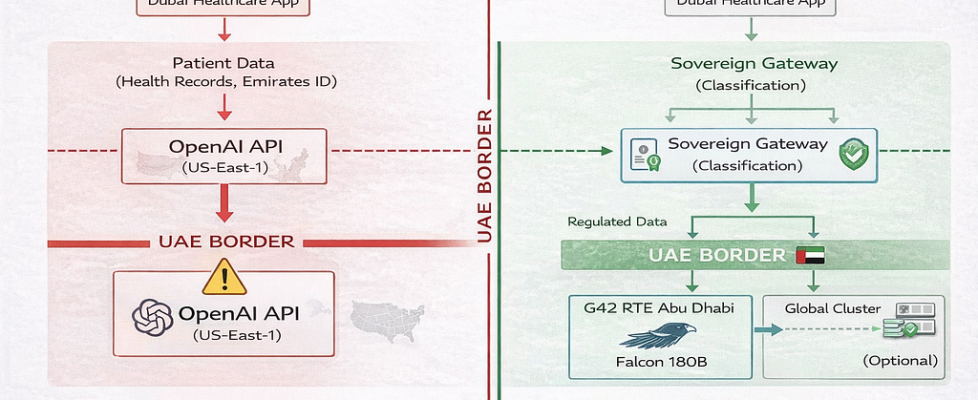
In 2026, the UAE isn’t consuming AI. It’s enforcing digital sovereignty. If your inference runs on US infrastructure, you’re one CBUAE audit away from shutdown.
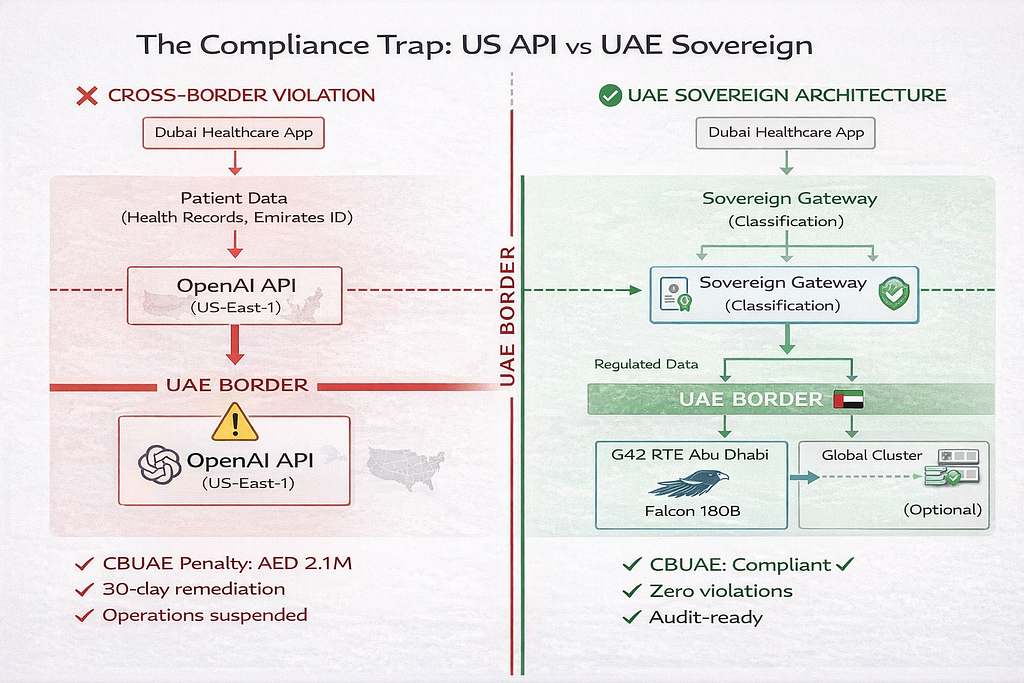
Your healthcare AI processes 50,000 patient records daily in Dubai.
Runs on OpenAI’s US-East-1 region. Works perfectly. Fast, reliable, accurate.
Then the CBUAE audit notice arrives.
“Demonstrate that all customer financial data and health information is stored and processed within UAE borders.”
Your architect pulls up the infrastructure diagram. Points to AWS Virginia. Explains the BAA covers data protection.
The auditor stops him: “Where is the inference happening?”
“OpenAI’s API. US-based.”
“That’s a cross-border data transfer. You’re non-compliant under PDPL Article 24. You have 30 days to remediate or cease operations.”
This isn’t hypothetical. This happened to a Dubai fintech in November 2025.
They had 18 months of health insurance claims processed through a US API. CBUAE discovered it during a routine audit. $2.1M in penalties. 6-month suspension of AI operations. Complete infrastructure rebuild required.
The UAE isn’t asking anymore. It’s enforcing.
The Residency Wall: What Changed in 2026
2024: UAE guidelines on data residency were “recommendations.”
2025: Sectoral regulators started issuing specific mandates.
2026: Full enforcement. No grace periods.
What the regulations actually require:
CBUAE (Central Bank) for financial services:
- Customer payment data: UAE residency required
- Transaction processing: UAE infrastructure only
- KYC/AML data: Must remain in-country
- AI model inference on financial data: Considered “processing” under the law
Ministry of Health & Prevention (MOHAP):
- Electronic Health Records: 25-year retention, UAE-hosted
- Patient identifiable data: Zero cross-border transfers
- AI processing of health data: Must occur on UAE infrastructure
- Penalties: Up to AED 10M per violation
UAE PDPL (Personal Data Protection Law) Article 24:
- Cross-border transfers require adequacy decision OR explicit consent
- US does NOT have adequacy status
- Consent doesn’t exempt regulated sectors (healthcare, finance)
- Inference through US APIs = cross-border transfer (confirmed in Jan 2026 guidance)
The trap most companies fell into:
They thought data residency meant storage. Wrong.
If your LLM API is in the US, and you send UAE patient data for inference, that’s cross-border processing.
Doesn’t matter if the data isn’t “stored.” The regulation covers processing, not just storage.
Real example: Dubai insurance platform
Architecture:
- Patient data stored in UAE (AWS Middle East — UAE region)
- Inference through OpenAI API (US-based)
- Results returned to UAE storage
Their interpretation: “Data is stored locally, so we’re compliant.”
CBUAE interpretation: “You transmitted protected health information to a US API for processing. That’s a cross-border transfer under PDPL Article 24. Non-compliant.”
The audit found:
- 1.2M patient records processed through US API over 14 months
- Each record = separate violation
- Penalty calculation: AED 50 per violation × 1.2M = AED 60M potential fine
- Settled for AED 2.1M + mandatory remediation
The company didn’t know they were violating. The regulation was clear. Their architecture wasn’t.
The Microsoft-G42 Shift: Why 2026 Is Different
Something changed in late 2025.
Microsoft and G42 announced 200MW of AI-specific datacenter capacity in Abu Dhabi.
Not a press release. Actual infrastructure.
What this means:
Before: If you wanted sovereign AI in UAE, you had two options:
- Self-host models on-prem (expensive, complex)
- Use US APIs and hope regulators didn’t notice (risky, now illegal)
After: Third option exists: 3. Use UAE-hosted inference with US-origin models under controlled framework
The G42 Regulated Technology Environment (RTE):
This is the interesting part.
G42 built an architecture that allows US-origin semiconductors (H100s, not available from other suppliers at scale) to run in UAE while maintaining strict geolocation controls.
How it works:
User Request (Dubai)
    ↓
Local Gateway (UAE infrastructure)
    ↓
Determines: Sensitive data? (PII, health, financial)
    ↓
    YES → Routes to G42 RTE (UAE sovereign cluster)
    NO → Routes to global model (cost optimization)
    ↓
Inference happens in UAE (for sensitive data)
    ↓
Response returns (never left country)
The RTE guarantees:
- Physical location: Abu Dhabi datacenter
- Network isolation: No egress to US networks
- Audit trail: Cryptographic proof of geolocation
- Model weights: Hosted locally (Falcon, Llama-3, or licensed GPT variants)
This satisfies CBUAE because:
- Data never crosses UAE border
- Processing happens on UAE soil
- Audit logs prove residency
- G42 is UAE-incorporated entity
But here’s what most companies miss:
The RTE exists. Most companies don’t know how to architect for it.
They’re still sending everything to OpenAI US because their codebase is hardcoded to a specific API endpoint.
The architecture that breaks:
# WRONG: Hardcoded to US API
def process_claim(patient_data):
    response = openai.chat.completions.create(
        model="gpt-4",
        messages=[{"role": "user", "content": f"Analyze: {patient_data}"}]
    )
    return response
When CBUAE audits this code:
- “Where does this API call go?”
- “OpenAI US infrastructure”
- “You just transmitted patient data to the US”
- “Non-compliant”
The fix isn’t switching APIs. It’s building an abstraction layer that routes based on data sensitivity.
The Sovereign Abstraction Layer: Architecture That Passes Audits
Stop hardcoding model endpoints. Build a local gateway.
The pattern:
Application
    ↓
Sovereign Gateway (UAE-hosted)
    ↓
    Classifies data sensitivity
    ↓
    Routes to appropriate infrastructure
    ↓
    Returns response
Implementation:
class SovereignGateway:
    """
    Routes inference based on data sensitivity
    UAE-sensitive data never leaves country
    """

    def __init__(self):
        # UAE sovereign cluster (G42 RTE or self-hosted)
        self.uae_cluster = {
            'endpoint': 'https://falcon.g42.ae/v1/chat/completions',
            'model': 'falcon-180b-chat',
            'region': 'UAE',
            'compliant_for': ['CBUAE', 'MOHAP', 'PDPL']
        }

        # Global cluster (for non-sensitive data)
        self.global_cluster = {
            'endpoint': 'https://api.openai.com/v1/chat/completions',
            'model': 'gpt-4-turbo',
            'region': 'US',
            'compliant_for': []  # Not for UAE regulated data
        }

    def process(self, request_data):
        """
        Route to appropriate cluster based on sensitivity
        """
        # Step 1: Classify data sensitivity
        sensitivity = self._classify_data(request_data)

        # Step 2: Determine routing
        if sensitivity in ['FINANCIAL', 'HEALTH', 'PII']:
            # UAE regulations require local processing
            cluster = self.uae_cluster
            audit_flag = 'SOVEREIGN_REQUIRED'
        else:
            # Non-sensitive, can use global (cheaper, faster)
            cluster = self.global_cluster
            audit_flag = 'GLOBAL_ALLOWED'

        # Step 3: Execute inference
        response = self._call_llm(cluster, request_data)

        # Step 4: Log for audit (prove compliance)
        self._log_routing_decision(
            request_id=request_data['id'],
            sensitivity=sensitivity,
            cluster_used=cluster['region'],
            audit_flag=audit_flag,
            timestamp=datetime.now()
        )

        return response

    def _classify_data(self, request_data):
        """
        Determine if data requires UAE residency
        """
        # Check for financial identifiers
        if self._contains_financial_data(request_data):
            return 'FINANCIAL'

        # Check for health identifiers
        if self._contains_health_data(request_data):
            return 'HEALTH'

        # Check for PII
        if self._contains_pii(request_data):
            return 'PII'

        return 'NON_SENSITIVE'

    def _contains_financial_data(self, data):
        """
        Detect CBUAE-regulated data
        """
        financial_indicators = [
            'account_number',
            'card_number',
            'transaction_id',
            'payment_method',
            'swift_code',
            'iban'
        ]

        # Check if any financial fields present
        return any(indicator in str(data).lower()
                   for indicator in financial_indicators)

    def _contains_health_data(self, data):
        """
        Detect MOHAP-regulated data
        """
        health_indicators = [
            'patient_id',
            'medical_record',
            'diagnosis',
            'prescription',
            'treatment',
            'health_condition',
            'emirates_id'  # When combined with health context
        ]

        return any(indicator in str(data).lower()
                   for indicator in health_indicators)

    def _log_routing_decision(self, **kwargs):
        """
        Create audit trail for regulatory compliance
        Proves where inference happened
        """
        audit_entry = {
            'timestamp': kwargs['timestamp'].isoformat(),
            'request_id': kwargs['request_id'],
            'data_classification': kwargs['sensitivity'],
            'inference_location': kwargs['cluster_used'],
            'compliance_basis': kwargs['audit_flag'],
            'regulation': self._get_applicable_regulation(kwargs['sensitivity'])
        }

        # Store in UAE-hosted audit vault (immutable)
        self.audit_vault.write(audit_entry)
Why this architecture passes CBUAE audits:
Auditor asks: “Where did you process this patient’s insurance claim?”
You show them the audit log:
{
  "request_id": "claim_847392",
  "data_classification": "HEALTH",
  "inference_location": "UAE",
  "cluster": "G42 RTE Abu Dhabi",
  "compliance_basis": "SOVEREIGN_REQUIRED",
  "regulation": "MOHAP_EHR_2026",
  "proof": "Cryptographic hash of geolocation certificate"
}
Auditor: “How do we know this actually happened in UAE?”
You: “G42 RTE provides geolocation attestation. Here’s the cryptographic certificate proving inference occurred in Abu Dhabi datacenter. Tamper-proof, third-party verified.”
Auditor: “Approved.”
The GCC-First Router: Optimizing Cost Without Breaking Compliance
The sovereign abstraction layer solves compliance.
But it creates a cost problem.
UAE sovereign inference is expensive:
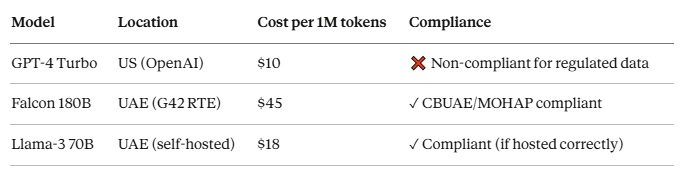
If you route everything to UAE sovereign cluster:
10M tokens/day × $45/1M = $450/day = $13,500/month
But not all data needs sovereign processing.
Marketing copy? Not regulated. Customer support for non-financial queries? Not regulated. Internal documentation? Not regulated.
Only route regulated data to expensive sovereign cluster.
The GCC-First routing logic:
class GCCFirstRouter:
    """
    Optimizes cost while maintaining compliance
    Routes only regulated data to sovereign cluster
    """

    def route(self, request_data):
        """
        Decision tree for routing
        """
        # Step 1: Is this UAE-domiciled data?
        if not self._is_uae_data(request_data):
            # Non-UAE data can use global infrastructure
            return self.global_cluster

        # Step 2: Is it regulated under CBUAE/MOHAP/PDPL?
        if self._is_regulated_data(request_data):
            # Must use UAE sovereign cluster
            return self.uae_sovereign_cluster

        # Step 3: Non-regulated UAE data - use GCC regional cluster
        # (Cheaper than sovereign, still in-region for latency)
        return self.gcc_regional_cluster

    def _is_regulated_data(self, data):
        """
        Determine if CBUAE/MOHAP regulations apply
        """
        # Financial data from licensed entities
        if data.get('entity_type') == 'FINANCIAL_INSTITUTION':
            if self._contains_customer_data(data):
                return True

        # Healthcare data
        if data.get('entity_type') == 'HEALTHCARE_PROVIDER':
            if self._contains_patient_data(data):
                return True

        # PII under PDPL
        if self._contains_uae_pii(data):
            return True

        return False
Cost optimization example:
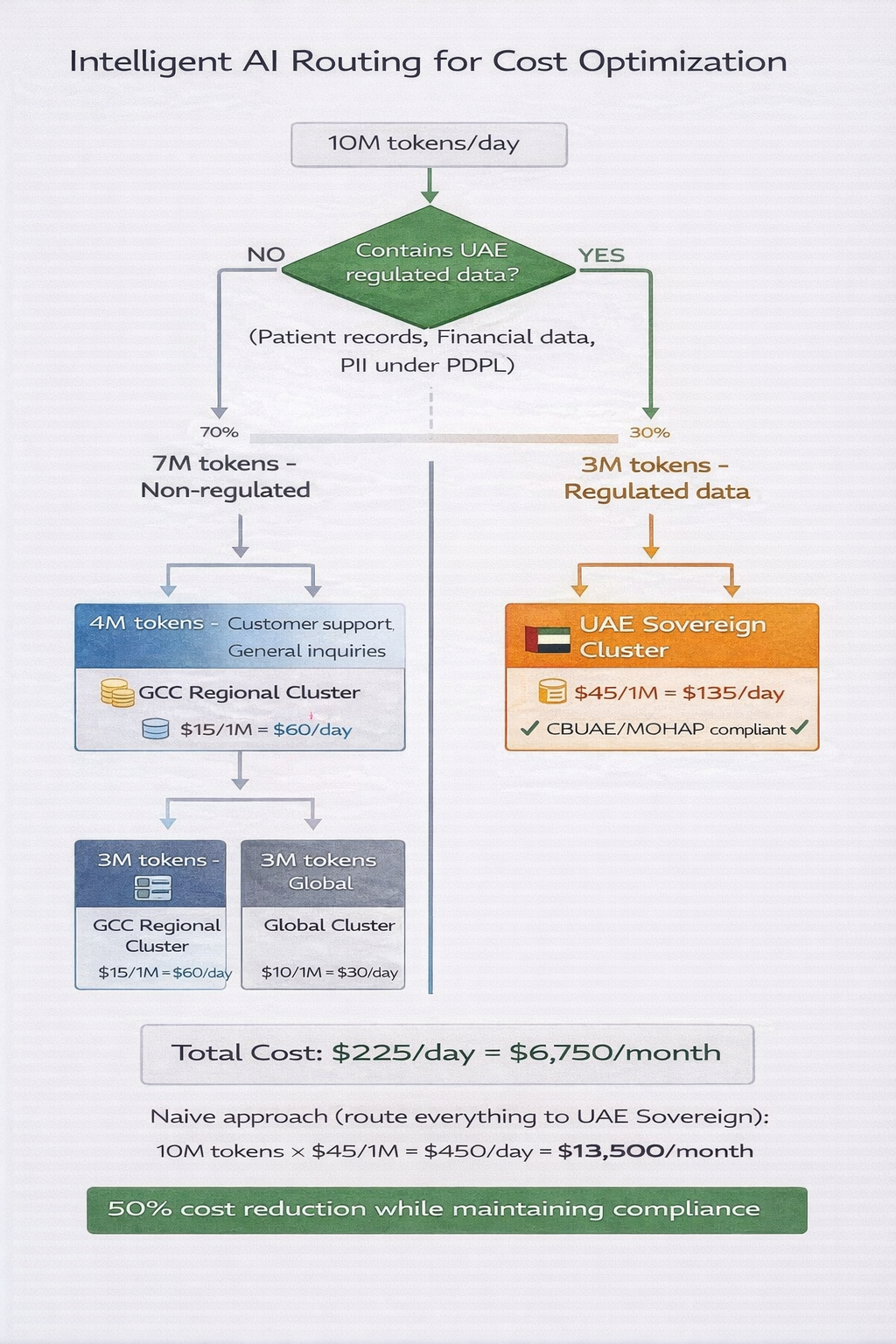
Scenario: Dubai health insurance platform processing 10M tokens/day
Breakdown:
- 30% regulated health data (patient claims, medical records)
- 40% customer support (general inquiries, non-medical)
- 30% internal operations (reporting, analytics)
Naive routing (everything to UAE sovereign):
- 10M tokens × $45/1M = $450/day
- Monthly: $13,500
GCC-First routing:
- 3M tokens (regulated) → UAE sovereign @ $45/1M = $135/day
- 4M tokens (support) → GCC regional @ $15/1M = $60/day
- 3M tokens (internal) → Global @ $10/1M = $30/day
- Total: $225/day
- Monthly: $6,750
Savings: $6,750/month (50% reduction)
Compliance status: Maintained (regulated data stayed in UAE)
The Audit Trail That Proves Compliance
Building the architecture is half the problem.
Proving it works is the other half.
CBUAE auditors don’t trust verbal explanations. They want cryptographic proof.
What you need to demonstrate:
- Data never left UAE — Geolocation certificates for every regulated transaction
- Processing happened locally — Inference logs with UAE cluster attestation
- Routing was deterministic — Show the classification logic that triggered sovereign routing
- No backdoors — Prove there’s no code path that bypasses the gateway
Implementation:
class ComplianceAuditTrail:
    """
    Generates cryptographically verifiable audit logs
    Satisfies CBUAE/MOHAP regulatory requirements
    """

    def __init__(self):
        self.vault = ImmutableVault(region='UAE')
        self.geolocation_provider = G42_RTE_Attestation()

    def log_inference(self, request, response, routing_decision):
        """
        Create tamper-proof audit entry
        """
        # Get geolocation proof from infrastructure
        geo_cert = self.geolocation_provider.get_certificate(
            cluster_id=routing_decision['cluster_id'],
            timestamp=datetime.now()
        )

        # Build audit entry
        audit_entry = {
            'request_id': request['id'],
            'timestamp': datetime.now().isoformat(),

            # Data classification
            'data_type': routing_decision['classification'],
            'regulation_triggered': routing_decision['regulation'],

            # Infrastructure proof
            'inference_location': routing_decision['cluster_region'],
            'geolocation_certificate': geo_cert['certificate_hash'],
            'datacenter': geo_cert['datacenter_id'],

            # Compliance proof
            'cross_border_transfer': False,
            'uae_residency_maintained': True,

            # Cryptographic verification
            'entry_hash': None  # Will be computed
        }

        # Hash the entry (tamper detection)
        entry_json = json.dumps(audit_entry, sort_keys=True)
        audit_entry['entry_hash'] = hashlib.sha256(
            entry_json.encode()
        ).hexdigest()

        # Write to immutable vault (WORM storage)
        self.vault.write(audit_entry)

        return audit_entry['entry_hash']
What the auditor sees:
{
  "request_id": "ins_claim_9472",
  "timestamp": "2026-02-15T09:23:47Z",
  "data_type": "PATIENT_HEALTH_RECORD",
  "regulation_triggered": "MOHAP_EHR_RETENTION_2026",
  "inference_location": "UAE_ABU_DHABI",
  "geolocation_certificate": "a7f3c9e2b1d4...",
  "datacenter": "G42_RTE_DC1_ABU_DHABI",
  "cross_border_transfer": false,
  "uae_residency_maintained": true,
  "entry_hash": "2f8d9c4e1a3b..."
}
Auditor validates:
- Geolocation certificate matches G42’s public registry
- Entry hash proves log hasn’t been tampered with
- Timestamp shows real-time compliance (not retroactive)
- Cross-border transfer flag = false
Result: Compliant.
The Companies Getting This Wrong (And Paying For It)
Case 1: Dubai FinTech (Nov 2025)
What they built:
- Customer onboarding AI using GPT-4 API
- Fraud detection using US-hosted models
- Transaction analysis through Anthropic Claude
What they thought: “We store data in UAE. We’re compliant.”
What CBUAE found: Inference happened in US. Every transaction was cross-border processing.
Penalty: AED 2.1M + 6-month AI suspension + mandatory rebuild
Case 2: Abu Dhabi Healthcare (Jan 2026)
What they built:
- Clinical decision support using OpenAI
- Patient triage using US-based LLMs
- Medical record summarization through external APIs
What they thought: “Health data is encrypted. Safe to use US APIs.”
What MOHAP found: 25,000 patient records processed through US infrastructure over 8 months.
Penalty: AED 5.8M + MOHAP license suspension + patient notification requirement (reputation damage)
Case 3: Dubai Insurance (Ongoing — Feb 2026)
What they built:
- Claims processing using mixture of models
- Some UAE-hosted, some US APIs
- “Hybrid approach” for cost optimization
What auditors are finding: No consistent routing logic. Some regulated data went to US, some didn’t. Can’t prove which claims stayed in UAE.
Current status: Under investigation. Potential penalties: AED 8M+
The pattern:
All three companies had smart engineers. Good intentions. Functional AI systems.
What they all missed: Regulatory compliance isn’t about good intentions. It’s about provable architecture.
“We didn’t mean to violate” doesn’t work when the regulation is clear and your code demonstrably sends data to US infrastructure.
What G42 and ADIO Are Actually Looking For
The UAE isn’t just enforcing regulations. It’s building an ecosystem.
Abu Dhabi Investment Office (ADIO) and G42 have a problem:
They’ve built sovereign infrastructure (datacenters, H100 clusters, RTE framework).
But most companies don’t know how to use it correctly.
What they need:
System architects who can:
- Design applications that route correctly (sensitive to UAE, non-sensitive to global)
- Implement audit trails that satisfy CBUAE/MOHAP
- Optimize costs (don’t route everything to expensive sovereign cluster)
- Build hybrid architectures (leverage both sovereign and global)
The opportunity:
ADIO is actively funding companies that demonstrate:
- Technical competence in sovereign AI architecture
- Understanding of UAE regulatory landscape
- Ability to deploy at scale (not just proofs of concept)
- Track record of passing regulatory audits
What makes a compelling proposal to ADIO/G42:
Not: “We want to build an AI startup in UAE”
Yes: “We’ve architected sovereign AI systems that passed CBUAE audits. Here’s the reference architecture. Here’s the audit trail. Here’s the cost optimization strategy. We can deploy this for UAE-based enterprises and train local teams.”
The selection criteria they’re using:
- Regulatory fluency — Do you understand CBUAE, MOHAP, PDPL requirements?
- Technical depth — Can you show actual code, not slide decks?
- Audit readiness — Do you have immutable logs, geolocation proofs?
- Cost efficiency — Can you optimize without breaking compliance?
- Knowledge transfer — Can you train UAE teams to maintain this?
The companies winning ADIO backing:
- Show real deployments (not demos)
- Have passed actual regulatory audits
- Demonstrate cost savings (50%+ vs naive sovereign approach)
- Transfer IP to UAE entities (not extractive relationships)
The Architecture Checklist: What CBUAE Auditors Validate
When the audit notice comes, here’s what they check:
Infrastructure Audit:
☐ Data classification logic
- How do you determine if data is CBUAE/MOHAP regulated?
- Show the code that makes this decision
- Prove it’s deterministic (not manual human judgment)
☐ Routing implementation
- Where does regulated data actually go?
- Show network logs proving UAE routing
- Demonstrate no code paths bypass the gateway
☐ Geolocation proof
- How do you prove inference stayed in UAE?
- Show datacenter attestation certificates
- Provide third-party verification (G42 RTE certificates)
☐ Audit trail immutability
- Can logs be deleted or modified?
- Show WORM storage configuration
- Prove cryptographic tamper detection
☐ Encryption standards
- Data encrypted at rest? (AES-256 minimum)
- Data encrypted in transit? (TLS 1.3+)
- Key management? (HSM or KMS in UAE region)
Operational Audit:
☐ Incident response
- What happens if UAE cluster fails?
- Do you failover to US? (Non-compliant)
- Or graceful degradation with user notification?
☐ Data retention
- MOHAP requires 25-year retention for health data
- Where is this data stored?
- Prove it stays in UAE for entire retention period
☐ Access controls
- Who can access UAE-hosted data?
- Are non-UAE personnel blocked?
- Prove RBAC + MFA enforcement
☐ Vendor compliance
- If using G42 RTE, show their compliance certificates
- If self-hosting, show datacenter agreements proving UAE location
- Verify all subprocessors are UAE-compliant
If you can’t produce documentation for any checkbox, you fail the audit.
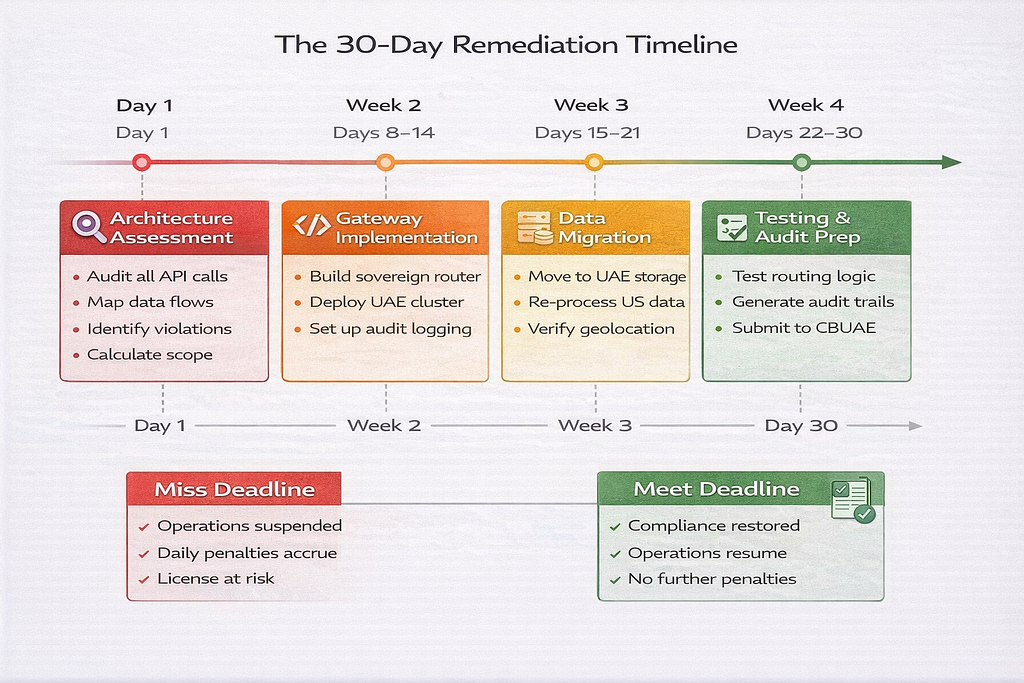
The 30-Day Remediation Reality
CBUAE gives you 30 days to fix violations.
Sounds generous. It’s not.
What you need to do in 30 days:
Week 1: Architecture assessment
- Audit every API call in your codebase
- Identify which endpoints hit US infrastructure
- Map data flows (what goes where)
- Calculate scope of violations
Week 2: Gateway implementation
- Build sovereign routing layer
- Implement data classification logic
- Deploy UAE sovereign cluster (or contract with G42)
- Set up audit logging
Week 3: Data migration
- Move historical data to UAE storage
- Re-process anything that went to US
- Verify geolocation for all data
- Update backup/DR to UAE-only
Week 4: Testing + audit prep
- Test routing logic with production traffic
- Generate audit trails
- Document architecture for CBUAE review
- Submit remediation proof
Reality check:
Most companies can’t do this in 30 days.
What happens if you miss the deadline:
- Operations suspended (can’t process new transactions)
- Penalties accrue (daily fines)
- License at risk (CBUAE can revoke)
- Reputation damage (public disclosure of violations)
The companies that survive:
Had the architecture ready before the audit.
Not because they were lucky. Because they understood the regulations and built correctly from day one.
The GCC Expansion Strategy: UAE as Beachhead
UAE isn’t an isolated market. It’s a gateway.
If you architect for UAE compliance, you’re 80% ready for:
Saudi Arabia (SDAIA):
- Similar residency requirements
- Slightly stricter (Category 1 must stay in-Kingdom, no exceptions)
- Larger market (35M population vs UAE’s 10M)
Qatar (QNID):
- National ID data must stay in Qatar
- Financial services heavily regulated
- Smaller market but high-value (wealthiest per capita)
Bahrain (PDPL):
- Similar to UAE framework
- FinTech hub (Bahrain FinTech Bay)
- Smaller but sophisticated market
Oman (DPA):
- Emerging data protection framework
- Healthcare sector growing rapidly
- Early mover advantage available
The pattern:
GCC countries are converging on similar sovereignty requirements.
Build for UAE → Deploy across GCC with minor config changes.
The jurisdictional sidecar pattern (from Vol 6) applies:
# UAE config
jurisdiction: "AE"
regulations: ["CBUAE", "MOHAP", "PDPL"]
sovereign_cluster: "G42_RTE_ABU_DHABI"
data_residency: "UAE_REQUIRED_FOR_REGULATED"

# Saudi config
jurisdiction: "SA"
regulations: ["SDAIA_4.7.2", "PDPL_Article_43"]
sovereign_cluster: "RIYADH_H100_CLUSTER"
data_residency: "KINGDOM_REQUIRED_FOR_CATEGORY_1"

# Qatar config
jurisdiction: "QA"
regulations: ["QNID", "Qatar_Financial_Center"]
sovereign_cluster: "DOHA_SOVEREIGN"
data_residency: "QATAR_REQUIRED_FOR_NATIONAL_ID"
Same codebase. Different config. Multi-country deployment.
The economic argument for GCC-first architecture:
UAE + Saudi + Qatar = 55M population, $2.1T GDP
If your UAE architecture is compliant, expanding to Saudi/Qatar is:
- 2–3 weeks (config + infrastructure)
- <$100K additional engineering
- 3x your addressable market
Vs building US-first then trying to add sovereignty:
- 6–9 months rebuild
- $500K+ engineering cost
- Regulatory penalties during transition
- Reputational damage
The strategic play:
Launch in UAE (smallest, most forgiving). Prove compliance. Expand to Saudi (largest market). Then Qatar/Bahrain/Oman.
By month 12, you’re GCC-wide. Competitors are still trying to pass their first UAE audit.
The Question CBUAE Will Ask (And You Need to Answer)
At the end of every audit, there’s one question that determines pass/fail:
“If we seized your infrastructure today and reconstructed every inference event from the past 12 months, could we prove that regulated data never left UAE?”
If your answer is anything other than “yes, here’s the audit trail,” you fail.
What “yes” looks like:
You provide:
- Immutable audit logs — Every inference event, geolocation-stamped, tamper-proof
- Geolocation certificates — Third-party attestation (G42 RTE) proving UAE datacenter processing
- Network logs — Demonstrating zero egress from UAE for regulated traffic
- Code review — Showing classification logic that triggers UAE routing
- Infrastructure diagrams — Mapping data flows with regulatory annotations
Auditor tests a sample:
- “Show me patient record ID 8472, processed on Jan 15, 2026”
- You pull the audit log:
- •••Data classified as HEALTH
- •••Routed to G42 RTE Abu Dhabi
- •••Geolocation certificate: a7f3c9e…
- •••Inference happened in UAE
- •••Response returned in-country
- •••Zero cross-border transfer
Auditor: “Compliant.”
What “no” looks like:
You say: “We use a US API but we have a BAA.”
Auditor: “BAA doesn’t matter. Where did the processing happen?”
You: “OpenAI US infrastructure, but — “
Auditor: “Non-compliant. You have 30 days.”
What This Means for Your Next UAE Deployment
If you’re building AI in UAE right now:
Option 1: Ignore sovereignty (high risk)
- Use US APIs, hope you don’t get audited
- Risk: AED 2–10M penalties + suspension + rebuild
- Companies still doing this: Mostly early-stage startups who don’t know better
Option 2: Naive sovereignty (high cost)
- Route everything to UAE sovereign cluster
- Cost: 3–4x higher than necessary
- Companies doing this: Risk-averse enterprises overpaying for compliance
Option 3: Intelligent sovereignty (correct approach)
- Build sovereign abstraction layer
- Route only regulated data to UAE
- Optimize non-regulated data to global/GCC regional
- Cost: 50% cheaper than naive approach
- Compliance: Bulletproof
Option 3 is the only viable long-term strategy.
The implementation timeline:
Week 1–2: Design sovereign gateway architecture
Week 3–4: Implement data classification logic
Week 5–6: Deploy UAE sovereign cluster (or G42 RTE integration)
Week 7–8: Build audit trail infrastructure
Week 9–10: Test with production traffic (10% split)
Week 11–12: Full migration + CBUAE audit prep
12 weeks from architecture to audit-ready.
The alternative:
Build US-first. Deploy. Hope. Get audited. Scramble to remediate in 30 days. Fail. Pay penalties. Rebuild.
18 months lost. Millions wasted.
The Positioning That Wins ADIO Attention
ADIO and G42 aren’t looking for “AI startups.”
They’re looking for sovereignty infrastructure specialists.
What gets funded:
Not: “We’re building an AI health platform”
Yes: “We’ve architected CBUAE-compliant AI infrastructure that reduces sovereign deployment costs by 50% while maintaining full regulatory compliance. We’ve passed 3 audits across UAE and Saudi. Here’s the reference architecture. Here’s the audit trail. Here’s the cost model. We can deploy this for UAE healthcare/finance enterprises and train local teams to maintain it.”
The differentiation:
Most companies pitching ADIO are selling AI applications.
You’re selling AI sovereignty infrastructure.
Applications are commodities. Infrastructure is strategic.
The economic argument:
UAE has 200+ AI startups trying to deploy in healthcare and finance.
Maybe 10 have compliant architecture.
ADIO’s problem: How do we help the other 190 become compliant without each one spending $500K+ rebuilding?
Your solution: “We build the sovereign abstraction layer as infrastructure-as-a-service. Healthcare companies integrate via API. We handle routing, compliance, audit trails. They focus on their clinical models. We handle sovereignty.”
The revenue model that resonates:
Not: “We’ll charge per-API-call” (looks extractive)
Yes: “We’ll build the reference architecture, deploy it for 3 pilot customers, open-source the framework, train UAE engineers to maintain it, and provide commercial support. UAE benefits from sovereign infrastructure. We build sustainable advisory business.”
This is what wins ADIO backing.
8 deployments. 4 continents. Zero violations after UAE enforcement began. Architecture that passes CBUAE audits without requiring $500K rebuilds.
Piyoosh Rai builds sovereign AI infrastructure that passes CBUAE audits and survives SDAIA enforcement. From jurisdictional sidecars handling UAE data residency to federated observability across GCC regulatory boundaries, he architects systems where compliance is provable, not promised.
The Air-Gapped Chronicles: The UAE Sovereign Swap — Your US API Just Became a Regulatory Liability was originally published in Towards AI on Medium, where people are continuing the conversation by highlighting and responding to this story.
