The AI Sandbox: Why Kubernetes Sandbox is the Future of AI Infrastructure

Beyond the StatefulSet Hack: A deep dive into SIG-Apps’ new native primitives for secure, 100ms-latency, and self-healing AI agent runtimes.
If you give an AI Agent a terminal, you’ve given it a loaded gun. Kubernetes just built the safety lock.
The landscape of artificial intelligence is undergoing a massive architectural shift. In the early days of generative AI (AI v1), interacting with a model was treated as a transient, stateless function call. You sent a prompt, waited 50ms, and the process died.
Today, AI v2 is eating AI v1. We are witnessing the rise of Autonomous Agents — long-lived, persistent workloads that coordinate, write code, and execute tools over hours or weeks.
But there’s a problem: Kubernetes wasn’t built for agents.
Traditional primitives like Deployments (designed for stateless replicas) and StatefulSets (designed for ordered databases) have left platform engineers stuck in the “StatefulSet Hack”—a brittle combination of single-pod sets and headless services that is an “operational nightmare” to scale.
The Kubernetes Agent Sandbox (SIG-Apps) project is the answer. It is the first native cloud-native primitive designed to turn Kubernetes into an Agent Operating System.
Real-World Use Case: The Code Interpreter Problem
To understand why this primitive matters, consider a simple but powerful use case: an AI code interpreter.
Frameworks like LangChain or CrewAI can generate and execute code as part of a task. For example, a user might upload a dataset and ask:
Analyze this and generate a report with charts.
Behind the scenes, the agent needs to:
- Execute arbitrary Python code
- Install dependencies dynamically
- Read/write files
- Run for several minutes (or longer)
Running this directly inside your application infrastructure is risky — you’re effectively giving an LLM a terminal with full access.
This is where Agent Sandbox fits:
- Isolation: Each request runs in its own sandboxed environment
- Low Latency: Warm pools eliminate cold starts
- Persistence: PVC-backed storage allows sessions to resume seamlessly
In other words, every agent gets its own disposable, secure “mini-computer” inside Kubernetes.
The Architecture of Autonomy
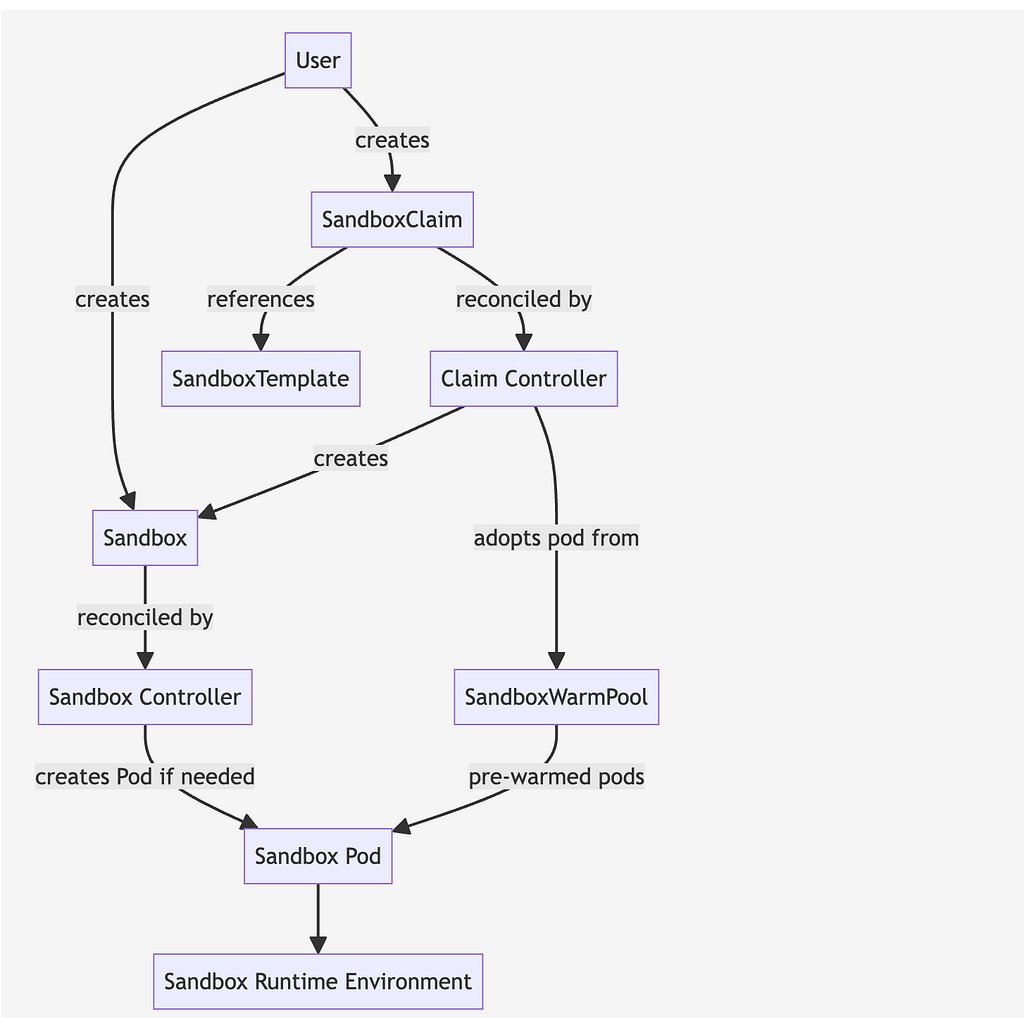
The Life of an Agent Request
- Orchestration: Your AI framework (CrewAI, LangChain, or the Python SDK) requests a new environment.
- The Claim: A SandboxClaim is issued against a pre-defined SandboxTemplate.
- The Warm Pool: The controller checks a SandboxWarmPool for a pre-provisioned, “warm” pod.
- The Hand-off: If a warm pod exists, ownership is transferred in under 100 milliseconds.
- Connectivity: The Sandbox Router (a high-speed FastAPI proxy) reads the X-Sandbox-ID header and instantly routes external traffic to the correct internal Pod IP.
Installation
You can install the agent-sandbox controller and its CRDs with the following command.
# Replace "vX.Y.Z" with a specific version tag (e.g., "v0.1.0") from
# https://github.com/kubernetes-sigs/agent-sandbox/releases
export VERSION="vX.Y.Z"

# To install only the core components:
kubectl apply -f https://github.com/kubernetes-sigs/agent-sandbox/releases/download/${VERSION}/manifest.yaml

# To install the extensions components:
kubectl apply -f https://github.com/kubernetes-sigs/agent-sandbox/releases/download/${VERSION}/extensions.yaml
You can interact with the agent sandbox programmatically using the Python SDK.
pip install k8s-agent-sandbox
🛠️ Core Primitives: Sandbox & SandboxTemplate
The project introduces a new declarative API under the agents.x-k8s.io namespace.
The Sandbox (The Atomic Unit)
A Sandbox is a stateful singleton. It has a stable hostname and native support for “Deep Hibernation.”
apiVersion: agents.x-k8s.io/v1alpha1
kind: Sandbox
metadata:
  name: analyst-agent-01
spec:
  podTemplate:
    spec:
      runtimeClassName: gvisor # Secure User-Space Kernel
      containers:
      - name: agent-runtime
        image: python:3.11-slim
The SandboxTemplate (The Blueprint)
Templates allow you to enforce “Guardrails-as-Code.” You define the security context (non-root, restricted ports) and resource limits once, and every agent inherits it.
apiVersion: extensions.agents.x-k8s.io/v1alpha1
kind: SandboxTemplate
metadata:
  name: secure-code-interpreter
spec:
  podTemplate:
    spec:
      securityContext:
        runAsNonRoot: true
        runAsUser: 1000
      containers:
      - name: agent-runtime
        image: k8s-agent-base:v2
🛡️ Pro Feature: Deep Hibernation & PVC-Persistence
One of the most innovative features in the 2026 roadmap is the PVC-based Scale-to-Zero.
In traditional K8s, if you scale a deployment to 0, your local pod state is gone. The Agent Sandbox controller implements a “Suspend/Resume” logic:
- Pause: When an agent is idle, the controller snapshots the Sandbox status and scales the pod to 0. Crucially, it preserves the Persistent Volume Claim (PVC).
- Resume: Upon the next API call, the controller re-provisions the pod and re-mounts the exact same PVC, allowing the agent to pick up its files and context exactly where it left off.
This is Agentic FinOps in action: near-zero compute cost(excluding storage) for idle agents with 100% state retention.
⚡ Pro Feature: Startup Actions & Automation
Bursty workloads (like Reinforcement Learning training) need fine-grained control over their lifecycle. The Sandbox spec now supports startupActions.
You can now define a sandbox that:
- Spins up to execute a specific script.
- Immediately pauses itself once the task is complete (or at a specific shutdownTime).
- Sends a status update back to the orchestrator.
⚙️ Scaling to Institutional Grade: Advanced Tuning
For SREs managing institutional platforms, the default settings won’t cut it. You need to tune the agent-sandbox-controller for high-throughput reconciliation.
Concurrency & API QPS
Modify your manifest.yaml or extensions.yaml to unleash the controller’s full potential:
args:
  - --leader-elect=true
  - --extensions
  - --sandbox-concurrent-workers=25       # Handle 25 reconciles at once
  - --sandbox-claim-concurrent-workers=25
  - --kube-api-qps=100                   # High-speed API communication
  - --kube-api-burst=200
Observability: The “Agent” Dashboard
The project has integrated Creation Latency Metrics and OpenTelemetry (OTel) tracing. You can now track:
- Warm Pool Efficiency: How often are agents being served from the warm pool vs. cold starting?
- Metadata Propagation Latency: The time it takes for labels to reach the underlying pods.
2026 Roadmap: Firecracker, Ray, and Beyond
The SIG-Apps team isn’t stopping at gVisor. The 2026–2027 roadmap includes:
- Firecracker & QEMU Support(potential future direction): Bringing hardware-level MicroVM isolation to the Sandbox API.
- Ray & CrewAI Integration: Native “plug-and-play” support for the world’s most popular agent frameworks.
- Pydantic-based Process Isolation: For lighter-weight sandboxing where full kernel isolation isn’t required.
The Verdict: The OS of the Future
Kubernetes is no longer just a place to run your website; it is the Operating System for the Agentic Era.
By standardizing the Sandbox primitive, SIG-Apps has solved the three “impossible” problems of AI infrastructure: Security (Isolation), Latency (Warm Pools), and Cost (PVC Hibernation).
If you are building an AI platform in 2026, the question is no longer how to hack it together — it’s how fast you can deploy your first Sandbox.
✔️ Found this useful? Drop a few 👏 claps
✔️ Follow for more DevOps, K8s, and AWS insights
✔️ Connect with me on LinkedIn
The AI Sandbox: Why Kubernetes Sandbox is the Future of AI Infrastructure was originally published in Towards AI on Medium, where people are continuing the conversation by highlighting and responding to this story.
