
The 10 most viewed blog posts of 2024

The 10 most viewed blog posts of 2024
Large language models remained a hot topic, but posts about cryptography and automated reasoning also drew readers.
Staff writer
Chronos: Adapting language model architectures for time series forecasting
By tokenizing time series data and treating it like a language, Amazon researchers were able to adapt a large language model’s architecture to the task of time series forecasting. In experiments, the model’s zero-shot performance matched or exceeded that of purpose-built time-series-forecasting models.
Better-performing 25519 elliptic-curve cryptography

Elliptic-curve cryptography is a method for doing public-key cryptography that has some advantages over methods that rely on large-number factorization, and “25519” elliptic-curve cryptography named for the large prime 2
255
– 19 is one of the most useful elliptic-curve schemes. Amazon Web Services researchers optimized assembly-level implementations of 25519 cryptography to run on AWS hardware, and they used automated reasoning to prove its functional correctness. The implementations are included in the open-source cryptographic library AWS LibCrypto,
Do large language models understand the world?
Can language models trained simply to predict the next word in a sequence of words actually represent words’ meanings? Amazon scientists Matthew Trager and Stefano Soatto argue that they not only can but do.

New tool, dataset help detect hallucinations in large language models
RefChecker is an approach to hallucination detection in LLMs that decomposes LLM outputs into knowledge triplets with a <subject, predicate, object> structure, enabling a more fine-grained assessment of factual accuracy than was possible with earlier methods, which used extracted sentences or phrases as claim summaries. RefChecker also includes a benchmark dataset with 100 examples of text generation tasks in each of three settings: zero context, noisy context, and accurate context.
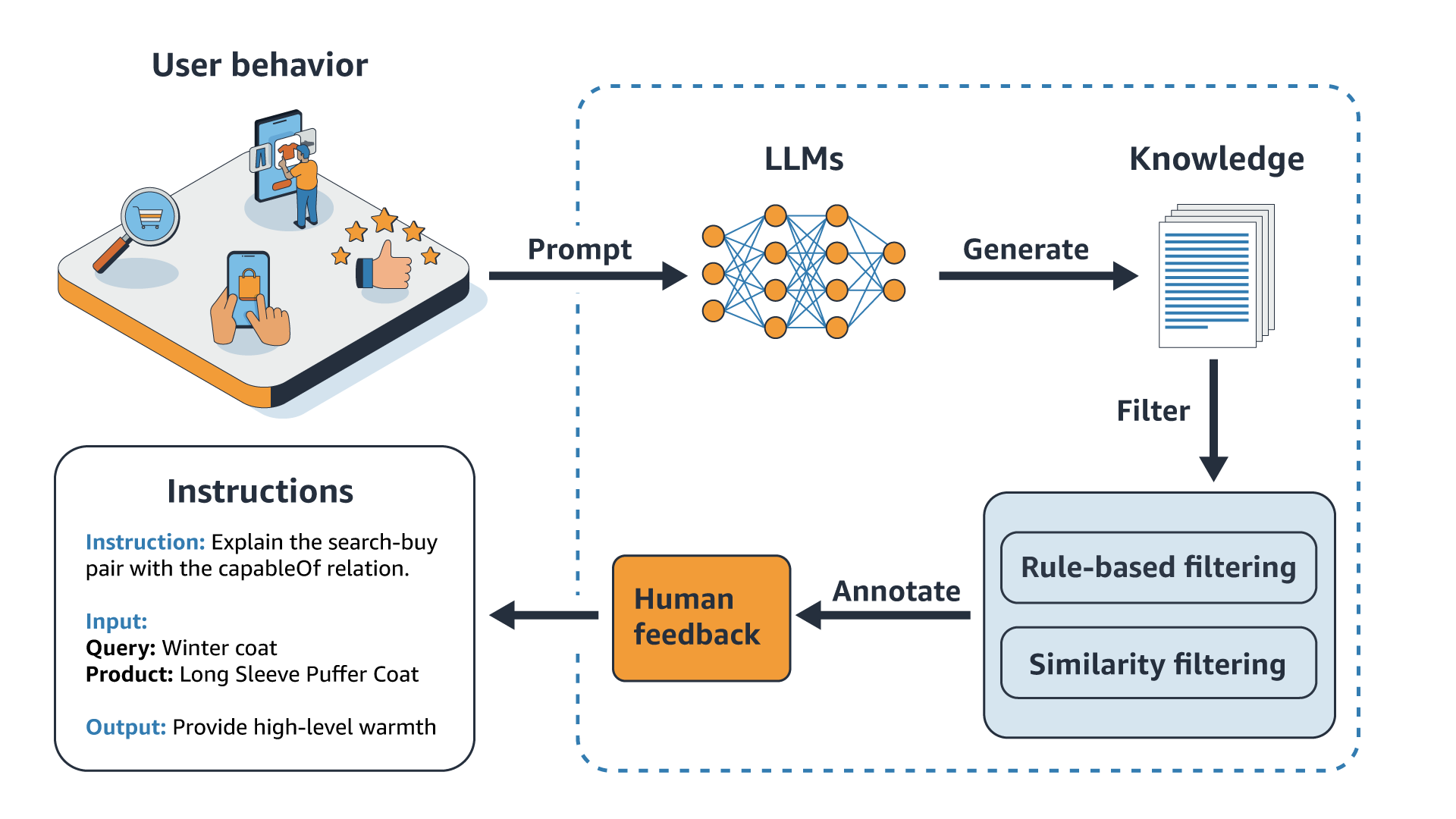
Building commonsense knowledge graphs to aid product recommendation
Sometimes, finding the product in Amazon Stores most relevant to a customer query can involve commonsense reasoning inferring, say, that “slip-resistant shoes” might be relevant to the query “shoes for pregnant women”. To help facilitate such reasoning, Amazon researchers used LLMs to extract commonsense relationships from customer interaction data and encoded those relationships in an enormous graph, which can be queried during product retrieval.
Automated evaluation of RAG pipelines with exam generation
The fight against hallucination in retrieval-augmented-generation (RAG) models starts with a method for accurately assessing it. To that end, Amazon researchers developed an approach that uses an LLM to produce multiple-choice tests for each document in the knowledge corpus relevant to a particular task. The RAG model is then scored according to its performance on the tests.
The technology behind Amazons GenAI-powered shopping assistant, Rufus
Trishul Chilimbi, a vice president and distinguished scientist with Amazon Stores Foundational AI organization, describes his team’s work on Rufus, the new generative-AI-powered shopping assistant for Amazon Stores. Rufus helps Amazon customers make more-informed shopping decisions by answering a wide range of questions in the Amazon Shopping app, from product details and comparisons to recommendations.
Virtual try-all: Visualizing any product in any personal setting

In contrast to earlier virtual-try-on models, which generated images of a human figure wearing different clothes, Amazon’s “virtual try-all” model allows users to seamlessly insert any product at any location in any scene. The user starts with a personal scene image and a product and draws a mask in the scene to tell the model where to insert the object. The model then integrates the item into the scene, with realistic angles, lighting, shadows, and so on. The key to the model’s success is a secondary U-Net encoder that produces a hint signal based on a rough copy-paste collage in which the product image, resized to match the scale of the background scene, has been inserted into the mask
The life of a prescription at Amazon Pharmacy
From LLMs that transcribe raw prescription data into standardized formats, to decision-tree models that generate accurate price estimates, to the Amazon Pharmacy assistant, which helps customers navigate the complexities of the pharmacy industry, AI is improving every aspect of customers’ interactions with Amazon Pharmacy.
Amazon Scholar solves century-old problem with automated reasoning
Almost 100 years ago, the Hungarian-Australian mathematician Esther Szekeres posed a problem that came to be known as the happy-ending problem:
what is the minimum number of points in a plane, no three of which are collinear, required to guarantee that n of the points constitute a convex polygon that does not contain any of the other points? The problem had been solved for n > 6 and n < 6, but not for n = 6. Using the tools of automated reasoning, Amazon Scholar Marijn Heule and colleagues finally solved the remaining case.

Tags: Time series, Cryptography, Large language models (LLMs), Hallucinations, Recommender systems , Retrieval-augmented generation (RAG), Generative AI, Formal verification
