SOLID Design Principles: Improve Object-Oriented Code in Python

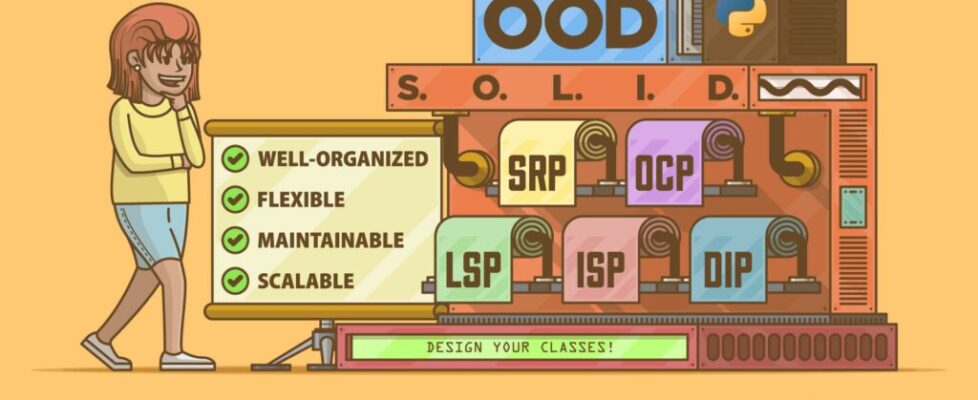
A great approach to writing high-quality object-oriented Python code is to consistently apply the SOLID design principles. SOLID is a set of five object-oriented design principles that can help you write maintainable, flexible, and scalable code based on well-designed, cleanly structured classes. These principles are foundational best practices in object-oriented design.
In this tutorial, you’ll explore each of these principles with concrete examples and refactor your code so that it adheres to the principle at hand.
By the end of this tutorial, you’ll understand that:
- You apply the SOLID design principles to write classes that you can confidently maintain, extend, test, and reason about.
- You can apply SOLID principles to split responsibilities, extend via abstractions, honor subtype contracts, keep interfaces small, and invert dependencies.
- You enforce the Single-Responsibility Principle by separating tasks into specialized classes, giving each class only one reason to change.
- You satisfy the Open-Closed Principle by defining an abstract class with the required interface and adding new subclasses without modifying existing code.
- You honor the Liskov Substitution Principle by making the subtypes preserve their expected behaviors.
- You implement Dependency Inversion by making your classes depend on abstractions rather than on details.
Follow the examples to refactor each design, verify behaviors, and internalize how each SOLID design principle can improve your code.
Free Bonus: Click here to download sample code so you can build clean, maintainable classes with the SOLID Principles in Python.
Take the Quiz: Test your knowledge with our interactive “SOLID Design Principles: Improve Object-Oriented Code in Python” quiz. You’ll receive a score upon completion to help you track your learning progress:
Interactive Quiz
SOLID Design Principles: Improve Object-Oriented Code in Python
Learn Liskov substitution in Python. Spot Square and Rectangle pitfalls and design safer APIs with polymorphism. Test your understanding now.
The SOLID Design Principles in Python
When it comes to writing classes and designing their interactions in Python, you can follow a series of principles that will help you build better object-oriented code. One of the most popular and widely accepted sets of standards for object-oriented design (OOD) is known as the SOLID design principles.
If you’re coming from C++ or Java, you may already be familiar with these principles. Maybe you’re wondering if the SOLID principles also apply to Python code. The answer to that question is a resounding yes. If you’re writing object-oriented code, then you should consider applying these principles to your OOD.
But what are these SOLID design principles? SOLID is an acronym that encompasses five core principles applicable to object-oriented design. These principles are the following:
- Single-responsibility principle (SRP)
- Open–closed principle (OCP)
- Liskov substitution principle (LSP)
- Interface segregation principle (ISP)
- Dependency inversion principle (DIP)
You’ll explore each of these principles in detail and code real-world examples of how to apply them in Python. In the process, you’ll gain a strong understanding of how to write more straightforward, organized, scalable, and reusable object-oriented code by applying the SOLID design principles. To kick things off, you’ll start with the first principle on the list.
Single-Responsibility Principle (SRP)
The single-responsibility principle (SRP) comes from Robert C. Martin, more commonly known by his nickname Uncle Bob. Martin is a well-respected figure in software engineering and one of the original signatories of the Agile Manifesto. He coined the term SOLID.
The single-responsibility principle states that:
A class should have only one reason to change.
This means that a class should have only one responsibility, as expressed through its methods. If a class takes care of more than one task, then you should separate those tasks into dedicated classes with descriptive names. Note that SRP isn’t only about responsibility but also about the reasons for changing the class implementation.
Note: You’ll find the SOLID design principles worded in various ways out there. In this tutorial, you’ll refer to them following the wording that Uncle Bob uses in his book Agile Software Development: Principles, Patterns, and Practices. So, all the direct quotes come from this book.
If you want to read alternate wordings in a quick roundup of these and related principles, then check out Uncle Bob’s The Principles of OOD.
This principle is closely related to the concept of separation of concerns, which suggests that you should divide your programs into components, each addressing a separate concern.
To illustrate the single-responsibility principle and how it can help you improve your object-oriented design, say that you have the following FileManager class:
file_manager_srp.py
from pathlib import Path
from zipfile import ZipFile

class FileManager:
    def __init__(self, filename):
        self.path = Path(filename)

    def read(self, encoding="utf-8"):
        return self.path.read_text(encoding)

    def write(self, data, encoding="utf-8"):
        self.path.write_text(data, encoding)

    def compress(self):
        with ZipFile(self.path.with_suffix(".zip"), mode="w") as archive:
            archive.write(self.path)

    def decompress(self):
        with ZipFile(self.path.with_suffix(".zip"), mode="r") as archive:
            archive.extractall()
In this example, your FileManager class has two different responsibilities. It manages files using the .read() and .write() methods. It also deals with ZIP archives by providing the .compress() and .decompress() methods.
This class violates the single-responsibility principle because there is more than one reason for changing its implementation (file I/O and ZIP handling). This implementation also makes code testing and code reuse harder.
To fix this issue and make your design more robust, you can split the class into two smaller, more focused classes, each with its own specific concern:
Read the full article at https://realpython.com/solid-principles-python/ »
[ Improve Your Python With 🐍 Python Tricks 💌 – Get a short & sweet Python Trick delivered to your inbox every couple of days. >> Click here to learn more and see examples ]
