
Part 2 — How to Build Your Own AI Agent: (Cloud-Agnostic, Fully Automated, Enterprise-Ready)

From natural-language prompts → to Terraform module → to PR → to CI/CD → to validation

Most AI content explains concepts.
This guide helps you build something real — a fully functioning AI agent that:
- Understands natural-language infrastructure requests
- Generates complete Terraform modules (multi-file)
- Enforces strict enterprise standards
- Auto-fixes issues via LLM reasoning
- Creates a GitHub branch
- Commits all files
- Opens a pull request
- Triggers GitHub Actions
- Runs unit tests
- Runs Terraform init + validate + plan
- Works in any cloud (AWS, Azure, GCP, etc.)
- Works in any pipeline (GitHub, Harness, GitLab, Jenkins, Azure DevOps, etc.)
By the end of this article, you’ll have the blueprint of a Digital DevOps Engineer Agent.
1️⃣ What Makes This Agent Different?
It does not assume AWS or Azure or GCP.
If your prompt says:
“Create AWS Lambda module” → Generates AWS Terraform
“Create Azure Storage Account module” → Generates Azure Terraform
“Create GCP Cloud Run module” → Generates GCP Terraform
It adapts automatically because it generates pure Terraform (HCL).
✔ Cloud‑Agnostic
Works with ANY Terraform provider, including:
- AWS
- Azure
- GCP
- OCI
- Cloudflare
- Kubernetes
- DigitalOcean
- VMware vSphere
- Proxmox
- GitHub provider
- And every provider on the Terraform registry
✔ CI/CD‑Agnostic
Runs in:
- GitHub Actions
- Harness
- GitLab CI
- Bitbucket Pipelines
- Jenkins
- Azure DevOps
- CircleCI
Anywhere Python + Terraform exist — the agent works.
✔ Enterprise‑Grade Validation
Your standards engine validates:
Required tags
snake_case variable names
IAM least privilege
Secret detection
Deprecated syntax detection
VPC subnet structure
Provider best practices
Module reusability
Terraform version constraints
And does this for every .tf file in the module.
✔ Complete Multi‑File Generation
Every request generates:
main.tf
variables.tf
outputs.tf
providers.tf
README.md
2️⃣ Understanding AI Agents (Enterprise Context)
An AI Agent is not just an LLM.
It is a system made of:
🔹 Brain (LLM): Interprets the user’s request.
🔹 Memory (Context, RAG): Holds standards, patterns, best practices.
🔹 Tools (Python, Filesystem, Terraform CLI, GitHub API): Allows the agent to act, not just talk.
🔹 Reasoning Loop: Plan → Generate → Validate → Fix → Loop
🔹 Policy Layer: Your org’s security, naming, tagging, compliance.
🔹 Runtime Environment: GitHub Actions, Pipelines, Local runner, Cloud VMs.
Together, they form a Digital DevOps Engineer.
3️⃣ Prerequisites
✔ Skills
- Python
- Terraform
- GitHub
- CI/CD
- Prompt engineering basics
✔ Installations
Run:
pip install openai langchain python-dotenv PyGithub
brew install terraform        # Mac
choco install terraform       # Windows
✔ Organization Inputs
Prepare a standards file:
standards.md
1. Tags required: environment, owner, cost_center.
2. Variables must use snake_case.
3. IAM must follow least privilege.
4. No hardcoded secrets.
5. Modules must be reusable.
6. VPC must include public + private subnets.
This becomes your policy engine.
4️⃣ Architecture of What We’re Building
User Provides Prompt
        ↓
┌───────────────────────────────────────────────────────┐
│  Agent Pipeline (agent_real.py)                       │
│  ────────────────────────────────────                 │
│  1. Plan → Break request into steps (LLM)            │
│  2. Generate → Create Terraform module files          │
│     • main.tf (resources)                             │
│     • variables.tf (inputs with validation)           │
│     • outputs.tf (outputs with descriptions)          │
│     • providers.tf (provider versions & config)       │
│     • README.md (usage documentation)                 │
│  3. Validate → Check against standards                │
│     • Required tags (environment, owner, cost_center) │
│     • snake_case variables                            │
│     • No hardcoded secrets                            │
│     • Least-privilege IAM                             │
│     • No deprecated features                          │
│     • Current provider best practices                 │
│  4. Fix → Auto-correct issues (LLM or heuristics)     │
│  5. Loop → Repeat validate/fix until clean            │
└───────────────────────────────────────────────────────┘
        ↓
┌───────────────────────────────────────────────────────┐
│  GitHub Integration (agent.py)                        │
│  ─────────────────────────                            │
│  • Create feature branch: ai/<slug>-YYYYMMDDHHMMSS    │
│  • Commit all module files to modules/<branch>/       │
│  • Open Pull Request                                  │
└───────────────────────────────────────────────────────┘
        ↓
┌───────────────────────────────────────────────────────┐
│  CI/CD Workflows (.github/workflows/)                 │
│  ────────────────────────────────────                 │
│  • python-tests.yml → Run validation tests            │
│  • terraform.yml → init + validate + plan all modules │
└───────────────────────────────────────────────────────┘
        ↓
   PR Ready for Review
5️⃣ Step 1: Build the Python Utility (Terraform Standards Validator)
Create: terraform_standards.py
This is your AI enforcer.
import re

TERRAFORM_STANDARDS = """
1. Required tags: environment, owner, cost_center.
2. IAM roles must have least-privilege policies.
3. Use snake_case for variables.
4. No hardcoded secrets allowed.
5. Modules must be reusable.
6. VPC must include public + private subnets.
"""


def validate(code: str) -> str:
    issues = []

    # Check for tags presence anywhere
    if not re.search(r"btagss*=s*{", code):
        issues.append("Missing required tags block (environment, owner, cost_center).")
    else:
        # Ensure required tag keys exist in any tags block
        tags_blocks = re.findall(r"tagss*=s*{([^}]*)}", code, flags=re.S)
        for tb in tags_blocks:
            if "environment" not in tb or "owner" not in tb or "cost_center" not in tb:
                issues.append("Tags block missing one of environment/owner/cost_center.")
                break

    # Hardcoded secret detection (common patterns)
    if re.search(r"(?i)aws_secret_access_key|aws_access_key_id|secrets*=|passwords*=|passwds*=|bSECRET_", code):
        issues.append("Hardcoded secret or credentials detected.")
    # Detect secrets in variable defaults or variable names (e.g., default = "secret123")
    if re.search(r"(?i)defaults*=s*".*(secret|password|passwd).*"", code) or re.search(r"(?i)variables+".*(password|secret|passwd).*"", code):
        issues.append("Hardcoded secret detected in variable default or name.")

    # Variable naming heuristic: flag variables with uppercase or camelCase
    if re.search(r"variables+".*([A-Z].*|[a-z]+[A-Z].*)"", code):
        issues.append("Variables should use snake_case (avoid CamelCase or uppercase).")

    # IAM least-privilege heuristic: look for wildcard resources or actions
    if re.search(r"aws_iam_policy|aws_iam_role_policy", code):
        if re.search(r'"?Resource"?s*:s*[?s*"?*"?', code) or re.search(r'"?Action"?s*:s*[?s*"?.**.*"?', code):
            issues.append("IAM policy uses wildcard Action or Resource; prefer least-privilege.")

    # IAM role existence but missing policy
    if "aws_iam_role" in code and not re.search(r"aws_iam_policy|role_policy|policys*=", code):
        issues.append("IAM role present but no inline or attached policy found.")

    # VPC subnet check
    if re.search(r"resources+"aws_vpc"", code) and not re.search(r"resources+"aws_subnet".*(public|private)|public_subnet|private_subnet", code, flags=re.S):
        issues.append("VPC must include both public and private subnets.")

    # Module reusability: prefer modules rather than repeating resources
    if re.search(r"resources+"aws_vpc".*resources+"aws_vpc"", code, flags=re.S):
        issues.append("Duplicate VPC resources detected; prefer reusable modules.")

    return "OK" if not issues else "n".join(issues)


if __name__ == "__main__":
    sample = '''
resource "aws_vpc" "main" {
  cidr_block = "10.0.0.0/16"
}
'''
    print(validate(sample))
import re

TERRAFORM_STANDARDS = """
1. Required tags: environment, owner, cost_center.
2. IAM roles must have least-privilege policies.
3. Use snake_case for variables.
4. No hardcoded secrets allowed.
5. Modules must be reusable.
6. VPC must include public + private subnets.
"""


def validate(code: str) -> str:
    issues = []

    # Check for tags
    if not re.search(r"btagss*=", code):
        issues.append("Missing required tags: environment, owner, cost_center.")

    # Hardcoded secret detection (simple heuristics)
    if re.search(r"(?i)secrets*=|passwords*=|passwds*=|bSECRET_", code):
        issues.append("Hardcoded secret detected.")

    # Variable naming heuristic: flag variables with uppercase letters
    if re.search(r"variables+".*[A-Z].*"", code):
        issues.append("Variables should use snake_case.")

    # IAM role policy check
    if "aws_iam_role" in code and not ("policy" in code or "aws_iam_policy" in code):
        issues.append("IAM roles must define least-privilege policy.")

    # VPC subnet check
    if re.search(r"resources+"aws_vpc"", code) and not re.search(r"aws_subnet|public_subnet|private_subnet", code):
        issues.append("VPC must include public + private subnets.")

    return "OK" if not issues else "n".join(issues)


if __name__ == "__main__":
    # quick local smoke test
    sample = '''
resource "aws_vpc" "main" {
  cidr_block = "10.0.0.0/16"
}
'''
    print(validate(sample))
6️⃣ Step 2: Build the Agent (Brain + Tools)
This file does the magic:
- Uses OpenAI (or Mock LLM for free testing)
- Generates 5 Terraform files with ### FILE: markers
- Parses multi-file output
- Validates each .tf file
- Fixes issues using LLM or fallback heuristics
- Repeats validation (max iterations)
- Returns a clean, production-ready module
Create: agent_real.py
import os
import re
import json
from dotenv import load_dotenv

load_dotenv()

from terraform_standards import validate, TERRAFORM_STANDARDS

OPENAI_MODEL = os.getenv("OPENAI_MODEL", "gpt-4o-mini")


PROMPT_TEMPLATE = """
You are an expert Terraform generator. Follow these org standards exactly:
{standards}

User request:
{request}

Produce a complete, production-ready, reusable Terraform module with proper enterprise structure.

Generate the following files with clear separators:

### FILE: main.tf
<main resource definitions with proper tags blocks in resource blocks only>

### FILE: variables.tf
<all input variables with descriptions, types, defaults, and validation>

### FILE: outputs.tf
<all outputs with value and description only - NO tags, NO other arguments>

### FILE: providers.tf
<required provider versions, terraform version constraints, and provider configurations>

### FILE: README.md
<module documentation with description, usage example, inputs table, outputs table, requirements>

CRITICAL Terraform Syntax Rules:
- Tags ONLY go inside resource blocks, NOT in output/variable/provider blocks
- Output blocks ONLY support: value, description, sensitive, depends_on
- Variable blocks ONLY support: type, description, default, validation, sensitive, nullable
- Provider blocks do NOT have tags - use default_tags in AWS provider if needed
- Always close ALL braces properly - verify each opening brace has a closing brace
- Use proper HCL syntax - check for missing commas, quotes, and braces

Resource-Specific Requirements:
- AWS Lambda: MUST specify exactly ONE of: filename (with default="lambda.zip"), s3_bucket+s3_key, or image_uri
- For reusable Lambda modules, use s3_bucket + s3_key as required variables (most common pattern)
- IAM roles: must have assume_role_policy with proper JSON
- Security groups: must have at least one ingress or egress rule
- VPCs: should include both public and private subnets
- CloudWatch alarms: require comparison_operator, evaluation_periods, metric_name, namespace, period, statistic, threshold

Ensure:
- Include required tags: environment, owner, cost_center in RESOURCE blocks only
- Use snake_case for all variable names
- No hardcoded secrets or credentials
- Least-privilege IAM policies (avoid Resource = "*")
- Proper variable validation and constraints
- Clear descriptions for all variables and outputs
- Module should be reusable across environments
- Include usage examples in README
- Use ONLY current, non-deprecated resource types and arguments
- Follow latest provider best practices (check documentation)
- Use required_providers block with version constraints
- Specify minimum terraform version in providers.tf
- Use terraform.workspace or variables for environment-specific values
- Avoid deprecated syntax (e.g., use for_each over count when appropriate)

IMPORTANT: Return ONLY raw Terraform code with ### FILE: separators.
DO NOT wrap code in markdown fences like ```hcl or ```terraform.
DO NOT include any code block markers or backticks.
Return clean, parseable Terraform code only.
"""


class MockLLM:
    @staticmethod
    def generate(prompt: str) -> str:
        # Keep the previous deterministic example for local testing
        from agent import MockLLM as OldMock
        return OldMock.generate(prompt)


def call_openai(prompt: str) -> str:
    try:
        from openai import OpenAI

        client = OpenAI(api_key=os.getenv("OPENAI_API_KEY"))
        resp = client.chat.completions.create(
            model=OPENAI_MODEL,
            messages=[{"role": "user", "content": prompt}],
            max_tokens=1500,
        )
        return resp.choices[0].message.content
    except Exception as e:
        print(f"OpenAI call failed: {e}")
        return MockLLM.generate(prompt)


def llm(prompt: str) -> str:
    if os.getenv("OPENAI_API_KEY"):
        return call_openai(prompt)
    return MockLLM.generate(prompt)


def generate_tf(request: str) -> dict:
    """Generate Terraform module files. Returns dict of {filename: content}"""
    prompt = PROMPT_TEMPLATE.format(standards=TERRAFORM_STANDARDS, request=request)
    result = llm(prompt)
    return parse_multi_file_response(result)


def parse_multi_file_response(response: str) -> dict:
    """Parse LLM response with ### FILE: separators into dict of files"""
    files = {}
    pattern = r"###s*FILE:s*([w.-]+)s*n(.*?)(?=###s*FILE:|$)"
    matches = re.findall(pattern, response, re.DOTALL | re.IGNORECASE)

    if matches:
        for filename, content in matches:
            # Strip markdown code fences if present
            cleaned_content = content.strip()
            # Remove opening code fence (```hcl, ```terraform, ```)
            cleaned_content = re.sub(r'^```(?:hcl|terraform)?s*n', '', cleaned_content)
            # Remove closing code fence
            cleaned_content = re.sub(r'n```s*$', '', cleaned_content)

            # Fix common LLM mistakes in outputs.tf
            if filename.strip() == 'outputs.tf':
                cleaned_content = fix_output_syntax(cleaned_content)

            files[filename.strip()] = cleaned_content.strip()
    else:
        # Fallback: treat entire response as main.tf
        content = response.strip()
        content = re.sub(r'^```(?:hcl|terraform)?s*n', '', content)
        content = re.sub(r'n```s*$', '', content)
        files["main.tf"] = content.strip()

    return files


def fix_output_syntax(content: str) -> str:
    """Remove invalid arguments from output blocks (e.g., tags)"""
    # Remove tags blocks from output definitions
    # Pattern: find output blocks and remove tags = { ... } from them
    def remove_invalid_output_args(match):
        output_block = match.group(0)
        # Remove tags blocks
        output_block = re.sub(r's*tagss*=s*{[^}]*}s*', 'n', output_block, flags=re.DOTALL)
        # Remove other invalid args (type, default, validation, etc.)
        output_block = re.sub(r's*types*=s*[^n]+n', 'n', output_block)
        output_block = re.sub(r's*defaults*=s*[^n]+n', 'n', output_block)
        return output_block

    # Match output blocks
    content = re.sub(
        r'outputs+"[^"]+"s*{[^}]*}',
        remove_invalid_output_args,
        content,
        flags=re.DOTALL
    )

    return content


def run_terraform_validate(files: dict) -> str:
    """Run actual terraform validate on generated files"""
    import tempfile
    import subprocess
    import shutil
    from pathlib import Path

    # Create temp directory
    temp_dir = tempfile.mkdtemp(prefix="tf-validate-")
    try:
        # Write all files
        for filename, content in files.items():
            file_path = Path(temp_dir) / filename
            file_path.write_text(content)

        # Run terraform init
        init_result = subprocess.run(
            ["terraform", "init", "-backend=false"],
            cwd=temp_dir,
            capture_output=True,
            text=True,
            timeout=60
        )

        if init_result.returncode != 0:
            return f"Terraform init failed:n{init_result.stderr}"

        # Run terraform validate
        validate_result = subprocess.run(
            ["terraform", "validate", "-json"],
            cwd=temp_dir,
            capture_output=True,
            text=True,
            timeout=30
        )

        if validate_result.returncode != 0:
            # Parse JSON output for better error messages
            try:
                import json
                result = json.loads(validate_result.stdout)
                if not result.get("valid", False):
                    errors = []
                    for diag in result.get("diagnostics", []):
                        severity = diag.get("severity", "error")
                        summary = diag.get("summary", "")
                        detail = diag.get("detail", "")
                        errors.append(f"{severity.upper()}: {summary}n{detail}")
                    return "n".join(errors)
            except:
                pass
            return f"Terraform validation failed:n{validate_result.stderr}"

        return "OK"

    except subprocess.TimeoutExpired:
        return "Terraform validation timed out"
    except Exception as e:
        return f"Terraform validation error: {str(e)}"
    finally:
        # Cleanup
        try:
            shutil.rmtree(temp_dir)
        except:
            pass


def validate_tf(files: dict) -> str:
    """Validate all .tf files in the module"""
    issues = []

    # First, validate individual files against standards
    for filename, content in files.items():
        if filename.endswith('.tf'):
            result = validate(content)
            if result != "OK":
                issues.append(f"{filename}: {result}")

    # Cross-file validation: check for undefined variable references
    defined_vars = set()
    if 'variables.tf' in files:
        var_matches = re.findall(r'variables+"([^"]+)"', files['variables.tf'])
        defined_vars = set(var_matches)

    # Check all .tf files for var. references
    for filename, content in files.items():
        if filename.endswith('.tf'):
            var_refs = re.findall(r'var.(w+)', content)
            for var_ref in var_refs:
                if var_ref not in defined_vars:
                    issues.append(f"{filename}: References undeclared variable 'var.{var_ref}'")

    # Run actual terraform validate (most comprehensive check)
    tf_issues = run_terraform_validate(files)
    if tf_issues != "OK":
        issues.append(f"Terraform validation: {tf_issues}")

    return "OK" if not issues else "n".join(issues)


def fix_tf(files: dict, issues: str) -> dict:
    """Fix issues in Terraform files"""
    if os.getenv("OPENAI_API_KEY"):
        # Use LLM to fix issues
        files_str = "nn".join([f"### FILE: {name}n{content}" for name, content in files.items()])
        fix_prompt = f"""The following Terraform module has validation issues that MUST be fixed:

ISSUES:
{issues}

CURRENT MODULE FILES:
{files_str}

FIX INSTRUCTIONS:
1. Fix ALL issues listed above
2. If a variable is referenced but not declared, add it to variables.tf with proper type and description
3. If tags are in output blocks, remove them (outputs only support: value, description, sensitive)
4. If provider uses undefined variables, add them to variables.tf
5. Ensure all braces are properly closed
6. Keep all existing working code intact

IMPORTANT: Return the COMPLETE corrected module with ### FILE: separators.
DO NOT use markdown code fences (no ```hcl or ```).
Return raw Terraform code only.
"""
        result = llm(fix_prompt)
        if result:
            return parse_multi_file_response(result)

    # Heuristic fallback: fix main.tf only
    import agent
    if "main.tf" in files:
        files["main.tf"] = agent.fix_tf(files["main.tf"], issues)
    return files


def full_pipeline(user_request: str, max_iterations: int = 3) -> dict:
    """Run the full agent pipeline. Returns dict of {filename: content}"""
    print(f"n Starting pipeline for: {user_request}")

    # Step 1: Generate initial code
    print("n Generating Terraform module...")
    files = generate_tf(user_request)

    if not files:
        print(" Failed to generate initial code")
        return {}

    print(f" Generated {len(files)} files: {', '.join(files.keys())}")

    # Step 2: Validate
    print("n Validating module...")
    issues = validate_tf(files)

    if issues == "OK":
        print(" Validation passed!")
        return files

    print(f"⚠  Validation issues found:n{issues}")

    # Step 3: Auto-fix loop
    iter_count = 0
    while issues != "OK" and iter_count < max_iterations:
        iter_count += 1
        print(f"n🔧 Auto-fix iteration {iter_count}/{max_iterations}...")

        fixed_files = fix_tf(files, issues)
        if fixed_files == files:
            print("  No changes made by fix attempt")
            break

        files = fixed_files
        issues = validate_tf(files)

        if issues == "OK":
            print(f" Validation passed after {iter_count} iteration(s)!")
        else:
            print(f"  Still have issues:n{issues}")

    if issues != "OK":
        print(f"n Could not fix all issues after {max_iterations} iterations")
        print("Returning module with remaining issues.")

    return files


def create_pr(branch_name: str, files: dict, module_path: str = None) -> str:
    """Reuse the create_pr from agent.py to avoid duplication"""
    import agent
    return agent.create_pr(branch_name, files, module_path)


if __name__ == "__main__":
    sample = "Create an AWS VPC module with public and private subnets and a basic IAM role."
    print(full_pipeline(sample))
Note: Using OpenAI in the Example — But This Agent Works With Any LLM
Example swap: OpenAI → Gemini
# Instead of OpenAI:
from openai import OpenAI
client = OpenAI()

# Use Gemini:
import google.generativeai as genai
genai.configure(api_key=os.getenv("GEMINI_API_KEY"))
model = genai.GenerativeModel("gemini-1.5-pro")

response = model.generate_content(prompt)
7️⃣ Step 3 — Local Build & Testing (Optional but Highly Recommended)
(Test the agent locally before sending code to GitHub)
Before integrating the agent into a CI/CD pipeline or letting it create PRs, you may want to test it locally. This step lets you:
- Validate the module generation
- Run standards checks
- See auto‑fixes happen in real‑time
- Inspect generated files
- Debug issues faster
- Avoid unnecessary PR noise
You can skip this and rely fully on GitHub Actions —
but local testing gives you a faster feedback loop, especially during development.
Run the agent locally with:
python run_example.py --prompt "Create an AWS Lambda with CloudWatch monitoring"
This produces:
- main.tf
- variables.tf
- outputs.tf
- providers.tf
- README.md
All validated and auto‑fixed before being written to:
8️⃣ Step 4 — Project Folder Structure
Before we move into CI/CD automation, here is the full directory structure of the Terraform Agent you just built.
This structure is intentionally modular, testable, and enterprise‑ready.
📁 Project Structure
terraform-agent/
├── agent_real.py                # Main AI agent (LLM + validation + fixes)
├── agent.py                     # PR creation + mock LLM utilities
├── terraform_standards.py       # Org standards + validation engine
├── run_example.py               # Local execution entrypoint
├── modules/                     # Auto-created PR modules
├── out/                         # Local generated modules (no PR)
├── tests/                       # Full unit test suite
│   ├── test_agent_pipeline.py
│   └── test_terraform_standards.py
└── .github/
    └── workflows/
        ├── python-tests.yml     # Unit tests run on every PR
        ├── terraform.yml        # Terraform validate + plan workflow
        └── e2e_pr.yml           # End-to-end PR generation workflow
9️⃣ Step 5 — Running the Workflow with a Prompt (CI/CD Automation)
Now that the codebase is structured correctly, you can run the entire agent and pipeline with a single prompt — either locally or directly inside GitHub.
You now have two ways to run the pipeline:
Option A: Run the Agent Locally (Fast Feedback Loop)
If you want to test code generation before opening a PR:
python run_example.py --prompt "Create an Azure Storage Account module"
This will:
- Generate all module files
- Validate them
- Auto-fix issues
- Write output to:
out/<branch-name>/
5. (Optional) Create a PR if you pass –create-pr
python run_example.py --prompt "Create a GCP Cloud Run module" --create-pr

Option B: Run the Entire Agent Inside GitHub Actions
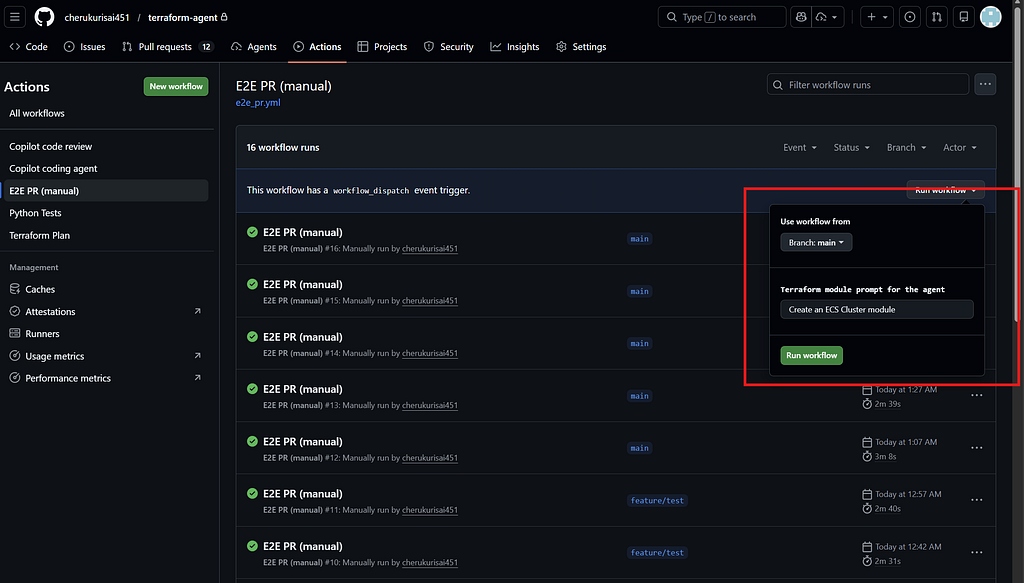
You can trigger the e2e_pr.yml workflow from GitHub UI.
name: E2E PR (manual)

on:
  workflow_dispatch:
    inputs:
      prompt:
        description: 'Terraform module prompt for the agent'
        required: false
        default: 'Create a reusable Terraform module that create a lambda function with health check with cloudwatch alarm'
        type: string

permissions:
  contents: write
  pull-requests: write

jobs:
  e2e:
    runs-on: ubuntu-latest
    steps:
      - uses: actions/checkout@v3
      - name: Setup Python
        uses: actions/setup-python@v4
        with:
          python-version: '3.10'
      - name: Install deps
        run: |
          python -m pip install --upgrade pip
          pip install -r requirements.txt
      - name: Run example (create PR)
        env:
          OPENAI_API_KEY: ${{ secrets.OPENAI_API_KEY }}
          # use GH_TOKEN if provided, otherwise fall back to the Actions-provided GITHUB_TOKEN
          GITHUB_TOKEN: ${{ secrets.GH_TOKEN || secrets.GITHUB_TOKEN }}
          GITHUB_REPO: ${{ github.repository }}
        run: |
          python run_example.py --prompt "${{ github.event.inputs.prompt }}" --create-pr
1. Go to
GitHub → Actions → E2E PR (Manual Run)
2. Click “Run Workflow”
3. Enter your natural language Terraform request:
Example prompt:
4. Click Run Workflow
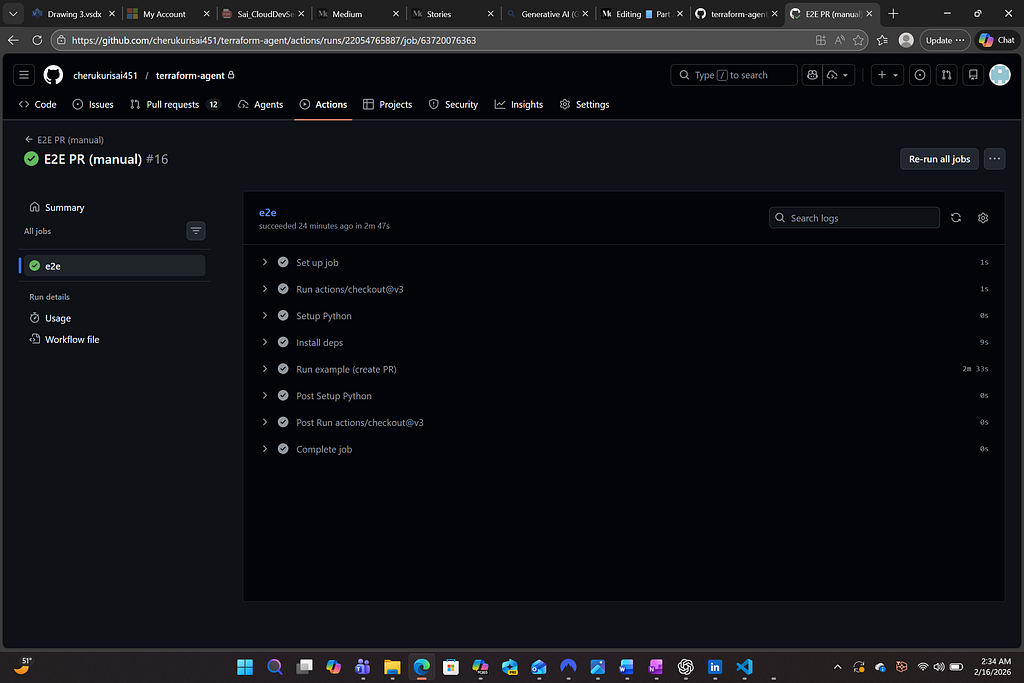
This workflow will:
✔ Run the full agent
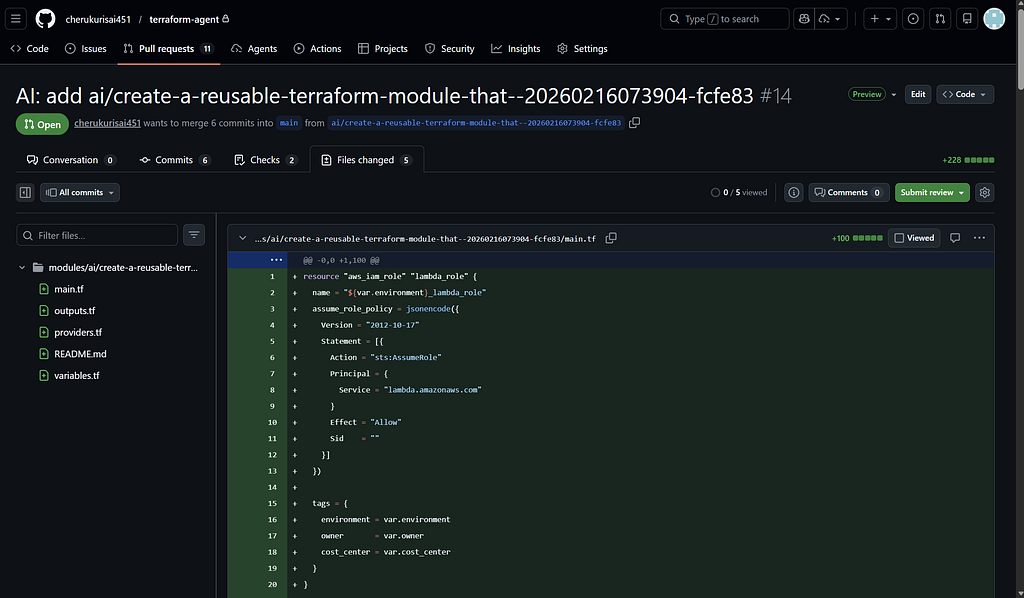
✔ Generate module (main.tf, variables.tf, outputs.tf, providers.tf, README.md)
✔ Validate with your standards file
✔ Auto-fix any issues
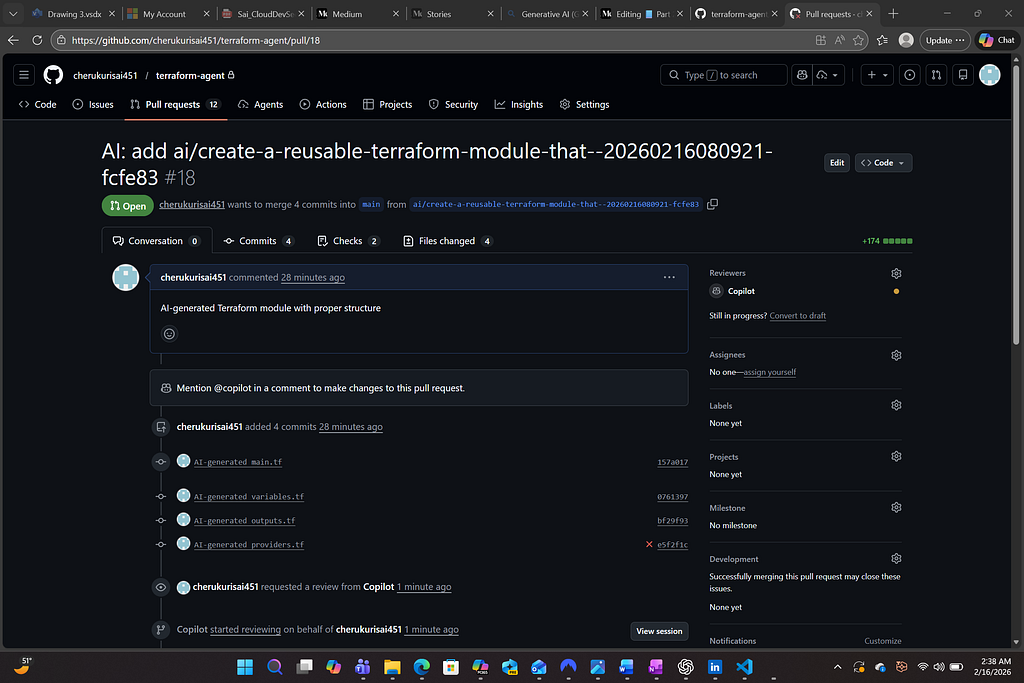
✔ Create AI/-timestamp branch
✔ Commit the module
✔ Open a Pull Request
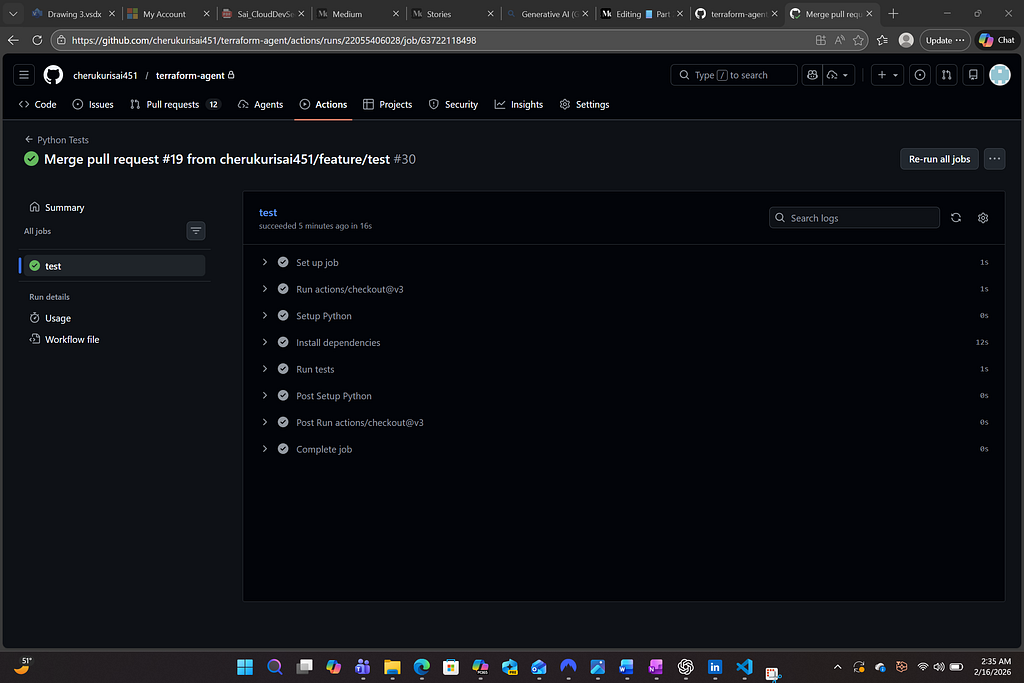
✔ Trigger python-tests.yml
✔ Trigger terraform.yml
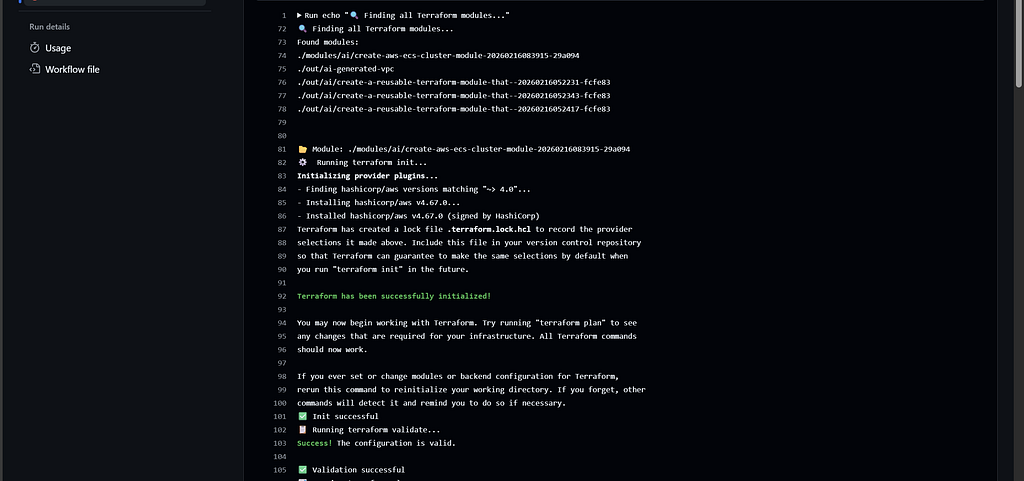
✔ Show terraform init/validate/plan output right in the pipeline
What Happens Automatically After PR Creation?
When the agent opens a PR, GitHub Actions takes over.
✔ Workflow #1 — Unit Tests
File: .github/workflows/python-tests.yml
name: Python Tests

on:
  push:
    branches: ["main", "master"]
  pull_request:

jobs:
  test:
    runs-on: ubuntu-latest
    steps:
      - uses: actions/checkout@v3
      - name: Setup Python
        uses: actions/setup-python@v4
        with:
          python-version: '3.10'
      - name: Install dependencies
        run: |
          python -m pip install --upgrade pip
          pip install -r requirements.txt
      - name: Run tests
        env:
          PYTHONPATH: ${{ github.workspace }}
        run: |
          pytest -q
requirements.txt

openai>=0.27.0
PyGithub>=1.59.0
python-dotenv>=1.0.0
pytest>=7.0.0
This runs:
- Standards tests
- Validation tests
- Agent pipeline tests
- Mock LLM & real LLM behavior tests
✔ Workflow #2 — Terraform Validation
File: .github/workflows/terraform.yml
This workflow:
name: Terraform Plan

on:
  pull_request:

jobs:
  terraform:
    runs-on: ubuntu-latest

    steps:
    - uses: actions/checkout@v3

    - name: Setup Terraform
      uses: hashicorp/setup-terraform@v3
      with:
        terraform_wrapper: false

    - name: Find and Validate All Modules
      run: |
        echo "🔍 Finding all Terraform modules..."

        # Find all directories containing .tf files
        MODULE_DIRS=$(find . -type f -name "*.tf" -exec dirname {} ; | sort -u)

        if [ -z "$MODULE_DIRS" ]; then
          echo "ℹ️  No Terraform modules found in this PR"
          echo "This is normal for PRs that don't include Terraform code"
          exit 0
        fi

        echo "Found modules:"
        echo "$MODULE_DIRS"
        echo ""

        # Validate each module
        for dir in $MODULE_DIRS; do
          echo ""
          echo "📂 Module: $dir"
          cd "$dir"

          echo "⚙️  Running terraform init..."
          if terraform init -backend=false; then
            echo "✅ Init successful"

            echo "📋 Running terraform validate..."
            if terraform validate; then
              echo "✅ Validation successful"
            else
              echo "❌ Validation failed"
              exit 1
            fi

            echo "📊 Running terraform plan..."
            if terraform plan -input=false -out=tfplan 2>&1 | tee plan.log; then
              echo "✅ Plan successful"
              echo ""
              echo "📄 Plan output:"
              terraform show tfplan
            else
              PLAN_EXIT=$?
              echo "⚠️  Plan failed (exit code: $PLAN_EXIT)"

              # Check if it's just missing variables (expected for reusable modules)
              if grep -q "No value for required variable" plan.log; then
                echo ""
                echo "ℹ️  This is a reusable module that requires input variables."
                echo "This is EXPECTED behavior. The module syntax is valid."
                echo ""
                echo "Missing variables:"
                grep "variable "" plan.log | head -10
                echo ""
                echo "✅ Module validation passed (plan failure due to missing vars is OK)"
              else
                echo ""
                echo "❌ Plan failed with actual errors:"
                cat plan.log
                exit 1
              fi
            fi
          else
            echo "❌ Init failed"
            exit 1
          fi

          cd - > /dev/null
        done
        echo ""
        echo "✅ All modules validated successfully!"
- Discovers modules in the PR
- Runs:
terraform init
terraform validate
Final Conclusion — You Just Built a Digital DevOps Engineer
This is not just an AI demo.
You now have a fully operational, cloud‑agnostic, Terraform‑agnostic Agentic DevOps system, capable of:
- Understanding natural language
- Generating Terraform modules
- Enforcing standards
- Auto-fixing code
- Creating GitHub PRs
- Passing unit tests
- Running terraform validate + plan
- Operating across AWS / Azure / GCP / any provider
- Running in any pipeline
This is the future of platform engineering:
- Consistent
- Automated
- Secure
- Extensible
- Agentic
And you’ve built the first working version.
Now extend it:
- Add tfsec / tflint security scanning
- Add Infracost cost intelligence
- Add policy-as-code (OPA/Rego)
- Add Slack/Jira approvals
- Add RAG with your internal playbooks
- Add multi-cloud capabilities
- Add Terratest integration
Your agent is no longer theory — it’s an operational teammate.
Welcome to Agentic DevOps. 🚀
🛠️ What You Can Build Next (Beyond Terraform)
The pattern you built in Part 2 is not limited to Terraform.
By swapping the generation prompt and your validation logic, you can build additional agents that safely accelerate development across your entire organization:
🧩 Helm Agent
Generate:
- Chart.yaml
- values.yaml
- templates
- non‑privileged containers
- resource limits
- required annotations
- org‑approved patterns
🧩 Kubernetes Manifest Agent
Generate Deployments, Services, Ingress, HPA, RBAC with:
- Policy checks
- OPA/Conftest validation
- Security constraints
- Label/annotation standards
🧩 CI/CD Pipeline Agent
Generate GitHub Actions / GitLab CI / Jenkins pipelines using:
- Org‑standard workflows
- Security gating
- Approval flows
🧩 Policy‑as‑Code Agent
Generate:
- OPA/Rego rules
- Gatekeeper constraints
- Governance or compliance templates
🧩 Any Config Agent
- Dockerfiles
- API Gateway configs
- Monitoring dashboards
- Secrets templates
- CloudFormation
- Kustomize
Everything becomes automatable with your organizational rules.
This means your teams can drastically reduce development time while staying secure, consistent, and aligned with internal standards.
Your Terraform Agent is simply the first example of what’s possible with Agentic DevOps.
🔜 What’s Coming in Part 3 — Automated Copilot PR Reviews
Now that the agent can generate Terraform modules, validate them, auto‑fix issues, create PRs, and run full CI/CD checks, the next logical step is improving your review workflow.
📘 Part 2 — How to Build Your Own AI Agent: (Cloud-Agnostic, Fully Automated, Enterprise-Ready) was originally published in Towards AI on Medium, where people are continuing the conversation by highlighting and responding to this story.
