Opinionated Takes on Meetups Organizing

Published on December 20, 2025 12:17 AM GMT
Screwtape, as the global ACX meetups czar, has to be reasonable and responsible in his advice giving for running meetups.
And the advice is great! It is unobjectionably great.
I am here to give you more objectionable advice, as another organizer who’s run two weekend retreats and a cool hundred rationality meetups over the last two years. As the advice is objectionable (in that, I can see reasonable people disagreeing), please read with the appropriate amount of skepticism.
Don’t do anything you find annoying
If any piece of advice on running “good” meetups makes you go “aurgh”, just don’t do those things. Supplying food, having meetups on a regular scheduled basis, doing more than just hosting board game nights, building organizational capacity, honestly who even cares. If you don’t want to do those things, don’t! It’s completely fine to disappoint your dad. Screwtape is not even your real dad.
I’ve run several weekend-long megameetups now, and after the last one I realized that I really hate dealing with lodging. So I am just going to not do that going forwards and trust people to figure out sleeping space for themselves. Sure, this is less ideal. But you know what would be even less ideal than that? If in two years’ time I throw in the towel because this is getting too stressful, and I stop hosting megameetups forever.
I genuinely think that the most important failure mode to avoid is burnout. And the non-fabricated options for meetups organizers are, often, host meetups that are non-ideal, or burn out. I would rather meetups in a city exist ~indefinitely in mildly crappy form, than if they exist in ideal form but only for a bit, and then the city has no more rationality meetups after that.
Anyways this hot take trumps all the other hot takes which is why it’s first. If the rest of the takes here stress you out, just ignore them.
Boss people around
You are a benevolent dictator, act like it. Acting like a dictator can be uncomfortable, and feeling uncomfortable as one is laudable. But you have to do it anyways because the people yearn to be governed. If you are not a benevolent dictator, there is going to be a power vacuum, and because of social monkey dynamics, some random attendee is going to fill that power vacuum, and they’re going to do a worse (they don’t know where the bathrooms are and to call for regular break times so people are not just sitting for 3 hours straight) and less benevolent job (they don’t know that they’re supposed to be a benevolent dictator instead of just talking at everyone for 3 hours straight) than you.
As an organizer, the attendees see you as having an aura of competence and in-chargeness around you. You’re just some guy, so this is kind of baffling. But you should take advantage of this in ways that ultimately benefit the group as a whole. More on this in the highly recommended The Art of Gathering by Priya Parker.[1]
Tell people to do things.
People around these parts like to help out more than they get the chance to. If you ever offered to help the host at a party but the host waved you away, you know what I’m talking about.
Further, many people actually become quite psychically uncomfortable if they feel like they have an increasing debt to you that they can’t pay back (e.g. because you keep hosting good meetups and they keep attending them). So I truly mean this: asking people to do things for you is doing them a favour. Ask them to fetch the latecomer from the door. Ask them to help you clean up after each event. Ask them to guest host meetups on topics they are well versed in.
Tell people how to participate, and sometimes to participate less.
A script I like when breaking people into conversational groups[2]: “Try to pay attention to the amount of conversational space you’re taking up. If you feel like you’re talking a bit more than other people, try to give other people more space, and if you feel like you’re talking a bit less, try to contribute a little more.” This does seem to help a little!
But sometimes it does not help enough, and the conversation ends up being monopolized by a person or two anyways. This sucks and is boring for everyone else trapped in that conversation. But you, as the benevolent dictator, can bring out the big guns, because of your aura of in-chargeness.
For example, I will regularly say “hey name, can you please try to reduce the amount of conversational space you are taking up?” More often, I will use a precise number: “Hey, I would like you to talk around 50/65/80% less.”
I don’t break this one out in the wider world, because this sounds like an unhinged request to most people. But rationalists find this an acceptable thing for organizers to say, and so I will keep pressing that button and not getting punished for it.[3]
Sometimes, people will take “please talk 50% less” as “please shut up forever”. If they stop speaking entirely after you make the request, you can invite them back into the conversational fold by asking them for their thoughts on the topic a little while later in the conversation. Then they get the idea.
I do the opposite thing too. If there is someone who is a little more reticent to speak, but has a thoughtful look on their face, or I notice them failing to break into the conversation a few times, I’ll also throw them a line, and ask them about what they feel about the readings or the latest turn in the conversation. The idea isn’t to get to perfect conversational parity, but to nudge the conversation maybe 30% more that way. This one is nice because if you do it enough, a few other people in the conversation will also pick up the idea that they should be looking out for other people who are interested in speaking, and helping you with gently prompting others to contribute. (This one’s fine to do anywhere since it’s very… legibly? pro-social, but you do need the magical organizer status force field to request that people talk less.)
Do not accommodate people who don’t do the readings
If there’s one thing I hate, it’s seeing rationalist groups devolve into vibes based take machines. Rationality meetups should cultivate the more difficult skills required to think correct things about the world, including reading longform pieces of text critically when that is a helpful thing to do (which it often is). Organizers should assign readings often, and cultivate a culture where doing the readings is a default expectation. Do not mollycoddle or be understanding or say “oh that’s fine” to people who have not done them. You can give new people a pass for misunderstanding the expectations the very first time they show up, and your regulars a pass if they had some sort of genuinely extenuating circumstance.
Especially in smaller meetups (say, under 15 average attendees), you really want to avoid the death spiral of a critical fraction of attendees not doing their readings, and thus the discussion accommodating their lack of context. This punishes the people who did do the readings and disincentivizes them from doing the readings in the future.[4]
As a side benefit, this also makes it so that each newcomer immediately feels the magic of the community. If a new person shows up to my meetups, I like starting out the meetup by asking people who have done the assigned readings to raise their hands. All the hands go up, as well as the new person’s eyebrows, and this is like crack to me.
Make people read stuff outside the rationality canon at least sometimes
Especially if you’ve been running the meetups for a few years. Rationality must survive contact with the wider world, even the parts of it that are not related to AI safety. Examples of things you can read:
- EA stuff
- stuff about our infrastructure
- the book legal systems very different from ours
- woo stuff
- stuff based on contemporary events
- contemporary feminist theory
- soviet feminist theory
Do closed meetups at least sometimes
Especially for contentious topics, such as gender war or culture war discourse, I restrict the meetups to only regulars. Two good reasons for this:
- There is unmet demand for discussion of more taboo subjects, which means newbies are disproportionately likely to show up to spicier events, and this makes them much more annoying to moderate
- People can have more authentic and productive conversations when they are surrounded by people they know and trust, and it’s unusually important to have authentic and productive conversations if you are discussing taboo subjects because otherwise they devolve into shitshows.
There is another reason, which is that this is sort of like, a way of rewarding your regulars for being regulars? Some amount of reward is good for the culture, but there are trade-offs and better ways of doing that. So I am not sure that this is a “good” reason.
My specific system is that the discord server for my community has roles for “regulars” and “irregulars”. People get the “irregular” role after they attend three meetups within a few months’ time, and the “regular” role after they… well, become regulars. I restrict more contentious meetups to only people with those roles, explain what they are, and explain that everyone else will be turned away at the door.
Experiment with group rationality at least sometimes
Many heads are better than one, but rationality in the community seems to be a solo activity. The group rationality tag on LessWrong is kind of dead. It should be less dead, and we should be distributing knowledge work more. Think about how your group can do that!
One easy type of doing this is the “skillshare” – if any of your attendees has a skill that they can teach others within a block of a few hours, help them host a meetup on teaching everyone else that skill. Some skillshares we’re done: singing, calligraphy, disk golf, drawing, crochet.
Other things you can do: distribute reading a book or a very long essay, distribute researching a topic, distribute writing it up.
Bias the culture towards the marginal rat(s) you want
My meetups website is somewhat notorious for looking like this:
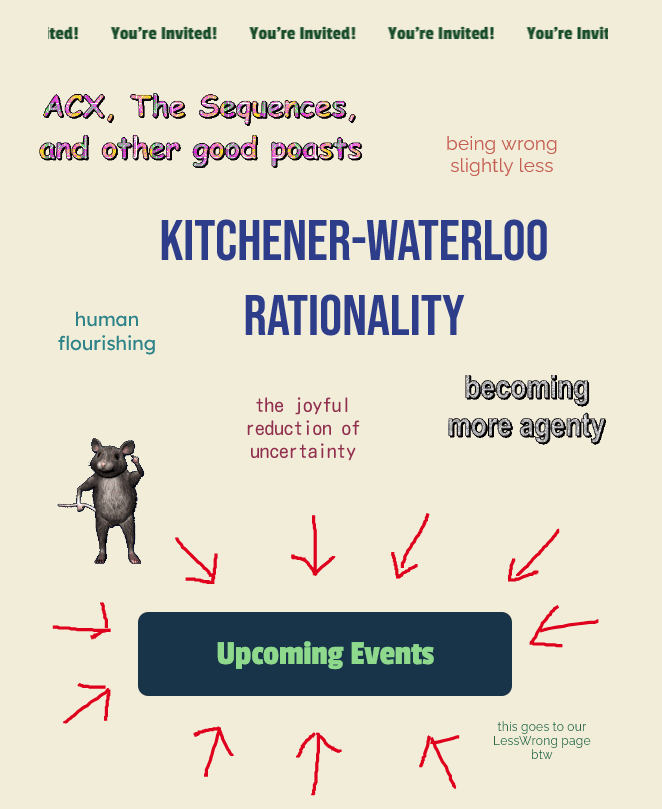
I’m not saying it’s zero percent a shitpost, but the polarization that it induces is intentional.
The mainline rationalists are going to check out your meetup no matter what your website looks like. And once they are there, they are going to be like “ah yes, this is a meetup for my people, very good,” and stick around. (Okay, yeah, make sure you have that part sorted first.)
So one question you should ask is: who is the marginal attendee that you want to attract? And then you want to bias your material towards them[5]. Here are some categories that might exist on the margins of rationality communities in various locales:
- important, busy people
- shy/anxious/depressed people
- EA/Progress Studies/Emergent Ventures/YIMBY people
- people who are into woo/vibecamp/burning man/catholicism
- tech entrepreneurs and startup founders
- econ majors
- people who have heard about rationality/EA and might secretly like some of its takes but believe the community vibe to be rancid (racist, sexist, transphobic, etc)
- this is very common among younger people, women, racial and gender minorities, queer people, and non-tech people
- leftists of varying levels of irony
- various kinds of accelerationists
- the alt right
- undercover FBI agents
As with all things except pokemon, you can’t get them all and you must consider trade-offs. My website will turn off the most fussy members of the tribe and the people who are largely here for the transhumanism, but I think the first group would kind of kill the vibes at a meetup anyways and I don’t think there’s too many of the second around these parts so I’m comfortable with the trade.
My website will also repel older members of the community, and I am sad about this. But I live in a college town and the numbers just don’t work out in their favour, especially since older members are more likely to be more central members of the tribe, and come check us out anyways.
Websites, of course, are not the end-all and be-all of culture. Some other things I do to steer the culture of my group:
- Make everyone wear name tags every time there is a new person or an irregular in attendance. Specify that people can optionally provide their pronouns. (If I had another organizer, I’d coordinate with them such that exactly one of us writes down our pronouns.)
- Makes trans people feel safer; discourages people who are either transphobic or so triggered from culture war stuff that they need a few more years to recover from coming back
- Encourage people with libertarian and right wing takes to continue giving them, and point out explicitly when counter-arguments are weak or bad-faith.
- Credibly signal that we are serious about this freedom of thought and pursuit of truth thing. This is important because the group culture has some markers of not doing that, such as girls with dyed hair and pronouns in regular attendance.
- Normalize responses like “I think this is misinformation” or “I don’t agree with this take” in response to claims that seem like misinformation or bad takes.
- Avoid the failure mode of feelings getting in the way of productive disagreement.
- Keep in mind that the meetups I run are generally located in Canada and excessive politeness is the norm. If you are running a meetup in, say, Germany, or the Bay Area, perhaps you need to nudge the culture in the opposite direction.
- Provide only vegetarian (mostly vegan) snacks
- Makes EAs and people who care about animal welfare feel more welcome
- Run EA meetups once a month
- Ensures that the EA and rationality scenes in the city never drift too far from each other
- Run woo meetups ~twice a year (authentic relating, meditation practice, David Chapman, etc)
- Some aspects of my meetups culture turns away the most woo people, which is intentional; woo people have other communities of their own, hardline rationalists generally do not, it is much more important for me to make the culture good for the second group even if it is at the expense of the first.
- But then I like to add a tiny amount of woo back in for the very d i s e m b o d i e d people who are left, because the optimal amount of woo is small but not zero.
There are other things that affect the meetup culture that I can’t realistically change, such as the layout and design of my apartment’s amenity room, or like, my own fundamental personality. You can only do so much.
You can choose to not care about any of this. The correct choice for most meetups organizers is to not spend precious organizing hours thinking about culture strategy, and just focus on running meetups they consider interesting and fun. But while you can choose to not think about the trade-offs, the trade-offs will persist nonetheless.
And remember, if any of this stresses you out, see take #1.
- ^
You can find a summary on the EA forums here, and this specific point is under the subheading “don’t be a chill host”.
- ^
I break people into different groups if a single group has more than eight people in it. At seven or eight people, it becomes difficult for many people to contribute to the group conversation. But sometimes groups of only 3 people fizzle out, and this seems like a worse failure mode, so I wait until the threshold of 8 to split.
- ^
The way that I think about this is something like: people who tend to monopolize the conversation know this about themselves, and will kick themselves about doing so after they get home and realize that that’s what they did. If the request is given in a non-hostile and casual way, they often genuinely appreciate the reminder in the moment.
- ^
I hear this take might not apply to larger groups where there will be enough people in the mix who have done the readings that they can just discuss with each other.
- ^
You can also consider the opposite; which groups you want to disincentive from attendance. But this seems anti-social so I shan’t say more about it.
