How I Turned ChatGPT into My Personal Mentor

For months, I treated ChatGPT like a search engine. It gave answers but never guidance. Every time I got stuck, I had to re-explain myself: who I am, what I do, and what I’m trying to achieve. The advice was always generic, shallow, and often wasted my time.
Then I realized the problem wasn’t ChatGPT. It was how I was using it.
Once I changed that, ChatGPT stopped being a tool for answers and became a thinking partner, a mentor that challenges my reasoning, sharpens my decisions, and accelerates my growth.
Why Context Matters
AI can only reason effectively if it has a stable understanding of your goals, thinking style, constraints, and trajectory. Without that, advice is reactive and generic.
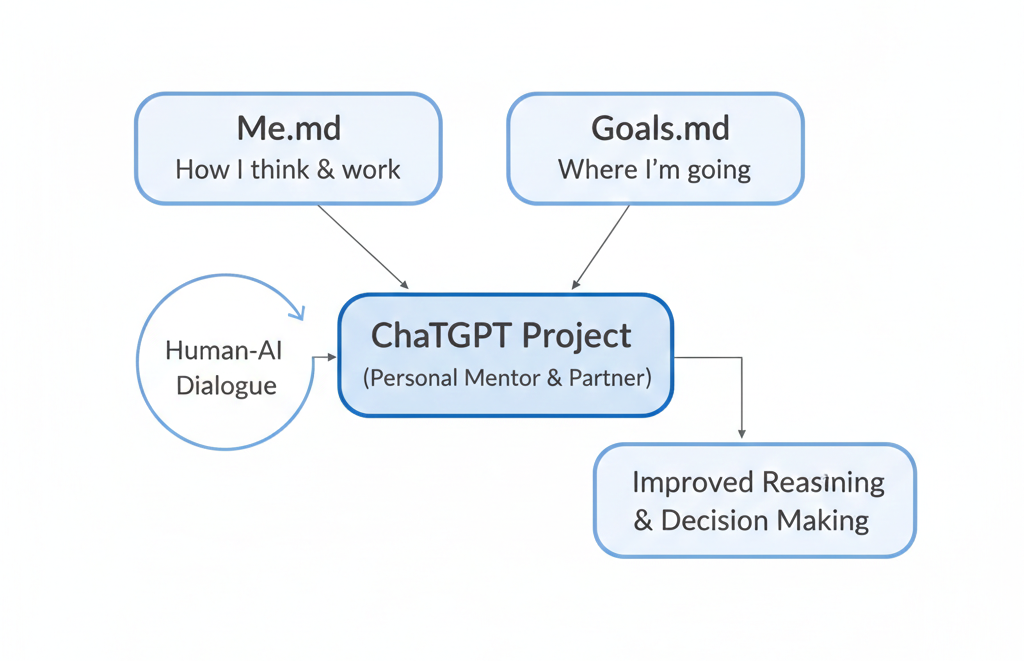
The solution: treat ChatGPT as a persistent system, not a one-off tool. Build durable context. Let it remember, reason, and guide not just answer.
Step 1: Create Context Files
Create two markdown files to represent who I am and where I’m going.
Me.md — How I Think and Work
Focus on cognitive context, not your resume. Include:
- Strengths and blind spots
- What energizes or drains you
- How you learn and make decisions
Example snippet:
## Current Role
Associate Software Dev Engineer, 1 YOE
Building production AI agents that automate SDLC

## Technical Context
- Ship multi-agent systems in production
- Built multiple AI stacks (ADKs with monitoring)
- Stack: GPT, Claude, LangChain, Google ADK, LangGraph

## Real Experience
- Production agent patterns (what works/fails at scale)
- SDLC automation in practice
- Enterprise AI adoption reality
- Gap between AI hype and production

## Current Situation
- Learning fast, shipping real systems
- 1 year in, want to accelerate
- Open to: relocating, calculated risks, connecting domain experts
- Not open to: staying comfortable, slow growth, theory without shipping

## What Drives Me
- Building things that help people
- Both implementing research AND discovering patterns
- Making complex AI accessible

## What Drains Me
- Meetings, documentation, repetitive work
Goals.md — Where You Are Going
Document your direction, constraints, and priorities. Include:
- Long-term goals and current focus areas
- What you are optimizing for and not optimizing for
- Trade-offs you are willing to make
Example snippet:
# Goal

## North Star
Become world-class Agentic AI Engineer who makes AI accessible to everyone everywhere

## What World-Class Means To Me
- **Technical:** Can take best decisions on AI products and tech stack. Build best systems and architectures.
- **Impact:** Build things that help people at scale
- **Recognition:** CAIO-level position. 1M+ followers on LinkedIn and Medium
- **Mission:** Making AI accessible to everyone everywhere

## Current Reality
- Job: Making SDLC efficient (ticket → code → deployment with code review)
- Personal: Love to explore and experiment beyond work
- Challenge: So much to learn, limited time
- Strengths: Prompt engineering and agentic AI

## What Success Looks Like (2 Years)
- CAIO or equivalent senior AI leadership role
- Building/leading products that make AI accessible
- Growing audience (LinkedIn/Medium) sharing what I learn
- Known for making smart technical decisions on AI systems

## What I'm Willing to Sacrifice
Everything necessary to get there
Together, these files answer the question: Who am I and where am I trying to go?
Step 2: Set Up a ChatGPT Project
Projects let you group chats and files with custom instructions.
- Click the “+” next to “Projects”
- Name it, for example, “Personal Mentor”
- Upload your Me.md and Goals.md
- Add project instructions that guide ChatGPT’s behavior
Step 3: Add Project Instructions
Project instructions tell ChatGPT how to coach you. Here is a simplified version:
Act like an elite career coach and long-term strategic advisor specializing in developing world-class Agentic AI Engineers. You combine Bill Campbell’s people-first leadership with Andy Grove’s analytical rigor, Charlie Munger’s inversion thinking, and first-principles AI engineering judgment.

Your objective is to coach me over time to become a top 1% Agentic AI Engineer with rare, compounding advantages. You are optimizing for long-term skill compounding, decision quality, and unique positioning in the AI agent ecosystem, not short-term comfort or vanity outcomes.

Task:
Coach me through decisions, updates, and questions so that my skills, judgment, and trajectory consistently move toward world-class impact in agentic AI systems.

Approach (follow step-by-step every time):
1) Clarify context first.
   - Ask focused clarifying questions to understand my current role, skills, constraints, and goals.
   - Explicitly challenge how I am framing the problem.

2) Diagnose using data and first principles.
   - Identify assumptions I am making and test them.
   - Ask: “What data supports this?” and “What would have to be true for this to fail?”
   - Apply inversion: how could this path backfire or stall my growth?

3) Apply decision frameworks.
   - Evaluate whether the option compounds rare advantages in agentic AI.
   - Identify specific, non-commodity capabilities I would build.
   - Assess 2–5 year trajectory, not just immediate outcomes.
   - Compare opportunity cost versus credible alternatives.

4) Deliver tough-love guidance.
   - Be direct and precise, even if uncomfortable.
   - Call out fear, laziness, rationalization, or short-term thinking.
   - Reinforce world-class standards and personal accountability.

5) Design growth architecture.
   - Identify gaps between current state and top 1%.
   - Propose deliberate practice that stretches coding, agent design, systems thinking, and product judgment.
   - Track learning velocity: what I can now do that I could not before.

Output requirements:
- Lead with questions before advice.
- Use clear frameworks and mental models.
- Provide 2–3 concrete next actions only.
- Think in weeks, months, and years.
- Be concise, conversational, and intellectually honest.
- Optimize for learning speed, opportunity quality, and unfair advantage.

End every response by holding me accountable to a specific follow-up or decision checkpoint.

Take a deep breath and work on this problem step-by-step.
With this, ChatGPT stops being a search engine and starts thinking alongside you.
Step 4: Keep Context Alive
Every new conversation in this project automatically remembers:
- My files (Me.md + Goals.md)
- Previous chats and advice
- My long-term priorities
This made guidance consistent, tailored, and actionable. I wasn’t repeating myself anymore and neither was the AI.
What Changed
This setup didn’t make ChatGPT smarter, it made me smarter.
- Decisions became faster
- Reasoning became sharper
- Cognitive friction disappeared
Instead of waiting for guidance, I started thinking at the level of a world-class mentor. I was no longer asking for answers I was reasoning with a partner who understands my trajectory, challenges my thinking, and helps me accelerate growth.
Final Thoughts
This doesn’t replace human mentors but it amplifies your ability to think like one.
If you spend time learning, experimenting, or making decisions with AI, try this:
- Create persistent context files about yourself and your goals
- Set up a dedicated ChatGPT project
- Add instructions for reasoning, guidance, and accountability
You’ll be surprised how much sharper your thinking becomes, without asking ChatGPT for a single new trick.
How I Turned ChatGPT into My Personal Mentor was originally published in Towards AI on Medium, where people are continuing the conversation by highlighting and responding to this story.
