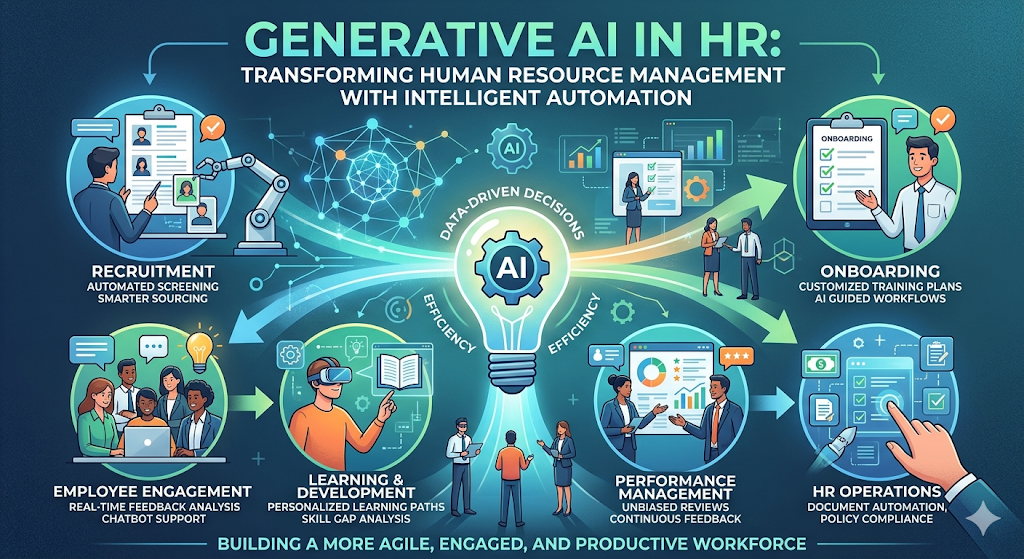
Generative AI in HR: Transforming Human Resource Management with Intelligent Automation

The role of human resource management is undergoing a significant transformation as organizations adapt to digital disruption, changing workforce expectations and increasing competition for talent. HR leaders today are expected to manage complex workforce challenges while also enabling organizational growth, innovation and employee engagement.
To meet these evolving demands, many organizations are turning to AI in HR to modernize how HR departments operate and make decisions. In particular, generative AI is emerging as a powerful capability within AI in human resources, enabling organizations to automate content creation, generate workforce insights and enhance employee interactions.
By embedding artificial intelligence in HR, organizations can streamline HR operations, strengthen talent management, and improve workforce management across the employee lifecycle. As a result, HR professionals and HR teams can shift their focus from administrative tasks toward more strategic initiatives that drive long-term workforce success.
This article explores how generative AI in HR works, where it is being applied across HR functions, and how organizations can unlock the benefits of AI in HR through responsible and strategic adoption.
The growing role of AI in HR transformation
The adoption of AI in HR management is accelerating as organizations recognize its potential to improve workforce productivity and decision-making. In many enterprises, AI for HR is becoming a core component of digital transformation initiatives.
AI’s capabilities in HR enables HR teams to create and manage large volumes of information more efficiently. HR departments regularly handle documents, communications, policies, training materials and employee feedback. AI tools can assist in creating, summarizing and organizing this information at scale.
For example, generative AI can automatically generate job postings based on role requirements, summarize employee performance feedback for managers, or draft personalized learning recommendations for employees. These capabilities enable HR professionals to deliver faster, more consistent HR services while maintaining quality and accuracy.
As organizations expand AI use cases in HR, AI is becoming an essential tool for improving HR operations, strengthening talent management, and supporting more effective workforce management.
Key use cases of AI in HR
Recruitment and talent acquisition
One of the most widely adopted AI use cases in HR is recruitment. AI in HR helps HR teams screen large volumes of resumes, identify candidates whose skills match job requirements and prioritize qualified applicants for further evaluation.
AI tools can also support candidate matching by comparing job requirements with applicant profiles across multiple talent sources. This enables HR professionals to shortlist suitable candidates faster and improve hiring efficiency.
In addition, AI for HR can automate interview scheduling, track candidate interactions and provide insights that help HR departments improve recruitment outcomes and strengthen talent management strategies.
Employee onboarding and HR documentation
AI can streamline onboarding by automating documentation and guiding employees through onboarding steps. AI in human resources can track onboarding progress, ensure required documentation is completed and assist employees with common onboarding queries.
AI tools can also organize HR documents, policies and internal resources so employees can quickly access the information they need. This improves the employee experience while reducing the administrative workload for HR teams and enhancing the efficiency of HR operations.
Learning and development
AI is helping organizations enhance learning and development programs within human resource management. AI systems can identify employee skill gaps, recommend relevant training programs and support personalized development plans.
By evaluating workforce capabilities and future skill requirements, AI for human resources helps organizations strengthen workforce capabilities and support long-term workforce management and talent management goals.
For HR leaders, these insights help ensure learning initiatives align with broader HR strategy and workforce transformation priorities.
Performance management
AI can support performance management by organizing employee performance data and providing insights that help managers evaluate employee contributions. AI in HR management can highlight performance trends, identify improvement areas and assist managers in preparing performance reviews.
AI tools can also track employee progress against performance goals, helping HR professionals and managers maintain greater transparency and consistency across HR functions.
Employee engagement and experience
Another important AI use case in HR is improving employee engagement and workplace experience. AI tools can review employee feedback, identify engagement trends and highlight areas that require attention.
These insights help HR leaders and HR departments understand workforce concerns, improve workplace policies and strengthen employee satisfaction.
By enabling more responsive decision-making, AI in HR helps HR teams improve communication and enhance the employee experience across the organization.
Workforce planning and workforce management
AI plays an important role in improving workforce management by helping organizations forecast workforce needs and identify skill shortages. AI systems can review workforce data, hiring trends and business priorities to support workforce planning decisions.
These insights help HR leaders make better staffing decisions and ensure organizations have the capabilities required to support business growth.
HR operations and service automation
AI can also improve the efficiency of HR operations by automating routine administrative tasks. AI-powered HR assistants can respond to employee queries, manage HR service requests and guide employees through common HR processes.
This allows HR professionals to spend less time on repetitive administrative activities and focus more on strategic responsibilities within human resource management.
Benefits of generative AI in HR
The adoption of AI in HR is helping organizations modernize human resource management by improving efficiency, enabling better workforce insights and enhancing employee experience. By integrating artificial intelligence in HR, organizations can strengthen key HR functions and support more effective workforce management.
- Improved efficiency in HR operations: AI automates repetitive administrative tasks such as resume screening, HR service requests and workforce data processing. This allows HR professionals and HR teams to focus on more strategic initiatives rather than routine HR operations.
- Better workforce insights and decision-making: By analyzing workforce data and performance information, AI in human resources helps HR leaders identify workforce trends, skill gaps and development needs. These insights support stronger talent management and more effective workforce planning.
- Enhanced employee experience: AI-powered HR tools provide faster responses to employee queries and enable more personalized support across HR departments. This improves employee satisfaction and strengthens engagement across the workforce.
- Better talent management strategies: AI for HR helps organizations identify high-performing employees, recommend development opportunities and support internal mobility. These capabilities help organizations strengthen long-term talent management initiatives.
- More effective workforce management: AI enables organizations to forecast workforce needs, monitor workforce trends and align staffing decisions with business priorities. This helps HR leaders implement more proactive HR strategy and improve overall workforce management.
Challenges of implementing generative AI in HR
While the potential of artificial intelligence in HR is significant, organizations must also address important challenges when adopting generative AI.
Data quality and governance are critical factors. AI systems rely on accurate workforce data to generate reliable insights and recommendations. Organizations must ensure that HR data remains secure, consistent and free from bias.
Another important consideration is responsible AI governance. HR departments must establish policies that ensure AI systems are used ethically and transparently in workforce decision-making.
Training and change management are also essential. HR teams and HR professionals need to understand how to use AI tools effectively and how to interpret AI-generated insights in the context of organizational decision-making.
By proactively addressing these challenges, organizations can maximize the value of AI in HR management while maintaining trust and accountability.
The future of generative AI in human resources
As generative AI technologies continue to evolve, their impact on AI in human resources will expand significantly. Future AI systems will likely support more advanced workforce analytics, predictive talent insights and personalized employee experiences.
Organizations will increasingly integrate AI with workforce management platforms, HR analytics tools and enterprise systems to create more intelligent and responsive HR ecosystems.
For HR leaders, this evolution presents an opportunity to redefine HR’s role within the enterprise. By combining human expertise with AI for HR, organizations can build more agile, data-driven and employee-centric HR strategies.
Conclusion
The adoption of generative AI in HR is reshaping how organizations approach human resource management. By embedding artificial intelligence in HR, organizations can automate routine tasks, generate valuable workforce insights and improve the effectiveness of HR operations.
From recruitment and learning to employee engagement and performance management, AI in HR is enabling HR departments to operate more efficiently while delivering better experiences for employees.
As organizations expand AI use cases in HR, the integration of generative AI and AI agents will play a critical role in modernizing HR functions and supporting more effective workforce management.
Organizations that adopt AI in human resources strategically will be better positioned to empower HR professionals, strengthen talent management and build a more adaptive and future-ready workforce.
Generative AI in HR: Transforming Human Resource Management with Intelligent Automation was originally published in Towards AI on Medium, where people are continuing the conversation by highlighting and responding to this story.
