Exahash, Zettahash, Yottahash

When I first heard of cryptographic hash functions, they were called “one-way functions” and seemed like a mild curiosity. I had no idea that one day the world would compute a mind-boggling number of hashes every second.
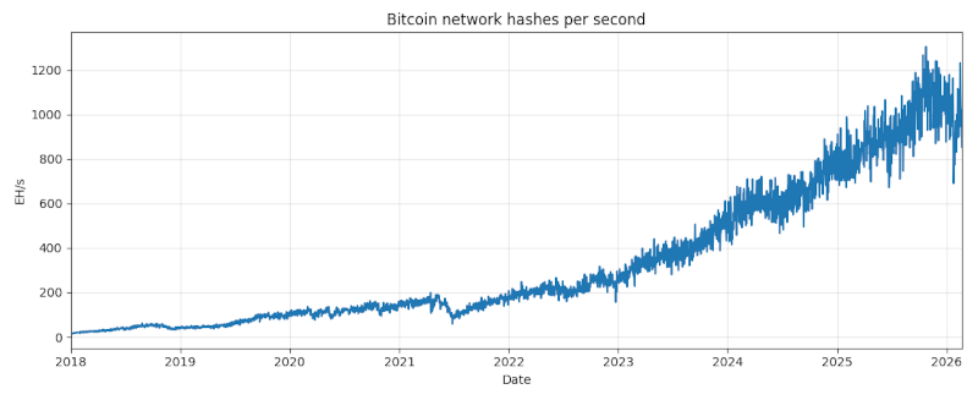
Because Bitcoin mining requires computing hash functions to solve proof-of-work problems, the world currently computes around 1,000,000,000,000,000,000,000 hashes, one zettahash, per second. Other cryptocurrencies uses hash functions for proof-of-work as well, but they contribute a negligible amount of hashes per second compared to Bitcoin.
The hashrate varies over time because the difficulty of Bitcoin mining is continually adjusted to keep new blocks being produced at about one every ten minutes. As hardware has gotten faster, the difficulty level of mining has gotten higher. When the price of Bitcoin drops and mining becomes less profitable, the difficulty adjusts downward. There are other factors too, and hashrate is variable.
The prefix giga- (109) wasn’t widely known until computer memory and storage entered the gigabyte range. Then the prefix prefix tera- (1012) became familiar when disk drives entered terabyte territory. The prefixes for larger units such as peta- (1015) and exa- (1018) are still not widely known. The prefixes zeta- (1021) and yotta- (1024) were adopted in 1991 and ronna- (1027) and quetta (1030) were adopted in 2022.
When the Bitcoin hashrate is relatively low, it’s in the range of hundreds of exahashes per second. At the time of writing the hashrate is 1.136 ZH/s, 1.136 × 10²¹ hashes per second. This puts the hashrate per day in the tens of yottahashes and the number of hashes per year in tens of ronnahashes.
Related posts
- New SI prefixes and their etymology
- Speculation for even more SI prefixes
- Names for extremely large numbers
- How blocks are chained in a blockchain
The post Exahash, Zettahash, Yottahash first appeared on John D. Cook.
