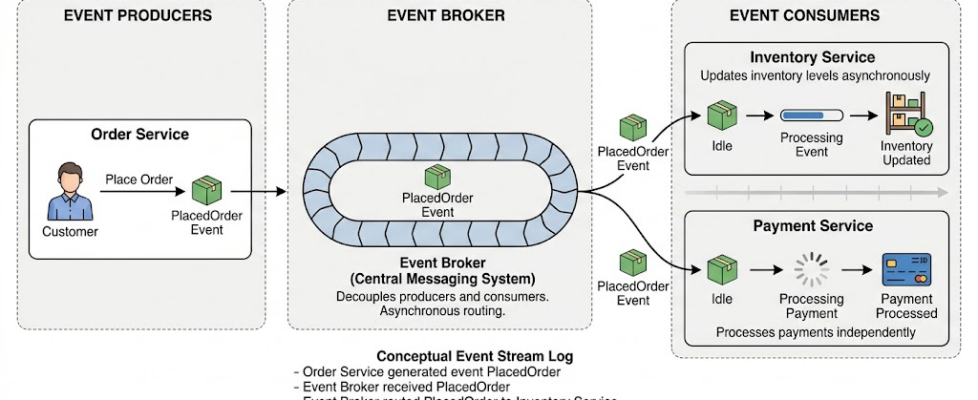
Event-Driven Architecture: An Engineer’s Practical Guide

Modern distributed systems are under constant pressure to scale, react in real time, and survive partial failures. Traditional synchronous architectures often struggle under these demands.
Event-Driven Architecture (EDA) offers a different model: systems communicate through events, allowing services to react independently and asynchronously. That shift unlocks scalability and resilience — but it also introduces new complexity.
This guide breaks EDA down in practical terms: how it works, why teams adopt it, where it shines, and where it can go wrong.
Mental Model
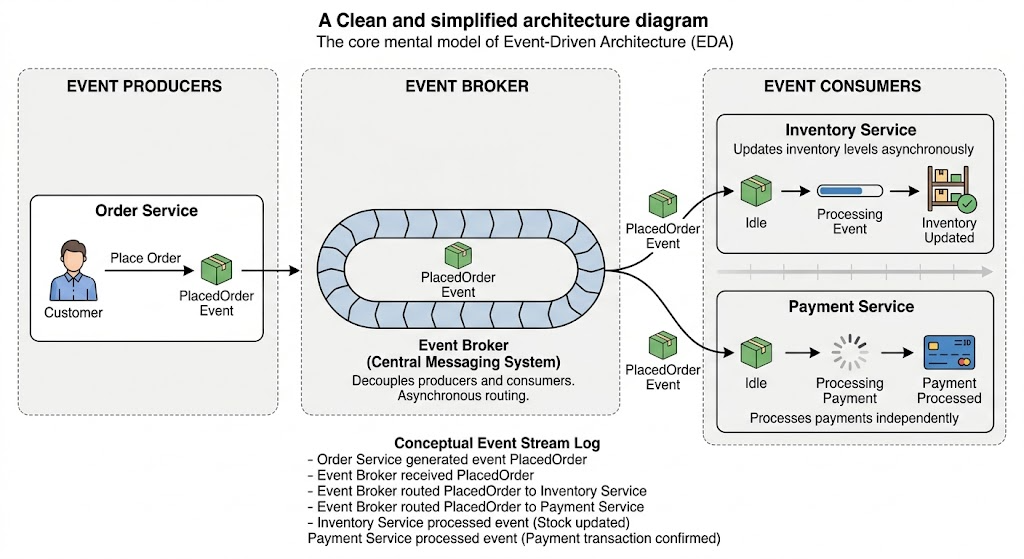
To build intuition for Event-Driven Architecture (EDA), start by picturing your system as a network of independent components that communicate not by waiting for direct responses but by emitting and responding to asynchronous events. Unlike traditional synchronous request-response patterns, where caller and callee tightly bind their execution flows, EDA components are decoupled: producers announce state changes or occurrences as events, and consumers react to those events whenever they receive them.
Consider a practical example: an e-commerce platform processing orders. When a customer places an order, the Order Service doesn’t call Inventory, Shipping, or Billing synchronously. Instead, it emits an OrderPlaced event to an event bus. Inventory Service listens for that event and decrements stock asynchronously; Shipping Service schedules delivery; Billing Service initiates payment. None of these services need to know about each other’s presence or state — they only respond to relevant events.
This mental model emphasizes asynchronous decoupling:
- Event producers emit events that describe what happened (e.g., an order was created).
- Event consumers react to those events independently and possibly in parallel.
- An event bus or message broker (Kafka, RabbitMQ, AWS EventBridge) relays events across components, buffering them to absorb traffic spikes and enabling scaling.
Diagram: Event Producers, Event Bus, Event Consumers
[Order Service]
     |
     | emits "OrderPlaced"
     v
[Event Bus / Message Broker]
    /       |
   v        v           v
[Inventory] [Shipping] [Billing]
(each consumes "OrderPlaced")
Why this matters to developers
This architecture is a powerful way to reduce coupling, improve scalability, and enable teams to evolve services independently. For example, if you need to onboard a new partner service that analyzes orders for fraud detection, it can simply subscribe to the OrderPlaced event — no changes required to existing services. This supports flexibility in large, complex ecosystems.
However, the tradeoff is complexity in reasoning and debugging. Tracing the flow of a single request is no longer linear; events can arrive out of order or be retried, making failures harder to diagnose. Developers must invest in observability tools with distributed tracing and correlating event IDs to reconstruct user journeys across service boundaries.
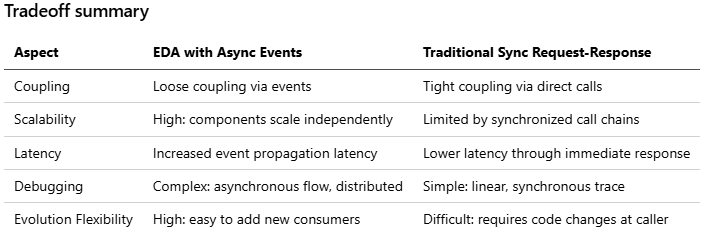
In essence, EDA shifts architectural complexity from tightly choreographed interactions to managing asynchronous flows, event ordering, and eventual consistency. Understanding this mental model prepares you to design scalable, loosely coupled systems but also to overcome challenges in observability and operational discipline.
Why This Exists
In modern backend systems, the perennial challenge is architecting software that can scale effortlessly, remain flexible for rapid evolution, and isolate faults without cascading failures. Event-Driven Architecture (EDA) emerges as a response to these needs, especially when traditional, tightly coupled, synchronous systems start to buckle under complexity and load.
The Problem with Tightly Coupled, Synchronous Systems
Imagine a simple e-commerce platform comprising two critical subsystems:
- Order Service: Handles incoming purchase requests and order validation.
- Inventory Service: Manages stock levels and ensures availability.
In a typical monolithic or tightly coupled microservice setup, the Order Service synchronously calls the Inventory Service to check and update stock before confirming an order. This blocking call pattern leads to several problems:
- Cascading Failures: If the Inventory Service is slow or down, the Order Service is directly impacted, causing order requests to back up and potentially fail.
- Limited Scalability: Both services must scale in lockstep or risk bottlenecks; scaling out Order Service alone without proportional Inventory scaling leads to request drops.
- Tight Coupling: Changes in one service’s interface or behavior risk breaking others due to direct dependencies.
How Event-Driven Architecture Addresses These Challenges
EDA decouples services through asynchronous event flows. Instead of the Order Service waiting synchronously, it publishes an OrderCreated event. The Inventory Service independently subscribes to this event and adjusts stock accordingly. The two services only share event contracts, not direct calls.
This approach yields:
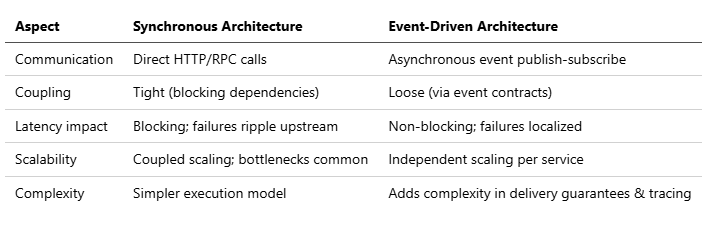
- Loose Coupling: Services evolve independently without breaking synchronous dependencies.
- Improved Scalability: Each service can scale independently based on event load without blocking others.
- Fault Isolation: Inventory issues don’t block order intake; instead, downstream compensations or retries handle inconsistencies.
Synchronous vs Event-Driven Coupling
A Meaningful Tradeoff: Complexity in Failure Handling
While EDA boosts scalability and system flexibility, it introduces complexity in operation and failure management:
- Delivery Guarantees: Ensuring exactly-once or at-least-once event delivery requires sophisticated messaging infrastructure and idempotent consumers.
- Event Loss or Delay: Network partitions or broker outages risk delayed or lost events, possibly causing data inconsistency.
- Debugging & Observability: Tracing an event’s lifecycle across multiple asynchronous services demands enhanced tooling beyond traditional request logging.
How Event-Driven Architecture Works
To understand Event-Driven Architecture (EDA) from a developer’s perspective, start with the core premise: decoupling software components, so they communicate via events — messages signaling that “something happened.” This asynchronous, loosely coupled interaction enables greater scalability and flexibility. But implementing EDA well requires a grasp of its key components, event flow, and tradeoffs.
Core Components and Event Flow
At its essence, EDA involves three roles:
- Event Producers: These are services or modules that detect state changes or meaningful actions and publish events representing those changes. For example, an Order Service publishes an OrderCreated event after receiving an order.
- Event Bus or Broker: This middleware transports events from producers to consumers asynchronously. Popular brokers include Apache Kafka, RabbitMQ, or cloud services like AWS SNS/SQS. The bus provides buffering, durability, and delivery guarantees.
- Event Consumers: Independent services that subscribe to relevant event topics and react accordingly. For example, a Shipping Service listens for OrderCreated and starts processing the shipment.
This architecture replaces direct synchronous calls with an event flow:
Order Service (Producer) --> [Event Bus] --> Shipping Service (Consumer)
Events travel asynchronously, enabling each component to scale or operate independently.
Practical Example: Order Processing Flow
Consider a simplified online store order processing:
- After order placement, the Order Service publishes:
event = {
    "type": "OrderCreated",
    "order_id": "abc123",
    "timestamp": "2026-04-08T10:00:00Z",
    "details": {...}
}
event_bus.publish("orders", event)
- The Shipping Service listens to the “orders” topic:
def on_event(event):
    if event["type"] == "OrderCreated":
        schedule_shipment(event["order_id"])
event_bus.subscribe("orders", on_event)
Here, event_bus abstracts the broker client that handles delivery. Because the bus holds events until consumers receive them, the Order Service can return success immediately without waiting for shipping confirmation, improving responsiveness.
Delivery Semantics and Tradeoffs
A major engineering tension in EDA is event delivery guarantees:

At-least-once is common in Kafka-based systems — events may be redelivered after consumer failure, so consumers must be idempotent or detect duplicates. Exactly-once requires complex coordination or transactional processing, increasing system complexity and often latency.
Choosing delivery semantics requires balancing operational simplicity and correctness. For many use cases, at-least-once with idempotent consumers suffices and keeps the system scalable and decoupled.
Failure Modes and Retry Handling
Failures in event-driven systems often manifest as:
- Event loss: When the broker or producer fails before event persistence.
- Duplicate delivery: Caused by retries on consumer acknowledgment failure.
- Consumer lag: When consumers fall behind, leading to stale processing.
Mitigating these involves:
- Using durable logs and acknowledgments in brokers.
- Implementing consumer idempotency and deduplication strategies.
- Monitoring consumer lag and provisioning more consumer instances.
For instance, in the order example, if the Shipping Service crashes after receiving an OrderCreated event but before confirming shipment, the event bus may redeliver the event. The Shipping Service must detect duplicate events and avoid double-shipping.
Diagram: Event Flow in Order Processing
+----------------+          +-------------+          +-----------------+
| Order Service  | --event--> | Event Bus  |  --event--> | Shipping Service |
| (Producer)     |          | (Broker)   |          | (Consumer)      |
+----------------+          +-------------+          +-----------------+
1. Order placed
2. OrderCreated event published asynchronously
3. Shipping Service consumes event and schedules shipment
Architecture Alternatives Overview
- Monolithic Architecture: A single deployable unit where order placement, inventory management, payment, and shipping logic coexist in-process. Communication is function calls or internal method invocations.
- Synchronous REST Microservices: Loosely coupled services (e.g., Order, Inventory, Payment) communicate via HTTP REST APIs synchronously. An order service calls the Inventory and Payment services in request-response flows.
- Event-Driven Architecture: Services emit and consume domain events asynchronously via a message broker. For example, placing an order emits an OrderPlaced event, triggering Inventory reservation and Payment processing independently.
Communication Flows
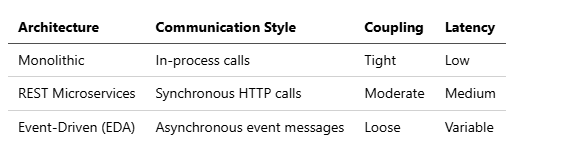
In conclusion, event-driven architecture excels in high-scale, complex domains that require decoupling and resilience, but it demands investment in tooling and developer discipline. Synchronous REST microservices offer a middle ground, and monoliths remain relevant for simpler or early-stage applications. Evaluating failure modes, latency, operational overhead, and team expertise is crucial to choosing the right pattern for your system.
Common Domains Leveraging EDA
- Microservices integration: Services communicate through events rather than synchronous APIs, promoting decoupling. Events trigger workflows without direct dependencies, aiding independent deployment and scaling.
- IoT data pipelines: Millions of devices emit sensor data asynchronously. EDA enables streaming ingestion, processing, and action with near-real-time responsiveness.
- Real-time analytics: Events from logs, clicks, or transactions feed dashboards and alerting systems, providing insights without causing backend strain.
Tools and Ecosystem
Selecting the right tools for an event-driven architecture (EDA) is crucial because they fundamentally shape scalability, delivery semantics, operational complexity, and failure handling. The ecosystem today is rich but far from one-size-fits-all. Understanding tradeoffs through a concrete example brings clarity.
Core tool categories
At the foundation, an EDA typically needs:
- Event brokers/event buses: Durable distributed logs or message queues that route events between producers and consumers.
- Stream processors and connectors: Components that transform, filter, or enrich event streams.
- Observability/logging: Tools to trace event flows and detect failures in asynchronous environments.
- Schema registries: Systems to enforce event contracts for backward/forward compatibility.

Engineering tradeoff example: Apache Kafka in e-commerce
Consider a large e-commerce platform leveraging Apache Kafka as its event bus backbone:
- Why Kafka? Its horizontal scalability and distributed log architecture elegantly handle huge volumes of order, inventory, and payment events across microservices.
- Integration points: Microservices produce events OrderPlaced to Kafka topics. Downstream consumers, such as the inventory service or shipment scheduler, asynchronously subscribe to relevant topics without direct coupling.
- Tradeoff: Kafka’s operational complexity is non-trivial. Setting up replication, handling partitions, managing schema evolution (via Confluent Schema Registry or Apicurio), and ensuring exactly-once semantics through transactional APIs require skilled infrastructure teams.
- Failure resilience: Kafka’s replication mechanism prevents data loss during broker failures. Consumer offsets track processing, enabling safe retries. Still, failures in schema compatibility or consumer logic can cause pipeline stalls, necessitating robust monitoring (e.g., Kafka Manager, Prometheus).
Tool ecosystem maturity and community
- Kafka benefits from a large ecosystem for connectors, stream processing frameworks (Kafka Streams, ksqlDB), and extensive community support.
- RabbitMQ offers mature client libraries in many languages and compliance with the AMQP standard.
- Cloud-native tools like AWS SNS/SQS reduce operational burden but lock you into a cloud provider.
- Emerging standards like CloudEvents and AsyncAPI improve interoperability, but adoption is uneven across tools.
Architecting with tooling in mind
A typical EDA platform architecture looks like this:
+----------------+           +------------+            +------------------+
| Microservices  | ---push-> | Event Bus  | --consume->| Downstream apps  |
| (Producers)    |           | (Kafka)    |            | (Consumers)      |
+----------------+           +------------+            +------------------+
          |                         |                           |
          |                     Schema Registry          Stream Processing
          |                                                    & Enrichment
          +---------------------------------------------------------------> Observability (Tracing/Logging)
Key takeaway
Choosing tooling is a balancing act between feature richness and operational overhead. Kafka excels in scaling and durability but demands operational investment, whereas managed services simplify ops at the cost of cloud lock-in. RabbitMQ or NATS offer simpler setups with lower scale ceilings.
For engineers, practical evaluation of expected throughput, failure recovery needs, team expertise, and latency targets must guide tool selection. Ignoring operational realities or assuming a tool fits all event-driven needs risks brittle, costly systems down the line.
Amazon’s Order and Inventory Management System
Amazon’s sprawling e-commerce platform exemplifies EDA’s power in handling millions of concurrent orders and inventory changes daily. Their backend is designed as a network of microservices communicating asynchronously via event streams — each service emitting events (e.g., order.created, payment.processed, inventory.updated) to signal state changes.
How this works in practice:
- When a customer places an order, the order service emits an order.created event.
- Payment service listens, authorizes payment, and emits a payment.completed or payment.failed event.
- Inventory service adjusts stock by consuming these events asynchronously, triggering inventory.reserved or inventory.depleted events.
This loose coupling allows services to scale independently and recover gracefully from transient failures without blocking the entire workflow.
A meaningful engineering tradeoff: Amazon’s architecture sacrifices strict transactional consistency for scalability and availability. Inventory updates and order confirmations are eventually consistent rather than immediately atomic. This tradeoff simplifies scalability but introduces complexities in handling eventual consistency anomalies, such as overselling items during peak load.
Failure scenario and mitigation: In early deployments, rapid event bursts caused event queues to back up, delaying inventory updates and leading to stock discrepancies. To address this, Amazon introduced backpressure and circuit breaker mechanisms in messaging middleware, along with fine-grained partitioning of event streams to balance load.
Uber’s Trip Life Cycle Event System
Uber orchestrates a complex web of events from trip requests to driver allocation, route updates, and billing, using EDA as the backbone of its real-time system. Here, low-latency event propagation is critical for user experience.
- Each update (trip.requested, driver.accepted, trip.started, trip.completed) flows asynchronously through Kafka topics.
- Microservices like matching, pricing, and notifications subscribe to relevant events and react independently.
Scalability implications: Uber scales event brokers horizontally by sharding topics and optimizing partition count, allowing millions of events per second with millisecond latencies. The decoupled architecture also supports rapid feature rollout without impacting core trip processing.
Operational challenge: When message ordering is vital — for example, tracking trip status — Uber faced issues due to eventual consistency and unordered event deliveries under high concurrency. Their solution involves introducing event versioning and sequence numbers, alongside idempotent consumer logic.
Netflix’s Video Streaming Platform
Netflix leverages an event-driven model primarily for user activity tracking and system monitoring. Every state change — such as video.started or recommendation.clicked — is published as an event. These triggers feed analytics pipelines, enabling real-time personalization and operational insights.
Why EDA? Netflix benefits from decoupling playback concerns from analytics, letting each scale independently. For example, spikes in viewing activity don’t directly impact event processors handling recommendation updates.
Failure mode: The sheer event volume risked overwhelming downstream consumers. Netflix implemented dynamic event throttling and consumer lag detection to prevent cascading failures.
Complexity in Debugging and Failure Recovery
Traditional request-response services use linear call traces, simplifying debugging. EDA replaces this with asynchronous messaging, leading to:
- Event Time Decoupling: Events might be delayed or reordered; tracing their lifecycle requires timestamps, correlation IDs, and event stores.
- Partial Failures: One service’s failure can silently delay downstream updates, causing an inconsistent state unless compensating transactions or retries are implemented.
- Duplicate Events: Brokers or network retries can produce duplicate events, forcing idempotent consumer logic, which complicates component design.
For instance, if the payment service crashes after inventory reservation but before acknowledging payment completion, the order status becomes inconsistent. Detecting and correcting such states often requires manual intervention or orchestrated compensation flows.
Handling Failure Modes — A Real-World Headache
A common failure mode in EDA is duplicate event processing due to broker retries or consumer crashes. Without careful design, duplicates can corrupt state or lead to financial loss (e.g., double charges).
Mitigation strategies include:
- Idempotent Consumers: Design handlers to detect and safely ignore repeated events.
- Event Versioning and Deduplication Tables: Persist event IDs to track consumed events.
- Alerts on Unusual Event Patterns: Use monitoring to detect spikes in retry volumes signaling systemic issues.
For example, Spotify experienced issues early in their event pipelines where duplicated music playback events led to billing inconsistencies, forcing refactoring towards idempotency and enhanced monitoring (source: https://ably.com/topic/event-driven-architecture-use-cases).
When Not to Use EDA
- Systems requiring strict transactional consistency with low-latency synchronous responses may suffer from increased complexity and harder debugging in EDA.
- Small teams or early-stage projects may lack resources for the operational overhead and should consider simpler architectures.
- If the event flow’s business logic is trivial and tightly coupled, simpler request/response or shared database patterns are preferable.
EDA’s operational costs — monitoring event flows, broker management, and guaranteeing reliable delivery — are critical factors affecting developer productivity and system reliability. The tradeoff between the architecture’s scalability and flexibility against the complexity of debugging asynchronous flows and handling failure modes is a decisive factor in choosing EDA. Real-world e-commerce order systems illustrate both the potential and pitfalls, emphasizing that EDA demands mature tooling, disciplined engineering, and vigilant operations to reap its benefits.
Hands-on Tutorial
To truly grasp Event-Driven Architecture (EDA), nothing beats building a minimal but practical example — so let’s walk through one using a simplified e-commerce order processing scenario. We’ll implement an event producer that publishes order events and a consumer that processes them asynchronously, connected via RabbitMQ, a lightweight and widely used message broker. This tutorial balances clarity and real-world complexity, emphasizing key engineering tradeoffs around delivery guarantees and ordering.
Why RabbitMQ and This Example?
RabbitMQ offers flexible routing and delivery options with relatively low operational complexity — ideal for developers experimenting with EDA concepts. Our example focuses on decoupling order submission from downstream processing, a common pattern that helps scale systems and improve fault tolerance in real services like Amazon or Shopify.
Step 1: Setup a RabbitMQ Broker
Start a RabbitMQ instance locally or on Docker:
docker run -d --hostname my-rabbit --name some-rabbit -p 5672:5672 rabbitmq:3
This broker acts as the event bus, decoupling producers and consumers.
Step 2: Implement the Producer (Order Service)
The producer simulates an order submission service that publishes a JSON event describing an order. Using Python’s pika client:
import pika
import json
connection = pika.BlockingConnection(pika.ConnectionParameters('localhost'))
channel = connection.channel()
channel.queue_declare(queue='order_events')
def publish_order(order_id, customer, amount):
    event = {
        "order_id": order_id,
        "customer": customer,
        "amount": amount,
        "status": "created"
    }
    channel.basic_publish(
        exchange='',
        routing_key='order_events',
        body=json.dumps(event)
    )
    print(f"Published event for order {order_id}")
publish_order("1001", "Alice", 299.99)
connection.close()
Concept: The producer emits the OrderCreated event asynchronously without caring when or how it’s processed next, fostering loose coupling.
Step 3: Implement the Consumer (Order Processor)
The consumer listens to the order_events queue, processes orders asynchronously, e.g., by reserving inventory or triggering payments:
def callback(ch, method, properties, body):
    event = json.loads(body)
    print(f"Processing order {event['order_id']} for {event['customer']}")
    # Business logic here
    ch.basic_ack(delivery_tag=method.delivery_tag)
channel.basic_consume(queue='order_events', on_message_callback=callback)
print("Waiting for order events...")
channel.start_consuming()
Concept: The consumer reacts to events without the producer’s knowledge, enabling independent scaling and failure isolation.
Core Engineering Tradeoff: Delivery Guarantees vs. Complexity
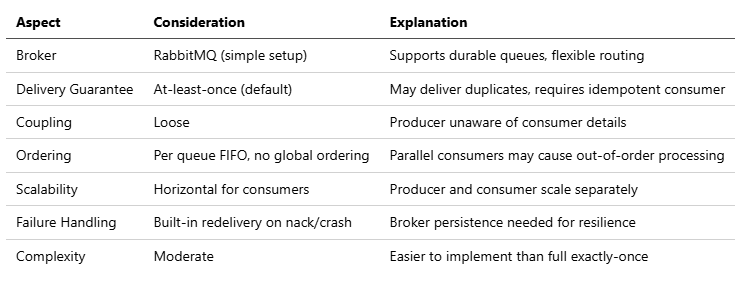
RabbitMQ’s default setup provides at-least-once delivery, meaning consumers may see duplicate events if acknowledgments fail. Handling exactly-once processing requires idempotent consumer code or complex distributed transaction protocols, increasing implementation complexity significantly.
In real-world e-commerce, duplicate order processing can cause inventory issues or billing errors, so teams must balance:
- Simplicity and speed: At-least-once delivery with idempotent processing or compensation.
- Stronger guarantees: Using distributed tracing and transactional outbox patterns but at greater development and operational cost.
Summary Table: RabbitMQ in This EDA Tutorial
Event Schema Evolution Mistakes
One frequent pitfall is poor management of event schemas as the system evolves. Unlike tightly coupled APIs, event consumers often rely on immutable event contracts. Changing event formats without backward compatibility breaks consumers unexpectedly.
Example: An e-commerce inventory system emits InventoryReserved events with fields like productId and quantity. If a developer adds or renames a field without maintaining compatibility, legacy services rejecting or misinterpreting events can cause wrong stock levels.
Ignoring Event Ordering
Events naturally flow asynchronously, but many business processes require ordering guarantees. Failing to enforce event sequencing leads to inconsistent states or race conditions.
Example Failure Scenario: Our e-commerce inventory service processes concurrent InventoryDecreased and InventoryReplenished events without ordering constraints. Imagine a delayed InventoryReplenished event arriving after a subsequent InventoryDecreased event is processed, artificially shrinking inventory counts and causing overselling.
When NOT to Use It
Event-Driven Architecture (EDA) promises decoupling, resilience, and scalability, but it comes with overhead that isn’t always justified. Understanding when not to use EDA is as critical as knowing when it shines — especially in practical, developer-facing terms. The core tension lies in balancing system complexity against asynchronous benefits. If your system doesn’t truly demand asynchronous, loosely coupled communication, EDA may add operational burden and debugging headaches without real payoff.
Practical Decision Points Against EDA
Ask yourself:
- Does the system require horizontal scaling or handle unpredictable spikes?
- Are decoupled, event-driven interactions solving real problems (e.g., audit, integration, or asynchronous processing)?
- Can latency and traceability tradeoffs be tolerated?
If the answer to these is mostly no, stick to synchronous or modular monolith designs to keep your architecture lean and maintainable.
In summary, while EDA is powerful, it is not a silver bullet. For small-scale, transactional systems — such as internal tools or low-traffic services — it’s added asynchronous complexity, operational overhead, and subtle failure modes often degrade rather than improve system quality. Prioritizing simplicity and direct calls can save engineering time, reduce bugs, and accelerate feature delivery.
Decision Framework
Choosing Event-Driven Architecture (EDA) is more than a technical call; it’s a strategic balance between business goals, system requirements, and engineering tradeoffs. The core question: when does the value of loose coupling, asynchronous communication, and scalability justify the added architectural complexity and operational overhead?
Start with Business Needs and Constraints
- Scalability: Are you expecting unpredictable or high throughput (e.g., thousands+ transactions per second)? Event-driven systems excel here by decoupling producers and consumers, enabling independent scaling.
- Decoupling Needs: Do teams own different domains that benefit from independent deployment? EDA allows services to evolve without tightly coupled APIs.
- Latency Tolerance: Is your application’s end-user experience okay with eventual consistency, or does it demand strict synchronous guarantees?
- Failure Tolerance: Can the system tolerate partial failures or delayed processing without impacting user experience?
Alternatives When EDA Isn’t a Fit
If latency sensitivity or strict linear workflows dominate, tightly coupled synchronous patterns (monolith or RPC-based microservices) offer simpler debugging and transactional guarantees. Likewise, if operational bandwidth is limited, starting with simpler architectures and evolving toward EDA as needs grow often makes practical sense.
Event‑Driven Architecture shines when systems must react, scale, and evolve independently under real‑world constraints. Used thoughtfully, it enables systems that are not only scalable but survivable. Used indiscriminately, it becomes an expensive abstraction tax.
As an engineer, your job is not to adopt trends — but to choose the simplest architecture that can safely grow with your system. EDA earns its place when growth, scale, and decoupling stop being theoretical concerns and start showing up in production.
When that moment arrives, you’ll know exactly why event‑driven architecture exists — and how to use it responsibly.
To understand how to implement these patterns using the industry-standard distributed event store, read my detailed follow-up: Understanding Kafka Architecture: A Comprehensive Overview.
Event-Driven Architecture: An Engineer’s Practical Guide was originally published in Towards AI on Medium, where people are continuing the conversation by highlighting and responding to this story.
