
Can someone help me with understanding how to solve Constrained Optimisation problem using augmented Lagrangian method?

submitted by /u/ProgressNo2227 [link] [comments]
Like
0
Liked
Liked
submitted by /u/ProgressNo2227 [link] [comments]
We study the problem of learning a drifting concept in the presence of Massart noise. In this framework, an online learner has access to a history of independent samples whose labels are noisy versions of a target concept that may change from round to round. The goal is to output, in each round, a hypothesis with small prediction error. We study the complexity of this learning problem for the fundamental class of margin-separable linear classifiers (halfspaces). On the […]
Reinforcement learning with verifiable rewards (RLVR) is a promising approach for enhancing reasoning and agentic behavior in large language models. However, rollout-intensive policy optimization is often limited by insufficient reward contrast, arising when overly simple or complex prompts generate low-variance feedback and when outcome-only rewards assign the same terminal assessment to every decision in a multi-turn rollout. Past efforts have focused on allocating available rollout resources to promising prompts, yet they only leverage sample informativeness at the prompt […]
We study a dynamic assortment problem on a two-sided service platform with incomplete information and heterogeneous customers in a discrete-time setting. In each period, a customer arrives seeking service, and the platform chooses an assortment of sellers to display. The customer then proposes a transaction to at most one seller in the assortment according to a multinomial logit choice model. After a fixed number of periods, sellers review the proposals they have received and each chooses at most […]

Ravenous, flesh-eating flies have busted through containment barriers and have now reemerged in the US. On Monday and Tuesday, the US Department of Agriculture reported three new cases, bringing the tally to five. One of the cases is in a dog, though it’s unclear where it became infected; the dog lives in New Mexico, had its infection reported in Texas, and may have recently traveled to Mexico, where the flies are also spreading. But the other four US […]
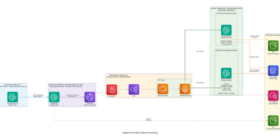
Turning multimodal first notice of loss (FNOL) evidence into tagged, decision-ready intake so adjusters start with context instead of raw artifacts. Manual FNOL processing consumes significant expert time on repetitive tasks because unstructured, multimodal evidence must be interpreted through portals designed for human interaction. Photos captured in the field, walkaround videos, scanned documents, and dictated or recorded notes all enter the system at intake, where decisions directly influence claim cycle time, downstream accuracy, and customer experience. Across insurance […]
In policy gradient methods, the actor typically outputs a Gaussian distribution. However, in practice, almost all environments have actions restricted to a certain range. Almost every implementation of PPO I’ve seen simply clips the action to the allowed range, but uses the unclipped action/distribution when computing log probabilities and entropies. However, this can lead to a failure mode where the distribution means take on high values, making it so the sampled actions are always clipped, killing exploration. The […]

Incident triage is time-sensitive because site reliability engineers (SREs) and support engineers often need to collect evidence, assess user impact, and create follow-up work across separate tools. With Amazon Quick and New Relic, you can coordinate those investigation and handoff steps in a single conversational workflow. This post shows engineering teams how to apply that principle to one of the most time-sensitive workflows in engineering: incident triage. You will build a custom incident triage assistant agent using Amazon […]
Gemini 3.5 Live Translate brings near real-time, natural speech translation to Google AI Studio, Google Translate and Google Meet.

Three tools. Three philosophies. One codebase. Here’s what engineers actually need to know. created by Gemini Claude Code vs. Codex vs. Cursor: The AI Coding Agent Showdown Engineers Are Talking About The terminal, the IDE, and the cloud. Three tools. One codebase. Which one wins? There’s a quiet war happening in developer tooling right now, and unlike most hype cycles, this one actually matters. Engineers aren’t just talking about AI assistants that autocomplete a line here or there — they’re talking about agents: tools […]