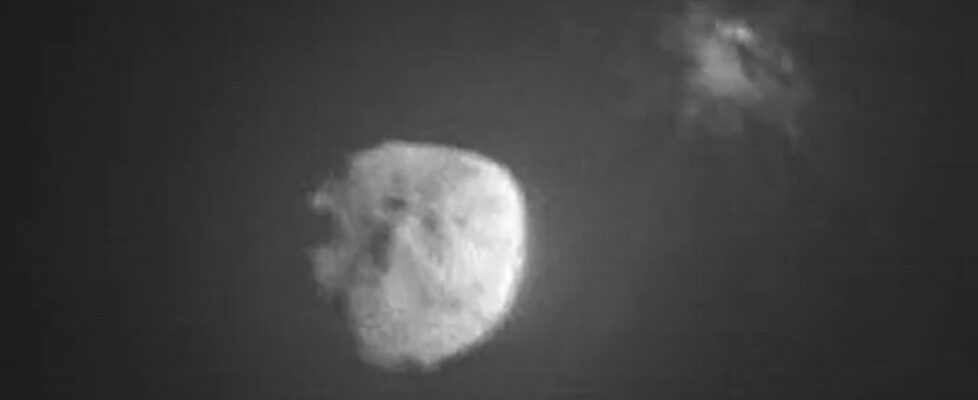
Asteroid defense mission shifted the orbit of more than its target

On September 26, 2022, NASA’s Double Asteroid Redirection Test (DART) spacecraft crashed into a binary asteroid system. By intentionally ramming a probe into the 160-meter-wide moonlet named Dimorphos, the smaller of the two asteroids, humanity demonstrated that the kinetic impact method of planetary defense actually works. The immediate result was that Dimorphos’ orbital period around Didymos, its larger parent body, was slashed by 33 minutes.
Of course, altering a moonlet’s local orbit doesn’t seem like enough to safeguard Earth from civilization-ending impacts. But now, as long-term observational data has come in, it seems we accomplished more than that. DART actually changed the trajectory of the entire Didymos binary system, altering its orbit around the Sun.
Tracking space rocks
Measuring the orbital shift of a 780-meter-wide primary asteroid and its moonlet from millions of miles away isn’t trivial. When DART slammed into Dimorphos, it didn’t knock the binary system wildly off its trajectory around the Sun. The change in the system’s heliocentric trajectory was expected to be small, a minuscule nudge that would become apparent only after months or years of continuous observation. By analyzing enough painstakingly gathered data, a global team of researchers led by Rahil Makadia at the University of Illinois Urbana-Champaign has now determined the consequences of the DART impact.
