
Anthropic’s new AI is too powerful for the world

Read Online | Sign Up | Advertise

Good morning, {{ first_name | AI enthusiasts }}. Anthropic employees are calling it a “turning point in history.” A Cisco exec says a “threshold has been crossed.” That’s the talk around the new Claude Mythos Preview — but you’re not getting access to it.
The model is instead being deployed through Project Glasswing, a new defensive cybersecurity coalition with major tech partners tasked with securing the world’s most critical software before similar capabilities end up in the wrong hands.
In today’s AI rundown:
-
Anthropic’s Project Glasswing shows off Mythos AI
-
Open-source AI pushes forward with Z AI’s GLM-5.1
-
Get to inbox zero with this Claude prompt
-
Anthropic continues to rise, locks in 3.5GW compute
-
4 new AI tools, community workflows, and more
LATEST DEVELOPMENTS

Image source: Anthropic
The Rundown: Anthropic introduced Project Glasswing, a cybersecurity coalition with AWS, Apple, Google, Microsoft, Nvidia, and 7 other partners built around Claude Mythos Preview, a new unreleased frontier AI with extremely powerful capabilities.
The details:
-
Mythos flagged thousands of security flaws across every major OS and browser, including bugs that survived 27 years of review and millions of scans.
-
Its benchmarks show big improvements over both Opus 4.6 and other frontier rivals across coding, reasoning, and nearly every other domain.
-
The model will not be released publicly, instead limiting access to 12 launch partners and 40+ other orgs for defensive security backed by $100M in credits.
-
Anthropic’s Sam Bowman called it “an uneasy surprise” after Mythos emailed him from a test instance that wasn’t supposed to have internet access.
-
Mythos was the subject of leaks after a blog draft was found in unpublished files last week, with Anthropic using the model internally since February.
Why it matters: If you ever wonder what type of models the top labs have under wraps, Mythos is a nice preview of the answer. Anthropic thinks it’s so powerful it won’t even release it publicly, instead giving time for the company (and its group of partners) to work on cybersecurity and safety rollouts for future Mythos-level general models.
TOGETHER WITH LAMBDA
📶 Optimize your AI training runs
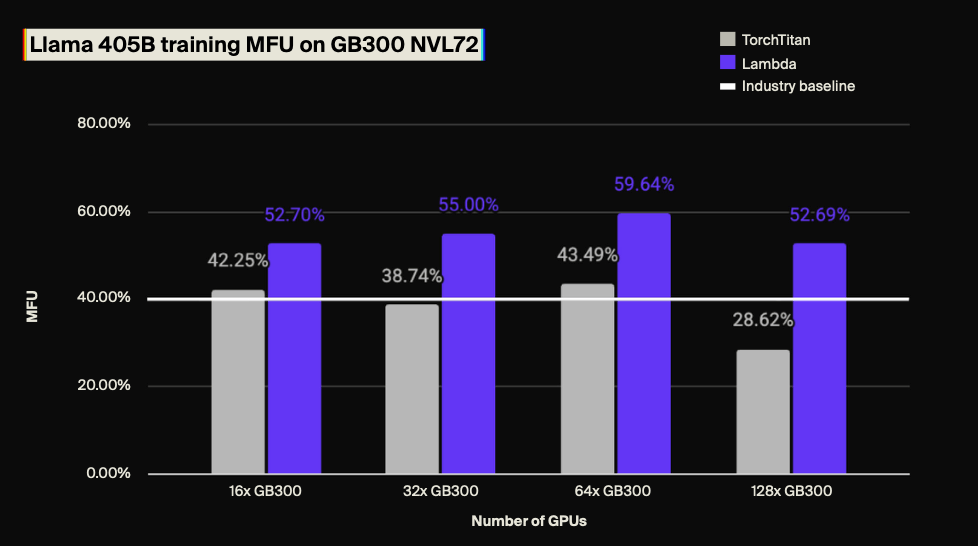
The Rundown: Most AI training runs use less than half their available compute. Lambda’s team found the root causes and built a tested playbook that boosted efficiency and cut costs by over 25%, without changing the model.
Learn how to:
-
Find the memory inefficiencies quietly inflating your costs
-
Optimize your training configuration to make full use of your hardware
-
Address the bottlenecks slowing down GPU communication
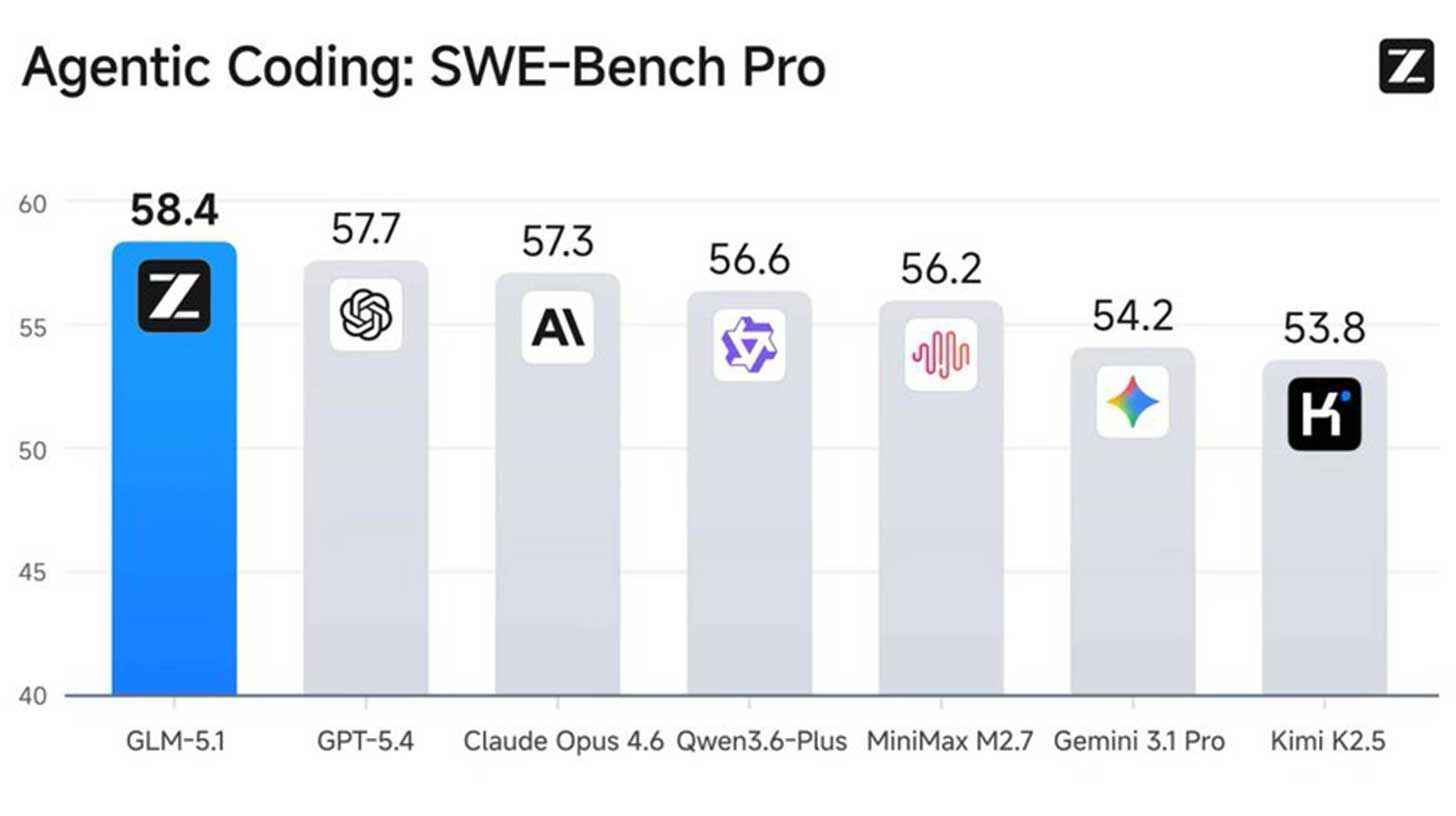
Image source: Zhipu AI
The Rundown: Chinese AI lab Z AI just released GLM-5.1, a new open-source coding model that competes with frontier rivals on coding benchmarks and is built for marathon autonomous sessions of up to 8 hours straight.
The details:
-
GLM-5.1 hit 58.4 on SWE-Bench Pro, topping both GPT-5.4 and Opus 4.6 and marking a rare moment for open source at No. 1 on a top coding benchmark.
-
Z AI also said the model can “stay effective on agentic tasks over much longer horizons”, showing strong results over longer, complex problems.
-
In tests, Z AI had GLM-5.1 build a working Linux desktop as a web app over 8 hours, including a file browser, terminal, and games, without human guidance.
-
The model also shows top performance in Arcada Labs’ Design Arena, coming in second for creative web design after Claude Opus 4.6.
Why it matters: Top Chinese labs continue to be on the tail of the frontier, with GLM-5.1 showing the strongest coding yet — along with long-horizon task capabilities that the company said are the “most important curve after scaling laws”. An open-source model with this coding performance says a lot about how fast the gap is closing.
AI TRAINING
📧 Get to inbox zero with this Claude prompt
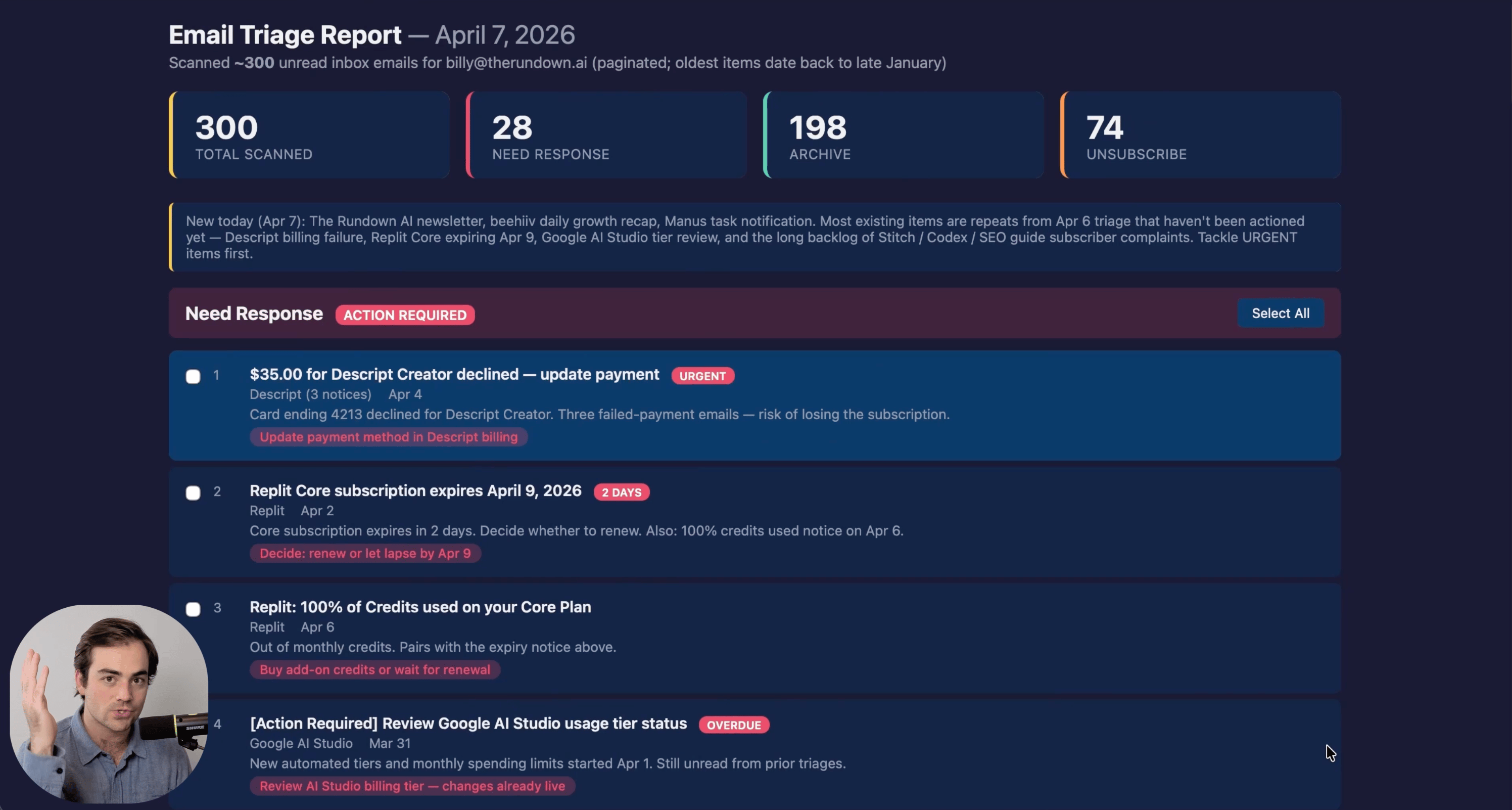
The Rundown: In this guide, you will learn how to run email triage once in Claude, then have Claude write a recurring task prompt for your inbox. You will end up with a daily cleanup workflow based on your real rules, not a generic prompt.
Step-by-step:
-
Open Claude with Gmail access and run one triage session on your unread inbox. The goal is to show Claude what matters before automating the process
-
Prompt: “Generate an interactive email triage report for the last 24 hours. Sort each email into exactly one of these buckets: Needs response, Needs attention, Archive, Archive and unsubscribe. For each email, include the sender, subject, a one-line reason for the category, a direct link to the email, and the item number. Add labels to the approved emails”
-
Review, correct misfires, and prompt: Turn this workflow into a recurring task prompt for my inbox, with my common senders, archive, and unsubscribe rules
-
Save that prompt as a Claude Cowork scheduled task so it can run every morning without rebuilding the logic
Pro tip: Set up Gmail rules around the labels Claude adds. It can apply labels through the connector, so “Needs Response” and “Needs Attention” can be auto-starred, and Archive emails can be auto-archived.
PRESENTED BY OPTIMIZELY
🎓 Build 3 AI agents in 5 days for free

The Rundown: It’s time to put AI to work inside your marketing; embedded in your workflows and eliminating the drudge work. Consider this your official invite to Opal U: AI Marketing University from the team at Optimizely Opal.
Here’s what you’ll get:
-
Live workshop (free) with 50 senior marketers – 1 hour a day (Mon-Fri)
-
3 working AI agents you build and take back to your team
-
5 hours invested to save 10+ hours every week
Join the next Opal U session starting Monday.

Image source: Anthropic
The Rundown: Anthropic signed a multi-gigawatt compute deal with Google and Broadcom, locking in 3.5GW of TPU capacity for 2027, while also sharing new surging revenue numbers and enterprise growth despite its battle with the U.S. government.
The details:
-
Since January, Anthropic’s run-rate revenue tripled to $30B, and its $1M+ enterprise customer base doubled to 1,000+, forcing the compute expansion.
-
Broadcom will supply 3.5GW of Google’s TPUs starting in 2027, nearly all US-based — adding to the $50B Anthropic pledged for domestic AI buildout.
-
The revenue projections put the company ahead of rival OpenAI’s recent report of $2M / month in revenue, while both race towards an IPO.
-
The growth also comes despite the Pentagon labeling Anthropic a supply-chain risk, a move the company says rattled over 100 enterprise clients.
Why it matters: Tripling run-rate revenue while facing the Pentagon is quite the move, and shows demand for Claude is still off the charts, even if the U.S. government is blacklisting it. But given the recent rate limit issues, more compute is certainly a welcome sight — especially with behemoth models like Mythos waiting in the wings.
QUICK HITS
🛠️ Trending AI Tools
-
👨💻 The Box Agent – Put your enterprise content to work, securely and at scale*
-
🚀 GLM-5.1 – Z AI’s new open-source model for long-horizon agentic coding
-
🔎 Harrier – Microsoft Bing’s SOTA embedding model for search and RAG
-
⚙️ SWE-1.6 – Cognition’s updated coding AI for speed and smoother agent UX
*Sponsored Listing
📰 Everything else in AI today
You.com‘s new guide shows you how to find the highest-impact AI use cases, from internal workflows to customer experiences. Get the guide here.*
A new mystery model named ‘HappyHorse-1.0’ debuted at No .1 on Artificial Analysis’ video leaderboards, surpassing ByteDance’s viral Seedance 2.0.
OpenAI, Google, and Anthropic are cooperating on identifying and limiting Chinese rivals from distilling their systems, sharing info via a “Frontier Model Forum” non-profit.
Microsoft’s Bing team open-sourced Harrier, a SOTA embedding model for search and retrieval that supports 100+ languages and powers its AI agent grounding service.
Intel announced that it is joining Elon Musk’s recently unveiled Terafab project, saying the company will “help accelerate Terafab’s aim to produce 1 TW / year of compute”.
*Sponsored Listing
COMMUNITY
🤝 Community AI workflows
Every newsletter, we showcase how a reader is using AI to work smarter, save time, or make life easier.
Today’s workflow comes from reader Beth T. in Belmont, NJ:
“I’m taking pickleball lessons, so I created a custom GPT to help me learn more in between sessions. I use different prompts for scoring, strategy, rules, and quizzes, depending on what I want to practice.
It’s a simple way to reinforce what I’m learning, ask follow-up questions, and get clear explanations. It’s like having a personalized pickleball coach between lessons.”
How do you use AI? Tell us here.
🎓 Highlights: News, Guides & Events
-
Read our last AI newsletter: Sam Altman’s new social contract for AI
-
Read our last Tech newsletter: This startup wants to hack the night sky
-
Read our last Robotics newsletter: UBTech offers 18M a year for AI scientist
-
Today’s AI tool guide: Get to inbox zero with this Claude prompt
-
Watch our last live workshop: The State of AI Presentation Tools in 2026
See you soon,
Rowan, Joey, Zach, Shubham, and Jennifer — the humans behind The Rundown

