AI Personal Shopping Assistant in the Indian Context


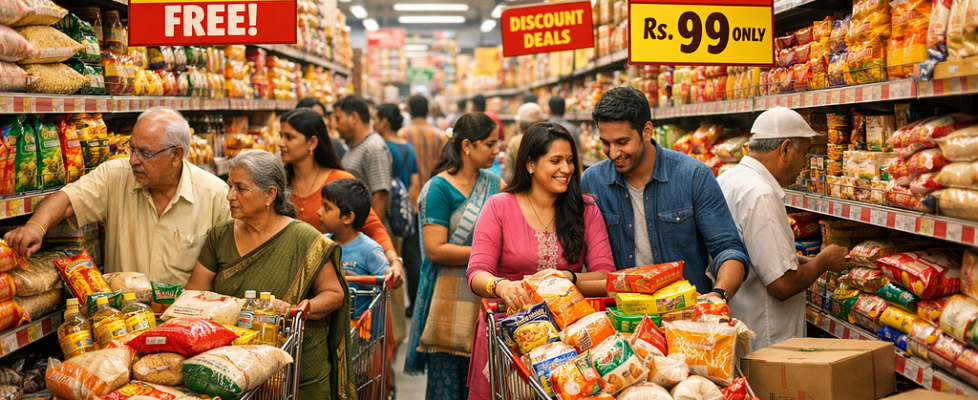
Indian value supermarkets operate under relentless pressure: high footfall, thin margins, intense price competition, and customers who must make quick decisions within strict household budgets. In this environment, even small frictions in the shopping journey quietly compound into lost value-for both customers and retailers.
To understand why ideas like a Personal Shopping Assistant are gaining relevance, we must first examine how customers actually shop today, and where the experience consistently breaks down.
Choice exists, but guidance does not
Walk into any large value supermarket in India and you’ll find shelves packed with options. Staples such as atta, rice, or sugar often include a mix of national brands, regional brands, and private labels. Prices are clearly displayed. Discounts are visible. On paper, the customer has everything needed to make a rational choice.
Yet at the shelf, many customers pause.
“Yeh sasta wala theek hoga kya?”
(Will this cheaper one actually be okay?)
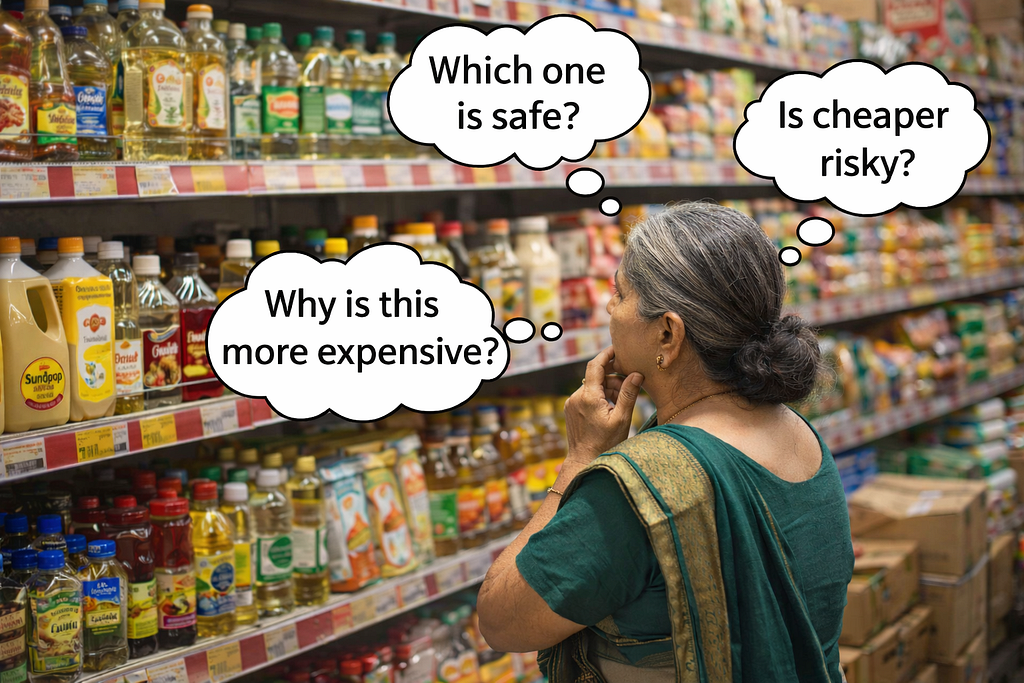
This hesitation is not about finding the lowest price, it is about confidence. Customers want to know whether the lower-priced option compromises on quality, whether it is suitable for daily household use, and whether choosing it will lead to regret later. The shelf does not answer these questions. Packaging and price labels are insufficient proxies for trust.
In the absence of guidance, customers protect themselves by choosing familiar brands, reducing quantities, or skipping categories altogether. From the retailer’s perspective, this hesitation directly impacts private label adoption, basket size, and margin- even though assortment and pricing are technically sound.
Price sensitivity is really risk sensitivity
Indian value customers are often described as price-driven, but their behavior reveals something subtler. They are risk-averse. A difference of ₹20–₹30 between two similar-looking products triggers an internal calculation that goes beyond price.
Will this last?
Will my family accept it?
Will I feel foolish for saving a small amount if the product disappoints?
When these questions remain unanswered, customers simplify the decision.
“Jo sab lete hain, wahi le lete hain.”
(I’ll take what most people buy)
This explains why cheaper alternatives do not automatically win, and why promotions sometimes fail to deliver expected uplift. Customers are not rejecting value -they are avoiding uncertainty.
Apparel: high potential, high anxiety
Apparel is one of the largest revenue contributors in many value supermarkets, and also one of the most fragile categories from a customer confidence standpoint.
Sizing inconsistencies, crowded trial rooms, and limited staff availability make apparel purchases feel risky. Even though return or exchange policies exist, customers are acutely aware of the effort involved: another visit, queues, explanations, and the possibility that the right size may no longer be available.
The internal dialogue reflects this concern:
“Size galat nikla toh jhanjhat ho jayega.”
(If the size turns out wrong, it becomes a hassle.)
To avoid this friction, customers quietly de-risk their choices. They buy fewer apparel items, avoid experimentation, or restrict purchases to what feels safest. The result is lower units per transaction and missed cross-sell opportunities -not because of price or assortment, but because of unresolved doubt at the moment of decision.
Promotions exist, but value is hard to interpret and harder to optimize
Value supermarkets run a large number of promotions, driven by supplier funding, inventory movement, and category-level targets. In practice, promotion planning is still largely handled through historical performance analysis, basic sell-through trends, and operational judgment -often using spreadsheets or rule-based processes rather than advanced optimization engines.
While this approach is pragmatic, it rarely accounts for how customers actually behave at the shelf. Factors such as local price sensitivity, demand elasticity by store, competitive pricing in the catchment, or SKU-level inventory positions are not consistently factored into promotion depth or selection. As a result, many promotions are price-compliant but not decision-optimal.
At the shelf, customers are exposed to multiple value cues at once: MRP, discounted price, pack-size economics, private label alternatives, and neighbouring products priced slightly higher or lower. Even when a product carries a single, clearly defined offer, customers must mentally evaluate whether it is genuinely better than the available alternatives.
A common response is hesitation.
“Samajh nahi aa raha… chhodo.”
(I don’t really understand this… let it be.)
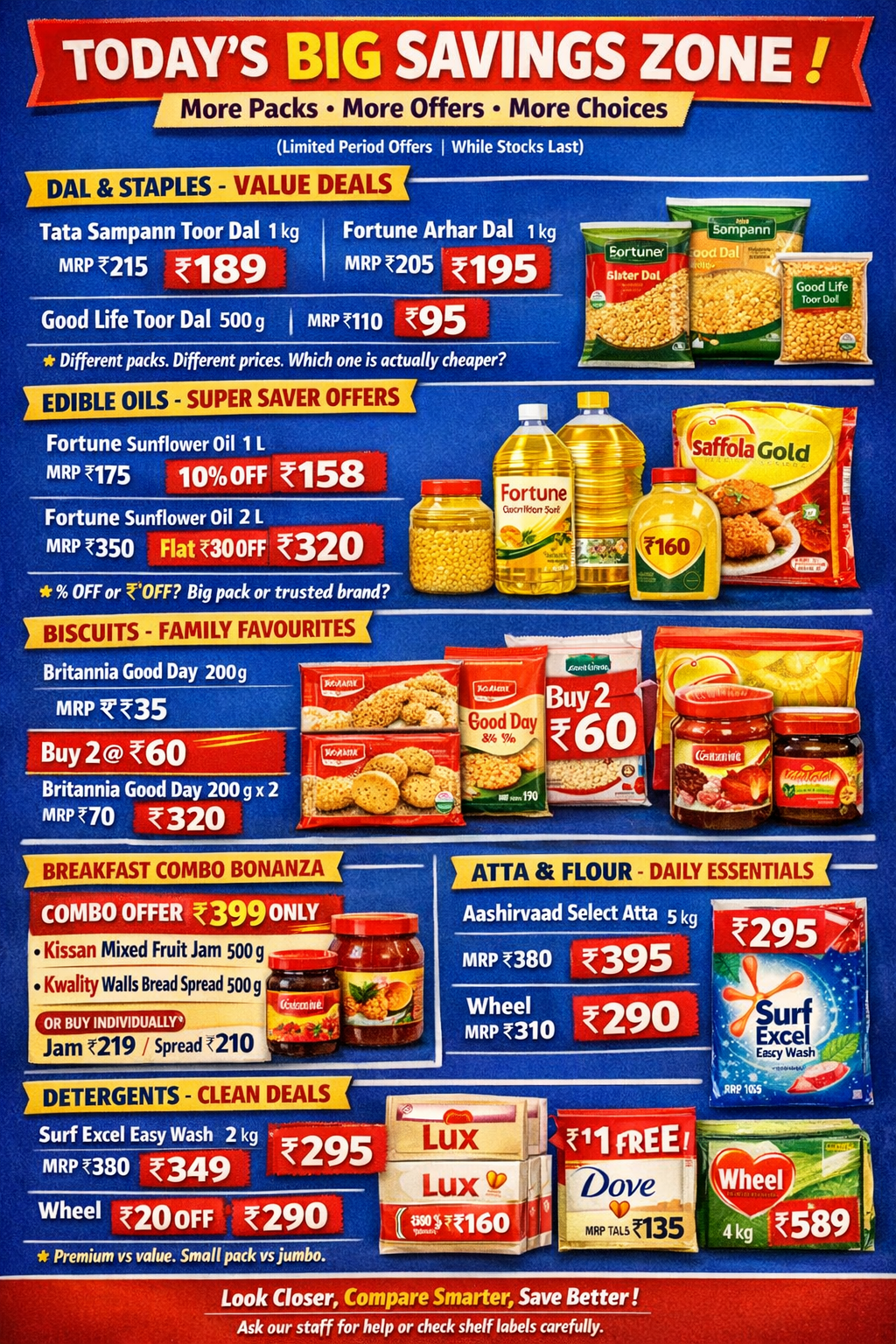
When time is limited, customers default to the simplest choice -often a familiar SKU or a single unit -rather than actively maximizing savings. Promotions fail not because prices are wrong, but because promotion design and customer decision-making are misaligned.
This creates a dual gap: customers struggle to confidently choose at the shelf, and retailers miss the opportunity to optimize promotions around how decisions are actually made.
The buying journey: how friction accumulates
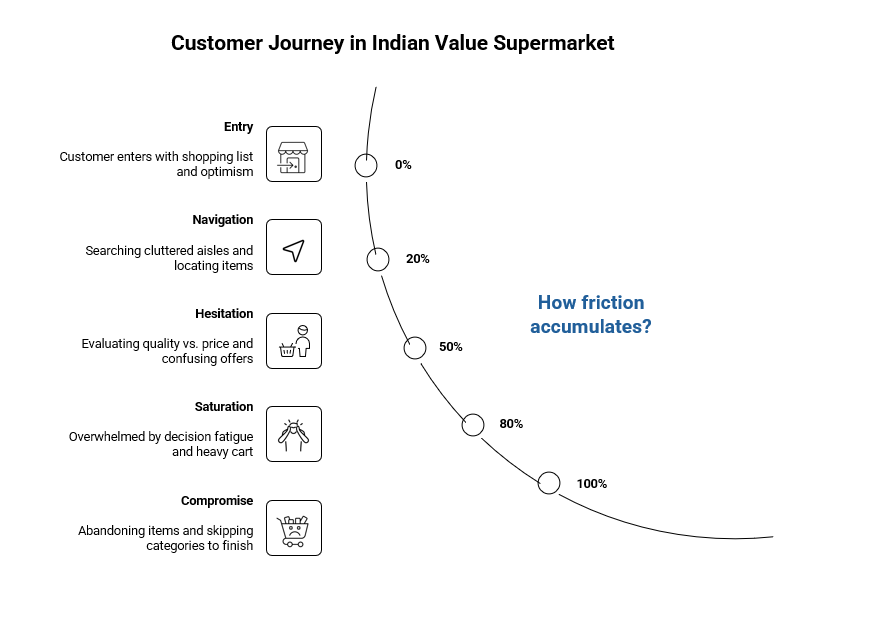
Most customers enter a value supermarket with a clear mission: complete household shopping within a fixed budget. They are not browsing for inspiration; they are trying to finish a task efficiently.
As they move through the store, friction accumulates gradually. Each hesitation -about quality, fit, price, or offers -adds mental load. By the time customers reach checkout, their priority shifts from optimizing value to simply closing the transaction.
Items are dropped. Quantities are reduced. Entire categories are skipped. The customer completes the purchase, but not the mission they originally came in with.
The common thread
Across staples, apparel, and general merchandise, the pattern is consistent. Customers are expected to evaluate trade-offs, interpret value, and make confident decisions -alone, under time and budget pressure.
This is not a problem of assortment, pricing, or intent. It is a decision-support gap at the point of choice.
From Friction to Focus: Five Decision Moments That Define Value Retail
While friction exists throughout the journey, value loss does not occur evenly. It concentrates around a small number of predictable decision moments that disproportionately influence conversion, basket size, and mix.
- The Budget Commitment Moment -staying “on track” across categories
- The Value Trade-off Moment -choosing between private labels and brands
- The Apparel Confidence Moment -deciding fit, usage, and durability
- The Promotion Value Moment -judging whether an offer is truly worthwhile
- The Mission Completion Moment -ensuring nothing essential was missed
These moments are frequent, commercially significant, and largely unsupported at scale. They define where decision support actually matters.
Reimagining Decision Support at Scale: The Personal Shopping Assistant
If the core challenge is lack of decision support at critical moments, the question is not whether guidance is needed, but how it can be delivered at scale without breaking the operating model.
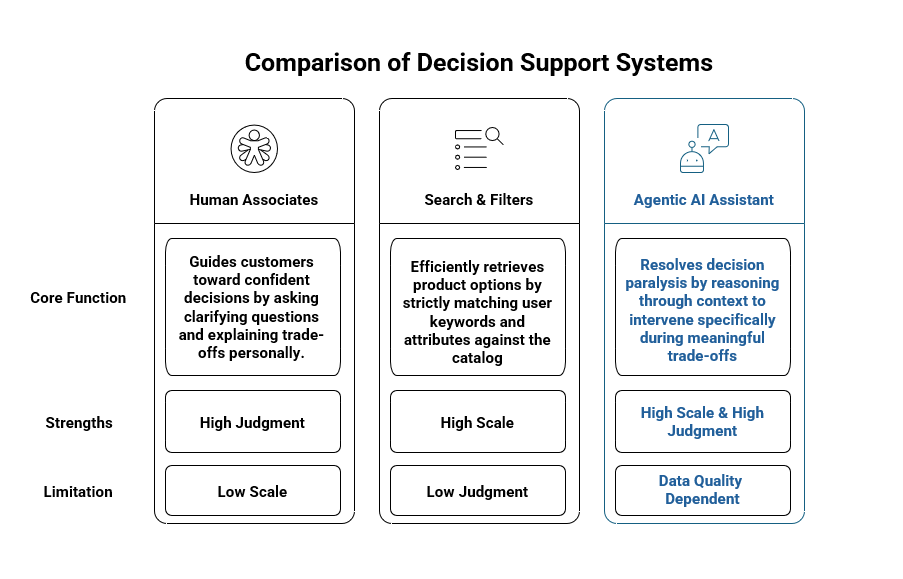
Historically, associates filled this role -asking clarifying questions, explaining trade-offs, and nudging customers toward confident decisions. When this happens, conversion and basket size improve immediately. The limitation, however, is scale and consistency.
Digital channels have scaled efficiently, but without judgment. Search and filters help customers find products, not decide between them. This is the gap the Personal Shopping Assistant is designed to address.
At its core, it is not a chatbot and not a replacement for staff. It is a decision-support layer that sits alongside the existing shopping experience -in-store, on mobile, or across both -and intervenes only when customers face meaningful trade-offs.
What makes this viable now is agentic AI: systems that reason within constraints, interpret context, and guide decisions rather than simply respond. Importantly, this does not require perfect data or wholesale system change. The challenge has never been data availability, but turning existing data into usable guidance at the moment of choice.
Key Design Tenets for Indian Value Retail
A Personal Shopping Assistant for value supermarkets must respect real constraints.
1. Budget-first reasoning
Guidance must operate at basket level, helping customers complete missions within budget.
2. Value-first, not brand-first
The assistant must explain trade-offs neutrally, building confidence rather than pushing products.
3. Speed over sophistication
Interactions must be short, optional, and resolve hesitation quickly.
4. Vernacular and cultural fluency
Hindi / Hinglish support is essential for adoption and trust.
5. Resilience to imperfect data
Indian retail data is often incomplete, delayed, or inconsistent across systems. The assistant must be able to work with whatever information is available at that moment — and still provide useful guidance.
These principles ensure relevance without operational disruption.
From Vision to Execution: What This Looks Like in Practice
For a Personal Shopping Assistant to work in Indian value supermarkets, it must be designed around the physical and behavioral realities of the store. Customers are often shopping under time pressure, navigating crowded aisles, and managing household constraints. They will not explore a new digital feature or engage in long conversations. Any solution that succeeds must therefore fit seamlessly into the existing shopping flow, with clear entry points, minimal effort, and predictable behavior.
At its core, the Personal Shopping Assistant is built on a simple principle: customers always initiate interaction; the system prepares silently.
Silent context preparation, not interruption
The assistant does not rely on unsolicited notifications, pop-ups, or aggressive prompts. While the store environment may use passive signals-such as Wi-Fi, BLE beacons, or shelf sensors -these are used only to prepare context in the background, not to engage the customer directly.
For example, if a customer is spending time in the staples or apparel section, the system may silently load category context, active promotions, and relevant SKUs. No message is shown. No alert is triggered. The shopping experience remains unchanged until the customer explicitly asks for help.
This distinction is critical. Proximity signals improve relevance and speed after interaction begins; they are never used to interrupt or guess intent prematurely.
How customers ask for help -by scanning
Customers interact with the assistant through one familiar action: scanning. What they choose to scan determines how specific the guidance becomes.
In high-friction sections, shelf-level QR codes are placed unobtrusively on shelf edges or signage. These codes do not represent a single product. Instead, they represent the entire shelf or category zone –for example, cooking oil, atta, or kids’ apparel.
When a customer scans a shelf QR code, the assistant understands:
- the store location
- the category
- the set of SKUs on that shelf
At this stage, the assistant does not assume which specific product the customer is considering. It therefore remains at a category level, offering a single, neutral insight that helps the customer orient themselves -without recommending any product.
For example, the assistant may state:
“Customers in this section usually choose based on three things: daily-use value, balanced quality, or occasional premium use.”
The screen then presents a small, neutral shortlist -typically one representative option from each category or price tier -allowing the customer to compare and choose. Only after the customer taps on a specific product does the assistant provide product-level guidance, tailored to that selection.
The customer can close the screen at any point and continue shopping without making a selection.
If the customer instead scans a specific product barcode -either directly or after selecting a product from the shelf view -the assistant now has explicit product-level intent. At this point, the guidance becomes precise and contextual to that SKU.
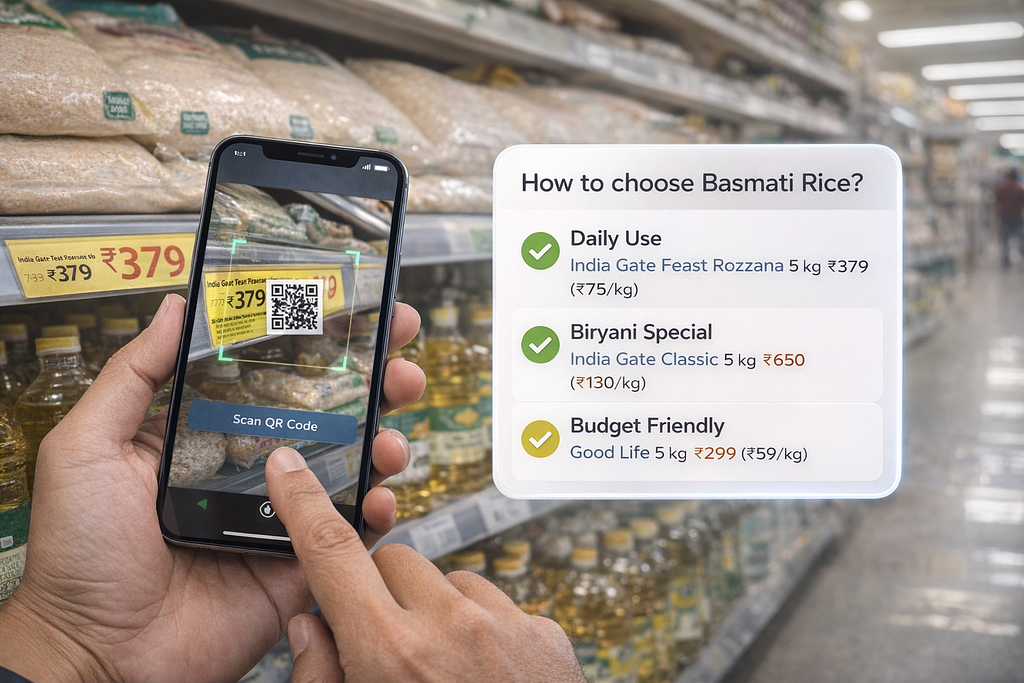
For example:
“Daily use ke liye yeh basmati best value hai -price kam hai aur taste regular khane ke liye bilkul theek.”
(For daily use, this basmati offers the best value -lower price and suitable taste for everyday meals.)
This two-step narrowing -from shelf to product -mirrors how customers actually think and prevents the system from making incorrect assumptions.
What the customer sees -and how little it says
The assistant never starts with questions, or open-ended chat. It begins with one short, relevant statement, framed in everyday language.
That statement typically addresses one of three things:
- suitability (daily use vs occasional use)
- value (relative savings or price-quality balance)
- trade-offs (what you gain or lose by choosing this option)
Unless the customer explicitly asks for more -by tapping options like “Why this?” or “Compare with brand” –the interaction ends immediately. There is no forced conversation and no attempt to extend engagement.
The assistant’s job is not to converse; it is to resolve hesitation and step aside.
Why this works in a busy Indian store
This interaction model works because it aligns with behaviors customers already exhibit inside stores. Scanning is familiar -customers scan UPI QR codes, check prices, and use their phones for quick tasks while shopping. Each interaction with the assistant lasts five to ten seconds.
Customers do not perceive this as “using AI.” They perceive it as getting clarity and moving on.
Just as importantly, store staff workflows remain unchanged. The assistant absorbs routine clarification questions, allowing staff to focus on exceptions or higher-value interactions.
Behind the scenes: reliability by design
From a technology standpoint, this experience is powered by a controlled, multi-agent decision system, not a generic conversational bot.
Different agents handle distinct responsibilities:
- a context agent establishes where the customer is in the store and journey
- a product intelligence agent retrieves approved facts from the catalog
- a pricing and promotion agent evaluates relative value and savings
- a decision orchestrator determines what to say, how specific to be, and when to stop
All responses are generated through retrieval-based workflows, grounded strictly in retailer-approved data: product attributes, current prices, promotions, inventory signals, and curated explanation templates. The system is trained for specific retail decision moments, not open-ended Q&A, and is continuously refined using feedback from category and store teams.
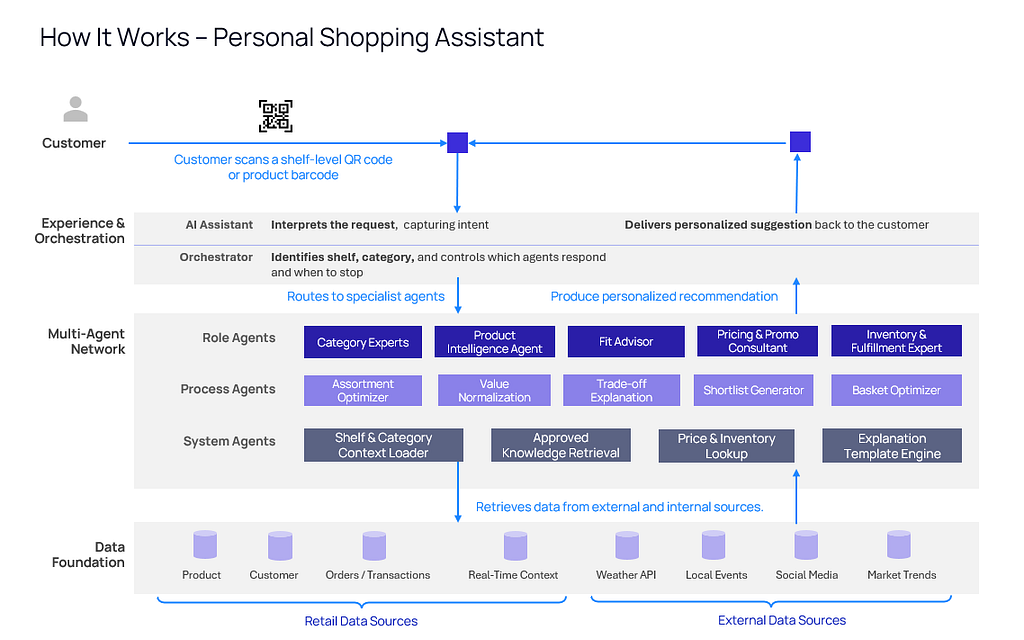
This narrow scope, strong grounding, and explicit control model address the core reason earlier agentic systems failed -unpredictability.
Conclusion: Decision Intelligence as the Next Competitive Advantage
The next phase of differentiation in Indian value retail will not come from more SKUs, deeper discounts, or another digital feature. Those levers are already stretched.
The opportunity lies in how decisions are made at scale.
Customers arrive with intent, budgets, and willingness to buy. What holds them back is unresolved uncertainty at critical moments. When that uncertainty is reduced, conversion improves, baskets expand, private labels gain acceptance, and promotions perform closer to their potential.
This is where AI readiness matters -not as a technology checkbox, but as the ability to translate existing retail intelligence into real-time decision support. Agentic AI makes this feasible, not by replacing human judgment, but by scaling it responsibly.
A Personal Shopping Assistant is not the end goal. It is the starting point for a new layer of decision intelligence -one that connects customer confidence, commercial outcomes, and AI capability into a single reinforcing loop.
That is the competitive edge that will matter next.
AI Personal Shopping Assistant in the Indian Context was originally published in Towards AI on Medium, where people are continuing the conversation by highlighting and responding to this story.
