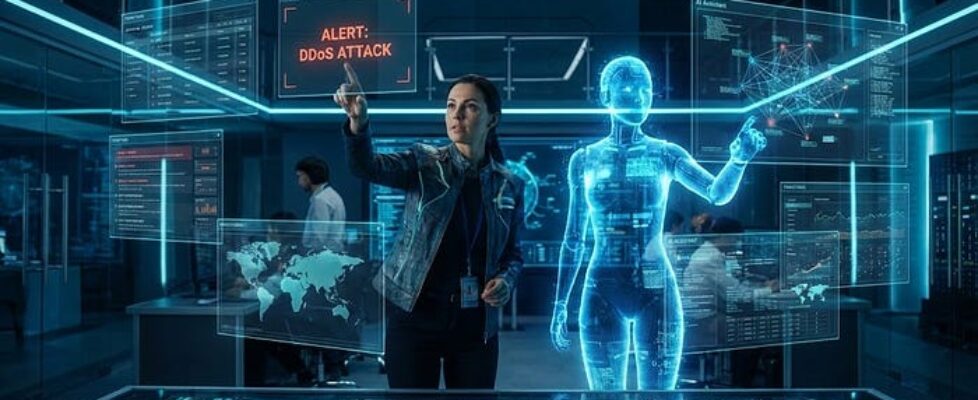
AI is Hunting SOC Analysts: How I’m Using AI to Stay Employed (Not Replaced) in 2026

Author(s): Narayan Regmi Originally published on Towards AI. Learn how SOC analysts can use AI tools to enhance their careers instead of being replaced. Discover 5 essential AI tools, automation strategies, and AI-proof skills for 2025. The Meeting That Changed Everything “We’re implementing AI-powered automation for Tier 1 alert triage. It should handle about 80% of the repetitive work.” My manager said it casually during our team meeting, as if he’d just announced a new coffee machine. But I felt my stomach drop. 80% of the work. The work I’d spent 90 days learning to do. The work that got me hired six months ago. I looked around the room. Three other junior analysts had the same expression: barely concealed panic masked by nodding and fake enthusiasm. Were we about to automate ourselves out of jobs? That was three months ago. Today, I’m not just surviving the AI revolution in security operations — I’m thriving because of it. The AI system my company deployed hasn’t replaced me. It’s made me significantly more valuable. But here’s the uncomfortable truth nobody wants to say out loud: AI is absolutely coming for SOC analyst jobs. The question isn’t whether it will impact your career. The question is: are you going to be the analyst who gets replaced, or the one who becomes irreplaceable by mastering AI? This isn’t a theoretical discussion. This is happening right now, in SOCs around the world. And if you’re not adapting, you’re already behind. The Uncomfortable Truth About AI in Security Operations Let me share some numbers that should concern every SOC analyst: According to recent cybersecurity research, AI and machine learning systems can now automatically classify and respond to security alerts with 95% accuracy for common threat scenarios. Gartner predicts that by 2025, 50% of Tier 1 SOC analyst positions will be eliminated or fundamentally transformed by automation. But here’s what the headlines won’t tell you: those same reports show that demand for senior SOC analysts and threat hunters is projected to grow by 40% over the next three years. Translation: Entry-level, repetitive SOC work is disappearing. High-skill, AI-augmented security analysis is exploding. What AI is Actually Replacing Right Now Let me be brutally honest about what’s being automated in my SOC: Alert Triage (80% automated): False positive identification Basic log correlation Known threat pattern matching Routine playbook execution Initial alert prioritization Routine Investigations (60% automated): Domain reputation checks IP geolocation and history User behavioral baseline comparisons Standard evidence collection Common IOC enrichment Documentation (70% automated): Incident summary generation Timeline construction from logs Standard report formatting Alert disposition documentation When I started as a SOC analyst, I spent 6–7 hours of my 8-hour shift doing exactly these tasks. That work is vanishing. But here’s what nobody mentions in the doom-and-gloom articles: I’m now spending those 6–7 hours doing work that’s significantly more interesting, more challenging, and more valuable to my organization. The Real Question Isn’t “Will AI Replace Me?” The real question is: “Am I doing work that only humans can do, or am I doing work that AI can do better?” If you’re spending your day: Manually checking VirusTotal for the 47th time Copy-pasting IPs into threat intelligence platforms Writing the same incident summary you’ve written 100 times Following a rigid playbook without thinking You’re in danger. Not because you’re bad at your job, but because you’re doing work that AI will do faster, cheaper, and with fewer errors. But if you’re: Investigating complex, multi-stage attacks Understanding business context and risk Hunting for unknown threats creatively Communicating with stakeholders Developing new detection strategies You’re building a career that AI will enhance, not eliminate. What AI Can’t (And Won’t) Replace After three months working alongside AI automation in my SOC, I’ve learned exactly where the boundaries are. There are specific aspects of security operations where human analysts remain not just relevant, but absolutely essential. 1. Complex Incident Analysis Requiring Business Context The Scenario: We received an alert about a marketing employee downloading 15GB of data after hours. What AI Said: “High-risk data exfiltration detected. Severity: Critical. Recommend account suspension.” What I Discovered: The marketing team was launching a new campaign the next morning. The employee was downloading video assets they’d created, which they owned the rights to. Their manager had approved weekend work. There was no security incident. AI saw patterns. I understood context. AI calculated risk based on behavior deviation. I calculated risk based on business reality, employee role, project timelines, and organizational trust. The lesson: AI is exceptional at pattern matching. Humans are exceptional at context understanding. You can’t automate business awareness. 2. Threat Hunting and Creative Investigation AI-powered detection is reactive. It finds what it’s been trained to find. Threat hunting is proactive. It searches for what nobody knows exists yet. Last month, I was investigating what seemed like routine failed login attempts. The AI system had correctly categorized it as “low priority — likely password spray, blocked by MFA.” But something felt off. The timing was too regular. The source IPs were residential, not datacenter. The usernames being targeted were all from one specific department. I spent three hours digging deeper — examining authentication logs, correlating with VPN access, checking for any successful parallel attacks, interviewing users. I discovered a sophisticated social engineering campaign targeting that department through LinkedIn messages, with the password spray as just one component of a broader attack. AI would never have pursued that investigation. The initial alert was properly classified as low risk and automatically closed. Human curiosity, pattern recognition across non-technical signals, and investigative instinct caught what automation missed. You can’t program intuition. 3. Stakeholder Communication and Incident Management When a security incident impacts the CEO’s email account, you don’t send them an AI-generated report filled with technical jargon about “SMTP header anomalies and OAuth token compromise indicators.” You pick up the phone, explain what happened in plain English, reassure them about containment measures, outline next steps, and manage their expectations about recovery time and impact. […]
